Team Singapore have to ‘keep pressing on’ against mounting Asian competition面对日益激烈的亚洲竞争,新加坡队必须“继续努力”。
Team Singapore won 18 medals at the 2026 Asian Games, marking their lowest gold tally and ranking since 1994 amid rising Asian sports competition. Read more at straitstimes.com.
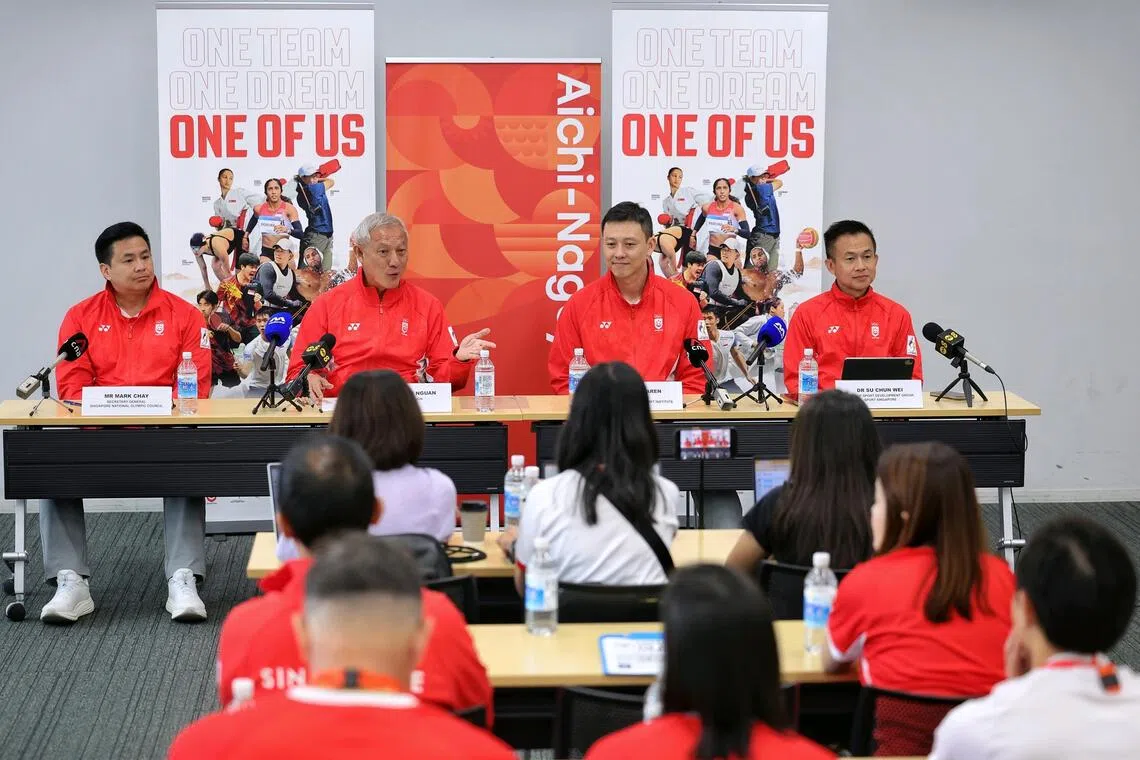
(From left) Singapore National Olympic Council secretary-general Mark Chay, chef-de-mission Goh Kee Nguan, High Performance Sport Institute chief Low Jia Ren and Sport Singapore chief of sport development group Su Chun Wei at Nagoya Harbour Hall on Oct 4.
Published Oct 04, 2026, 04:30 PM
Updated Oct 04, 2026, 09:33 PM
Team Singapore won 18 medals, including two golds, at the 2026 Asian Games, their lowest gold tally in 29 years, partly due to the exclusion of sports they are traditionally strong in.
Despite the dip, there were historic achievements including Shanti Pereira's 200m title defence and Loh Kean Yew's first badminton singles silver, plus multiple national records and personal bests.
Officials noted the rising competition in Asia, stressed internal medal projections were met, and expressed optimism for future events, especially the 2029 SEA Games in Singapore with many young debutants.
NAGOYA – Despite several historic breakthroughs for Team Singapore at the 2026 Asian Games, the Republic’s two-gold haul in Japan was its lowest at the quadrennial event in 28 years, highlighting the increasingly competitive landscape on the continent.
While the 18 medals (2-9-7) won at the Sept 19 to Oct 4 Asiad exceeded the haul of 16 (3-6-7) from Hangzhou three years ago, Singapore claimed one less gold than they did in China.
At the Team Singapore wrap-up conference on Oct 4, High Performance Sport Institu te chi ef Low Jia Ren acknowledged that the medal return was lower than in recent Asiads, but pointed to the exclusion of sports that the nation is traditionally strong in as a factor that could influence these numbers.
The 2026 Games did not include sports such as bowling, which has reaped 24 medals for Singapore at the continental showpiece.
The last time the sport was contested at the Asiad was in 2018.
Kitefoiling, in which Olympic bronze medallist Maximilian Maeder won a gold medal in China, was also omitted from the sailing competition this time.
Low said: “Notwithstanding this, of course, the goal is for Singapore and all our athletes to do their best.
“Whatever the event or sport being featured, our role is to help provide them with the best environment to be able to thrive, and when we get to the start line, it’s game on and all of us then will be cheering for them and rooting for them.”
Singapore also ranked 21st out of 46 nations and territories in Japan, marking their lowest placing since the 1994 Hiroshima Games, when th e ev ent began featuring at least 40 countries and territories.
Su Chun Wei, Sport Singapore’s sport development group chief, noted that the level of Asian sports is also rapidly progressing, citing the performance of Thailand’s athletics contingent as an example.
Thailand were fourth in the athletics medal table with three golds, two silvers and a bronze, with sprinter Puripol Boonson making a statement at these Games as he claimed the sprint double in record-breaking style.
The 20-year-old broke two Games records en route to clinching the 100m crown, while he won the 200m title in an Asian record-equalling 19.88 sec .
Su said: “A learning point for us is that at this particular Asian Games, we have got to go back and (look at) what we need to do to prepare ourselves for the next four years as the competition level has changed significantly – there’s no way else to say this (and we have) to keep pressing on.”
While the overall performance dipped compared with previous years, there were still bright sparks, including multiple firsts from the Republic’s 300-strong contingent, which competed across 26 sports.
There was sprinter Shanti Pereira, who retained her 200m title to become the first woman to do so at the Games, and mixed martial arts fighter Tiffany Teo, who bagged the women’s traditional 60kg gold in the sport’s maiden appearance at the Asiad.
Loh Kean Yew also achieved what no other Singaporean badminton player had as he reached the men’s singles final and clinched a silver medal while distance swimmer Gan Ching Hwee dazzled with a silver hat-trick in the freestyle events.
Singapore’s fencers delivered their best showing at the Asiad with a historic silver by epee fencer Kiria Tikanah Abdul Rahman, as well as bronzes by women’s foilist Maxine Wong and the women’s epee team.
There were also unprecedented bronze medals from golfer Shannon Tan and taekwondo exponent Darren Yap.
Ten national records across swimming, athletics and sport climbing were also broken, alongside 23 personal best and five season’s best performances.
The local contingent also brought home a record nine silvers, surpassing the previous best of seven earned at the 2010, 2006 and 1951 Games.
Su said: “Converting the colour from silver to gold is what we continue to want, to have that winning touch, so we’ll work on that.
“We fully acknowledge that we are so close, but we have to close that.”
While medal targets were not revealed publicly ahead of the Games, Low said Singapore’s athletes “have met our internal medal projections”.
Many of Asia’s top sporting nations and those from South-east Asia who placed above Singapore in the medal table – Thailand, Malaysia, Indonesia, the Philippines and Vietnam – had publicly announced medal targets ahead of the Games.
When asked about the possibility of disclosing medal targets in the future, Low said: “Never say never, we don’t want to say very sure that we won’t or will.
“Projections are important... and at a system level, it makes it a bit difficult because, as you’ve seen at these Games, some athletes perform, some didn’t, others exceeded their performance, and as a system, our role is to help them succeed.
“As a high-performance sport institute, of course we want to have systems, of course we want to have accountability and this is why we want to have accountability.”
But he also stressed that there are various considerations, adding: “The question is, if we come forth publicly with medal targets, does it help to serve our cause? This is a question that has trade-offs... the trade-off is that for some athletes and coaches and even sports, the pressure they face is multiplied when the targets are made public.”
With the SEA Games set to return to Singapore in 2029, Low believes that the performance that was shown by the Republic’s young athletes at the Asiad bodes well for the future.
He noted that many of the personal bests and national records registered by Singapore’s athletes in Japan came from teenage athletes.
Debutants formed 64% of the Singapore contingent, which had an average age of 23.
Low said: “It gives us a lot of hope for 2029 and in three years’ time, there will be more athletes coming on.
“Hopefully some of our senior athletes remain in the system as well and we really look forward to a rousing 2029 on home ground.”
Dive into all the sporting action and trends in Singapore with ST’s weekly newsletter.
Kimberly Kwek joined The Straits Times in 2019 as a sports journalist and has since covered a wide array of sports, including golf and sailing.
(从左至右)新加坡国家奥林匹克理事会秘书长蔡明、代表团团长吴启源、高性能体育学院院长刘嘉仁和新加坡体育发展集团负责人苏春伟于 10 月 4 日在名古屋港湾大厅合影。
发布于2026年10月4日下午4:30
更新于2026年10月4日晚上9:33
新加坡队在 2026 年亚运会上获得 18 枚奖牌,其中包括两枚金牌,这是他们 29 年来获得的金牌数最少的一次,部分原因是他们传统强项被排除在外。
尽管成绩有所下滑,但仍有一些历史性成就,包括 Shanti Pereira 卫冕 200 米冠军,以及 Loh Kean Yew 首次获得羽毛球单打银牌,此外还有多项国家纪录和个人最佳成绩。
官员们注意到亚洲竞争日益激烈,强调内部奖牌预测已经实现,并对未来的赛事表示乐观,特别是对2029年在新加坡举行的东南亚运动会,届时将有很多年轻选手首次参赛。
名古屋——尽管新加坡队在2026年亚运会上取得了一些历史性的突破,但该国在日本仅获得两枚金牌,这是28年来在四年一度的亚运会上获得的金牌数最少的一次,凸显了亚洲大陆竞争日益激烈的现状。
虽然新加坡在 9 月 19 日至 10 月 4 日的亚运会上获得的 18 枚奖牌(2-9-7)超过了三年前在杭州获得的 16 枚奖牌(3-6-7),但新加坡获得的金牌数比在中国少了一枚。
10 月 4 日,在新加坡代表队总结会议上,高性能运动学院院长刘嘉仁承认,奖牌数低于近几届亚运会,但他指出,该国传统强项被排除在外,这可能是影响奖牌数的一个因素。
2026 年奥运会没有包括保龄球等项目,而保龄球曾为新加坡在这项洲际盛会上赢得 24 枚奖牌。
上一次亚运会设立该项目比赛项目是在2018年。
风筝冲浪项目,包括奥运会铜牌得主马克西米利安·梅德尔在中国赢得的金牌,此次也被排除在帆船比赛之外。
Low表示:“尽管如此,当然,我们的目标是让新加坡和所有运动员都发挥出最佳水平。”
“无论比赛项目是什么,我们的职责都是帮助他们提供最好的环境,让他们能够茁壮成长。当我们到达起跑线时,比赛就开始了,我们所有人都会为他们欢呼喝彩。”
新加坡在日本的 46 个国家和地区中排名第 21 位,这是自 1994 年广岛奥运会以来新加坡的最低排名,当时该赛事至少有 40 个国家和地区参加。
新加坡体育理事会体育发展组组长苏春伟指出,亚洲体育水平也在迅速提高,并以泰国田径队的表现为例。
泰国在田径奖牌榜上排名第四,获得三枚金牌、两枚银牌和一枚铜牌。短跑运动员普里蓬·汶森在本届奥运会上表现出色,以破纪录的方式包揽了短跑双料冠军。
这位 20 岁的选手在夺得 100 米冠军的过程中打破了两项奥运会纪录,同时以 19.88 秒的成绩追平了亚洲纪录,赢得了 200 米冠军。
苏说:“对我们来说,一个重要的教训是,在本届亚运会上,我们必须回顾并思考我们需要做些什么来为未来四年做好准备,因为竞争水平已经发生了显著变化——除此之外,我们别无他法,只能继续努力。”
虽然整体成绩与往年相比有所下滑,但仍有一些亮点,包括共和国300名参赛选手在26个体育项目中取得的多项第一名。
短跑运动员 Shanti Pereira 卫冕了 200 米冠军,成为奥运会历史上第一位获得此殊荣的女子运动员;综合格斗选手 Tiffany Teo 在女子 60 公斤级比赛中夺得金牌,这是该项运动首次亮相亚运会。
罗建耀也取得了其他新加坡羽毛球运动员从未取得过的成就,他打入了男子单打决赛并获得银牌;与此同时,长距离游泳运动员颜清辉在自由泳项目中表现出色,获得了三枚银牌。
新加坡击剑运动员在亚运会上取得了最佳成绩,重剑运动员基里亚·蒂卡娜·阿卜杜勒·拉赫曼获得了一枚历史性的银牌,女子花剑运动员马克辛·王和女子重剑队也获得了铜牌。
高尔夫球手 Shannon Tan 和跆拳道选手 Darren Yap 也史无前例地获得了铜牌。
游泳、田径和攀岩项目共打破了 10 项全国纪录,同时还创造了 23 项个人最佳成绩和 5 项赛季最佳成绩。
当地代表团还带回了创纪录的九枚银牌,超过了此前在 2010 年、2006 年和 1951 年奥运会上获得的七枚银牌的最好成绩。
苏说:“我们一直想把颜色从银色变成金色,这样才能有制胜的点睛之笔,所以我们会努力实现这个目标。”
“我们完全承认我们已经非常接近目标,但我们必须完成最后的冲刺。”
虽然赛前并未公开奖牌目标,但罗先生表示,新加坡运动员“已经达到了我们内部的奖牌预期”。
亚洲许多顶级体育强国以及在奖牌榜上排名高于新加坡的东南亚国家——泰国、马来西亚、印度尼西亚、菲律宾和越南——都在奥运会前公开宣布了奖牌目标。
当被问及未来是否有可能公布奖牌目标时,罗说:“永远不要说永远,我们不想说我们不会或一定会公布。
“预测很重要……但在系统层面,这有点困难,因为正如你在本届奥运会上看到的,有些运动员发挥出色,有些运动员表现不佳,还有一些运动员超越了他们的预期,而作为一个系统,我们的作用是帮助他们取得成功。
“作为一所高水平体育机构,我们当然希望有完善的体系,我们当然希望有问责机制,这就是我们想要问责的原因。”
但他也强调,这其中有很多需要考虑的因素,并补充道:“问题是,如果我们公开设定奖牌目标,这对我们实现目标是否有帮助?这是一个需要权衡的问题……权衡之处在于,对于一些运动员、教练甚至整个体育项目而言,目标公开后,他们面临的压力会成倍增加。”
东南亚运动会将于 2029 年重返新加坡,Low 认为新加坡年轻运动员在亚运会上的表现预示着美好的未来。
他指出,新加坡运动员在日本创造的许多个人最佳成绩和国家纪录都来自青少年运动员。
新加坡代表团中,首次参赛者占 64%,平均年龄为 23 岁。
洛说:“这让我们对 2029 年充满希望,三年后,将会有更多运动员涌现出来。”
“希望我们的一些资深运动员也能继续留在队中,我们非常期待在2029年在主场取得激动人心的成绩。”
通过《海峡时报》的每周新闻简报,深入了解新加坡的所有体育赛事和趋势。
金伯利·郭于 2019 年加入《海峡时报》担任体育记者,此后报道了包括高尔夫和帆船在内的各种体育项目。