Singapore makes $118m push to manufacture materials from living organisms under bioeconomy initiative新加坡斥资1.18亿美元,在生物经济倡议下利用活体生物制造材料。
Examples of such products include sustainable aviation fuel, which can replace petroleum-based jet fuel. Read more at straitstimes.com.
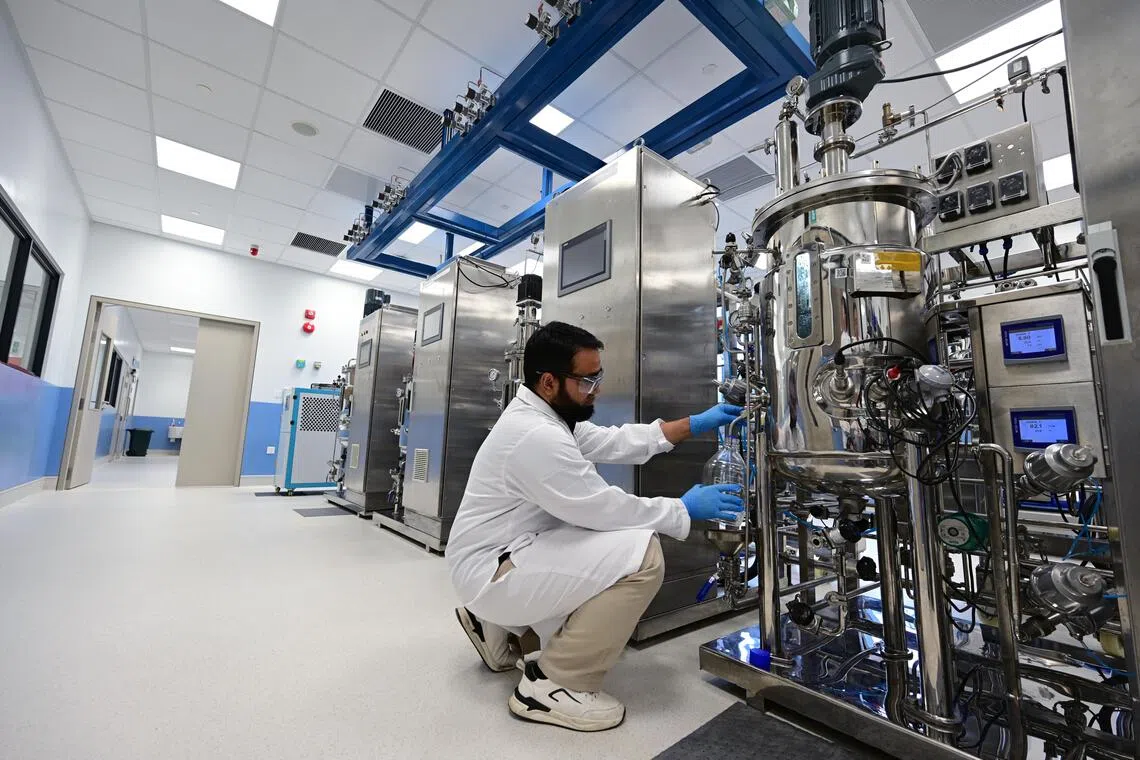
Part of the National Centre for Engineering Biology used for bioproduction and scale-up.
ST PHOTO: NG SOR LUAN
Published Oct 05, 2026, 03:15 PM
Updated Oct 05, 2026, 03:15 PM
Singapore commits $118 million to develop sustainable manufacturing materials using living organisms, aiming to support industry-aligned research and commercialisation through the new Bioeconomy Innovation Office at A*STAR.
The initiative focuses on transforming agricultural waste, engineering microbes with AI, improving industrial production with digital tech, and producing commercially relevant products.
The National Centre for Engineering Biology, supported by a nearly $50 million grant, will unite top universities to advance engineering biology, fostering sustainable specialty chemicals and scaling up industrial bioprocessing technologies.
SINGAPORE - Singapore wants to harness nature’s living “factories” to produce enzymes, chemicals and materials - some of which can replace fossil fuels - and is making a $118 million push to grow its bioeconomy sector.
Examples of these products include sustainable aviation fuel, which can replace petroleum-based jet fuel. Polymers made from castor oil can be a substitute for plastics made from crude oil, while the use of biomethane for energy can reduce the need to burn fossil-based natural gas.
The Bioeconomy Funding Initiative was announced on Oct 5 by Education Minister Desmond Lee at the launch of the National Centre for Engineering Biology.
The effort is driven by the Economic Development Board (EDB) and A*STAR . Its launch comes amid projections for how the global market for such materials and chemicals could exceed US$200 billion by 2030.
This initiative is Singapore’s largest funding tranche for developing the bioeconomy sector in Singapore, according to the government agencies.
The initiative joins existing funding of about $82 million, and contributes to a total commitment of some S$200 million for bioeconomy-related projects over the next five years.
EDB’s managing director Jermaine Loy said at the launch event at the National University of Singapore (NUS) that the promising outlook for the bioeconomy is driven in part by the rollout of regulation spurring firms to look for alternatives that replace raw materials dependent on fossil fuels.
Biology has also increasingly been used to make products that perform better than existing products, in areas such as agricultural crop protection, and consumer care, he added.
Against this backdrop, the fund will build research capabilities in areas where Singapore has an advantage in to tackle challenges flagged by local companies, start-ups, and investors. For instance, its position in South-east Asia is also where most of the world’s palm oil is produced.
“Our ambition is for the bioeconomy to become a new source of growth for Singapore,” said Loy.
He said the bioeconomy could create new business opportunities in the development of specialty chemicals and advanced materials,create good jobs and new career pathways for Singaporeans.
EDB said this emerging area could also strengthen Singapore’s energy and chemical sector, which today accounts for about 20 per cent of the country’s total manufacturing output.
EDB vice-president for chemicals and materials Kelly Lai said Singapore’s s trong energy and chemicals sector, as well as related expertise in synthetic biology and research and innovation, will enable the country to better tap the opportunities in the bioeconomy.
Said Lai: “Home to a diverse range of companies — from global majors to specialised players — with a long-term presence here to serve demand across Asia, (the sector) has the depth and scale to pursue new growth pathways.
“The bioeconomy gives these companies new tools to diversify raw material sources, develop novel high-value products, and produce more sustainable chemicals and materials, supporting Singapore’s broader push into specialty chemicals and advanced materials.”
For instance, researchers at the existing HH@NUS SINERGY L aboratory - a partnership between the NUS and industrial polymer firm Huahao Chemical - have found a way to use living cells as factories to make building blocks for a polymer in fibres and fabrics .
The initiative will focus on four areas.
The first aims to transform underused agricultural waste from producing biodegradable fuels , such as as crude glycerol from palm residues, into cheaper , sustainable r aw materials.
The second seeks to engineer microbes and enzyme s by using advanced tools including artificial intelligence.
The third looks at improving industrial-scale processes using smart monitoring and digital technologies to reduce waste and lower costs.
The last area will find the most effective ways to produce c ommercially-relevant products such as high-grade synthetic rubbers and cosmetic ingredients.
Projects under the initiative will be managed by the new Bioeconomy Innovation Office in A* STAR , which will help promising innovations reach adoption and commercialisation.
A*STAR’s interim programme director for the Bioeconomy Innovation Office Wong Min Hao said the fund will also help boost the resilience of supply chains by finding materials that can reduce a heavy reliance on petrochemicals.
He cited the region’s unique waste streams of palm oil, cassava, tapioca and rice, as areas Singapore could look into . If successful, this could mean tha t chemicals used to dye items could use such ingredients instead of petrochemical s, he added.
Ultimately, the fund aims to push for more commercial outcomes at the end of five years, said Wong.
New centre for engineering biology
Meanwhile, the National Centre for Engineering Biology – hosted at NUS – will nurture scientists and innovators that will shape the future of the field that programmes and harnesses living cells, said Lee.
He was speaking at the opening of the inaugural Singapore Engineering Biology Week that brings together those in the field.
He added: “Students and researchers will work across disciplines and institutions, and engage industry on real-world needs.
“In doing so, they will deepen their expertise and make an impact.”
Officially opened on Oct 5, the centre is supported by a National Research Foundation grant of nearly $50 million, awarded over seven years starting in 2023.
It brings together Singapore’s institutes of higher learning, including NUS, Nanyang Technological University, and the Singapore Institute of Technology.
The centre will focus on building knowledge and technologies in engineering biology for the sustainable biomanufacturing of specialty chemicals such as flavour and fragrance compounds.
Its ongoing flagship project, led by NUS, focuses on AI-guided engineering biology for sustainable specialty chemicals, with the aim of engineering microbes and enzymes which can convert renewable feedstocks – organic materials used to create fuels and other chemicals – i nto specialty chemicals.
Said the centre’s executive Matthew Chang: “Our goal is to enable more sustainable ways of making products that society depends on, using renewable feedstocks and cleaner manufacturing processes.”
More than 150 researchers , students, and professional staff involved contribute to the centre’s work across partner institutions.
Recruitment is ongoing for about 50 more roles, the centre’s institutes of higher learning said in a statement.
These roles span principal investigators, postdoctoral researchers, and graduate students, alongside technical, engineering, laboratory support, and centre management staff.
Additional Reporting by Zhaki Abdullah
Engineers/Engineering
A*Star/Agency for Science, Technology and Research
国家工程生物学中心的一部分,用于生物生产和规模化生产。
圣徒照片:吴索銮
发布于 2026 年 10 月 5 日下午 3:15
更新于2026年10月5日下午3:15
新加坡承诺投入 1.18 亿美元,利用生物体开发可持续制造材料,旨在通过新加坡科技研究局 (A*STAR) 新成立的生物经济创新办公室,支持与产业相符的研究和商业化。
该计划的重点是转化农业废弃物、利用人工智能改造微生物、利用数字技术改进工业生产以及生产具有商业价值的产品。
国家工程生物学中心获得了近 5000 万美元的拨款支持,将联合顶尖大学推进工程生物学发展,促进可持续特种化学品的研发,并扩大工业生物加工技术的规模。
新加坡——新加坡希望利用大自然的生物“工厂”来生产酶、化学品和材料——其中一些可以替代化石燃料——并正在投入 1.18 亿美元来发展其生物经济部门。
这些产品的例子包括可持续航空燃料,它可以替代石油基喷气燃料。蓖麻油制成的聚合物可以替代原油制成的塑料,而利用生物甲烷发电可以减少对化石天然气的燃烧需求。
生物经济资助计划于10月5日由教育部长李智陞在国家工程生物学中心启动仪式上宣布。
这项工作由新加坡经济发展局 (EDB) 和新加坡科技研究局 (A*STAR) 共同推动。该项目的启动正值全球此类材料和化学品市场预计到 2030 年规模将超过 2000 亿美元之际。
据政府机构称,这项计划是新加坡迄今为止为发展生物经济领域提供的最大一笔资金。
该计划与现有的约 8200 万美元资金相结合,使未来五年内用于生物经济相关项目的总承诺额达到约 2 亿新元。
新加坡经济发展局 (EDB) 总经理 Jermaine Loy 在新加坡国立大学 (NUS) 的启动仪式上表示,生物经济前景光明的部分原因是监管措施的推出促使企业寻找替代依赖化石燃料的原材料的替代方案。
他还补充说,生物学也越来越多地被用于制造性能优于现有产品的产品,例如在农业作物保护和消费者护理领域。
在此背景下,该基金将着力提升新加坡具有优势领域的研究能力,以应对本地企业、初创公司和投资者提出的挑战。例如,新加坡地处东南亚,而东南亚正是全球棕榈油的主要产地。
“我们的目标是让生物经济成为新加坡新的增长源泉,”罗先生说。
他表示,生物经济可以在特种化学品和先进材料的开发方面创造新的商机,为新加坡人创造良好的就业机会和新的职业发展道路。
新加坡经济发展局表示,这一新兴领域还可以加强新加坡的能源和化工行业,该行业目前约占新加坡制造业总产值的20%。
新加坡经济发展局化学品及材料副总裁赖凯莉表示,新加坡强大的能源和化工行业,以及在合成生物学、研发和创新方面的相关专业知识,将使新加坡能够更好地抓住生物经济领域的机遇。
赖先生表示:“这里汇聚了众多公司——从全球巨头到专业企业——它们长期扎根于此,服务于整个亚洲的需求,(该行业)拥有足够的深度和规模去追求新的增长路径。
“生物经济为这些公司提供了新的工具,使其能够实现原材料来源多元化,开发新型高价值产品,并生产更可持续的化学品和材料,从而支持新加坡向特种化学品和先进材料领域更广泛地发展。”
例如,新加坡国立大学与工业聚合物公司华昊化学合作成立的 HH@NUS SINERGY 实验室的研究人员已经找到了一种利用活细胞作为工厂来制造纤维和织物中聚合物构建模块的方法。
该计划将重点关注四个领域。
第一个目标是将未充分利用的农业废弃物(例如棕榈残渣中的粗甘油)转化为更便宜、更可持续的原材料,这些废弃物原本用于生产可生物降解的燃料。
第二种方法是利用包括人工智能在内的先进工具来改造微生物和酶。
第三点着眼于利用智能监控和数字技术改进工业规模流程,以减少浪费和降低成本。
最后一个领域将探索生产具有商业价值的产品(例如高级合成橡胶和化妆品成分)的最有效方法。
该计划下的项目将由新加坡科技研究局 (A*STAR) 新成立的生物经济创新办公室管理,该办公室将帮助有前景的创新成果得到应用和商业化。
新加坡科技研究局生物经济创新办公室临时项目主任黄敏豪表示,该基金还将通过寻找能够减少对石化产品严重依赖的材料,来帮助提高供应链的韧性。
他指出,该地区独特的棕榈油、木薯、西米和稻米废弃物是新加坡可以研究的领域。他补充说,如果成功,这意味着用于染色的化学品可以用这些原料代替石油化工产品。
黄表示,该基金的最终目标是在五年后取得更多商业成果。
新的生物学工程中心
李表示,与此同时,新加坡国立大学的国家工程生物学中心将培养科学家和创新者,他们将塑造未来生物细胞编程和利用领域。
他是在首届新加坡工程生物学周的开幕式上发表讲话的,该活动旨在汇聚该领域的专业人士。
他补充道:“学生和研究人员将跨学科、跨机构合作,并与业界就现实世界的需求进行互动。
“这样做,他们将加深自己的专业知识,并产生影响。”
该中心于 10 月 5 日正式开放,由国家研究基金会拨款近 5000 万美元,分七年拨付,从 2023 年开始。
它汇集了新加坡的高等学府,包括新加坡国立大学、南洋理工大学和新加坡理工学院。
该中心将致力于构建工程生物学领域的知识和技术,以实现香料和香精化合物等特种化学品的可持续生物制造。
其正在进行的旗舰项目由新加坡国立大学牵头,专注于人工智能引导的工程生物学,用于生产可持续的特种化学品,其目标是改造微生物和酶,使其能够将可再生原料(用于制造燃料和其他化学品的有机材料)转化为特种化学品。
该中心执行主任马修·张表示:“我们的目标是利用可再生原料和更清洁的生产工艺,以更可持续的方式生产社会赖以生存的产品。”
超过 150 名研究人员、学生和专业人员参与到该中心与合作机构的合作工作中。
该中心的高等学府在一份声明中表示,目前正在招聘约 50 个职位。
这些职位涵盖首席研究员、博士后研究员和研究生,以及技术、工程、实验室支持和中心管理人员。
扎基·阿卜杜拉补充报道
工程师/工程
新加坡科技研究局/新加坡科学、技术与研究局