US spy chief tapped as White House AI czar美国情报局长被任命为白宫人工智能沙皇
Director of National Intelligence Jay Clayton will now helm broad domestic technology and economic policy discussions.
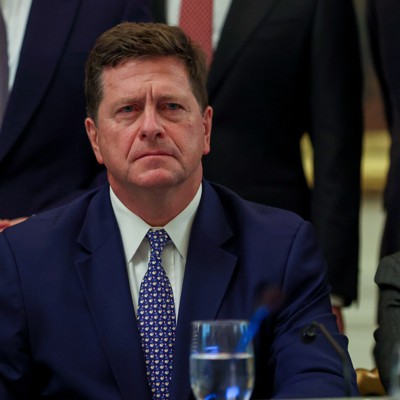
U.S. Director of National Intelligence Jay Clayton attends a meeting on artificial intelligence in the East Room of the White House on September 29, 2026 in Washington, DC. Kevin Dietsch/Getty Images
Director of National Intelligence Jay Clayton will now helm broad domestic technology and economic policy discussions.
Artificial Intelligence
The nation's top spy is now also the White House's AI czar.
President Donald Trump named Jay Clayton, who was sworn in as director of national intelligence in July, to lead what Trump referred to in a Truth Social post as the “Super Intelligence Force” meant to coordinate the government’s engagement with various organizations, critical-infrastructure providers, and AI companies.
Last month, Trump ordered federal agencies to start calling AI "super intelligence."
According to its charter, the task force will create plans to handle AI-enabled threats, streamline breach notifications, and improve government-response capacities while aiming to avoid overregulation. Its creation follows growing public concerns over AI safety and cybersecurity risks, as well as heated political discussions over the data-center buildouts that power many of today’s AI systems.
“The risk of not being first is high,” Clayton told the Wall Street Journal in a Saturday exclusive that discussed the task force. “Not being first increases the identified, and unidentified, risks, particularly from our adversaries,” he said. “Being first will better enable us to address those risks on behalf of the American people.”
The task force has three vice chairs: Defense Undersecretary for Research and Engineering Emil Michael, Office of Personnel Management Director Scott Kupor and Federal Trade Commission Chairman Andrew Ferguson. Its members include Vice President JD Vance, Defense Secretary Pete Hegseth, and other senior advisors, alongside external advisors like venture capitalist David Sacks — who previously worked as Trump’s AI and crypto czar early in the administration — and former Secretary of State Condoleezza Rice. It will have 120 days to report on the risks and opportunities of AI and establish a plan for the federal government to tackle it.
The panel’s establishment marks a shift for an administration that has predominantly maintained a hands-off approach toward AI governance. But officials have faced mounting pressure over the past six months to respond as a new generation of sophisticated, autonomous AI models demonstrating advanced cybersecurity capabilities have repeatedly circumvented or escaped technical safeguards.
Its creation highlights a steady group of voices in the administration and tech industry that believe the time for AI safeguard discussions should begin, though Trump and other officials have largely continued to lean toward a more relaxed approach to regulating the technology.
In public discussions, officials and researchers typically frame AI development as a trade-off between slowing down for safety and accelerating to maintain an edge over foreign adversaries pursuing AI for military and economic gains.
China has especially become a major player in the global AI race. Clayton’s appointment to the task force appears to signal a shift by the administration to cast AI as a geopolitical and national-security subject area.
His dual role is a unique move for the White House, placing the current DNI — who oversees the 18 U.S. spy agencies — at the helm of broad domestic technology and economic policy discussions. Clayton brings a background as a corporate lawyer and former SEC chairman, distinguishing him from tech-focused people from Silicon Valley.
AI has already transformed how spy agencies digest vast troves of collected data and build intelligence products , among other things.
Sen. Mark Warner, D-Va., the vice chairman of the Senate Intelligence Committee, said that he welcomed the administration’s attention toward the fast-evolving technology but said Clayton’s new title lacks a coherent strategy.
“We still do not know what authority this new role will have, whether it will include developing safety standards or reviewing the most advanced models, or how it fits into the administration’s broader approach to AI,” Warner said in a statement. “That lack of clarity is especially concerning as leading AI companies themselves are confronting increasingly capable systems that can evade safeguards and exploit cybersecurity vulnerabilities.”
“I hope this appointment is an opportunity for the administration to move beyond slogans and toward a serious, coordinated national strategy for AI,” he said.
NEXT STORY: Hegseth plans ‘Autonomous Warfare Command’
2026年9月29日,美国国家情报总监杰伊·克莱顿在华盛顿特区白宫东厅出席人工智能会议。图片来源:Kevin Dietsch/Getty Images
国家情报总监杰伊·克莱顿将主导广泛的国内技术和经济政策讨论。
人工智能
美国最高间谍如今也兼任白宫人工智能沙皇。
唐纳德·特朗普总统任命杰伊·克莱顿(Jay Clayton)领导特朗普在 Truth Social 上发帖所称的“超级情报部队”。克莱顿于 7 月宣誓就任国家情报总监。该部队旨在协调政府与各种组织、关键基础设施提供商和人工智能公司的合作。
上个月,特朗普下令联邦机构开始将人工智能称为“超级智能”。
根据其章程,该工作组将制定应对人工智能威胁的计划,简化数据泄露通知流程,并提升政府应对能力,同时力求避免过度监管。该工作组的成立源于公众对人工智能安全和网络安全风险日益增长的担忧,以及围绕支撑当今众多人工智能系统的数据中心建设而展开的激烈政治讨论。
克莱顿在周六接受《华尔街日报》独家专访时谈到该工作组时表示:“未能抢占先机的风险很高。未能抢占先机会增加已识别和未识别的风险,尤其是来自我们对手的风险。抢占先机将使我们能够更好地代表美国人民应对这些风险。”
该工作组设有三位副主席:国防部负责研究与工程的副部长埃米尔·迈克尔、人事管理办公室主任斯科特·库珀和联邦贸易委员会主席安德鲁·弗格森。其成员包括副总统约翰·万斯、国防部长皮特·赫格塞斯和其他高级顾问,以及外部顾问,例如风险投资家大卫·萨克斯(他曾在特朗普政府早期担任人工智能和加密货币事务负责人)和前国务卿康多莉扎·赖斯。工作组将在120天内提交关于人工智能风险和机遇的报告,并制定联邦政府应对人工智能的计划。
该委员会的成立标志着本届政府在人工智能治理方面采取了更为开放的态度,此前政府一直奉行不干预的政策。但过去六个月来,随着新一代复杂、自主的人工智能模型展现出先进的网络安全能力,并屡次绕过或逃脱技术安全措施,官员们面临着越来越大的压力,要求他们做出回应。
它的出现凸显了政府和科技行业中一群稳定的声音,他们认为现在应该开始讨论人工智能安全保障措施,尽管特朗普和其他官员在很大程度上仍然倾向于对这项技术采取更宽松的监管方式。
在公开讨论中,官员和研究人员通常将人工智能的发展描述为一种权衡:一方面为了安全而放慢速度,另一方面为了在利用人工智能获取军事和经济利益的外国对手面前保持优势而加速发展。
中国尤其已成为全球人工智能竞赛中的重要参与者。克莱顿被任命为特别工作组成员,似乎表明本届政府正在转变思路,将人工智能视为地缘政治和国家安全领域的重要议题。
他的双重角色对白宫而言是一项独特的举措,使现任国家情报总监——负责监管美国18个情报机构——能够主导广泛的国内技术和经济政策讨论。克莱顿拥有公司律师和前美国证券交易委员会主席的背景,这使他与硅谷那些专注于科技领域的人士有所区别。
人工智能已经改变了间谍机构处理海量收集数据和构建情报产品的方式等等。
参议院情报委员会副主席、弗吉尼亚州民主党参议员马克·沃纳表示,他欢迎政府关注这项快速发展的技术,但表示克莱顿的新头衔缺乏连贯的战略。
华纳在一份声明中表示:“我们仍然不清楚这个新角色将拥有哪些权限,是否包括制定安全标准或审查最先进的模型,以及它将如何融入政府更广泛的人工智能战略。这种不确定性尤其令人担忧,因为领先的人工智能公司自身也正面临着功能日益强大的系统,这些系统能够绕过安全措施并利用网络安全漏洞。”
“我希望这次任命能让本届政府有机会超越口号,制定一项严肃、协调的国家人工智能战略,”他说。
下一篇报道:赫格塞斯计划建立“自主作战指挥部”