Making every classroom inclusive让每个教室都具有包容性
SUBANG JAYA: The way children learn is changing, with classrooms no longer the only environments shaping their development.
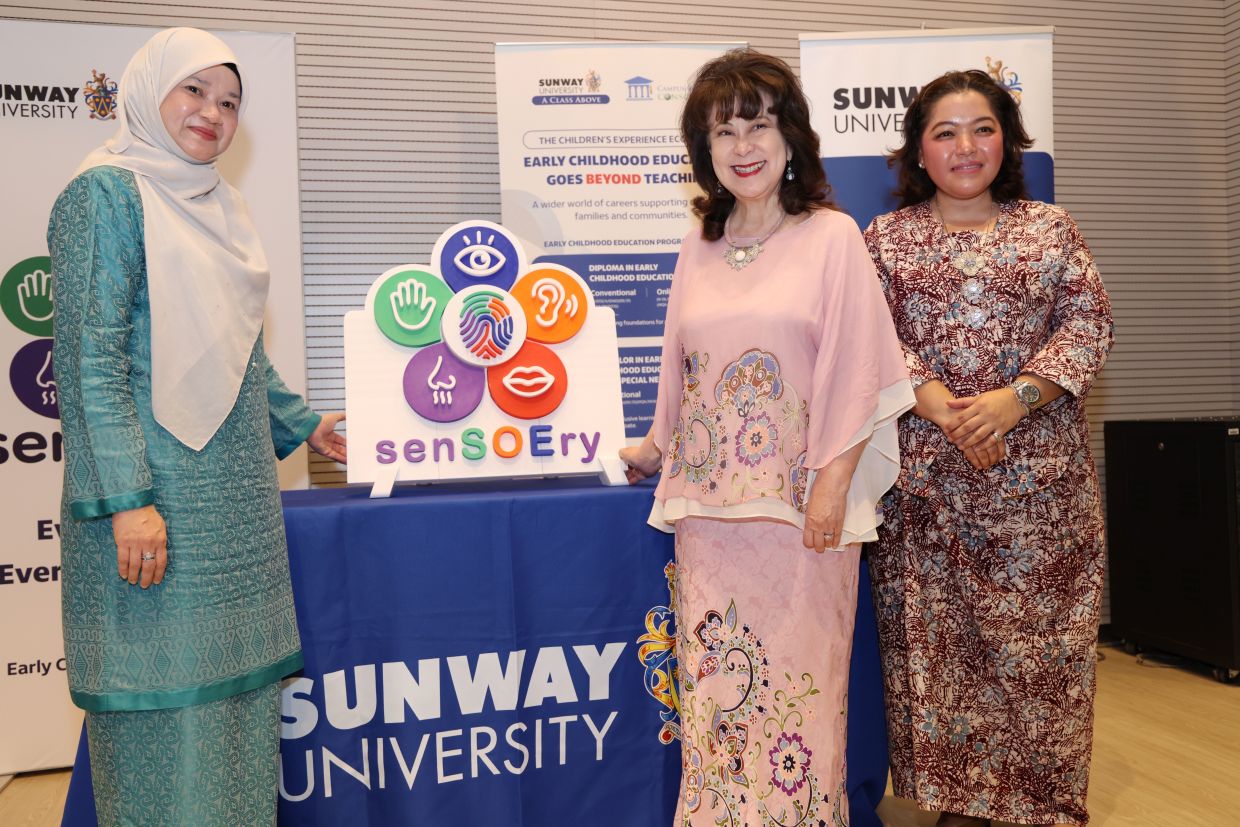
Fadhlina launching Sunway University’s early childhood education programmes in the presence of Prof Lee (centre) and Sunway University School of Education dean Prof Dr Malissa Maria Mahmud (right). — GLENN GUAN/The Star
SUBANG JAYA: The way children learn is changing, with classrooms no longer the only environments shaping their development.
From childcare centres and sensory gyms to digital platforms and therapy settings, young children are shaped by an expanding network of experiences.
This is prompting educators and support systems to rethink how early childhood education can better accommodate different needs.
At a recent series of discussions hosted by Sunway University’s School of Education, experts highlighted inclusion as an increasingly important part of early childhood education.
Panellists highlighted inclusion as an increasingly important part of early childhood education during a discussion session.
Sunway University PhD candidate and discussion moderator Desiree Kaur said the focus should be on adapting the environment rather than expecting children to conform to it.
South-east Asian Ministers of Education Organization Regional Centre for Special Educational Needs (Seameo Sen) director and Sunway University Adjunct Prof Jamilah Kadir described an effective inclusive classroom as one built around “intentional diversity”, where children of different abilities learn and play together.
Jamilah said a classroom can be lively, where "children with different abilities" converge while being "very playful and happy".
“This is where they discover together about life," she said before adding that labelism has yet to come into play.
Sunway University Assoc Prof Dr Amanallah Soltani said inclusion also meant ensuring every child could participate meaningfully.
“This is where every child can feel safe, valued, seen, can participate as well as fully engage in every activity with different ways to communicate, play, learn, and express themselves,” he said.
However, many neurodivergent children continue to encounter barriers when entering early childhood centres, including requirements such as being toilet-trained or being able to sit still.
Jamilah said such requirements could become a form of gatekeeping.
“If we give parents a set of checklists that the child must pass before they can enter a classroom, then that is not education - it is gatekeeping,” she said.
“The child should not have to be ready for the classroom; the classroom should be ready for the child.”
Amanallah said this required educators to reconsider approaches that focused primarily on changing the child through isolated therapies.
“I thought that I needed to change my mindset. This is not something wrong with the child - something is wrong with the environment,” he explained.
“Inclusive education is about changing something in the classroom, changing the teaching strategy, adapting them with a specific child,” said Amanallah.
The discussion also highlighted the importance of support beyond the classroom.
We Rock the Spectrum Kid’s Gym founder Nori Abdullah said meaningful learning depended on creating an environment that supported children across different aspects of their lives.
“If you want somebody to be able to learn, then the environment has to be conducive to it,” she said before adding that it ultimately includes other stakeholders such as the family and parents.
Nori also called for society to move beyond simply tolerating differences towards accepting and valuing them.
“What do we, overall, as a society, know or understand about people who are different and how far are we willing to go beyond tolerance to acceptance, that people are different and we want to value everybody for who they are?” she asked.
From a regulatory perspective, Social Welfare department childcare centre (Taska) regulatory division chief assistant director Norhida Abdul Aziz said inclusion had to be balanced with safety.
“It’s not only about opening the door; it is to make sure that beyond the door, the kids are safe - both the ones with special needs and the ones without,” she said.
“I want the children to feel a sense of belonging so that they will actively want to go every day and not feel left out.”
Norfida said her division had introduced targeted modules covering Autism, Down Syndrome and Cerebral Palsy for early childhood carers to help raise standards across the sector.
Looking ahead, Jamilah proposed structural changes to Malaysia’s early education system, including a mandated co-teaching model supported by allied health professionals in inclusive classrooms.
She said having therapists within school settings could reduce the financial burden on lower-income families while allowing children to receive support when needed.
At the regional level, Seameo Sen is advancing the Asean Seameo Joint Roadmap on Early Childhood Care and Education for 2026–2030, which aims to guide early childhood care and education standards across South-East Asia.
Seameo is a regional intergovernmental organisation set up in 1965 to advance cooperation in education, science and culture, with a focus on Special Educational Needs (Sen).
Jamilah said Malaysia had established many of the necessary policies, but greater attention was now needed on implementation at ground level.
“The policies are there, but how do we make sure that they are translated into layman's terms at ground level?” she asked.
Jamilah stated that an inclusive education teaches children respect, acknowledgement and that the world is diverse.
“The world itself is inclusive in nature, so why do we need a classroom or a school that is exclusive?”
The discussions coincided with Sunway University’s efforts to strengthen the preparation of future early childhood educators through new programmes.
Sunway University's School of Education has introduced three new programmes in early childhood education, namely Bachelor in Early Childhood Education with Special Needs (Honours), Diploma in Early Childhood Education (Conventional) and Diploma in Early Childhood Education (Open and Distance Learning, ODL).
The programmes were officially launched by Education Minister Datuk Seri Fadhlina Sidek alongside Sunway Education Group chief executive officer Prof Datuk Elizabeth Lee.
Fadhlina highlighted the importance of early learning and said the government was working towards making preschool education compulsory under the 13th Malaysia Plan.
“The best start for children begins with the best preparation for those who educate them,” she said, describing early childhood education as one of the most important stages in a child’s growth and exploration of the world.
Prof Lee says quality early childhood education helps establish a child’s cognitive, emotional and social foundations for life.
Prof Lee said quality early childhood education helps establish a child’s cognitive, emotional and social foundations for life.
“Quality early childhood education nurtures curiosity, creativity, communication skills and a lifelong love of learning and it teaches children how to think, not merely what to think,” she said.
"By strengthening the quality of early childhood education and advancing inclusive pedagogical practices, we are helping to ensure that no child is left behind, especially those who need our support the most," concluded Prof Lee.
To learn more about these new programmes, visit https://sunwayuniversity.edu.my/school-of-education/courses.
Thank you for your report!
HONOR Magic4 Pro: A pain-point killer smartphone to be unveiled in Malaysia soon
From menstruation to menopause
WHEN A FAVOUR MAY BE A BRIBE
法德琳娜在李教授(中)和双威大学教育学院院长玛丽莎·玛丽亚·马哈茂德教授(右)的陪同下,启动了双威大学的幼儿教育课程。——格伦·关/《星报》
梳邦再也:儿童的学习方式正在发生变化,教室不再是塑造他们发展的唯一环境。
从托儿中心和感官健身房到数字平台和治疗场所,幼儿的成长受到不断扩展的体验网络的影响。
这促使教育工作者和支持系统重新思考如何让幼儿教育更好地满足不同的需求。
在双威大学教育学院最近举办的一系列讨论会上,专家们强调包容性是幼儿教育中越来越重要的组成部分。
在讨论环节中,与会专家强调,包容性是幼儿教育中越来越重要的组成部分。
双威大学博士候选人兼讨论主持人迪西蕾·考尔表示,重点应该放在适应环境上,而不是期望孩子去适应环境。
东南亚教育部长组织特殊教育需求区域中心(Seameo Sen)主任兼双威大学兼职教授贾米拉·卡迪尔 (Jamilah Kadir) 将有效的包容性课堂描述为围绕“有意多样性”而建立的课堂,在这种课堂中,不同能力的孩子一起学习和玩耍。
贾米拉说,教室里会充满活力,“不同能力的孩子们”聚集在一起,既“非常活泼快乐”。
“在这里,他们一起探索人生,”她说道,并补充说,贴标签的现象还没有出现。
双威大学副教授阿曼纳拉·索尔塔尼博士表示,包容性还意味着确保每个孩子都能有意义地参与其中。
他说:“在这里,每个孩子都能感到安全、被重视、被关注,都能参与其中,并以不同的方式进行交流、玩耍、学习和表达自己,充分投入到每一项活动中。”
然而,许多神经多样性儿童在进入幼儿中心时仍然会遇到障碍,包括一些要求,例如必须接受如厕训练或能够安静地坐着。
贾米拉表示,这样的要求可能会变成一种门槛。
“如果我们给家长一套清单,要求孩子必须通过这些清单才能进入教室,那不是教育,而是设限,”她说。
“不应该让孩子为课堂做好准备;而应该让课堂为孩子做好准备。”
阿曼纳拉表示,这要求教育工作者重新考虑主要侧重于通过孤立的疗法来改变孩子的做法。
“我觉得我需要改变一下我的想法。这不是孩子的问题,而是环境的问题,”他解释说。
“融合教育是指改变课堂上的某些内容,改变教学策略,使其适应特定孩子的需求,”阿曼纳拉说。
讨论还强调了课堂之外的支持的重要性。
We Rock the Spectrum 儿童健身房创始人 Nori Abdullah 表示,有意义的学习取决于创造一个能够支持儿童在生活各个方面的环境。
“如果你想让某人能够学习,那么环境必须有利于学习,”她说道,并补充说,这最终还包括其他利益相关者,如家庭和父母。
诺里还呼吁社会不要仅仅容忍差异,而应该接受和重视差异。
她问道:“作为一个社会,我们总体上对与众不同的人了解多少?我们愿意在容忍和接纳之间走多远,才能真正理解人与人之间的差异,并尊重每个人的独特之处?”
从监管角度来看,社会福利部托儿中心(Taska)监管部门首席助理主任诺希达·阿卜杜勒·阿齐兹表示,包容性必须与安全相平衡。
“这不仅仅是打开一扇门;而是要确保门外的孩子们是安全的——无论是有特殊需要的孩子还是没有特殊需要的孩子,”她说。
“我希望孩子们能感受到归属感,这样他们就会主动想要每天来上学,而不是感到被冷落。”
Norfida表示,她的部门已经为幼儿保育员推出了针对自闭症、唐氏综合征和脑瘫的专项模块,以帮助提高整个行业的标准。
展望未来,贾米拉提出了对马来西亚早期教育体系进行结构性改革的建议,其中包括在融合课堂中强制推行由专职医疗人员支持的合作教学模式。
她表示,在学校配备心理治疗师可以减轻低收入家庭的经济负担,同时也能让孩子们在需要时获得帮助。
在区域层面,东南亚教育部长组织(Seameo Sen)正在推进《2026-2030年东盟东南亚教育部长组织幼儿保育和教育联合路线图》,该路线图旨在指导东南亚各地的幼儿保育和教育标准。
东南亚教育部长组织(Seameo)是一个区域性政府间组织,成立于 1965 年,旨在促进教育、科学和文化领域的合作,重点关注特殊教育需求(Sen)。
贾米拉表示,马来西亚已经制定了许多必要的政策,但现在需要更加重视在基层落实这些政策。
她问道:“政策是有的,但我们如何确保这些政策能够被基层民众理解并接受呢?”
贾米拉表示,包容性教育教导孩子们尊重、认可他人,并认识到世界是多元化的。
“世界本身具有包容性,那么我们为什么需要一个排外的教室或学校呢?”
这些讨论恰逢双威大学通过新课程加强未来幼儿教育工作者培养的努力。
双威大学教育学院推出了三个新的幼儿教育课程,分别是:幼儿教育(特殊需求)荣誉学士学位、幼儿教育(传统)文凭和幼儿教育(开放和远程学习,ODL)文凭。
这些项目由教育部长拿督斯里法德琳娜·西迪克和双威教育集团首席执行官拿督伊丽莎白·李教授正式启动。
法德琳娜强调了早期学习的重要性,并表示政府正在努力根据马来西亚第十三个计划将学前教育列为义务教育。
“对孩子来说,最好的开端始于教育他们的人做好最充分的准备,”她说道,并将幼儿教育描述为孩子成长和探索世界过程中最重要的阶段之一。
李教授表示,优质的早期儿童教育有助于为孩子的一生奠定认知、情感和社会基础。
李教授表示,优质的早期儿童教育有助于为孩子的一生奠定认知、情感和社会基础。
“优质的早期儿童教育能够培养孩子的好奇心、创造力、沟通能力和终身学习的热情,并且教给孩子如何思考,而不仅仅是思考什么,”她说。
李教授总结道:“通过加强幼儿教育质量和推进包容性教学实践,我们正在帮助确保不让任何一个孩子掉队,尤其是那些最需要我们支持的孩子。”
要了解有关这些新课程的更多信息,请访问 https://sunwayuniversity.edu.my/school-of-education/courses。
感谢您的报告!
荣耀Magic4 Pro:一款解决用户体验痛点的智能手机即将登陆马来西亚
从月经到更年期
何时恩惠也可能是贿赂