Key North-South Corridor works producing most noise, dust to be completed by end-2027: Jeffrey Siow造成噪音和粉尘污染最大的南北走廊关键工程将于2027年底前完工:杰弗里·西奥
Most major North-South Corridor construction works causing noise and dust will finish by end-2027, with road restorations completed from 2028. Read more at straitstimes.com.
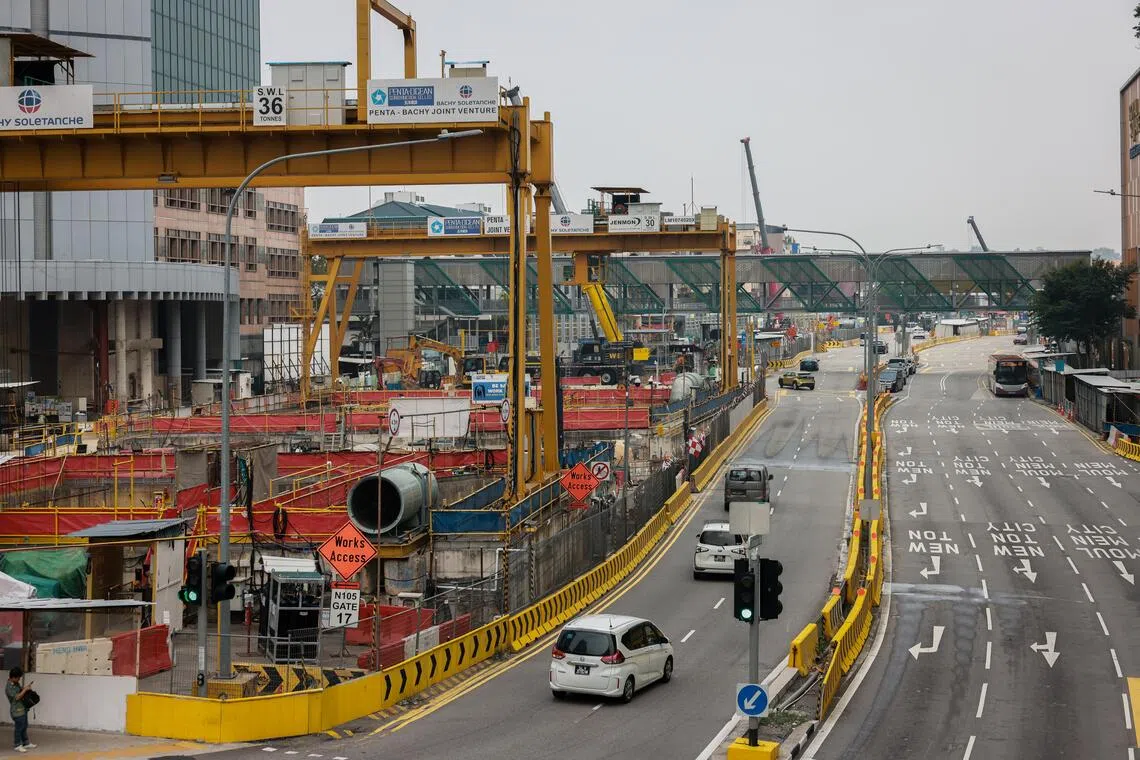
The North-South Corridor construction site at Thomson Road, as seen from an overpass beside Novena Square, on Sept 17.
Published Oct 06, 2026, 12:54 PM
Updated Oct 06, 2026, 12:56 PM
Most major noisy and dusty works for the North-South Corridor will finish by end-2027, with road and pedestrian access restored from 2028 to aid local businesses.
The NSC delay of about two years is due to complex underground conditions and safety risks, pushing viaduct opening to 2029 and tunnel opening to 2031.
LTA is managing challenges by improving pedestrian access during construction.
SINGAPORE – Most major structural works for the North-South Corridor (NSC) that create most of the noise and dust will be completed by the end of 2027, said Transport Minister Jeffrey Siow.
The completion of surface works will get priority, he added, so that surface conditions will start to improve from next year.
The Land Transport Authority will then reinstate roads, footpaths and other affected spaces from 2028. For instance, surface conditions for Lentor Avenue and Sembawang Road are expected to be back to normal by mid-2028, he said.
Siow was responding to questions in Parliament on Oct 6 on delay of the NSC. Denise Phua (Jalan Besar GRC) and Lee Hui Ying (Nee Soon GRC), for instance, asked what can be done for residents and businesses affected by the delay.
Siow said the authorities will be paying more attention to businesses along the construction route, including making it a priority to restore access routes for pedestrians when surface works are completed.
This is because changes to pedestrian routes or road access affect customer traffic for neighbourhood businesses .
LTA will also try to put in place more direct walking routes to shops and eateries and make it easier for customers to get to the shops.
Siow added that several businesses in Housing Board rental shops most affected by NSC construction works have been receiving rental rebates on a case-by-case basis, and HDB will continue to extend the rebates if there are grounds to do so.
As a general principle, the Government does not compensate stakeholders for project delays because that can add significant costs upfront to these projects, he said.
Jackson Lam (Nee Soon GRC), Lee Hong Chuang (Jurong-East Bukit Batok GRC) and Yip Hon Weng (Yio Chu Kang) also raised questions about the costs of the two-year delay to the completion of the NSC.
Siow said the delay is likely to result in a higher project cost but LTA is still assessing the extent of permissible claims by contract, and so it is unable to provide an updated project cost at this point. It will do so later.
He also touched on why more time is required to complete the 21.5km highway linking the northern towns to the city. He said: “The NSC is one of the most complex road projects we have undertaken in Singapore.”
It passes through densely built-up areas and bypasses major utilities, heavily used roads and even MRT lines, he added.
In some places, tunnelling works took place less than a metre away from the North-South Line and Circle Line, which are both in operation, said Siow.
The delay means that the NSC viaduct, which runs from Admiralty West to Lentor Avenue, will now open in stages from 2029 , instead of 2027.
Meanwhile, the tunnel section from Lentor Avenue to East Coast Parkway will open in phases from 2031 instead of 2029.
On pre-construction soil investigations, he said such investigations are not exhaustive as they are done on a sampling basis using scanning tools and physical drilling in key areas.
Siow added that there are limits to what can be detected, especially when ground conditions are variable.
As excavation progressed, he said the actual conditions at several locations turned out to be different and more difficult than what was indicated in the soil investigations.
For example, in Gambas Avenue and Woodlands Avenue 8, harder rock was found at shallower depths than expected.
And in Novena, the issue was fractured rock and groundwater seeping through the cracks.
WP MP Louis Chua (Sengkang GRC) and Yip asked if soil investigations provide enough information on underground conditions and engineering risks.
Siow said LTA and its contractors tried different ways to resolve these challenges, including deploying more manpower and equipment, adjusting construction methods and changing the sequence of works.
LTA engineers studied all their options before concluding that compressing the programme further with these ground conditions would pose significant safety risks.
“This is not the trade-off that we should make,” Siow said.
As these works are taking place beside people’s homes, roads that are in use and operational MRT infrastructure, contractors will not rush the work if it puts workers, residents or commuters at risk, he added.
As for Yip’s question on why stakeholders were not alerted of the delay earlier, Siow said LTA made the announcement “as soon as practicable”.
Engineers needed to assess the situation, see how to continue project works, and do it safely. It was only when the works progressed that the engineers realised the risks were too great, and a decision was made to accept there will be a delay, he added.
Singapore Parliament
9 月 17 日,从诺维娜广场旁的立交桥上看到的汤申路南北走廊施工现场。
发布于 2026 年 10 月 6 日下午 12:54
更新于2026年10月6日下午12:56
南北走廊的大部分大型噪音和粉尘工程将于 2027 年底完工,道路和行人通道将于 2028 年恢复,以帮助当地企业。
由于地下条件复杂和安全风险,NSC 的工期延误了大约两年,高架桥的开通时间推迟到 2029 年,隧道的开通时间推迟到 2031 年。
陆路交通管理局正在通过改善施工期间的行人通道来应对挑战。
新加坡——交通部长萧敬腾表示,造成大部分噪音和灰尘的南北走廊(NSC)主要结构工程将于2027年底完工。
他补充说,路面工程的完成将优先进行,以便路面状况从明年开始改善。
陆路交通管理局将从2028年起恢复道路、人行道和其他受影响的区域。例如,预计到2028年中期,伦多大道和三巴旺路的路面状况将恢复正常。
10月6日,萧正熙在国会回答有关国家安全委员会延期的问题时发表了上述言论。例如,惹兰勿刹集选区议员潘丽芬和义顺集选区议员李慧莹询问,对于受延期影响的居民和企业,可以采取哪些措施。
萧先生表示,当局将更加关注施工路线沿线的商户,包括在地面工程完工后优先恢复行人通道。
这是因为行人路线或道路通行方式的改变会影响附近商家的客流量。
陆路交通管理局还将努力开辟更多通往商店和餐馆的直接步行路线,让顾客更容易到达商店。
萧先生补充说,受国家安全委员会施工影响最大的几家建屋发展局出租店铺的商户已根据具体情况获得租金回扣,如果情况允许,建屋发展局将继续延长回扣期限。
他表示,政府的一般原则是不会对项目延误向利益相关者进行补偿,因为这会给这些项目增加大量的前期成本。
林志强(义顺集选区)、李鸿昌(裕廊东武吉巴督集选区)和叶鸿荣(义顺集选区)也对国家安全委员会延期两年完成的成本提出了质疑。
萧先生表示,延误可能会导致项目成本增加,但陆路交通管理局仍在评估合同允许的索赔范围,因此目前无法提供更新后的项目成本。稍后会提供。
他还谈到了为何连接北部城镇与市区的这条21.5公里长的高速公路需要更多时间才能完工。他说:“国家南北大道是新加坡迄今为止最复杂的道路项目之一。”
他还补充说,这条线路穿过人口稠密的建成区,绕过主要公用设施、繁忙的道路,甚至地铁线路。
萧先生说,在某些地方,隧道施工地点距离南北线和环线(这两条线路都在运营中)不到一米。
延误意味着从海军部西到伦多大道的NSC高架桥将从2029年开始分阶段开放,而不是原定的2027年。
与此同时,从伦托大道到东海岸公园大道的隧道段将从 2031 年开始分阶段开放,而不是原计划的 2029 年。
关于施工前的土壤调查,他表示,此类调查并不全面,因为它们只是在关键区域使用扫描工具和物理钻探进行抽样调查。
Siow补充说,可探测到的东西是有限的,尤其是在地面条件多变的情况下。
他表示,随着挖掘工作的进行,几个地点的实际情况与土壤调查所显示的情况有所不同,而且更加困难。
例如,在甘巴斯大道和伍德兰兹大道 8 号,在比预期更浅的深度发现了更硬的岩石。
而在诺维纳,问题是岩石破裂,地下水从裂缝中渗出。
工人党议员蔡瑞生(盛港集选区)和叶先生询问土壤调查是否能提供足够的地下状况和工程风险信息。
Siow表示,陆路交通管理局及其承包商尝试了不同的方法来解决这些挑战,包括部署更多的人力和设备、调整施工方法和改变施工顺序。
LTA工程师研究了所有方案后得出结论:在当前地质条件下进一步压缩工期将带来重大的安全风险。
“这不是我们应该做出的权衡,”萧说。
他补充说,由于这些工程是在居民住宅、正在使用的道路和运营中的地铁基础设施旁边进行的,如果这样做会危及工人、居民或通勤者的安全,承包商就不会仓促施工。
至于叶先生提出的为何没有更早通知利益相关者延期的问题,萧先生表示,陆路交通管理局“在切实可行的情况下尽快”发布了公告。
工程师需要评估情况,研究如何安全地继续推进项目工作。他补充说,只有当工程进展到一定阶段后,工程师们才意识到风险过大,最终决定接受工期延误的事实。
新加坡国会