Happiness Initiative’s Well-Being Circles to conclude after 5 years幸福倡议的幸福圈项目将在5年后结束
The grassroots mental wellness programme has reached more than 1,000 participants from ages 18 to 80.
新闻视频
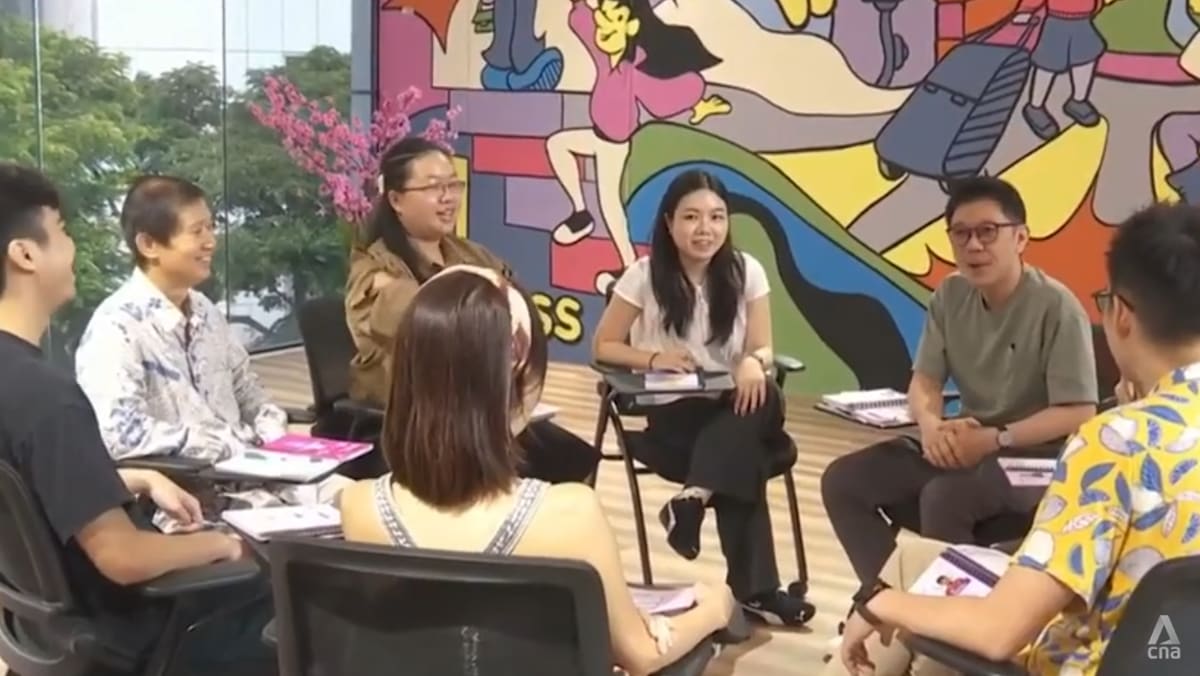
The grassroots mental wellness programme has reached more than 1,000 participants from ages 18 to 80.
CNA's Ivy Chok (in white, centre) joined a Well-Being Circles session where strengths were discussed. (Image: CNA)
This audio is generated by an AI tool.
SINGAPORE: For five years, groups of strangers have spent their Saturdays sitting in small circles, sharing their personal experiences and learning practical ways to boost their mental wellness.
But the latest batch of participants will be the last to go through the Well-Being Circles, an initiative where participants trade personal stories and take part in reflective exercises.
The mental wellness programme, run by social enterprise Happiness Initiative, is winding down after reaching more than 1,000 participants, as its organisers rethink how to reconfigure the programme for people with less time to spare.
“We realised that participants nowadays find it harder and harder to commit,” said co-founder Sherman Ho.
CNA Games Guess Word Crack the word, one row at a time Buzzword Create words using the given letters Mini Sudoku Tiny puzzle, mighty brain teaser Mini Crossword Small grid, big challenge Word Search Spot as many words as you can Show More Show Less “When you talk about coming for an eight-week long programme, committing eight Saturdays, people find it difficult.” The final run of the initiative, which ends in November, has 84 participants, ranging in age from 18 to 80.
“When you talk about coming for an eight-week long programme, committing eight Saturdays, people find it difficult.”
The final run of the initiative, which ends in November, has 84 participants, ranging in age from 18 to 80.
FROM LARGE EVENTS TO SMALL CIRCLES
The social wellness enterprise has been running mental wellness programmes for almost a decade.
Before COVID-19, these included large-scale events. But when the pandemic brought group gatherings to a halt, its sessions moved online and became smaller.
That shift helped Mr Ho realise that these smaller settings could work better for participants.
“To really have an impact on someone's well-being, you need (the setting) to be very intimate because it’s such a subjective experience,” he said.
“In order for people to really grasp a lot of these concepts and all these skills that we talk about, you need them to bring in their personal experiences.”
That became the basis for Well-Being Circles.
Each small group is typically made up of about seven participants and two facilitators.
Some former participants also returned as volunteers to facilitate subsequent sessions.
Happiness Initiative's co-founder Sherman Ho speaks to CNA. (Image: CNA)
Mr Ho said such spaces matter more in a city like Singapore, where the fast-paced environment can take a toll on people's well-being and leave little time to slow down and reflect.
“It's a very stressful place to live in. The high cost of living, people are always rushing here and there. I think that creates a certain culture where … you always need to move on to the next thing,” he said.
Technology has added another layer to those pressures, he noted.
“Technology plays a very big part in a lot of stressors and mental health issues that we see today,” he said, pointing to the rise of artificial intelligence and the pervasive use of social media, especially among young people.
“We don't have that time to understand what's the implication of all this technology on people.”
Participants explored the idea of reframing negative beliefs into positive ones through discussions, reflections and games. (Image: CNA)
LEARNING THROUGH SHARING
In one session observed by CNA, participants explored the idea of personal strengths through discussions, reflections and games, including an exercise involving lego blocks.
Well-Being Circles facilitator Darren Soon said in daily life, including within families, people often hear the question: “What’s wrong with you?”
“But (here), the question that we ask each other is, ‘What's strong in you? What's good in you?’ We are all unique, and all of us are created to have a place in this world, and we are worth it,” he said.
For participant Rachel Loh, the sessions came at a time of significant change in her life – she recently got married and started a new job.
“These two major transitions do take a toll on my life. And sometimes, I get very overwhelmed,” she said.
Ms Loh pointed out one concept in the programme that stood out for her – reframing negative beliefs into positive ones.
She said this mindset helps people stay grounded and present instead of dwelling and spiralling from negative emotions.
Ms Rachel Loh, a participant at Well-Being Circles, speaking to CNA. (Image: CNA)
MOVING TOWARDS NEW CONVERSATIONS
Ending the current Well-Being Circles does not necessarily mean the programme will disappear for good.
For Mr Ho, the pause is a chance for the team to rest after running sessions almost every Saturday for five years, as well as to reflect on and redesign the programme.
“I think that if we keep pushing on and running it, it's also contradicting what we talk about: Well-being,” he said, adding that the challenge is designing a shorter programme without compromising what participants gain from it.
“There will always be trade-offs,” said Mr Ho. “What's important is the impact of the programme, (and the) accessibility.”
Future versions could take place over two or three weekends or perhaps even be condensed into a single weekend.
The aim would remain the same: Teaching participants skills they can subsequently apply in their own lives.
“I feel that well-being is always a personal responsibility. Whatever your life circumstances, we all have the power to transcend it and build a better life for ourselves,” said Mr Ho.
Happiness Initiative continues to run other well-being programmes for schools and workplaces.
Get our pick of top stories and thought-provoking articles in your inbox
Stay updated with notifications for breaking news and our best stories
Join our channel for the top reads for the day on your preferred chat app
这项基层心理健康计划已惠及 1000 多名年龄在 18 岁至 80 岁之间的参与者。
CNA记者Ivy Chok(图中身穿白色衣服者)参加了一场身心健康小组讨论会,会上大家探讨了各自的优势。(图片:CNA)
这段音频是由人工智能工具生成的。
新加坡:五年来,一群互不相识的人们每周六都会围坐在一起,分享彼此的个人经历,并学习提升心理健康的实用方法。
但最新一批参与者将是最后一批参加“幸福圈”活动的参与者,该活动旨在让参与者分享个人故事并参与反思练习。
由社会企业“幸福倡议”运营的心理健康计划在吸引了超过 1000 名参与者后正在逐步结束,因为其组织者正在重新思考如何调整该计划,以适应那些空闲时间较少的人。
联合创始人何雪曼表示:“我们意识到,如今的参与者越来越难以做出承诺。”
CNA游戏 猜词游戏 逐行破解单词 流行词游戏 用给定的字母组成单词 迷你数独 小谜题,脑力挑战 迷你填字游戏 小方格,大挑战 单词搜索 尽可能多地找出单词 显示更多 显示更少 “当人们谈到要参加一个为期八周的项目,需要投入八个星期六的时间时,他们会觉得很难。” 这项活动的最后一期将于11月结束,共有84名参与者,年龄从18岁到80岁不等。
“当你谈到要参加一个为期八周的课程,需要投入八个星期六的时间时,人们会觉得很难。”
该计划的最后一期将于 11 月结束,共有 84 名参与者,年龄从 18 岁到 80 岁不等。
从大型活动到小型聚会
这家社会健康企业已经开展心理健康项目近十年了。
在新冠疫情爆发前,这些活动包括大型聚会。但疫情导致群体聚集活动停止后,活动转移到了线上,规模也缩小了。
这一转变让何先生意识到,这种规模较小的环境可能对参与者更有效。
他说:“要想真正对一个人的幸福感产生影响,你需要(这样的环境)非常私密,因为这是一种非常主观的体验。”
“为了让人们真正理解我们谈论的这些概念和技能,你需要让他们融入自己的个人经验。”
这便成为了幸福圈的基础。
每个小组通常由大约七名参与者和两名引导员组成。
一些往届学员也作为志愿者回来协助举办后续课程。
幸福倡议组织联合创始人何世文接受亚洲新闻台采访。(图片:亚洲新闻台)
何先生表示,在像新加坡这样的城市,这样的空间更为重要,因为快节奏的环境会对人们的身心健康造成影响,让人没有时间慢下来反思。
“这里的生活压力很大。生活成本高,人们总是忙忙碌碌。我认为这造就了一种特定的文化……你总是需要不断地追求下一个目标,”他说。
他指出,科技又给这些压力增添了另一层含义。
“科技在当今我们所看到的许多压力源和心理健康问题中扮演着非常重要的角色,”他说道,并指出人工智能的兴起和社交媒体的普遍使用,尤其是在年轻人中。
“我们没有时间去了解所有这些技术对人们的影响。”
参与者通过讨论、反思和游戏,探索了将消极信念转化为积极信念的方法。(图片:CNA)
通过分享学习
在 CNA 观察的一次课程中,参与者通过讨论、反思和游戏(包括一项涉及乐高积木的练习)探索了个人优势的概念。
健康圈组织者达伦·苏恩表示,在日常生活中,包括在家庭中,人们经常会听到这样的问题:“你怎么了?”
“但是(在这里),我们彼此问的问题是,‘你身上有什么强大的地方?你身上有什么优点?’我们都是独一无二的,我们生来就应该在这个世界上占有一席之地,我们都值得拥有这一切,”他说。
对于参与者 Rachel Loh 来说,这些课程正值她人生发生重大变化之际——她最近结婚并开始了一份新工作。
“这两件大事确实给我的生活带来了不小的压力。有时候,我会感到非常不知所措,”她说。
罗女士指出,该节目中有一个概念让她印象深刻——将消极信念转化为积极信念。
她说,这种心态能帮助人们保持脚踏实地、活在当下,而不是沉溺于负面情绪中,陷入恶性循环。
参与“身心健康圈”活动的瑞秋·罗女士接受亚洲新闻台采访。(图片:亚洲新闻台)
迈向新的对话
结束目前的幸福圈活动并不一定意味着该项目将永远消失。
对于何先生来说,这段暂停期让团队有机会在五年来几乎每个星期六都进行训练后休息一下,同时也让团队有机会反思和重新设计训练计划。
“我认为,如果我们继续推进并实施这个项目,那就与我们谈论的‘福祉’背道而驰了,”他说道,并补充说,目前的挑战在于设计一个更短的项目,同时又不影响参与者从中获得的收益。
何先生说:“任何事情都难免会有取舍。重要的是项目的影响和可及性。”
未来的版本可能会持续两到三个周末,甚至可能压缩到一个周末内完成。
目标不变:教授参与者可以在自己生活中应用的技能。
“我认为,身心健康始终是个人的责任。无论生活境遇如何,我们都有能力超越困境,为自己创造更美好的生活。”何先生说道。
幸福倡议组织继续为学校和工作场所开展其他健康计划。
订阅我们的邮件,即可获取精选热点新闻和引人深思的文章。
订阅通知,第一时间获取突发新闻和精彩报道。
加入我们的频道,即可在您常用的聊天应用上获取当日热门文章。