EU deepens collective space security with mutual defense pact欧盟通过共同防御条约深化集体空间安全
The move is one more step in the EU's long-running, but recently accelerated, effort to create "strategic autonomy" in the space arena.
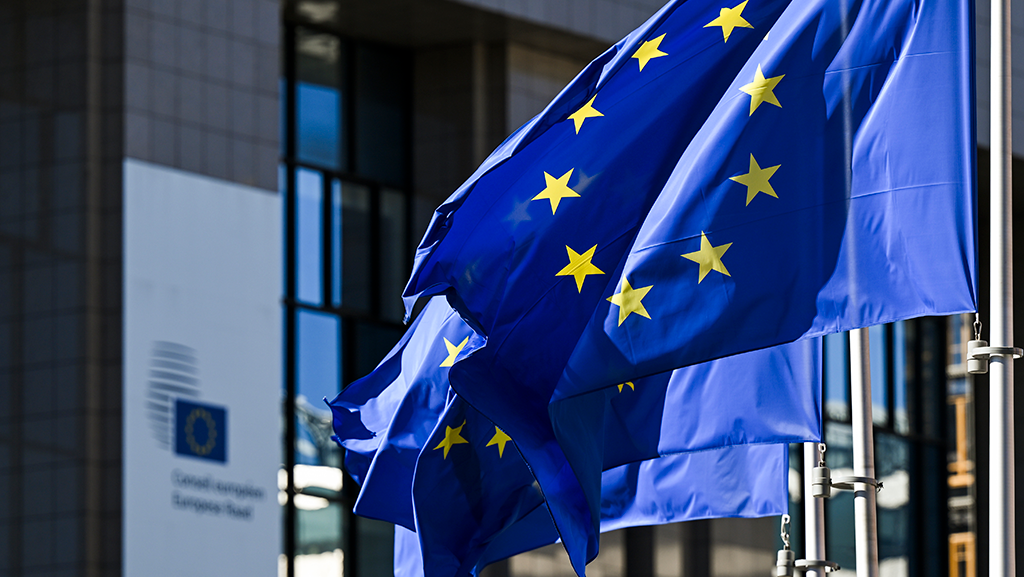
The European Union's flag (Photo: European Council of Ministers)
WASHINGTON — For the first time, the 27 member states of the European Union (EU) officially have given approval for a collective response — via political, economic or even military means — to threats against any one nation’s satellites and related terrestrial infrastructure, under a recent decision by the group’s ruling Council of Ministers.
The key tenet of the multifaceted Sept. 23 Council Decision 2026/2195 is a green light for joint action, according to several US and European analysts.
“This framework aims to do the same thing as the recent US disclosure of on-orbit space control weapons : deterring space threats,” said Clayton Swope, deputy director of the Center for Strategic and International Studies’ Aerospace Security Project. “Europe is looking at space threats as a collective threat, not just as a threat to one nation. Accordingly, it’s prepared to respond as Europe rather than just as one country.”
Michael Gleason, a long-time expert on the EU at The Aerospace Corporation’s Center for Space Policy and Strategy, agreed. The upshot of the decision, he said, is that “if a member state says that they want the EU to help them respond, then the EU could make a decision to do so.”
Further, Gleason said the move is one more step in the EU’s long-running, but recently accelerated, effort to create “ strategic autonomy ” in the space arena.
“This is consistent with what the EU’s plans have been, and going forward, we’re going to see a lot more widening and deepening of other space initiatives in the space security and defense arena,” he added.
The decision document outlines measures to both broaden and expand the EU’s Space Threat Response Architecture created in 2021, which empowered the EU to respond to threats against jointly owned/operated satellite systems, such as Europe’s version of GPS Galileo and the Copernicus remote sensing constellation. It also enhances the ability of the High Representative for Foreign Affairs and Security Policy ― the EU’s top diplomat for security-related issues ― to unilaterally take action if an urgent response is required.
The new Council Decision “expands the scope of the EU’s response space threats to the security of the EU, the security of Member States or both even if they are not directly linked to the EU space assets,” according to an EU fact sheet .
“In short, it strengthens and adapts the existing architecture to the current space threat environment. This includes, for example, cyber-attacks and espionage, but also possible disruptions to supply chains, ground stations or the wider space-based infrastructure,” the fact sheet adds.
The decision can be read as an outgrowth of the EU’s framework space security and defense strategy published in 2023, said Xavier Pasco, senior researcher at France’s Foundation for Strategic Research.
The strategy initiated the creation by the EU headquarters of a common threat picture, called upon member states to strengthen their individual response capabilities, and urged them to at least consider whether joint action might be necessary.
Whereas the 2023 document laid out “more indirect approaches” for threat response, the new Council Decision “focuses more on the role the EU would play in more direct strategies for protection, threat identification, etc,” he told Breaking Defense.
The move could be particularly important for Austria, Cyprus, Ireland and Malta, the four EU members that are not also members of NATO and thus not covered by the alliance’s Article 5 mutual defense pact. And for those members in both groups, this new system also offers a different pathway should NATO not choose to respond for whatever reason .
Of course, as Swope pointed out, the new decision is only an enabling document. It does not add any new military capabilities to EU members arsenals; nor does it guarantee the EU will have the political will to actually go all the way to military action in response to threats or low-level attacks.
“[T]he question is whether Europe’s collective teeth have sufficient bite to deter hostile space activities, particularly ones from Russia. Whether from one country or 27, Russia seems happy to ignore diplomatic naming and shaming,” he said. “Can this unified approach ramp up the consequences enough to produce a different result?”
欧盟旗帜(图片来源:欧洲部长理事会)
华盛顿——根据欧盟最高领导人部长理事会最近的一项决定,欧盟 27 个成员国首次正式批准对任何国家卫星及相关地面基础设施受到的威胁采取集体应对措施——通过政治、经济甚至军事手段。
据几位美国和欧洲分析人士称,9 月 23 日安理会第 2026/2195 号决议的核心原则是为联合行动开绿灯。
“这一框架旨在实现与美国近期披露的在轨空间控制武器相同的目标:威慑太空威胁,”战略与国际研究中心航空航天安全项目副主任克莱顿·斯沃普表示。“欧洲将太空威胁视为集体威胁,而不仅仅是对某个国家的威胁。因此,欧洲准备以欧洲的名义而非单个国家的名义做出应对。”
航空航天公司空间政策与战略中心长期研究欧盟问题的专家迈克尔·格里森对此表示赞同。他说,这项决定的最终结果是,“如果一个成员国表示希望欧盟帮助其应对危机,那么欧盟就可以决定是否提供帮助。”
此外,格里森表示,此举是欧盟长期以来(但最近加快了)在太空领域建立“战略自主权”努力的又一步。
“这与欧盟的计划是一致的,展望未来,我们将看到太空安全和国防领域的其他太空倡议得到更广泛的拓展和深化,”他补充道。
该决定文件概述了旨在扩大和扩展欧盟于2021年建立的“空间威胁应对架构”的各项措施。该架构赋予欧盟应对针对共同拥有/运营的卫星系统(例如欧洲版的GPS伽利略系统和哥白尼遥感星座)的威胁的权力。此外,该文件还增强了欧盟外交与安全政策高级代表(欧盟负责安全事务的最高外交官)在必要时单方面采取行动的能力。
根据欧盟的一份情况说明书,新的理事会决定“扩大了欧盟应对空间威胁的范围,这些威胁可能危及欧盟安全、成员国安全或两者,即使这些威胁与欧盟的空间资产没有直接联系”。
“简而言之,它加强并调整了现有架构,以适应当前的太空威胁环境。这包括网络攻击和间谍活动,也包括供应链、地面站或更广泛的天基基础设施可能遭受的干扰,”情况说明书补充道。
法国战略研究基金会高级研究员泽维尔·帕斯科表示,这一决定可以被视为欧盟于 2023 年发布的《空间安全和防御战略框架》的延伸。
该战略促使欧盟总部创建共同威胁图景,呼吁成员国加强各自的应对能力,并敦促它们至少考虑是否有必要采取联合行动。
他告诉《防务新闻》,虽然 2023 年的文件提出了应对威胁的“更间接的方法”,但新的理事会决定“更侧重于欧盟在更直接的保护、威胁识别等方面发挥的作用”。
此举对奥地利、塞浦路斯、爱尔兰和马耳他这四个欧盟成员国尤为重要,因为它们并非北约成员国,因此不受北约第五条共同防御条约的约束。而对于同时属于欧盟成员国和北约成员国的国家而言,如果北约出于任何原因选择不予回应,这一新机制也提供了一条不同的应对途径。
当然,正如斯沃普所指出的,这项新决定仅仅是一份授权文件。它既没有为欧盟成员国的武器库增加任何新的军事能力,也没有保证欧盟有政治意愿在面对威胁或低烈度袭击时采取军事行动。
“问题在于,欧洲的集体威慑力是否足以阻止敌对的太空活动,特别是来自俄罗斯的活动。无论是来自一个国家还是27个国家,俄罗斯似乎都乐于无视外交上的点名批评,”他说道。“这种统一战线能否加大惩罚力度,从而产生不同的结果?”