P1 registration: 15% of Phase 2C students at 12 popular primary schools live in public housingP1注册情况:12所热门小学第二阶段C期学生中,15%居住在公共住房。
Read more at straitstimes.com.
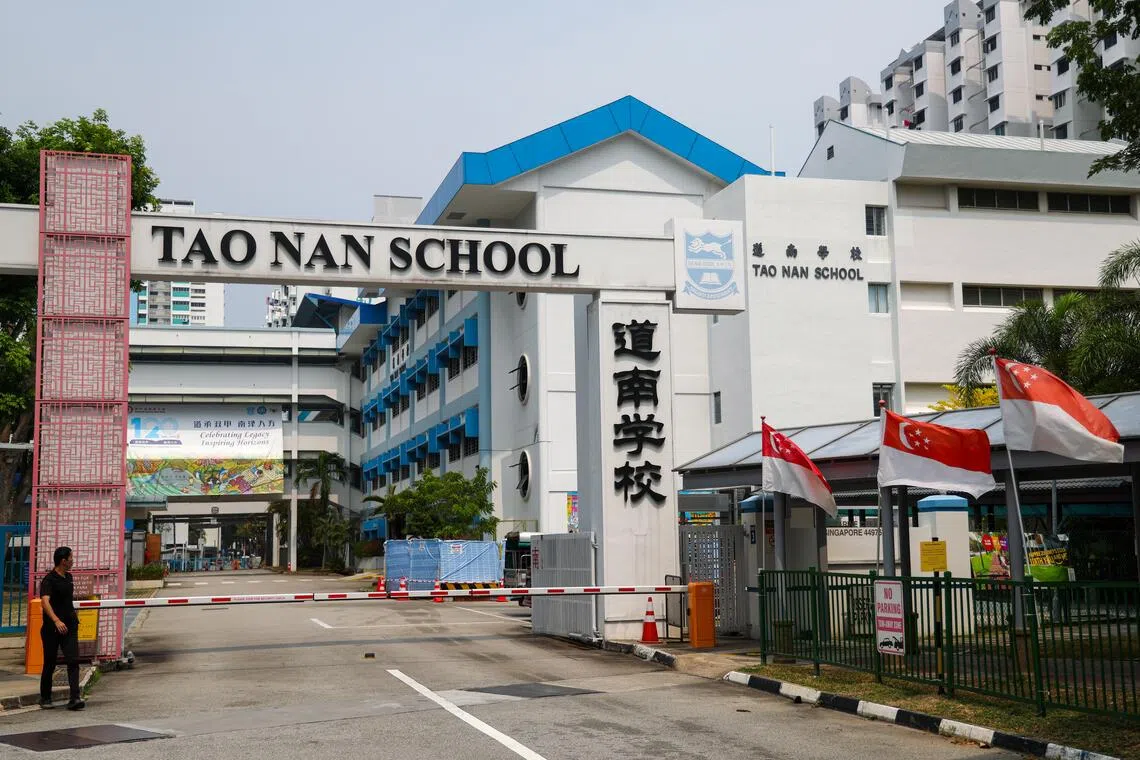
Tao Nan Primary School, one of the 12 schools on the new two-track system, will reserve more places for children living more than 2km away.
PHOTO: LIANHE ZAOBAO
Published Oct 07, 2026, 03:39 PM
Updated Oct 07, 2026, 03:44 PM
- MOE will raise Phase 2C places in most primary schools from 40 to 60 spots from 2027, to help children without school links get in.
- Twelve schools in areas with less public housing will split Phase 2C places into two tracks, to improve social mix and keep access for nearby families.
- Desmond Lee said only 15% of Phase 2C students at those 12 schools live in public housing, and the two-track scheme aims to improve access and social mixing.
SINGAPORE - Fewer than 1 in 6 students who enter 12 popular schools here during Phase 2C of the Primary 1 registration come from public housing, said Education Minister Desmond Lee.
Lee cited this statistic on Oct 7, as he responded in Parliament to 16 questions that MPs had filed on changes to the P1 registration system that the Ministry of Education (MOE) had announced on Sept 10.
The changes mean that, from the next registration exercise in 2027, most schools here will reserve 60 spots for children in Phase 2C, up from the current 40. This phase is for students without prior connections to the school, with those living nearby getting priority admission.
Additionally, 12 schools in neighbourhoods where public housing is significantly lower than the national average will set aside spots in Phase 2C for children who live more than 2km away, to ensure access to a more diverse mix of applicants.
These schools will split the 60 reserved places - along with any spots leftover from previous stages - into two tracks, with half of the places meant for those staying within 2km of the school and the remaining half for those who live further away.
Lee said on Oct 7 that, for a start, MOE has decided to implement this two-track scheme in neighbourhoods where public housing constitutes less than 40 per cent of homes within a 2km radius.
Schools in these neighbourhoods tend to reflect this social mix, and the 15 per cent of successful Phase 2C applicants who come from public housing “is very low” and is something that MOE is keeping an eye on, he added.
MPs who filed questions on the topic included Gho Sze Kee (Mountbatten), who asked if the changes might “systematically disadvantage” children who live next to a school coming under the two-track scheme.
Gho said she had spoken to many upset parents, as the only primary school in her ward is Kong Hwa School, which is routinely oversubscribed. Of the other schools close by, four are on the list of 12 schools - Tanjong Katong Primary, Tao Nan School, CHIJ Katong (Primary) and Ngee Ann Primary.
“With this new framework, we are simply drawing a circle around a school and handicapping every children living within that circle,” she said. “Worse, this framework makes the assumption that children living outside of that circle will be from different social economic backgrounds.”
In response, Lee said the increased ring-fencing of spots under Phase 2C is precisely to tilt the allocation in favour of those living near to a school like Kong Hwa.
The objective of both changes is to widen access for children regardless of prior connections to a school and to encourage more mixing among students from different backgrounds, he added.
When a neighbourhood consists predominantly of one housing type, home-school distance by itself does not necessarily widen access to families of different socio-economic backgrounds, which is why the two-track scheme is being implemented, said Lee.
Nominated MP Kenneth Goh said increasing the number of places in Phase 2C comes at the expense of other groups who would benefit in earlier phases, such as the children of alumni. He suggested expanding the number of vacancies in popular schools that are consistently oversubscribed, or to allow these schools to open in new locations.
Lee said that increasing the intake for popular schools sounds sensible, but larger cohorts will run up against infrastructure constraints, such as the need for more classrooms at the expense of spaces for other meaningful activities.
Should such schools have room to expand and increase their intake, this might not necessarily improve their social mix, he noted.
Meanwhile, enrolment at other nearby schools might also fall, given that cohort sizes are shrinking, which could lead to the merger or closure of these schools and impact MOE’s ability to provide a good spread of schools across the island, said the minister.
As for letting a popular school take over the name and grounds of a less popular school, some of the alumni and community of these so-called less popular schools “have a very strong view about that”, said Lee.
Non-Constituency MP Andre Low asked what baseline or outcome indicators MOE will use to assess socio-economic mixing, and if the ministry will publish annual statistics on application and admission outcomes for each school.
In response, Lee said there is no such construct to see if a school meets an ideal socio-economic mix, because no two schools - nor neighbourhoods - are identical.
“The school mix is a function of many things - the legacy of the school, the so-called popularity of the school, the make-up of its neighborhood and so on,” he said.
The minister said that ultimately, parents make a decision on where they would like to place their children, and they have different considerations. These include distance to one’s home or workplace, that they were alumni of a school, or that a school provides a program that resonates with them.
“Ultimately, whether (the changes) work will depend, as I said, on parental decisions,” said Lee. “But at least now we widen the circle and give opportunities. And for those living within zero to two kilometers, we are preserving access, we are not taking it away.”
Elisha Tushara is a correspondent at The Straits Times, specialising in Singapore’s education landscape.
Singapore Parliament
Primary 1 registration
道南小学是新双轨制教育体系下的 12 所学校之一,将为居住在 2 公里以外的孩子预留更多学位。
图片来源:联合早报
发布于 2026 年 10 月 7 日下午 3:39
更新于2026年10月7日下午3:44
- 教育部将从 2027 年起将大多数小学的第二阶段 C 类入学名额从 40 个增加到 60 个,以帮助没有入学关系的孩子入学。
- 在公共住房较少的地区,十二所学校将把 2C 期学位分成两个部分,以改善社会融合,并保持附近家庭的入学机会。
- 德斯蒙德·李表示,这 12 所学校中只有 15% 的第二阶段 C 类学生住在公屋里,双轨制计划旨在改善入学机会和社会融合。
新加坡——教育部长李智陞表示,在小学一年级入学登记第二阶段C中,进入新加坡12所热门学校的学生中,来自公共住房的学生不到六分之一。
李显龙总理于 10 月 7 日在国会回应议员们提出的 16 个问题时引用了这一统计数据。这些问题是关于教育部于 9 月 10 日宣布的小学一年级注册制度的变更。
这些变化意味着,从 2027 年的下一次注册开始,这里的大多数学校将为 2C 阶段的儿童预留 60 个名额,高于目前的 40 个。该阶段面向与学校没有先前联系的学生,居住在附近的学生将获得优先录取。
此外,在公共住房远低于全国平均水平的社区中,有 12 所学校将在第二阶段 C 中为居住在 2 公里以外的儿童预留名额,以确保申请者构成更加多样化。
这些学校将把预留的 60 个名额(以及之前阶段剩余的任何名额)分成两组,一半名额给住在学校 2 公里范围内的学生,另一半名额给住在更远地方的学生。
李在 10 月 7 日表示,教育部决定首先在方圆 2 公里内公共房屋占比低于 40% 的社区实施这项双轨制计划。
他补充说,这些社区的学校往往反映了这种社会构成,而来自公共房屋的2C期申请成功者仅占15%“非常低”,教育部正在密切关注这一情况。
就此议题提出质询的议员包括 Gho Sze Kee(蒙巴顿选区),他询问这些变化是否会“系统性地使”居住在实行双轨制学校附近的儿童处于不利地位。
Gho表示,她与许多忧心忡忡的家长交谈过,因为她所在选区唯一的公立小学是光华小学,而这所学校一直供不应求。附近的其他学校中,有四所被列入了12所学校的名单,分别是丹戎加东小学、道南小学、加东圣婴女校(小学部)和义安小学。
“有了这个新框架,我们只不过是在学校周围画了一个圈,然后让圈内所有孩子都处于不利地位,”她说。“更糟糕的是,这个框架还假定圈外的孩子来自不同的社会经济背景。”
对此,李表示,第二阶段C期增加名额限制正是为了将分配比例向居住在光华学校附近的家庭倾斜。
他补充说,这两项改革的目标都是扩大儿童入学机会,无论他们之前是否与学校有联系,并鼓励不同背景的学生之间进行更多交流。
李说,当一个社区主要由一种类型的房屋组成时,单靠家校距离本身并不一定能扩大不同社会经济背景家庭的入学机会,这就是为什么要实施双轨制方案的原因。
委任议员吴庆炎表示,增加第二阶段C期学位名额会损害其他群体的利益,例如校友子女等本应在前期受益的群体。他建议增加那些长期供不应求的热门学校的空缺名额,或者允许这些学校在新的地点开办。
李表示,增加热门学校的招生人数听起来合情合理,但更大的招生规模会遇到基础设施方面的限制,例如需要更多的教室,从而牺牲其他有意义的活动空间。
他指出,如果这类学校有扩建和增加招生规模的空间,这未必能改善其社会构成。
部长表示,与此同时,由于学生群体规模缩小,附近其他学校的入学人数也可能下降,这可能导致这些学校合并或关闭,并影响教育部在全岛范围内提供良好学校分布的能力。
李说,至于让一所受欢迎的学校接管一所不太受欢迎的学校的名称和场地,这些所谓不太受欢迎的学校的一些校友和社区成员“对此有非常强烈的看法”。
非选区议员安德烈·洛询问教育部将使用哪些基准或结果指标来评估社会经济融合情况,以及教育部是否会公布每所学校的申请和录取结果的年度统计数据。
对此,李表示,没有这样的结构来判断一所学校是否符合理想的社会经济组合,因为没有两所学校——也没有两个社区——是完全相同的。
他说:“学校的构成取决于很多因素——学校的历史、所谓的受欢迎程度、周边社区的构成等等。”
部长表示,最终由家长决定子女的就读学校,他们的考量因素各不相同。这些因素包括学校离家或工作地点的远近、是否是该校校友,或者学校提供的课程是否符合他们的兴趣。
李说:“最终,正如我所说,这些改变是否奏效取决于家长的决定。但至少现在我们扩大了覆盖范围,提供了更多机会。对于居住在0到2公里范围内的人们,我们保留了他们的入学机会,而不是剥夺了他们的权利。”
Elisha Tushara 是《海峡时报》的记者,专门报道新加坡的教育领域。
新加坡国会
小学一年级注册