S’pore to contribute marine expertise, international connections to global ocean protection: Gan Kim Yong新加坡将贡献海洋专业知识和国际联系,为全球海洋保护贡献力量:颜金勇
He was speaking aboard a research vessel at the OceanX Summit, which was also attended by film-maker James Cameron. Read more at straitstimes.com.
新闻视频
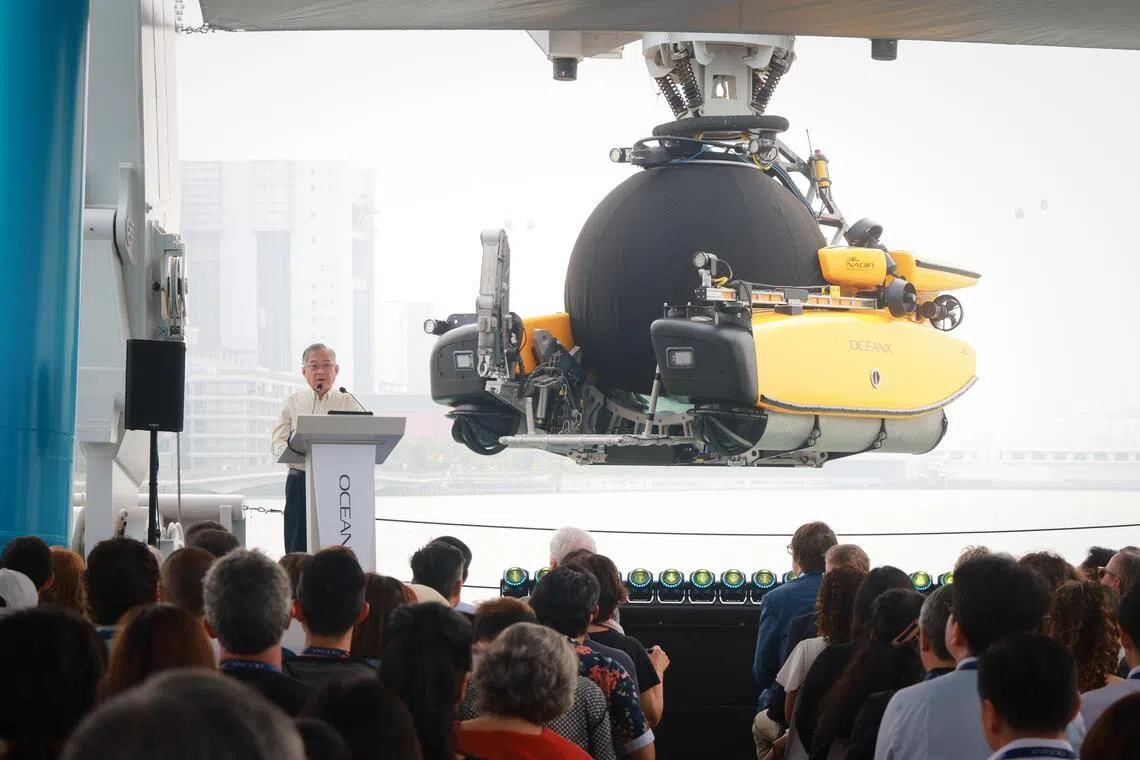
Deputy Prime Minister Gan Kim Yong speaking at the OceanX Summit aboard the OceanXplorer research vessel berthed at the Marina at Keppel Bay on Oct 7.
ST PHOTO: JASON QUAH
Published Oct 07, 2026, 04:25 PM
Updated Oct 07, 2026, 04:25 PM
- Singapore will share marine science, expertise and regional links to help protect the oceans, said Gan Kim Yong at the OceanX Summit.
- He cited the 2025 Monsoon Rise expedition, which mapped 8,300 sq km of seafloor and found deep-sea species, as a model for high seas research.
- Gan said the UN High Seas Treaty, new technology, and mixed funding are vital to turn ocean research into practical conservation solutions.
SINGAPORE – Singapore will contribute its marine knowledge and connections to international efforts to protect the oceans , a global resource that must be managed responsibly, said Deputy Prime Minister Gan Kim Yong on Oct 7.
“The ocean sustains livelihoods and supports ecosystems, much of which we still know very little about, (and) that we are also still discovering and learning about.
“No country owns the ocean, and no country can protect it alone,” added Gan, who was speaking at the OceanX Summit aboard the OceanXplorer research vessel at the Marina at Keppel Bay.
OceanX is a US-based non-profit ocean-exploration initiative. Its annual three-day summit brings together experts in ocean science, education, technology and finance to advance ocean conservation and research.
Gan, who is also Minister for Energy, Trade and Industry (Trade), said Singapore can contribute by working with regional and international partners to develop capabilities and share knowledge and expertise with other countries in the management of the marine environment.
He highlighted a 24-day expedition in 2025 by researchers from the National University of Singapore and OceanX to explore a largely unexplored seamount chain in international waters off Christmas Island, called Monsoon Rise.
They mapped more than 8,300 sq km of sea floor and uncovered deep-sea sharks with glowing bodies and sea pigs, a type of sea cucumber that dwells in the deep sea.
The mission was carried out aboard the 87m-long OceanXplorer vessel and also involved scientists from other countries such as Indonesia, Fiji, Thailand and Vietnam.
Discoveries from the mission were showcased through an interactive exhibition on the ship. Guests could point to a 3D model of two underwater mountain ranges to unveil creatures dwelling beneath.
Attendees viewing a coral reef through an immersive display at the OceanX Summit aboard the research vessel. ST PHOTO: JASON QUAH
Attendees viewing a coral reef through an immersive display at the OceanX Summit aboard the research vessel.
In other immersive exhibits, visitors could pilot a virtual submersible through a Malaysian coral reef and learn about environmental DNA – genetic material that animals shed – by following the journey of an octopus through virtual reality headsets.
Gan pointed out that research initiatives such as the Monsoon Rise mission will become increasingly important as countries implement the UN High Seas Treaty, a global deal that aims to protect marine life in the two-thirds of the ocean beyond national boundaries, where illegal fishing, pollution and wildlife trafficking are rife.
The treaty comprises several key pillars that more than 100 signatory countries, including Singapore, must adhere to: It provides a legal framework to protect marine biodiversity and conduct environmental impact studies, sets out rules for sharing gains from scientific discoveries on deep-sea marine life, and helps developing countries participate fully in ocean research and conservation.
Deputy Prime Minister Gan Kim Yong trying out a virtual submersible simulator during the OceanX Summit. ST PHOTO: JASON QUAH
Deputy Prime Minister Gan Kim Yong trying out a virtual submersible simulator during the OceanX Summit.
“The (treaty) gives the international community a framework to preserve biodiversity and use marine resources responsibly,” said Gan.
Experts have also said that Singapore’s strengths lie in high seas research and the sharing of expertise with developing nations, which is also a key component of the UN accord.
“Advances in sensors, robotics, artificial intelligence and other technologies are giving us new ways to observe the ocean as well as understand the changes that are going on,” he said.
His remarks also come two weeks after a $60 million national research initiative on marine science was launched to help Singapore and the broader South-east Asian region deal with challenges ranging from coastal development to climate change, which harms marine life and habitats like coral reefs.
The National Institute for Marine and Ocean Sciences will develop the tools needed for sustaining and valuing marine ecosystems alongside economic development.
However, research will not be sufficient until it is turned into practical solutions, and that requires different forms of capital, noted Gan.
Governments will continue to invest in research and infrastructure, while companies bring technology and the ability to deploy solutions at scale.
Attendees networking at the OceanX Summit. ST PHOTO: JASON QUAH
Attendees networking at the OceanX Summit.
Philanthropic organisations and family offices can play a complementary role, he added.
Gan said: “(They provide) patient capital, networks, and expertise to support exploration and early-stage ideas, where the potential benefits may be very significant, but commercial returns will take time to realise.
“Working together, we can create pathways for promising ideas to move from research to test of concept, and eventually to wider application.”
Also attending the summit was Hollywood film-maker James Cameron, known for Avatar and Titanic. He executive-produced and narrated the National Geographic documentary series OceanXplorers, which follows the research vessel on its ocean adventures.
In 2012, Cameron became the first human to complete a solo dive to a depth of 11km, reaching the deepest, darkest part of the ocean – Challenger Deep in the Mariana Trench – in a submersible.
At a dialogue onboard on Oct 7, Cameron highlighted the importance of using underwater robots to continuously monitor the deepest parts of the ocean. Unlike satellites that continuously observe atmospheric patterns and dynamics, there is no equivalent tool for monitoring the ocean’s deepest parts.
Famed Canadian film-maker James Cameron speaking at the OceanX Summit. ST PHOTO: JASON QUAH
Famed Canadian film-maker James Cameron speaking at the OceanX Summit.
“The ocean is at least as complex as the atmosphere... Just going to one point in space and time and getting samples and data from one point doesn’t tell us about this enormous dynamic system,” he added.
“We’re never going to get a 100% handle on the speed and impact of climate change until we understand the carbon ( movements ) in the ocean.”
Shabana Begum is a correspondent, with a focus on environment and science, at The Straits Times.
10月7日,副总理颜金勇在停泊于吉宝湾码头的OceanXplorer科考船上出席OceanX峰会并发表讲话。
《海峡时报》摄影:JASON QUAH
发布于 2026 年 10 月 7 日下午 4:25
更新于2026年10月7日下午4:25
颜金勇在 OceanX 峰会上表示,新加坡将分享海洋科学、专业知识和区域联系,以帮助保护海洋。
- 他以 2025 年的“季风隆起”考察为例,该考察绘制了 8300 平方公里的海底地图,并发现了深海物种,作为公海研究的典范。
甘表示,联合国公海条约、新技术和混合资金对于将海洋研究转化为实际的保护方案至关重要。
新加坡——新加坡副总理颜金勇10月7日表示,新加坡将贡献其海洋知识和人脉资源,为保护海洋这一全球资源做出国际贡献,必须负责任地管理海洋。
“海洋维持着人们的生计,支撑着各种生态系统,而我们对其中很多方面仍然知之甚少,(而且)我们仍在不断发现和学习。
“没有哪个国家拥有海洋,也没有哪个国家能够独自保护海洋,”甘先生补充道。他是在吉宝湾码头的 OceanXplorer 研究船上举行的 OceanX 峰会上发表这番讲话的。
OceanX是一家总部位于美国的非营利性海洋探索组织。其每年举办为期三天的峰会,汇聚海洋科学、教育、技术和金融领域的专家,以推进海洋保护和研究。
兼任能源、贸易及工业部长(贸易)的颜金勇表示,新加坡可以通过与区域和国际伙伴合作,发展能力,并与其他国家分享海洋环境管理方面的知识和专业技能,从而做出贡献。
他重点介绍了新加坡国立大学和 OceanX 的研究人员将于 2025 年进行的为期 24 天的探险,探索圣诞岛附近国际水域中一条尚未被充分探索的海山链,即季风隆起。
他们绘制了超过 8300 平方公里的海底地图,发现了身体会发光的深海鲨鱼和海猪(一种生活在深海的海参)。
此次任务是在 87 米长的 OceanXplorer 号船上进行的,还有来自印度尼西亚、斐济、泰国和越南等其他国家的科学家参与其中。
此次考察的发现通过船上的互动展览进行了展示。参观者可以指向两个水下山脉的3D模型,从而揭示生活在其下的生物。
在海洋探索峰会(OceanX Summit)上,与会者在研究船上通过沉浸式展示观看珊瑚礁。(海峡时报摄影:JASON QUAH)
与会者在海洋探索峰会上,于研究船上通过沉浸式展示观看珊瑚礁。
在其他沉浸式展览中,参观者可以驾驶虚拟潜水器穿越马来西亚的珊瑚礁,并通过虚拟现实头盔跟随章鱼的旅程,了解环境 DNA(动物脱落的遗传物质)。
甘指出,随着各国落实联合国公海条约(一项旨在保护国家边界以外三分之二海洋生物的全球性协议,该条约规定非法捕鱼、污染和野生动物走私在这些海域十分猖獗),季风上升任务等研究计划将变得越来越重要。
该条约包含几个关键支柱,包括新加坡在内的 100 多个签署国必须遵守:它为保护海洋生物多样性和开展环境影响研究提供了法律框架,制定了分享深海海洋生物科学发现成果的规则,并帮助发展中国家充分参与海洋研究和保护。
越南副总理颜金勇在海洋科技峰会(OceanX Summit)期间体验虚拟潜水器模拟器。(海峡时报摄影:JASON QUAH)
越南副总理颜金勇在 OceanX 峰会期间体验虚拟潜水器模拟器。
“该条约为国际社会提供了一个保护生物多样性和负责任地利用海洋资源的框架,”甘说。
专家还表示,新加坡的优势在于公海研究和与发展中国家分享专业知识,这也是联合国协议的关键组成部分。
他说:“传感器、机器人、人工智能和其他技术的进步,为我们提供了观察海洋以及了解正在发生的变化的新方法。”
他的这番言论也发生在新加坡启动一项耗资 6000 万美元的海洋科学国家研究计划两周之后。该计划旨在帮助新加坡和更广泛的东南亚地区应对从沿海开发到气候变化等一系列挑战,气候变化会损害海洋生物和珊瑚礁等栖息地。
国立海洋科学研究所将开发在经济发展的同时维持和重视海洋生态系统所需的工具。
甘指出,然而,研究成果只有转化为实际解决方案才能发挥作用,而这需要不同形式的资金。
各国政府将继续投资于研究和基础设施,而企业则带来技术和大规模部署解决方案的能力。
与会者在 OceanX 峰会上交流互动。ST 摄影:JASON QUAH
参加 OceanX 峰会的与会者进行交流。
他还补充说,慈善组织和家族办公室可以发挥互补作用。
甘表示:“(他们提供)耐心资本、网络和专业知识来支持探索和早期想法,这些想法的潜在收益可能非常显著,但商业回报需要时间才能实现。
“通过共同努力,我们可以为有前景的想法创造途径,使其从研究走向概念验证,并最终实现更广泛的应用。”
出席峰会的还有好莱坞电影制作人詹姆斯·卡梅隆,他以《阿凡达》和《泰坦尼克号》而闻名。他担任国家地理纪录片系列《海洋探险家》的执行制片人和旁白,该系列纪录片记录了这艘科考船的海洋探险之旅。
2012 年,卡梅隆成为第一个独自下潜到 11 公里深处的人类,他乘坐潜水器到达了海洋最深、最黑暗的地方——马里亚纳海沟的挑战者深渊。
10月7日,卡梅隆在船上的一次对话中强调了使用水下机器人持续监测海洋最深处的重要性。与持续观测大气模式和动态的卫星不同,目前还没有类似的工具可以用于监测海洋最深处。
加拿大著名电影导演詹姆斯·卡梅隆在OceanX峰会上发表讲话。(ST摄影:JASON QUAH)
加拿大著名电影制作人詹姆斯·卡梅隆在 OceanX 峰会上发表讲话。
“海洋的复杂程度至少不亚于大气层……仅仅到达时空中的一个点,从该点获取样本和数据,并不能告诉我们这个庞大的动态系统是怎样的,”他补充道。
“在我们了解海洋中的碳(运动)之前,我们永远无法100%掌握气候变化的速度和影响。”
沙巴娜·贝古姆是《海峡时报》的记者,主要关注环境和科学领域。