Tougher penalties for drivers providing unlicensed point-to-point services under proposed new rules拟议的新规将对提供无证点对点服务的司机处以更严厉的处罚。
It will also be illegal to publish or share adverts for illegal P2P services. Read more at straitstimes.com.
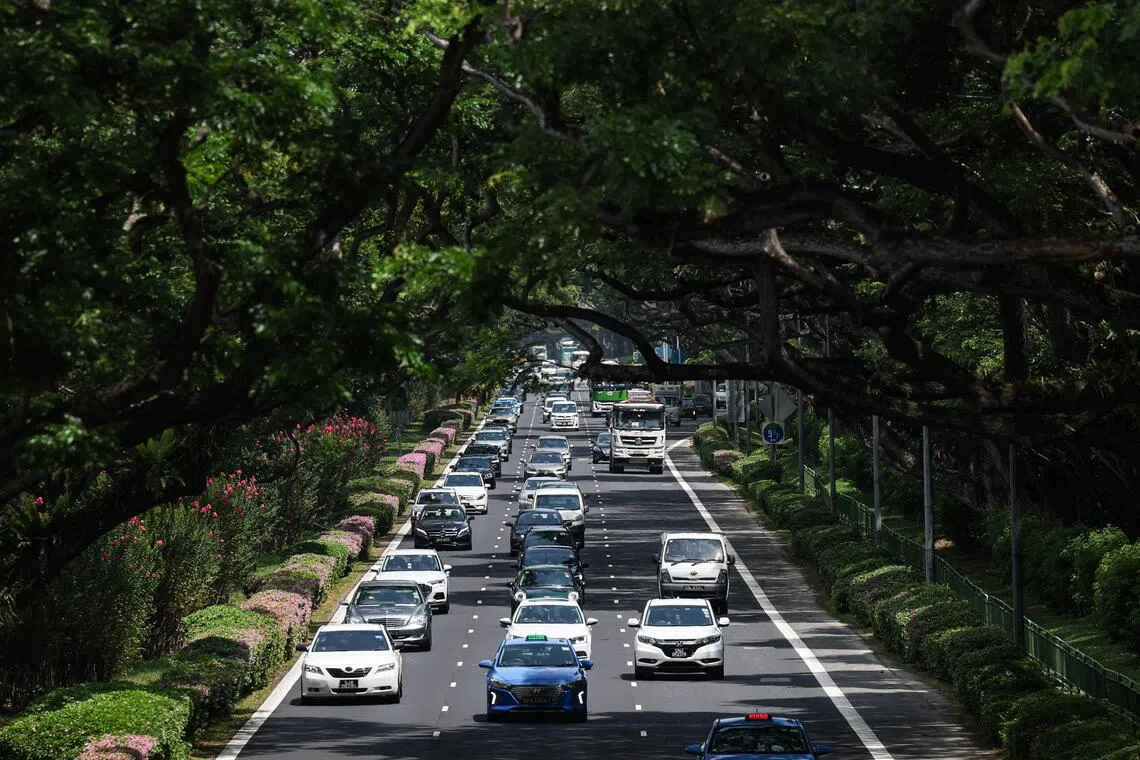
Generic of vehicles along East Coast Parkway (ECP) on June 29, 2026. Can be used for stories on vehicles, cars, vans, COE, ERP, road tax. ST PHOTO: BRIAN TEO
Vanessa Paige Chelvan
Published Oct 07, 2026, 05:45 PM
Updated Oct 07, 2026, 05:45 PM
SINGAPORE – Drivers who use unlicensed vehicles to provide point-to-point (P2P) transport services can face higher fines of up to $10,000 under proposed changes to beef up enforcement against illegal operators.
It will also be illegal to publish, forward or share advertisements for illegal P2P services, including on messaging platforms such as Telegram if the proposed changes become law.
Minister of State for Transport Baey Yam Keng, speaking in Parliament on Oct 7, said illegal P2P services pose safety risks to passengers and undermine the livelihoods of licenced drivers.
He urged commuters not to use such services, which may not have valid insurance coverage.
“We have not introduced specific penalties against commuters for the use of illegal P2P services for now. But we may do so in future,” he said at the second reading of the Land Transport and Related Matters Bill.
Offenders can be fined up to $3,000 for providing P2P transport services using unlicensed vehicles, under existing rules.
Baey also proposed changing the law to order advertisers to remove advertisements for illegal P2P services, and require online platforms to provide information on who is behind the advertisements.
Since July 2025, LTA has impounded about 240 vehicles used to provide illegal P2P services.
Baey said: “Investigations take around three to four months, exceeding the current one-month period before a seized unlicensed (vehicle) must be released in the absence of prosecution.
“Therefore, we will lengthen this mandatory release timeline to three months. This will give LTA sufficient time to investigate and build a complete case.”
Rules governing the sale of active mobility devices will also be tightened, including for online sellers.
Laws that now apply to brick-and-mortar retailers will be extended to online sellers, who will be required to display warning notices and usage rules. They will also be barred from advertising or selling non-compliant devices.
“As online sales become common, consumers should likewise have confidence that their online purchases are compliant,” Baey said.
The proposed changes will also make it an offence to falsely claim that a device or battery is compliant, or to advertise illegal modification services. LTA will be able to order sellers to amend or remove online listings and advertisements that flout the rules.
The law also plans to address fire risks posed by lithium-ion batteries used in active mobility devices.
There were 55 fires involving active mobility devices in 2023, 67 in 2024 and 49 in 2025. One cause is the use of incompatible batteries, which can pose safety risks even when installed in compliant power-assisted bicycles (PABs) and motorised personal mobility devices (PMDs).
Under the proposed changes, sellers will have to make clear battery compatibility, voltage and capacity. Advertising, selling or using a battery with an incompatible device will be an offence.
“This approach places responsibilities on both the seller and the user,” Baey said.
The new rules on online sales, advertising and battery safety are expected to take effect in the second quarter of 2027.
Penalties for illegally importing PABs and motorised PMDs will also be beefed up later in 2026.
For individuals, the maximum penalty will double from a $5,000 fine, six months’ jail or both, to a $10,000 fine, 12 months’ jail or both. For companies and other groups, the maximum fine will rise from $10,000 to $40,000.
As for Blue Seal PABs, they will no longer be allowed on public paths and roads from Jan 1, 2028.
These PABs were approved before the more comprehensive EN15194 safety standard became mandatory in 2016, which means those still in use are at least 10 years old.
Baey said ageing electrical components could increase fire risks, while suitable original replacement parts for older models may also be harder to obtain.
Existing users will have more than a year to switch to compliant devices, while LTA will work with national e-waste recycler Alba to step up collection drives for the safe disposal of Blue Seal PABs.
The law will also be tightened to give LTA stronger powers to keep deregistered vehicles off Singapore’s roads.
Although more than 99 per cent of deregistered vehicles are disposed of properly, about 1,900 were not properly disposed of over the past five years and could still be in circulation.
Some have been linked to serious crimes such as drug trafficking, Baey said. The number of deregistered vehicles detected on the roads rose from 75 in 2024 to 245 in 2025.
Penalties for keeping or using deregistered vehicles were raised earlier in 2026. First-time offenders can now be fined up to $20,000, jailed for up to two years, or both.
The latest changes are aimed at ensuring newly deregistered vehicles are properly disposed of, while clearing the existing pool of vehicles that have not been disposed of.
One measure is a new Authorised Exporter Scheme, which LTA aims to introduce in the fourth quarter of 2027 after consulting the industry.
Under the scheme, vehicles meant for export must be handed to an LTA-authorised exporter, instead of owners arranging their export themselves or through motor dealers or freight services. Authorised exporters will have to meet requirements on how the vehicles are stored and processed.
The Bill will also extend the regulatory sandbox for autonomous vehicles (AVs) on roads until the end of 2028, allowing existing deployments to continue while a new law governing AVs is developed.
The Government aims to introduce the new Autonomous Vehicles Act in about a year, Baey said.
Separately, a new sandbox will be introduced for autonomous mobile robots operating on public paths, such as delivery robots and larger autonomous cleaning machines.
Under the sandbox, LTA will regulate these robots according to their size and risk, with three pathways for deployment.
Public agencies will be able to designate areas they manage as testbeds, allowing AVs to be deployed for different uses. One example is the JTC-managed Punggol Digital District.
Smaller, lower-risk robots that meet specified limits on speed, weight and dimensions will face lighter regulation and can be deployed more quickly. This includes a Delta Electronics robot that delivers groceries and medicine to seniors across three blocks in Bendemeer.
Larger or higher-risk robots, such as autonomous road sweepers, will continue to undergo testing and require LTA approval before they can be deployed.
LTA will also be able to impose penalties, including fines, for breaches of the sandbox rules.
As for owners of EV chargers in landed homes, they will no longer have to send them for mandatory inspections every two years.
Baey said such chargers pose lower public safety risks as access is restricted and they are typically used by only one household. Removing the requirement will also reduce recurring compliance costs for owners.
Owners will remain responsible for maintaining their chargers, while LTA can still require an inspection if specific safety concerns arise.
The Bill will also make it easier for LTA to take enforcement action against illegal EV charging, including the use of unregistered chargers, charging at prohibited locations or using chargers in unauthorised ways.
Personal mobility devices
Self-driving vehicles
Electric and hybrid vehicles
Ministry of Transport
2026年6月29日,东海岸公园大道(ECP)沿线车辆的通用照片。可用于报道车辆、轿车、货车、拥车证(COE)、企业道路通行证(ERP)和路税等相关内容。照片由《海峡时报》摄影师张文杰(BRIAN TEO)拍摄。
凡妮莎·佩奇·切尔万
发布于 2026 年 10 月 7 日下午 5:45
更新于2026年10月7日下午5:45
新加坡——根据拟议的改革措施,使用无牌车辆提供点对点 (P2P) 运输服务的司机可能面临高达 10,000 美元的罚款,以加强对非法经营者的执法力度。
如果这些提议的变更成为法律,那么在 Telegram 等即时通讯平台上发布、转发或分享非法 P2P 服务的广告也将是违法的。
交通部政务部长白炎庆10月7日在国会发言时表示,非法P2P服务对乘客构成安全风险,并损害持证司机的生计。
他敦促通勤者不要使用此类服务,因为这些服务可能没有有效的保险保障。
“目前我们还没有对使用非法P2P服务的通勤者出台具体的处罚措施。但将来我们可能会这样做,”他在《陆路交通及相关事项法案》二读时表示。
根据现行规定,使用无牌车辆提供P2P运输服务的违法者最高可被处以3000美元的罚款。
贝伊还提议修改法律,责令广告商删除非法 P2P 服务的广告,并要求在线平台提供有关广告背后人员的信息。
自 2025 年 7 月以来,陆路交通管理局已扣押了约 240 辆用于提供非法 P2P 服务的车辆。
贝伊说:“调查大约需要三到四个月,超过了目前扣押的无牌车辆在没有起诉的情况下必须释放的一个月期限。
“因此,我们将强制释放期限延长至三个月。这将使陆路交通管理局有足够的时间进行调查并收集完整的证据。”
针对主动出行辅助设备的销售规则也将收紧,包括针对在线销售商的规则。
现行适用于实体零售商的法律也将适用于线上卖家,他们将被要求张贴警告标识和使用规则,并被禁止宣传或销售不合规的设备。
“随着网上销售的普及,消费者也应该相信他们的网上购物是合规的,”贝伊说。
拟议的变更还将规定,虚假宣称设备或电池符合规定,或宣传非法改装服务,均属违法行为。陆路交通管理局(LTA)有权责令卖家修改或删除违反规定的在线商品信息和广告。
该法律还计划解决主动式移动设备中使用的锂离子电池带来的火灾风险。
2023 年有 55 起涉及主动式移动设备的火灾,2024 年有 67 起,2025 年有 49 起。其中一个原因是使用了不兼容的电池,即使安装在符合标准的电动辅助自行车 (PAB) 和电动个人移动设备 (PMD) 中,也可能造成安全隐患。
根据拟议的变更,销售商必须明确标明电池的兼容性、电压和容量。广告宣传、销售或将电池与不兼容的设备一起使用将构成违法行为。
“这种做法将责任同时赋予了卖家和用户,”贝伊说。
关于网络销售、广告和电池安全的新规预计将于 2027 年第二季度生效。
2026 年晚些时候,非法进口 PAB 和机动 PMD 的处罚力度也将加大。
对于个人而言,最高处罚将从5000美元罚款、6个月监禁或两者并罚,提高到10000美元罚款、12个月监禁或两者并罚。对于公司和其他团体,最高罚款将从10000美元提高到40000美元。
至于蓝印章 PAB,从 2028 年 1 月 1 日起将不再允许在公共道路和小径上使用。
这些 PAB 是在更全面的 EN15194 安全标准于 2016 年强制实施之前获得批准的,这意味着仍在使用的 PAB 至少已有 10 年的历史。
贝伊表示,老化的电子元件可能会增加火灾风险,而老款机型的合适原装替换零件也可能更难获得。
现有用户将有一年多的时间来更换为合规设备,同时陆路交通管理局将与国家电子垃圾回收商 Alba 合作,加大收集力度,安全处置蓝印 PAB。
法律还将加强,赋予陆路交通管理局更大的权力,以阻止已注销车辆在新加坡道路上行驶。
虽然超过 99% 的注销车辆都得到了妥善处置,但在过去五年中,仍有约 1900 辆注销车辆没有得到妥善处置,可能仍在流通。
贝伊表示,其中一些车辆与贩毒等严重犯罪有关。2024年,道路上查获的注销车辆数量为75辆,而2025年则上升至245辆。
2026年初,对持有或使用已注销车辆的处罚力度有所提高。初犯者现在可能被处以最高2万美元的罚款、最高两年的监禁,或两者并罚。
最新变化旨在确保新注销车辆得到妥善处置,同时清理尚未处置的现有车辆。
其中一项措施是新的授权出口商计划,陆路交通管理局计划在咨询业界意见后,于 2027 年第四季度推出该计划。
根据该计划,用于出口的车辆必须交给陆路交通管理局(LTA)授权的出口商,车主不得自行安排出口,也不得通过汽车经销商或货运公司出口。授权出口商必须满足车辆存储和处理方面的相关要求。
该法案还将把道路上自动驾驶汽车 (AV) 的监管沙盒延长至 2028 年底,允许现有部署继续进行,同时制定新的自动驾驶汽车管理法律。
贝伊表示,政府计划在一年左右的时间内推出新的自动驾驶汽车法案。
此外,还将推出一个新的沙盒,用于在公共道路上运行的自主移动机器人,例如送货机器人和大型自主清洁机器。
在沙盒机制下,陆路交通管理局将根据机器人的大小和风险对其进行监管,并提供三种部署途径。
公共机构可以将所辖区域指定为测试场地,允许自动驾驶汽车用于不同用途。例如,裕廊集团管理的榜鹅数码区就是一个例子。
体积更小、风险更低,且符合特定速度、重量和尺寸限制的机器人将面临更宽松的监管,并能更快地投入使用。例如,台达电子公司生产的一款机器人,就为本德米尔三个街区的居民配送食品杂货和药品。
体积更大或风险更高的机器人,例如自动道路清扫车,将继续接受测试,并在部署前需要获得陆路交通管理局的批准。
LTA 还将有权对违反沙盒规则的行为处以处罚,包括罚款。
至于拥有独立式住宅电动汽车充电桩的业主,他们将不再需要每两年将充电桩送去进行强制性检查。
贝伊表示,此类充电桩的公共安全风险较低,因为其使用受到限制,而且通常仅供一个家庭使用。取消强制要求还将降低车主的日常合规成本。
车主仍需负责维护其充电桩,而如果出现特定的安全问题,陆路交通管理局仍可要求进行检查。
该法案还将使陆路交通管理局更容易对非法电动汽车充电行为采取执法行动,包括使用未注册的充电器、在禁止地点充电或以未经授权的方式使用充电器。
个人移动设备
自动驾驶汽车
电动和混合动力汽车
交通部