MPs back tighter data centre regulations but raise questions on competitiveness, sustainability议员们支持加强数据中心监管,但对竞争力和可持续性提出质疑。
A law was passed in parliament requiring operators of data centres in Singapore with a critical IT load of at least 3 megawatts to be licensed.
A law was passed in parliament requiring operators of data centres in Singapore with a critical IT load of at least 3 megawatts to be licensed.
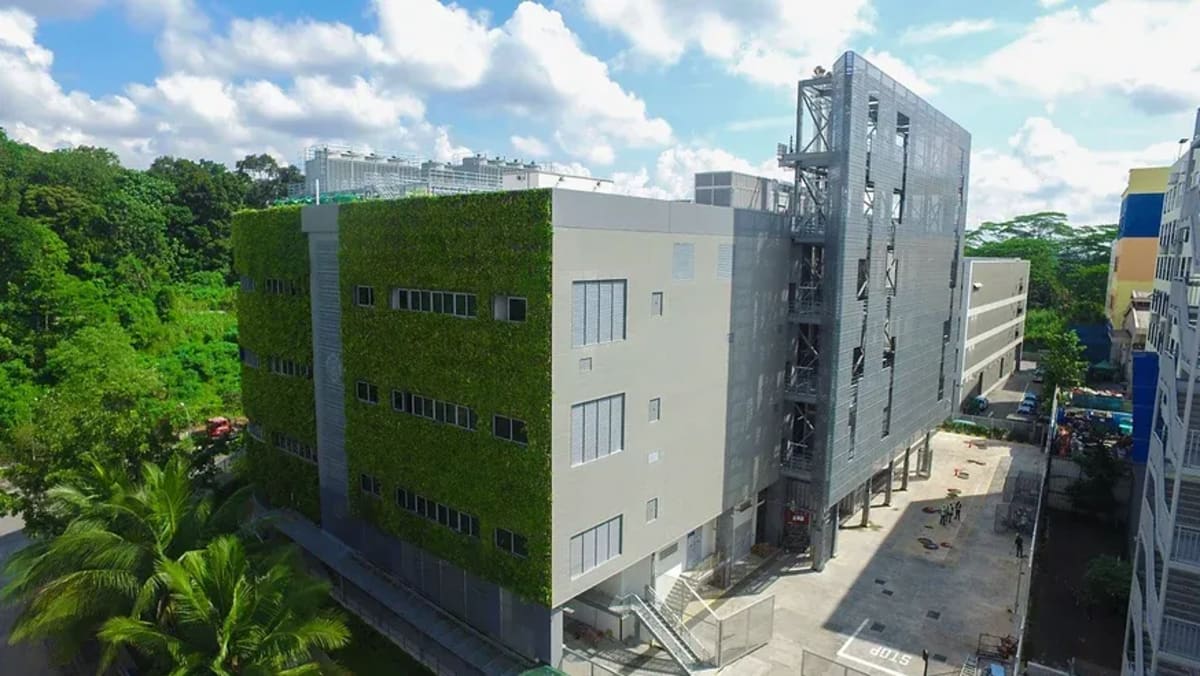
Empyrion DC says its facility in Singapore has an external wall with green plants to improve energy efficiency. (Image: Seraya Partners)
This audio is generated by an AI tool.
SINGAPORE: Members of Parliament (MPs) supported new regulations for data centres under a new law passed in parliament on Wednesday (Oct 7), but raised concerns about the sector's competitiveness and sustainability.
The Digital Infrastructure Bill introduced two new licensing regimes to strengthen the security and resilience of major cloud services and data centres, as well as the environmental sustainability of their operations in Singapore.
Nineteen MPs debated the issue during the second reading of the Bill, which lasted over five hours across two days.
In his closing speech, Senior Minister of State for Digital Development and Information Tan Kiat How said MPs raised practical questions on competitiveness, sustainability, scarce resources, jobs and skills, as well as the need for secure and resilient infrastructure. He said the debate reinforced three broad principles.
These were that Singapore should plan ahead instead of waiting for serious disruptions or acute resource pressures, that data centre capacity should grow in a disciplined manner, and that clear and proportionate regulation is not the opposite of competitiveness.
"Singapore needs more compute as our economy digitalises and AI becomes more widely used, but land, power, water, and our carbon budget are finite," Mr Tan said.
"Our objective cannot simply be more capacity; it must be greater value from the capacity that we host."
The new law aims to strengthen the foundations of Singapore's digital economy and provide regulatory clarity to support long-term infrastructure investment in Singapore.
Operators of data centres in Singapore with a critical IT load of at least 3 megawatts (MW) will need to be licensed.
Both existing and new data centres will be required to meet facility-level energy-efficiency requirements, including power usage effectiveness requirements, as a first step.
Further requirements, including for IT equipment and water efficiency, could be introduced in the future.
A licensing regime will also be introduced for major co-location and cloud data centres with a critical IT load of at least 10MW, as well as major cloud service providers whose Infrastructure-as-a-Service and Platform-as-a-Service services generate at least S$100 million (US$78.2 million) in average annual revenue from users in Singapore over the three preceding years.
CNA Games Guess Word Crack the word, one row at a time Buzzword Create words using the given letters Mini Sudoku Tiny puzzle, mighty brain teaser Mini Crossword Small grid, big challenge Word Search Spot as many words as you can Show More Show Less
Two licensing regimes - one for security and resilience of foundational digital infrastructure services, namely major data centres (DCs) and cloud services, and another for the environmental sustainability of DCs. They aim to give the Infocomm Media Development Authority the tools to be an effective gatekeeper and standards-setter. In security and resilience, the government is targeting the underlying infrastructure whose disruption could affect many businesses and organisations at the same time. It will start with two types of services - major DC facility services with a critical IT load (CIL) of at least 10 megawatts, and major regulated cloud computing services that generate at least S$100 million in average annual revenue from users in Singapore over the preceding three years and provide either Infrastructure-as-a-Service or Platform-as-a-Service. As for environmental sustainability, the licensing regime will apply to operators of DCs in Singapore with a CIL of at least three megawatts, roughly the power demand of a major suburban mall. The maximum financial penalty for most breaches is S$1 million or 10 per cent of the licensee's annual turnover in Singapore, whichever is higher. Senior Minister of State for Digital Development and Information Tan Kiat How, who outlined the amendments in parliament on Tuesday (Oct 6), said the government’s ambition is not maximum compute but “maximum value from compute” for Singapore, businesses and its people.
CONCERNS ABOUT COMPETITIVENESS
While supportive of the new regulations, MPs said they should not come at the expense of Singapore's competitiveness.
MP Sharael Taha (PAP-Pasir Ris-Changi) said regulation should raise standards without making Singapore uncompetitive.
The question was not simply about how data centres are regulated, but how Singapore is positioning itself for the next phase of the AI economy and ensuring that "every megawatt of scarce energy we commit creates the greatest possible economic and strategic value", said Mr Taha.
With its limited resources, Singapore's objective cannot be "unlimited growth" of data centres, he said.
"Neither should the answer be to constrain growth to the point where the next generation of AI infrastructure simply goes elsewhere,” he said.
He asked whether the government has assessed the cost per megawatt of compliance, particularly for existing data centres and how this compares with regional competitors.
Security, resilience and sustainability are necessary foundations for Singapore’s digital economy, said MP Sharael Taha. Regulation is only one side of the equation; the other is ambition, he said. Speaking in parliament on Tuesday (Oct 6), he stressed the need to regulate data centres to be more efficient and resilient, as well as demand that scarce resources are used responsibly. At the same time, the government must create the conditions for Singapore to capture the next generation of cloud compute and AI investments in a balanced way, he said. The challenge is to achieve intelligent growth, as well as more compute and economic value and greater strategic capability from every unit of scarce energy, he added.
MP Edward Chia (PAP-Holland-Bukit Timah) said higher standards could be a competitive advantage for Singapore rather than a regulatory cost.
He said that companies handling critical workloads would value resilient infrastructure, while those making substantial, long-term investments would value regulatory consistency.
"Singapore need not compete on price alone. Our competitive proposition should be to offer trusted, resilient, connected, and resource-efficient compute, supported by a predictable regulatory environment,” Mr Chia said.
Responding to the MPs, Mr Tan said the cost mattered, but Singapore does not compete on the basis of having the cheapest land or electricity, as other markets have more of both.
"Singapore's role is different. It is a trusted, connected, and high-value hub for workloads where reliability, security, resilience, connectivity, and proximity to enterprise activities matter more. That means we do not need to host every megawatt. We need to host the right capacity, and make the capacity we host work harder for Singapore," Mr Tan said.
He pointed out that Singapore received more than 20 applications in its recent data centre call for applications exercise, showing that operators continue to see Singapore as a key part of their regional strategy.
He agreed with Mr Chia's observation that regulatory quality could be Singapore's competitive edge.
"Good regulation is not about having the most rules; it is about having the right rules applied predictably," Mr Tan said.
"We are setting a clear floor, and making sure those covered by the regime meet it, and raise that floor over time when it is practical and necessary."
He added that the government intended to minimise the administrative burden on service providers and operators by streamlining operational processes for those covered under the Bill.
Countries and corporations worldwide are scrambling to meet AI-driven demand for data centre capacity, but we need to ask if this arms race compromises our ability to meet our climate targets, said MP He Ting Ru. In parliament on Tuesday (Oct 6), she said Singapore must lead by example in driving sustainable, responsible and people-centric technological growth. Its approach to data centres has to prioritise its people's needs, mitigate the socioeconomic impact and boost transparency on emissions. Ms He spoke about the toll exacted by data centres on electricity and water grids, and on another scarce resource in Singapore - land. She asked how the government will take public feedback into account in deciding whether and where to build data centres. Singapore should also aim to mitigate the effects its data centre policies have beyond its shores, she added.
LIMITED RESOURCES FOR DATA CENTRES
MPs broadly agreed that data centres use significant amounts of land, water and power - resources that are limited in Singapore.
They questioned whether Singapore has enough low-carbon electricity to support the further growth of data centres, and whether expansion could put additional pressure on the national grid.
Several asked if the strain on the national grid could raise electricity costs for households.
MP He Ting Ru (WP-Sengkang) said future data centre capacity should only be introduced if the grid infrastructure could support the additional energy usage comfortably, and that the "cost of upgrades required, if any, should not be borne by consumers".
Similarly, MP Louis Chua (WP-Sengkang) asked how much the 60 per cent increase in data centre capacity over the last four years had contributed to electricity prices.
The Digital Infrastructure Bill will help maintain Singapore as a digital hub that is trusted, resilient and resource responsible, said MP Choo Pei Ling. Speaking in parliament on Wednesday (Oct 7), she highlighted three goals - resilience, sustainability and value. On resilience, she wanted to know if the authorities would consider a risk-based cross-sectoral exercise programme. Turning to sustainability, she suggested a public scorecard on what operators control. On value, she suggested publishing a standard framework tracking the types of commitment made and complied with.
In response, Mr Tan said that in Singapore, data centres do not buy electricity at the regulated household tariff, but from retailers at commercial rates or directly from the wholesale electricity market. Data centres also pay for their own dedicated grid connections.
"The household tariff is driven mainly by fuel and electricity generation costs, and the growth of data centres is not expected to raise this cost," Mr Tan said.
"As overall electricity demand grows, the grid may need to be expanded or reinforced. These system-level upgrades benefit the reliability and resilience of the entire grid, and their costs are shared across users through the existing grid charging framework."
In response to questions about whether data centre capacity will be capped, Mr Tan said it was not sensible to place an “arbitrary cap”.
"Doing so would mean constraining the growth of our broader economy and use of digital technologies in society that benefits all Singaporeans," Mr Tan said.
MPs such as Mr Chua called for publication of Power Usage Effectiveness (PUE) and Water Usage Effectiveness (WUE) figures at facility or operator levels, as well as annual aggregate electricity and water consumption, while MP Choo Pei Ling (PAP-Chua Chu Kang) proposed a progressively introduced public scorecard covering PUE and WUE.
Mr Tan said operators can tap existing schemes to improve energy efficiency, such as the Economic Development Board's Resource Efficiency Grant for Emissions, which offsets the cost of upgrading to more energy-efficient equipment.
He noted that Singapore is among the few countries in the world to set a water efficiency target for data centres.
On the sector's electricity and water use, he said the Energy Market Authority reports the electricity consumption by sector, including the information and communication sector, which covers data centres.
National water agency PUB also publishes the water efficiency benchmark for data centres, he said.
“The relevant agencies will consider what further sector-level information can usefully be made available without disclosing commercially sensitive information,” he added.
In parliament on Wednesday (Oct 7), Senior Minister of State for Digital Development and Information Tan Kiat How responded to clarifications sought by Members of the House on the Digital Infrastructure Bill. The Bill was then passed.
SECURITY AND RESILIENCE
Dr Choo, MP Yip Hon Weng (PAP-Yio Chu Kang) and MP Victor Lye (PAP-Ang Mo Kio) said that even if individual providers had sound resilience plans, services could still fail if they depended on the same underlying infrastructure.
"Banks, clinics, and government services can each comply and still depend on the same cloud provider, substation, cooling station, cooling system, or cable route. Engineers call this common mode failure. There is a shared point of failure," Dr Choo said.
She pointed out that a smaller facility, including one under the 10MW threshold, could still be tasked to perform a critical function.
She asked if the Infocomm Media Development Authority (IMDA) would assess factors such as substitutability, concentration of users and cross-border dependence.
Mr Yip said that an individual provider could have a good recovery plan but still depend on a shared facility, power supply, connectivity pathway or operational team.
If the shared dependency failed, multiple providers could fail simultaneously, he said.
He proposed joint recovery exercises for major foundational digital infrastructure licensees with shared dependencies.
"These exercises should test whether essential services can resume within recovery timeframes (appropriate) to the likely harm caused by disruption. They should involve the relevant sector regulators and, where necessary, critical upstream operators," he said.
Mr Tan said that the Bill gives the government visibility across major providers.
"A single operator sees its own incident. The regulator needs to see the whole system. This helps us identify common dependencies and patterns that no individual operator may be able to see," he said.
IMDA, as the sector regulator, works closely with national agencies such as the National Security Coordination Secretariat on interdependency matters, he added.
"The Bill gives IMDA powers to set up business continuity, disaster recovery, and incident reporting requirements."
Get our pick of top stories and thought-provoking articles in your inbox
Stay updated with notifications for breaking news and our best stories
Join our channel for the top reads for the day on your preferred chat app
新加坡议会通过了一项法律,要求在新加坡运营关键IT负载至少为3兆瓦的数据中心的运营商必须获得许可。
Empyrion DC表示,其位于新加坡的设施外墙种植了绿色植物,以提高能源效率。(图片:Seraya Partners)
这段音频由人工智能工具生成。
新加坡:国会议员们支持根据周三(10 月 7 日)在国会通过的新法律对数据中心制定的新规,但对该行业的竞争力和可持续性表示担忧。
数字基础设施法案引入了两项新的许可制度,以加强新加坡主要云服务和数据中心的安全性和韧性,以及其运营的环境可持续性。
19 位议员在法案二读期间就此问题进行了辩论,辩论持续了两天,超过五个小时。
数码发展及新闻部高级政务部长陈杰豪在闭幕致辞中表示,议员们提出了关于竞争力、可持续性、稀缺资源、就业和技能以及安全可靠的基础设施等实际问题。他指出,此次辩论强化了三大原则。
这些观点包括:新加坡应该提前做好规划,而不是等到出现严重混乱或资源压力骤增;数据中心容量应该以有纪律的方式增长;以及明确且适度的监管并不等同于竞争力的反义词。
“随着新加坡经济数字化和人工智能的广泛应用,新加坡需要更多的计算能力,但土地、电力、水和碳预算都是有限的,”陈先生说。
“我们的目标不能仅仅是增加容量;而必须从我们所拥有的容量中创造更大的价值。”
新法旨在加强新加坡数字经济的基础,并提供监管方面的明确性,以支持新加坡的长期基础设施投资。
在新加坡,关键 IT 负载至少达到 3 兆瓦 (MW) 的数据中心运营商需要获得许可。
作为第一步,现有数据中心和新建数据中心都必须满足设施级别的能效要求,包括电力使用效率要求。
未来可能会出台更多要求,包括对信息技术设备和用水效率的要求。
对于关键 IT 负载至少达到 10MW 的大型托管和云数据中心,以及在过去三年中,其基础设施即服务 (IaaS) 和平台即服务 (PaaS) 服务在新加坡的平均年收入至少达到 1 亿新元(7820 万美元)的大型云服务提供商,也将引入许可制度。
CNA游戏 猜词游戏 逐行破解单词 流行词游戏 用给定的字母组成单词 迷你数独 小小谜题,挑战你的大脑 迷你填字游戏 小方格,大挑战 单词搜索 尽可能多地找出单词 显示更多 显示更少
两项许可制度——一项针对基础数字基础设施服务(即大型数据中心和云服务)的安全性和韧性,另一项针对数据中心的环境可持续性。这两项制度旨在赋予新加坡资讯通信媒体发展局(IMDA)有效把关和制定标准的能力。在安全性和韧性方面,政府的目标是那些一旦中断就可能同时影响众多企业和机构的底层基础设施。该制度将首先涵盖两类服务:关键IT负载(CIL)至少为10兆瓦的大型数据中心设施服务,以及过去三年在新加坡平均年收入至少为1亿新元且提供基础设施即服务(IaaS)或平台即服务(PaaS)的大型受监管云计算服务。至于环境可持续性,该许可制度将适用于新加坡数据中心运营商,其关键IT负载至少为3兆瓦,大致相当于一个大型郊区购物中心的用电量。大多数违规行为的最高罚款为100万新元或持牌机构在新加坡年营业额的10%,以较高者为准。数字发展及新闻部高级政务部长陈杰豪周二(10月6日)在国会概述了这些修正案,他表示,政府的目标并非追求极致的计算能力,而是为新加坡、企业和人民创造“计算能力的最大价值”。
对竞争力的担忧
议员们虽然支持新规,但也表示不应以牺牲新加坡的竞争力为代价。
国会议员沙拉尔·塔哈(人民行动党-巴西立-樟宜)表示,监管应该提高标准,但又不至于使新加坡失去竞争力。
塔哈先生表示,问题不仅仅在于如何监管数据中心,还在于新加坡如何为人工智能经济的下一阶段做好准备,并确保“我们投入的每一兆瓦稀缺能源都能创造最大的经济和战略价值”。
他表示,新加坡资源有限,其目标不可能是数据中心的“无限增长”。
“解决办法也不应该是限制增长,以至于下一代人工智能基础设施只能转移到其他地方,”他说。
他询问政府是否评估了每兆瓦的合规成本,特别是现有数据中心的合规成本,以及这与区域竞争对手相比如何。
新加坡国会议员沙拉尔·塔哈表示,安全、韧性和可持续性是新加坡数字经济的必要基石。他指出,监管只是等式的一方面,另一方面是雄心壮志。周二(10月6日),他在国会发言时强调,需要对数据中心进行监管,以提高其效率和韧性,并要求负责任地使用稀缺资源。同时,他表示,政府必须创造条件,使新加坡能够以平衡的方式吸引下一代云计算和人工智能投资。他补充说,挑战在于如何实现智能增长,以及如何从每一单位稀缺能源中获得更多计算和经济价值,并提升战略能力。
国会议员谢永康(人民行动党-荷兰-武吉知马选区)表示,更高的标准对新加坡来说可能是一种竞争优势,而不是监管成本。
他表示,处理关键工作负载的公司会重视具有弹性的基础设施,而那些进行大量长期投资的公司会重视监管的一致性。
“新加坡不必仅仅依靠价格竞争。我们的竞争优势应该在于提供值得信赖、具有弹性、互联互通且资源高效的计算能力,并辅以可预测的监管环境,”谢先生说。
针对议员们的提问,陈先生表示成本固然重要,但新加坡的竞争优势并不在于拥有最便宜的土地或电力,因为其他市场在这两方面都更胜一筹。
“新加坡的角色有所不同。它是一个值得信赖、互联互通且高价值的工作负载中心,可靠性、安全性、弹性、连接性和与企业活动的接近性至关重要。这意味着我们不需要托管每一兆瓦的电力。我们需要托管合适的容量,并让我们托管的容量更好地为新加坡服务,”陈先生说。
他指出,新加坡在最近的数据中心招标活动中收到了 20 多份申请,这表明运营商仍然将新加坡视为其区域战略的关键组成部分。
他同意谢先生的观点,即监管质量可能是新加坡的竞争优势。
“好的监管不在于制定最多的规则,而在于以可预测的方式应用正确的规则,”谭先生说。
“我们正在设定一个明确的底线,确保受该制度约束的人达到这个底线,并在实际需要时逐步提高这个底线。”
他还补充说,政府打算通过简化法案涵盖对象的运营流程,最大限度地减少服务提供商和运营商的行政负担。
新加坡国会议员何婷茹表示,世界各国和企业都在竞相满足人工智能驱动的数据中心容量需求,但我们需要扪心自问,这场“军备竞赛”是否会损害我们实现气候目标的能力。周二(10月6日),她在国会表示,新加坡必须以身作则,推动可持续、负责任且以人为本的技术增长。新加坡的数据中心发展方针必须优先考虑民众的需求,减轻其对社会经济的影响,并提高排放透明度。何婷茹议员谈到了数据中心对电力、水网以及新加坡另一项稀缺资源——土地——造成的负担。她质问政府在决定是否以及在何处建设数据中心时,将如何考虑公众的反馈意见。她补充说,新加坡还应努力减轻其数据中心政策对境外环境的影响。
数据中心资源有限
议员们普遍认为,数据中心会消耗大量的土地、水和电力——而这些资源在新加坡都是有限的。
他们质疑新加坡是否有足够的低碳电力来支持数据中心的进一步发展,以及扩张是否会给国家电网带来额外的压力。
一些人询问,国家电网的压力是否会导致家庭用电成本上升。
国会议员何廷儒(工人党-盛港)表示,未来只有在电网基础设施能够轻松支持额外能源使用的情况下,才能引入数据中心容量,并且“如有必要进行升级,相关费用不应由消费者承担”。
同样,国会议员蔡瑞祥(工人党-盛港)也询问,过去四年数据中心容量增长 60% 对电价产生了多大影响。
国会议员朱佩玲表示,《数字基础设施法案》将有助于新加坡继续保持其作为值得信赖、具有韧性且资源可持续的数字中心的地位。她在周三(10月7日)的国会发言中强调了三个目标:韧性、可持续性和价值。关于韧性,她想知道当局是否会考虑开展一项基于风险的跨部门演练计划。谈到可持续性,她建议建立一个公开的评分卡,记录运营商的控制范围。关于价值,她建议发布一个标准框架,追踪各项承诺的落实情况。
对此,陈先生表示,在新加坡,数据中心并非按受管制的居民用电价格购电,而是按商业价格从零售商处购买电力,或直接从批发电力市场购电。数据中心还需要支付其专用电网连接的费用。
“家庭用户电费主要受燃料和电力生产成本的影响,数据中心的增长预计不会增加这一成本,”谭先生说。
“随着整体电力需求的增长,电网可能需要扩建或加固。这些系统级升级有利于提高整个电网的可靠性和韧性,其成本将通过现有的电网收费机制由用户分摊。”
针对数据中心容量是否会受到限制的问题,陈先生表示,设定“任意上限”是不明智的。
“这样做将限制我们更广泛的经济增长以及数字技术在社会中的应用,而这些技术本应造福所有新加坡人,”陈先生说。
蔡先生等议员呼吁公布设施或运营商层面的电力使用效率 (PUE) 和用水效率 (WUE) 数据,以及年度总用电量和用水量,而朱佩玲议员(人民行动党-蔡厝港)则提议逐步推出涵盖 PUE 和 WUE 的公共记分卡。
陈先生表示,运营商可以利用现有的计划来提高能源效率,例如经济发展局的资源效率减排补助金,该补助金可以抵消升级到更节能设备的成本。
他指出,新加坡是世界上少数几个为数据中心设定节水目标的国家之一。
关于该行业的电力和用水情况,他表示,能源市场管理局会按行业报告电力消耗量,其中包括信息和通信行业(涵盖数据中心)。
他说,国家水务局(PUB)也发布了数据中心的用水效率基准。
他补充说:“相关机构将考虑在不泄露商业敏感信息的前提下,还能提供哪些其他行业层面的信息。”
10月7日(星期三),数字发展及新闻部高级政务部长陈杰豪在国会就《数字基础设施法案》回应了议员们的质询。该法案随后获得通过。
安全与韧性
朱医生、议员叶汉荣(人民行动党-义顺)和议员赖维德(人民行动党-宏茂桥)表示,即使各个服务提供商都有完善的应对计划,如果它们依赖于相同的底层基础设施,服务仍然可能出现故障。
“银行、诊所和政府服务机构都可以遵守相关规定,但仍然依赖同一家云服务提供商、变电站、冷却站、冷却系统或电缆线路。工程师称之为共模故障,即存在一个共同的故障点,”朱博士说。
她指出,规模较小的设施,包括低于 10MW 阈值的设施,仍然可以被赋予执行关键功能的任务。
她询问新加坡资讯通信媒体发展局(IMDA)是否会评估替代性、用户集中度和跨境依赖性等因素。
叶先生表示,单个服务提供商可能制定了良好的恢复计划,但仍然依赖于共享的设施、电力供应、连接路径或运营团队。
他说,如果共享依赖项出现故障,多个提供商可能会同时出现故障。
他提议对具有共同依赖关系的主要基础数字基础设施许可证持有者进行联合恢复演练。
他表示:“这些演练旨在检验基本服务能否在适当的恢复时间内恢复,以应对中断可能造成的损害。演练应包括相关行业监管机构,并在必要时包括关键的上游运营商。”
陈先生表示,该法案使政府能够全面了解主要供应商的情况。
“单个运营商只能看到自身发生的事故。监管机构需要了解整个系统。这有助于我们识别单个运营商可能无法看到的共同依赖关系和模式,”他说道。
他补充说,作为行业监管机构,IMDA 与国家安全协调秘书处等国家机构在相互依存问题上密切合作。
“该法案赋予新加坡资讯通信媒体发展局(IMDA)权力,制定业务连续性、灾难恢复和事故报告要求。”
订阅我们的邮件,即可获取精选热点新闻和引人深思的文章。
订阅通知,第一时间获取突发新闻和精彩报道。
加入我们的频道,即可在您常用的聊天应用上获取当日热门文章。