Rope in online sellers to help curb problem of unsafe mobility devices, say MPs in Parliament议员们在议会表示,应让网络卖家参与进来,以帮助遏制不安全代步工具的问题。
Read more at straitstimes.com.
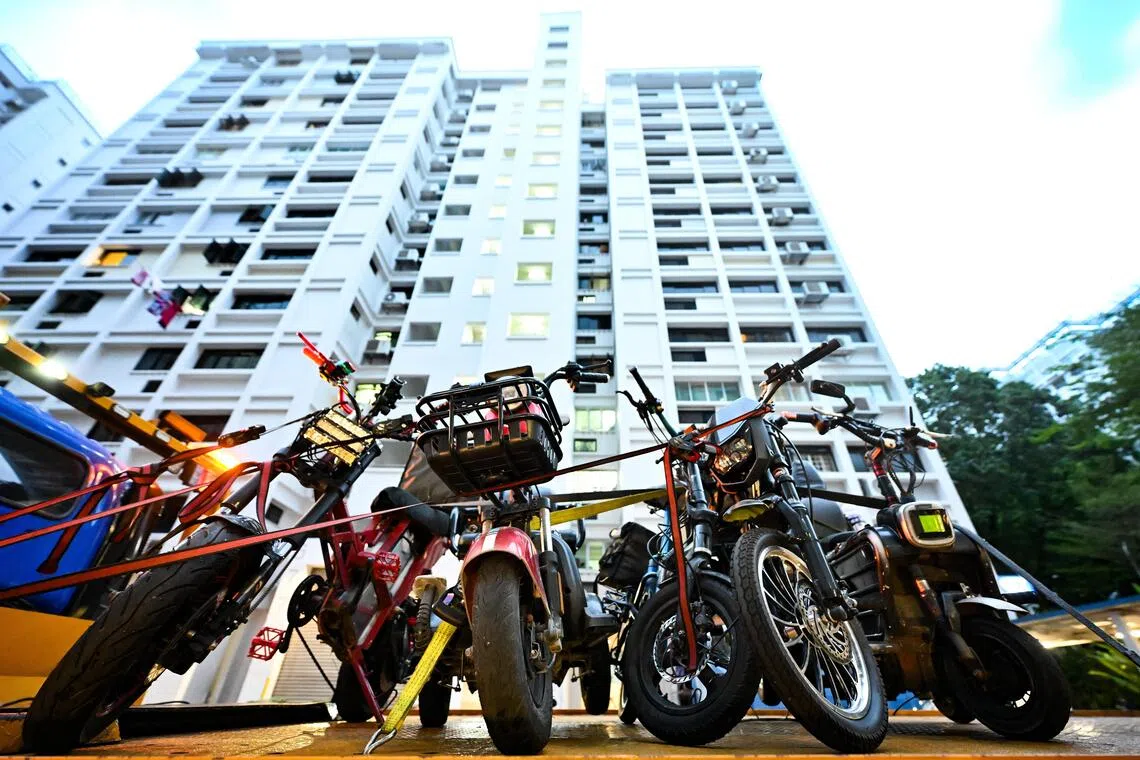
Several MPs who spoke during the debate on the Land Transport and Related Matters Bill called for stronger safeguards against unsafe batteries.
ST PHOTO: LIM YAOHUI
Vanessa Paige Chelvan
Published Oct 07, 2026, 09:36 PM
Updated Oct 07, 2026, 09:38 PM
SINGAPORE - Online retailers need to play a bigger part in keeping unsafe active mobility devices (AMD) and non-compliant batteries off their platforms, said MPs in Parliament on Oct 7.
And while it is a good move to tighten the law in efforts to crackdown on such devices, MPs added that there are questions about how the authorities will weed out devices and batteries sold online.
Tin Pei Ling (Marine Parade-Braddell Heights GRC) asked how the Land Transport Authority planned to find non-compliant listings in online marketplaces that advertise personal mobility devices and batteries.
“Will it rely on active monitoring, public reports or marketplace cooperation?” asked Tin, who chairs the Government Parliamentary Committee for transport.
And although the changes tackle the supply side of non-compliance in the sector, could the authorities do more to focus on policies that work on the demand side of such devices, she asked.
For instance, the warning and specification on these devices can be made simple enough such that casual sellers and ordinary buyers can comply with legal requirements governing these devices, she said.
“And will there be a clear, accessible list of approved models and compatible batteries, for example through a QR code or a searchable online register, so that the buyer does not have to try making sense of technical specifications?” she added.
Tin was among a number of MPs who spoke about fires – sometimes fatal – that broke out in the homes of residents. Many of the fires were caused by personal mobility devices charged with incompatible batteries.
Several MPs who spoke during the debate on the Land Transport and Related Matters Bill called for stronger safeguards against unsafe batteries, including getting major e-commerce sites to do more to stop these products from reaching consumers.
Alex Yeo (Potong Pasir) said an AMD-linked fire in his constituency in 2025 injured a resident and damaged their home. He added that there were 187 fires involving AMDs in HDB estates between 2020 and 2024, about half of which occurred while the devices were being charged.
Yeo suggested giving LTA powers to direct marketplaces to disable access to the offending listings if sellers could not be reached, refused to comply or repeatedly relisted the product.
MPs also sought clearer guidance for consumers on how to determine if batteries were compatible with their devices.
Hazlina Abdul Halim (East Coast GRC) proposed a standardised battery compatibility label, similar to an energy-efficiency label showing which device models the battery is compatible with.
Ng Shi Xuan (Sembawang GRC) raised concerns that the new rules could reduce consumer choice and raise prices if independent battery makers were shut out of the market.
Ng, who owns a battery company, asked if third-party manufacturers would be able to show that their batteries met the same safety standards as those made by original equipment manufacturers.
MPs also raised concerns about illegal point-to-point transport services and the safety and accountability of autonomous vehicles (AVs).
On illegal point-to-point transport services, MPs backed tougher enforcement but said sufficient legal alternatives should also be available.
For example, Hamid Razak (West Coast-Jurong West GRC) said the authorities should ensure that legitimate cross-border services remain available and affordable as enforcement is tightened.
“Otherwise, we may be suppressing an illegal market without actually addressing the demand that created it in the first place,” he said.
He asked the authorities to monitor waiting times, fares and the availability of cross-border transport services.
MPs also sought greater assurances about the safety of AVs amid an expansion of self-driving car trials in Singapore.
Cassandra Lee (West Coast-Jurong West GRC) suggested that victims of AV accidents be compensated first, while liability between operators, technology providers and insurers is decided later.
Hazlina called for clear operating conditions for AVs on public paths, including when they should stop or give way, what should happen if connectivity is lost and how quickly a human can intervene.
Yip Hon Weng (Yio Chu Kang SMC) said liability could be spread across software developers, sensor vendors, mapping providers, fleet operators and maintenance contractors when an autonomous system fails.
“A sandbox should be a place to learn, not a place in which responsibility disappears,” he said. “When autonomy comes, accountability must stay.”
Wrapping up the debate, Minister of State for Transport Baey Yam Keng said the key responsibility for complying with the new rules on online sales of AMDs and their batteries will remain with sellers.
Online marketplaces will not have to pre-screen listings, and the Bill does not give LTA the power to order platforms to take down offending listings, he added.
However, LTA will instead continue working with platforms to remove non-compliant listings and can require them to provide information about sellers, he said.
Foreign-based sellers without a Singapore connection are often beyond the reach of local laws, with existing import controls still the main safeguard against non-compliant devices.
As for batteries, Baey said third-party batteries for active mobility devices can still be found compatible if tested with the right device model, and they meet safety standards.
There were 49 active mobility device fires in 2025, he said. In many cases, a battery that was safe on its own was not necessarily safe when paired with a particular device.
LTA already publishes an online list of compatible batteries for approved e-bike models and will publish similar lists for approved e-scooters and mobility scooters before the new rules kick in.
Baey also addressed concerns about deregistered vehicles, which Tin said were difficult to track once they were taken off the register.
In her speech earlier in the debate, Tin said the in-vehicle unit of a deregistered vehicle would have been removed, and asked how the authorities could tell if such a vehicle was still being driven.
Baey said LTA plans to leverage ERP 2.0 to improve detection. Its satellite-based technology can be used to locate deregistered vehicles, as long as the on-board unit has not been removed or tampered with.
Roadside surveillance cameras can continue to detect deregistered vehicles without an OBU.
Since 2024, about 14% of the cases investigated by LTA involving the use of deregistered vehicles involved vehicles that had already been handed over to dealers or exporters, he added. “Bad actors are using more sophisticated methods to acquire and use them,” he said.
On cross-border transport, Baey said average daily cross-border taxi trips have risen by about 20% since the Singapore-Malaysia cross-border taxi scheme was enhanced in May.
Singapore has fully utilised its quota of 300 taxis, while Malaysia has filled more than half of its quota, and the two sides are discussing further increasing the number of licensed taxis, he added.
Personal mobility devices
在《陆路交通及相关事项法案》辩论期间,多位议员呼吁加强对不安全电池的防范措施。
ST 照片:林耀辉
凡妮莎·佩奇·切尔万
发布于 2026 年 10 月 7 日晚上 9:36
更新于2026年10月7日晚上9:38
新加坡——10月7日,国会议员在国会表示,在线零售商需要发挥更大的作用,将不安全的移动出行设备(AMD)和不合规的电池从其平台上移除。
议员们表示,虽然加强法律以打击此类设备是一个好举措,但当局将如何清除网上销售的设备和电池仍然存在疑问。
陈佩玲(马林百列-布莱德尔高地集选区)询问陆路交通管理局计划如何查找在线市场上不合规的个人代步工具和电池广告。
“它将依靠积极的监督、公开报告还是市场合作?”政府议会交通委员会主席丁先生问道。
她问道,虽然这些改变着眼于该行业不合规行为的供应端,但当局能否更加注重那些能够解决此类设备需求端问题的政策呢?
她表示,例如,这些设备上的警告和规格说明可以做得足够简单,以便普通卖家和买家能够遵守管理这些设备的法律要求。
她补充道:“是否会有一个清晰易懂的已批准型号和兼容电池清单,例如通过二维码或可搜索的在线注册表,以便买家不必费力去理解技术规格?”
蒂恩是众多谈及居民家中火灾(有时造成人员伤亡)的议员之一。许多火灾是由使用不兼容电池的个人代步工具引起的。
在《陆路交通及相关事项法案》辩论期间,几位议员呼吁加强对不安全电池的防范措施,包括让大型电子商务网站采取更多措施阻止这些产品流入消费者手中。
波东巴西选区议员杨耀祥表示,2025年他所在选区发生的一起与自动充电宝(AMD)相关的火灾导致一名居民受伤,房屋受损。他还补充说,2020年至2024年间,组屋区共发生187起与自动充电宝相关的火灾,其中约一半发生在充电过程中。
Yeo建议赋予LTA权力,指示市场平台在无法联系到卖家、卖家拒绝配合或卖家反复重新上架商品的情况下,禁用对违规商品的访问。
议员们还要求为消费者提供更清晰的指导,说明如何确定电池是否与其设备兼容。
Hazlina Abdul Halim(东海岸集选区)提议制定一个标准化的电池兼容性标签,类似于能效标签,以显示电池与哪些设备型号兼容。
吴世轩(三巴旺集选区)表示担忧,如果将独立电池制造商排除在市场之外,新规可能会减少消费者的选择并推高价格。
拥有一家电池公司的吴先生问道,第三方制造商是否能够证明他们的电池符合与原始设备制造商生产的电池相同的安全标准。
议员们还对非法点对点运输服务以及自动驾驶汽车 (AV) 的安全性和问责制表示担忧。
对于非法点对点运输服务,议员们支持加强执法力度,但也表示应该提供足够的合法替代方案。
例如,哈米德·拉扎克(西海岸-裕廊西集选区)表示,随着执法力度的加强,当局应确保合法的跨境服务仍然可用且价格合理。
“否则,我们可能只是在打击非法市场,而没有真正解决最初产生非法市场的需求,”他说。
他要求有关部门监控跨境交通服务的等待时间、票价和可用性。
随着新加坡自动驾驶汽车试验的扩大,国会议员们也要求对自动驾驶汽车的安全性做出更多保证。
卡桑德拉·李(西海岸-裕廊西集选区)建议,应先对自动驾驶汽车事故的受害者进行赔偿,然后再决定运营商、技术提供商和保险公司之间的责任。
哈兹利纳呼吁制定明确的自动驾驶汽车在公共道路上的运行条件,包括何时应该停止或让行,如果失去连接应该怎么办,以及人类可以多快进行干预。
叶汉荣(义顺单选区议员)表示,当自动驾驶系统出现故障时,责任可能涉及软件开发商、传感器供应商、地图提供商、车队运营商和维护承包商。
“沙盒环境应该是学习的地方,而不是责任消失的地方,”他说。“自主权到来时,问责制必须保留。”
辩论结束时,交通部政务部长白炎庆表示,遵守网上销售AMD及其电池新规的主要责任仍在于卖家。
他还补充说,在线市场无需预先筛选商品信息,而且该法案也没有赋予陆路交通管理局权力,命令平台删除违规商品信息。
不过,他表示,陆路交通管理局将继续与平台合作,删除不合规的房源信息,并可要求平台提供卖家信息。
与新加坡没有联系的外国卖家往往不受当地法律的约束,现有的进口管制仍然是防止不合规设备的主要保障。
至于电池,Baey 表示,如果使用正确的设备型号进行测试,并且符合安全标准,仍然可以找到适用于主动移动设备的第三方电池。
他表示,2025年共发生49起主动式移动设备起火事故。在许多情况下,单独使用时安全的电池,与特定设备搭配使用时并不一定安全。
陆路交通管理局 (LTA) 已在网上公布了获批电动自行车型号的兼容电池清单,并将在新规生效前公布获批电动滑板车和代步车的类似清单。
Baey 还谈到了注销车辆的问题,Tin 表示,一旦车辆从登记册中移除,就很难追踪。
在辩论早些时候的发言中,Tin表示,已注销车辆的车载单元会被拆除,并质问当局如何才能知道这样的车辆是否仍在行驶。
贝伊表示,陆路交通管理局计划利用ERP 2.0系统来提高检测能力。只要车载设备没有被拆除或篡改,该系统的卫星定位技术就可以用来定位已注销的车辆。
即使没有车载单元 (OBU),路边监控摄像头也能继续检测到已注销的车辆。
他补充说,自2024年以来,陆路交通管理局调查的涉及使用注销车辆的案件中,约有14%的案件涉及已交付给经销商或出口商的车辆。“不法分子正在使用更复杂的方法来获取和使用这些车辆,”他说。
关于跨境交通,Baey表示,自5月份新加坡-马来西亚跨境出租车计划得到加强以来,平均每日跨境出租车出行量增长了约20%。
他补充说,新加坡已充分利用其 300 辆出租车的配额,而马来西亚已用完其配额的一半以上,双方正在讨论进一步增加持牌出租车的数量。
个人移动设备