Parliament passes law banning online sales and ads for non-compliant active mobility devices议会通过法律,禁止在线销售和宣传不合规的主动出行设备
MPs also discussed how drivers' livelihoods may be affected by the future roll-out of autonomous vehicles.
MPs also discussed how drivers' livelihoods may be affected by the future roll-out of autonomous vehicles.
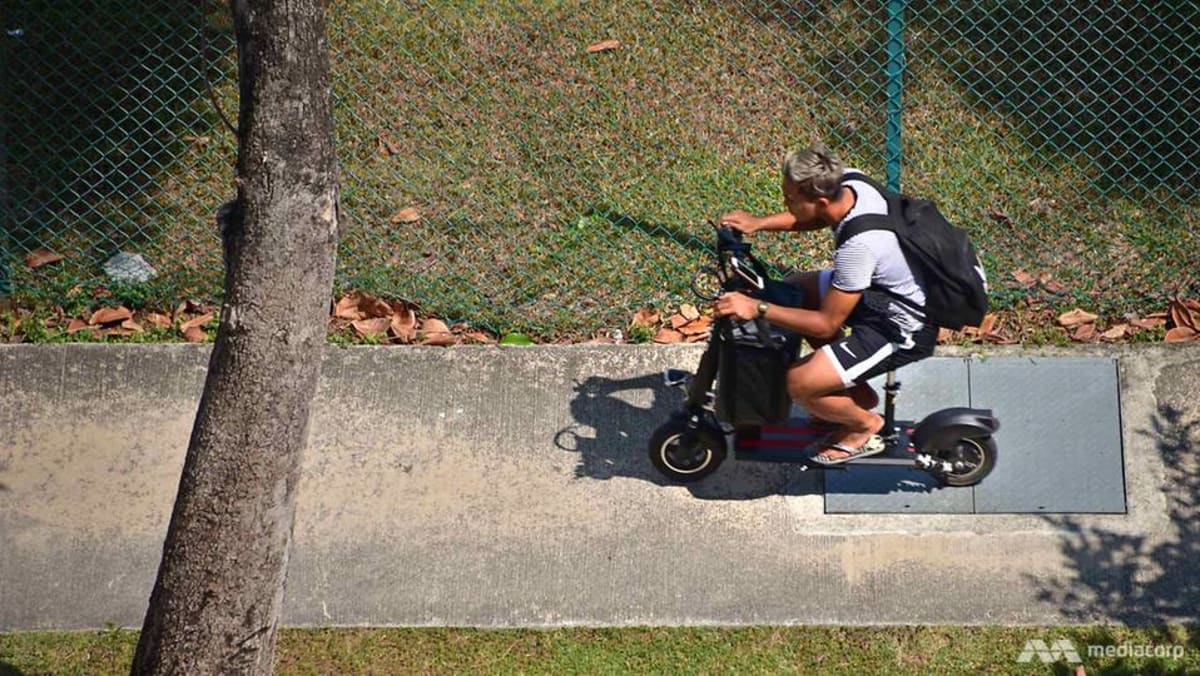
A man riding a personal mobility device on a pedestrian footpath in Singapore. (File photo: CNA/Gaya Chandramohan)
This audio is generated by an AI tool.
SINGAPORE: Online retailers face new restrictions on selling and advertising non-compliant active mobility devices, and must display warning notices about device and usage rules after parliament passed new measures into law on Wednesday (Oct 7).
To prevent fires caused by active mobility devices – with 49 such blazes occurring in 2025 – the Ministry of Transport also moved to ban the use of non-compatible batteries in power-assisted bicycles, motorised personal mobility devices and mobility vehicles.
The wide-ranging Land Transport and Related Matters Bill also introduced a new regulatory sandbox for autonomous vehicles (AVs) to be deployed on public paths, prompting a debate in the House about the future roll-out of AVs and how it may impact drivers’ livelihoods.
The new law also strengthens enforcement against illegal point-to-point transport services, and toughens measures to remove deregistered vehicles, which have been used in crimes like drug trafficking.
CNA Games Guess Word Crack the word, one row at a time Buzzword Create words using the given letters Mini Sudoku Tiny puzzle, mighty brain teaser Mini Crossword Small grid, big challenge Word Search Spot as many words as you can Show More Show Less It also removes mandatory inspection of electric vehicle (EV) chargers in landed homes to reduce compliance burden, while boosting enforcement against illegal charging of EVs. Parliament backed the Bill after close to five hours of debate, with 26 Members of Parliament (MPs) speaking.
It also removes mandatory inspection of electric vehicle (EV) chargers in landed homes to reduce compliance burden, while boosting enforcement against illegal charging of EVs.
Parliament backed the Bill after close to five hours of debate, with 26 Members of Parliament (MPs) speaking.
It will be an offence to sell or advertise non-compliant active mobility devices online, under proposed changes to the law. Sellers will have to display warning notices on device listings, informing buyers of device and usage rules. To reduce fire risks, new battery safety rules will be introduced, barring the fitting and use of non-compatible batteries in such devices. Penalties for illegally importing power-assisted bicycles and motorised personal mobility devices will be raised. Minister of State for Transport Baey Yam Keng announced the details in parliament on Wednesday (Oct 7). Meanwhile, action will be taken to keep deregistered vehicles off the roads, including an Authorised Exporter Scheme and a shorter grace period for disposal. Mr Baey also outlined stronger deterrence and enforcement measures against providers of illegal point-to-point ride services, adding that the government is not ruling out penalties for commuters in future. The government also aims to introduce new legislation in a year, governing the use of autonomous vehicles on the roads. It will also launch a new sandbox to facilitate deploying autonomous mobile robots on public paths on a larger scale.
NON-COMPLIANT ACTIVE MOBILITY DEVICES
The new restrictions make it an offence to sell or advertise non-compliant active mobility devices online. They extend current rules largely designed for physical retailers to the online space, Minister of State for Transport Baey Yam Keng said in his opening speech on Wednesday.
The rules take effect in the second quarter of 2027. They apply to online listings and advertisements that originate in Singapore, or are made by a Singapore-connected person and accessible in the country.
In addition, the Land Transport Authority (LTA) will be able to direct sellers to amend or remove offending online listings or advertisements.
The rules do not apply to foreign-based sellers with no Singapore presence, who are kept in check by import controls instead, said Mr Baey.
Several MPs flagged the enforcement gap around overseas online sellers.
“Online sales frequently involve sellers operating outside Singapore,” said MP Dennis Tan (WP-Hougang), adding that “practical enforcement against overseas sellers may understandably present different challenges, particularly where such sellers have no assets, operations, or personnel in Singapore”.
The objectives of the proposed changes are sound and many of the provisions are sensible and necessary, said MP Dennis Tan. Speaking in parliament on Wednesday (Oct 7), he pointed out that the success of the framework will depend on how effectively the new powers are exercised in practice. He sought clarifications on the implementation of the provisions relating to overseas online sellers, battery safety and authorised exporters of electric vehicle charging infrastructure.
MPs also asked about scope for expanding responsibility to the operators of online marketplaces.
“When an overseas or anonymous seller cannot be reached, will LTA have a direct and sufficiently broad power to require the operator to disable access to the offending product listing in Singapore?” asked MP Charlene Chen (PAP-Tampines).
A few MPs made reference to directives that authorities can issue under the Online Criminal Harms Act for online platforms to disable Singapore users’ access to offending content. They asked if a similar mechanism could be put in place for errant listings.
Mr Baey said the rules will not be able to apply to foreign-based sellers with no Singapore presence as they fall outside the country’s jurisdiction.
He added that the legislation was calibrated to balance the compliance burden on operators of online marketplaces.
He noted that the Online Criminal Harms Act addresses serious criminal offences affecting national security, national harmony or individual safety with an online nexus.
“For non-compliant active mobility devices, we will rely on other levers, including continuing to work with platforms to remove non-compliant listings and advertisements,” he said.
MPs raised other areas the rules could target.
MP Ng Shi Xuan (PAP-Sembawang) asked LTA to consider whether “greater traceability from manufacturer or importer to seller” would help to identify the source of non-compliant batteries and strengthen enforcement against illicit sellers.
MP Kenneth Tiong (WP-Aljunied) urged separate consideration of the compliance of battery chargers, giving examples of instances where fires started because of third-party, incompatible chargers with original batteries.
LIST OF APPROVED RETAILERS
Several MPs asked how consumers could easily determine whether batteries were compliant under the new rules.
MP Hazlina Abdul Halim (PAP-East Coast) proposed a standardised compatibility label showing which devices a battery could be used with, so consumers would not need technical expertise to identify a suitable battery.
MP Tin Pei Ling (PAP-Marine Parade–Braddell Heights), who is also chair of the transport government parliamentary committee, asked if there could be a clear list of approved models and compatible batteries.
This could be in the form of a searchable online register or a QR code.
She also asked for support to help existing users of non-compliant batteries transition to the new rules, noting that some may rely on their devices for their livelihoods or daily living.
As Singapore looks to expand the use of autonomous vehicles, they will collect enormous amounts of data and operators will be required to keep records and share information with the Land Transport Authority. In parliament on Wednesday (Oct 7), MP Tin Pei Ling noted that the movements and images of ordinary people will also be captured. She asked how a balance can be struck and the data protected, and what guardrails will be in place against cyberattacks which could cause widespread harm on the roads. She also raised questions about enforcing the disposal of deregistered vehicles and regulating the sales, advertising, battery safety and alterations of active mobility devices.
On affordability, MP Fadli Fawzi (WP-Aljunied) cautioned against placing an "unsustainable financial burden" on consumers and urged retailers not to use the new requirements as an opportunity to inflate prices.
Responding to the MPs, Mr Baey said LTA already publishes an online list of compatible batteries for approved power-assisted bicycle (PAB) models, and intends to publish similar lists for whitelisted e-scooters and mobility scooter models before the new rules take effect.
This would provide consumers and retailers with a common reference, he said.
"A battery that is safe on its own is not necessarily safe when used with a particular device," Mr Baey said, adding that compatibility was not simply based on what a seller declared.
On the transition for existing users, Mr Baey said the government does not intend to subsidise replacements or offer trade-ins.
Safety and the impact on workers were among the concerns raised over the wider deployment of autonomous vehicles (AVs).
Ms Hazlina called for regular publication of information on significant incidents, near misses, complaints and corrective actions arising from AV trials.
She also asked what would trigger a deployment pause or a change in operating conditions.
MP Yeo Wan Ling (PAP-Punggol) described driving as an important "employment buffer" for generations of Singaporeans, and asked what would take its place if it became less available. She also called for workers and unions to be consulted as AV deployment progresses.
Mr Fadli suggested trialling autonomous night buses along rail corridors after train operating hours.
Mr Baey said operators would have to demonstrate that their vehicles can safely share paths with other users, including giving way to pedestrians.
LTA could require safeguards such as speed limits or on-site safety operators, while the government is also studying how key safety and operational information could be shared with the public.
On jobs, Mr Baey said the government did not expect an immediate impact on taxi and private-hire car drivers. Several hundred AVs are expected by the end of 2028, compared with about 72,000 taxi and private-hire car drivers today.
The majority of point-to-point transport would continue to be provided by human drivers "for the foreseeable future".
Drivers interested in opportunities in the AV industry or other sectors can tap courses, career conversion programmes and training incentives, including salary support of up to 90 per cent.
As for autonomous buses, the government would take an "even more gradual and calibrated approach" than with autonomous passenger cars, Mr Baey said.
This is because the current public bus operating environment is complex and serves a diverse range of passengers.
In parliament on Wednesday (Oct 7), Minister of State for Transport Baey Yam Keng responded to clarifications sought by Members of the House on the Land Transport and Related Matters (No. 2) Bill. The Bill was then passed.
OTHER SUGGESTIONS AND CONCERNS
Turning to efforts against illegal point-to-point transport services, Mr Baey cautioned passengers who choose to take such rides.
“We have not introduced specific penalties against commuters for the use of illegal point-to-point services for now. But we may do so in future,” he said.
He added that commuters should not use these illegal services as they often lack valid insurance coverage.
He also updated the House on the take-up of the cross-border taxi scheme between Singapore and Malaysia.
The average daily number of cross-border taxi trips has risen by about 20 per cent since the taxi quota was enhanced from 200 to 300 taxis from each side in May.
Singapore’s cross-border taxi quota has been fully utilised, while Malaysia has used more than half of its quota, said Mr Baey. Both countries aim to gradually increase the quota to 500.
On deregistered vehicles, the new law strengthens controls over the disposal of these vehicles by requiring them to be exported through LTA-authorised exporters.
MPs called for record-keeping and audits to ensure that all parties fulfil their responsibilities.
Mr Baey said that LTA will take steps to strengthen accountability. For example, it will conduct risk-based audits and revoke the licences of authorised exporters if they breach requirements.
He added that LTA expects about 20 to 50 authorised exporters to join the scheme.
The new law removes a requirement for EV chargers installed in landed homes to be inspected every two years. MPs asked how safety would be ensured in these residences.
Mr Baey said LTA will publish online guidelines that cover basic maintenance and safety checks, signs of deterioration or damage, and recommended servicing practices to ensure chargers remain safe.
The agency will also continue to conduct risk-based audits to ensure compliance with EV charging rules, such as reviewing certifications submitted by charger equipment specialists and licensed electrical workers, he said.
Get our pick of top stories and thought-provoking articles in your inbox
Stay updated with notifications for breaking news and our best stories
Join our channel for the top reads for the day on your preferred chat app
议员们还讨论了自动驾驶汽车的未来推广可能会如何影响驾驶员的生计。
一名男子在新加坡的人行道上骑着个人代步工具。(资料照片:CNA/Gaya Chandramohan)
这段音频由人工智能工具生成。
新加坡:周三(10 月 7 日),国会通过新法案后,在线零售商在销售和宣传不合规的主动出行设备方面面临新的限制,并且必须展示有关设备和使用规则的警告通知。
为了防止因主动式移动设备引起的火灾(2025 年发生了 49 起此类火灾),交通部还采取行动,禁止在电动辅助自行车、机动个人移动设备和代步车中使用不兼容的电池。
范围广泛的《陆路交通及相关事项法案》还引入了一个新的监管沙盒,允许在公共道路上部署自动驾驶汽车 (AV),这引发了议会就自动驾驶汽车的未来推广及其对驾驶员生计的影响展开辩论。
新法律还加强了对非法点对点运输服务的执法力度,并加大了清除已注销车辆的措施,这些车辆曾被用于贩毒等犯罪活动。
CNA游戏 猜词游戏 逐行破解单词 流行词游戏 用给定的字母组成单词 迷你数独 小谜题,脑力挑战 迷你填字游戏 小方格,大挑战 单词搜索 尽可能多地找出单词 显示更多 显示更少 该法案还取消了对独立式住宅电动汽车充电桩的强制性检查,以减轻合规负担,同时加强对非法充电行为的执法力度。经过近五个小时的辩论,国会通过了该法案,共有26名国会议员发言。
该法案还取消了对独立式住宅中电动汽车 (EV) 充电器的强制性检查,以减轻合规负担,同时加强对非法充电电动汽车的执法力度。
经过近五个小时的辩论,议会通过了该法案,共有 26 名议员发言。
根据拟议的法律修订,在线销售或宣传不合规的电动代步工具将构成违法行为。卖家必须在设备列表中展示警告标识,告知买家设备和使用规则。为降低火灾风险,将出台新的电池安全规则,禁止在此类设备中安装和使用不兼容的电池。非法进口电动自行车和机动个人代步工具的处罚力度也将加大。交通部政务部长白炎庆于周三(10月7日)在国会公布了相关细节。与此同时,政府将采取措施,包括推出授权出口商计划和缩短车辆处置宽限期,以确保已注销车辆不再上路。白炎庆先生还概述了针对非法点对点拼车服务提供商的更强有力的威慑和执法措施,并补充说,政府不排除未来对通勤者处以罚款的可能性。政府还计划在一年内出台新的立法,规范自动驾驶车辆在道路上的使用。它还将推出一个新的沙盒,以促进在公共道路上更大规模地部署自主移动机器人。
不合规的主动移动设备
新规将在线销售或宣传不符合规定的辅助出行设备定为违法行为。交通部政务部长白炎庆在周三的开幕致辞中表示,这些新规将目前主要针对实体零售商的规定扩展到了线上领域。
这些规则将于 2027 年第二季度生效。它们适用于源自新加坡的在线列表和广告,或者由与新加坡有关联的人制作并在该国境内可访问的在线列表和广告。
此外,陆路交通管理局(LTA)将有权指示卖家修改或删除违规的在线商品信息或广告。
贝先生表示,这些规定不适用于在新加坡没有实体机构的外国卖家,而是通过进口管制来约束他们。
多位议员指出,针对海外网络卖家的执法存在漏洞。
“网上销售经常涉及在新加坡境外运营的卖家,”国会议员陈志远(工人党-后港)表示,并补充说,“对海外卖家进行实际执法可能会面临不同的挑战,尤其是在这些卖家在新加坡没有资产、运营或人员的情况下”。
国会议员陈志远表示,拟议改革的目标合理,其中许多条款也合情合理且必要。他在周三(10月7日)的国会发言中指出,该框架的成功与否将取决于新权力在实践中如何有效行使。他要求就有关海外网络卖家、电池安全以及电动汽车充电基础设施授权出口商的条款的实施细则作出澄清。
议员们还询问了扩大在线市场运营商责任范围的可能性。
“如果无法联系到海外或匿名卖家,陆路交通管理局是否拥有直接且足够广泛的权力,要求运营商禁用在新加坡的违规产品列表?”议员陈嘉琳(人民行动党-淡滨尼)问道。
一些议员提到,根据《网络犯罪法》,当局可以向网络平台发出指令,禁止新加坡用户访问违规内容。他们询问是否可以对违规内容列表建立类似的机制。
贝先生表示,这些规定将无法适用于在新加坡没有实体存在的外国卖家,因为他们不在新加坡的管辖范围内。
他还补充说,该立法经过精心设计,旨在平衡在线市场运营商的合规负担。
他指出,《网络犯罪危害法》旨在打击与网络相关的、影响国家安全、国家和谐或个人安全的严重犯罪行为。
“对于不合规的主动出行设备,我们将依靠其他手段,包括继续与平台合作,删除不合规的列表和广告,”他说。
议员们提出了其他一些规则可以针对的领域。
国会议员黄诗璇(人民行动党-三巴旺)要求陆路交通管理局考虑“从制造商或进口商到销售商的更大可追溯性”是否有助于识别不合规电池的来源,并加强对非法销售商的执法力度。
国会议员张建宗(工人党-阿裕尼)敦促单独考虑电池充电器的合规性,并举例说明因第三方不兼容的充电器与原装电池不匹配而引发火灾的案例。
获准零售商名单
多位议员询问消费者如何才能轻松确定电池是否符合新规。
国会议员哈兹丽娜·阿卜杜勒·哈利姆(人民行动党东海岸选区)提议制定一个标准化的兼容性标签,显示电池可以与哪些设备一起使用,这样消费者就不需要技术专长来识别合适的电池。
议员陈佩玲(人民行动党-马林百列-布莱德尔高地选区),同时也是交通政府国会委员会主席,询问是否可以提供一份明确的已批准车型和兼容电池清单。
这可以采用可搜索的在线注册表或二维码的形式。
她还请求支持,帮助现有不合规电池用户过渡到新规,并指出有些人可能依靠这些设备维持生计或日常生活。
随着新加坡计划扩大自动驾驶汽车的使用,这些车辆将收集海量数据,运营商将被要求保存记录并与陆路交通管理局共享信息。周三(10月7日),国会议员陈佩玲在国会指出,普通民众的行踪和影像也将被记录。她质询如何平衡各方利益,确保数据安全,并提出应对网络攻击的保障措施,以防止网络攻击对道路交通造成广泛危害。她还就如何强制处置已注销车辆、监管自动驾驶设备的销售、广告、电池安全和改装等方面提出了疑问。
关于价格承受能力,议员法德利·法兹(工人党-阿裕尼)警告不要给消费者造成“不可持续的经济负担”,并敦促零售商不要利用新规定来抬高价格。
针对议员们的提问,Baey先生表示,陆路交通管理局已经公布了经批准的电动辅助自行车(PAB)车型兼容电池的在线清单,并计划在新规生效前公布类似清单,用于已列入白名单的电动滑板车和代步车车型。
他表示,这将为消费者和零售商提供一个共同的参考标准。
“单独使用安全的电池并不一定与特定设备一起使用时是安全的,”贝伊先生说,并补充说兼容性并非仅仅取决于卖家的声明。
关于现有用户的过渡问题,贝伊先生表示,政府不打算补贴更换设备或提供以旧换新服务。
自动驾驶汽车 (AV) 的广泛部署引发了人们对安全性和对工人的影响的担忧。
哈兹利纳女士呼吁定期公布自动驾驶汽车试验中发生的重大事故、险些发生的事故、投诉和纠正措施等信息。
她还询问什么情况会触发部署暂停或运行条件的变化。
议员杨婉玲(人民行动党榜鹅选区)指出,驾车是几代新加坡人重要的“就业保障”,并质疑如果驾车变得不那么方便,什么可以替代它。她还呼吁在自动驾驶汽车推广过程中,应与工人和工会进行协商。
法德利先生建议在列车运营时间结束后,沿铁路走廊试行无人夜间巴士。
贝伊先生表示,运营商必须证明他们的车辆能够安全地与其他用户共享道路,包括礼让行人。
陆路交通管理局可能会要求采取限速或现场安全人员等保障措施,同时政府也在研究如何与公众分享关键的安全和运营信息。
关于就业问题,贝伊先生表示,政府预计自动驾驶汽车不会立即对出租车和网约车司机造成影响。预计到2028年底,自动驾驶汽车的数量将达到数百辆,而目前出租车和网约车司机的数量约为7.2万人。
在可预见的未来,大部分点对点运输仍将由人类司机提供。
对自动驾驶汽车行业或其他行业的机会感兴趣的驾驶员可以利用相关课程、职业转换计划和培训奖励,包括高达 90% 的工资补贴。
贝伊先生表示,对于自动驾驶公交车,政府将采取比自动驾驶乘用车“更加渐进和谨慎的方式”。
这是因为当前公共汽车运营环境复杂,服务对象涵盖各种类型的乘客。
10月7日(星期三),交通部政务部长白炎庆在国会就《陆路交通及相关事项(第二号)法案》回应了议员们提出的澄清要求。该法案随后获得通过。
其他建议和顾虑
贝伊先生在谈到打击非法点对点运输服务的努力时,告诫选择乘坐此类交通工具的乘客。
他说:“目前我们还没有对使用非法点对点服务的通勤者出台具体的处罚措施。但将来我们可能会这样做。”
他还补充说,通勤者不应该使用这些非法服务,因为它们通常缺乏有效的保险保障。
他还向议会汇报了新加坡和马来西亚之间跨境出租车计划的实施情况。
自 5 月份跨境出租车配额从每边 200 辆增加到 300 辆以来,跨境出租车日均出行次数增加了约 20%。
贝先生表示,新加坡的跨境出租车配额已全部用完,而马来西亚的配额也已用掉一半以上。两国都计划逐步将配额增加到500辆。
对于已注销车辆,新法律加强了对这些车辆处置的控制,要求必须通过陆路交通管理局授权的出口商出口。
议员们呼吁建立记录保存和审计机制,以确保各方履行其职责。
贝伊先生表示,陆路交通管理局将采取措施加强问责制。例如,将开展基于风险的审计,并对违反规定的授权出口商吊销许可证。
他还补充说,陆路交通管理局预计将有 20 至 50 家获得授权的出口商加入该计划。
新法取消了对独立式住宅中安装的电动汽车充电桩每两年进行一次检查的要求。议员们质问如何确保这些住宅的安全。
贝先生表示,陆路交通管理局将发布在线指南,内容涵盖基本维护和安全检查、劣化或损坏迹象以及推荐的维修措施,以确保充电桩保持安全。
该机构还将继续进行基于风险的审计,以确保遵守电动汽车充电规则,例如审查充电设备专家和持证电工提交的认证,他说道。
订阅我们的邮件,即可获取精选热点新闻和引人深思的文章。
订阅通知,第一时间获取突发新闻和精彩报道。
加入我们的频道,即可在您常用的聊天应用上获取当日热门文章。