Royal Air Force Turned A Torpedo Bomber Into A Flying Flamethrower During World War II二战期间,英国皇家空军将一架鱼雷轰炸机改装成了飞行火焰喷射器。
With the weapon installed, the aircraft could spew a terrifying stream of flame behind it, but that doesn't mean it was effective.
Updated Jan 20, 2021 4:36 PM EST
Among the many radical and often seemingly harebrained schemes to provide aircraft with additional firepower that emerged during World War II, the British Royal Air Force’s efforts to transform a twin-engined torpedo bomber into an aerial flamethrower certainly stand out. While very few details about this particular project are available, there is at least a film of the flamethrower in action, during trials.
The film , which is three minutes and 35 seconds long, was made by the RAF Film Production Unit and is dated April 1944. It begins with an aerial sequence showing a Bristol Beaufort torpedo bomber carrying the flamethrower, passing at one point over an airfield. It then shifts to a clip where we see the ground crew using a trolley to transport what appears to be a purpose-made cylinder containing the fuel for the flamethrower to the aircraft. Using a mechanism built into the trolley, the ground crew raise the cylinder into the bomb bay of the aircraft.
The process of loading the flamethrower device into the Beaufort., Youtube Screencap
We then see the Beaufort in low-level flight, with the nozzle of the flamethrower clearly protruding from the bomb bay. As the flamethrower ignites, a jet of fire apparently several hundred feet long is left trailing behind the aircraft. A Douglas Boston , another twin-engined bomber, is seen flying alongside and a little behind the Beaufort, at a suitably safe distance. The film concludes with scenes of the burning ground and vegetation left in the aircraft’s wake.
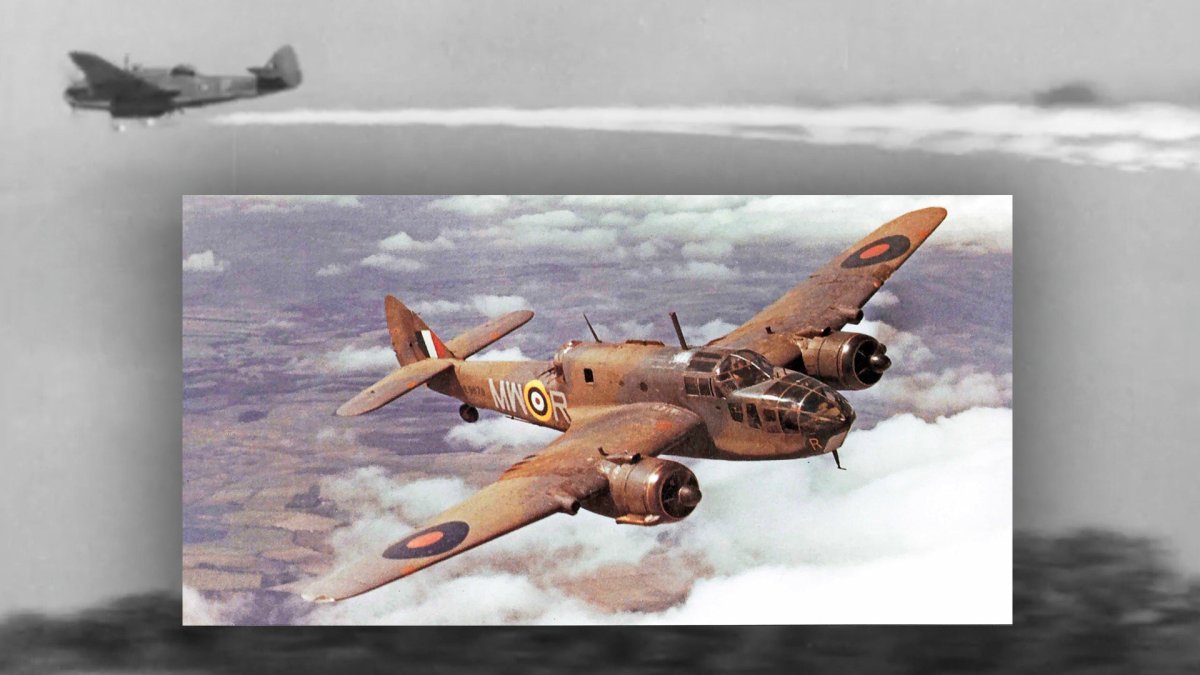
Developed for the maritime strike role, the Beaufort is today best remembered as being the precursor to the much more successful Bristol Beaufighter , which eventually replaced it. However, 2,130 Beauforts were built, 700 of which were completed in Australia, and served with the RAF in Europe and North Africa as well as in the Pacific theater.
The four-seat Beaufort was powered by Bristol Taurus or Pratt & Whitney Twin Wasp engines. The aircraft’s more typical primary armament consisted of a single 1,650-pound 18-inch torpedo or up to 2,000 pounds of bombs or air-dropped naval mines.
Standard in-service Beaufort Mk Is of No. 42 Squadron, RAF, based at Leuchars, Scotland, around 1941., Public Domain
The little information about the flamethrower project that is readily available is provided by historian Tim Mason, who has written extensively on the once-secret work of different British military aircraft trials establishments. For the Royal Air Force, the most important of these in World War II was the Aeroplane and Armament Experimental Establishment, or A&AEE, which had been established at Boscombe Down, Wiltshire, in 1918. In his authoritative work The Secret Years: Flight Testing at Boscombe Down, 1939–1945 , Mason recounts that a single Beaufort Mk I, serial number EK997, arrived at the establishment in late 1943, where modifications for the flamethrower trials began.
The little information about the flamethrower project that is readily available is provided by historian Tim Mason, who has written extensively on the once-secret work of different British military aircraft trials establishments. For the Royal Air Force, the most important of these in World War II was the Aeroplane and Armament Experimental Establishment, or A&AEE, which had been established at Boscombe Down, Wiltshire, in 1918. In his authoritative work
The Secret Years: Flight Testing at Boscombe Down, 1939–1945 , Mason recounts that a single Beaufort Mk I, serial number EK997, arrived at the establishment in late 1943, where modifications for the flamethrower trials began.
The cylinder, known as an Aeroflame container, was attached to the existing torpedo rack on the Beaufort. The Beaufort may well have been chosen for the trials due to the broad similarities between this canister and the torpedo that it was originally designed to carry. The container carried 1,500 pounds of fuel for the flamethrower that was discharged through a pipe pointing to the rear and extending two feet below the rear fuselage.
While Mason writes that it’s not known whether or not ignition trials took place at the A&AEE, the available film makes it clear that those tests certainly happened. Where they occurred is unclear.
There is no indication in the available sources as to exactly how the Aeroflame was expected to be used had it progressed to frontline service. There are some suggestions the program was connected to fighter defense, which might suggest that aircraft equipped with it were intended to torch pursuing fighters. Earlier in the war, facing the Blitz on the United Kingdom by the German Luftwaffe, the British certainly explored some radical weapons to be used against hostile aircraft. These included aerial mines suspended from long cables that were dropped into formations of hostile aircraft, powerful airborne searchlights to illuminate bombers at night, and even an “emergency fighter,” the Miles M.20 , a cheap and easy-to-build aircraft that was completed in just nine weeks.
Ground crew rolling the Aeroflame canister across the airfield prior to loading., Youtube Screencap
There is a precedent for an aerial flamethrower intended to ward off enemy fighters. In September 1940, at the height of the Battle of Britain , a Luftwaffe Dornier Do 17 bomber was shot down over southern England . The aircraft’s fuselage was equipped with an infantry flamethrower set up to fire rearward, controlled by the radio operator. This was a trial installation only and the flamethrower apparently failed to work at higher altitudes. The fact that the aircraft in question was shot down by an RAF Hawker Hurricane fighter approaching from the rear seems to confirm its limited utility. Either way, despite evidence that some other German bombers were also outfitted with flamethrowers for self-defense, there is no record of this being a regular occurrence or of there being any success in bringing down an intercepting fighter.
A still frame from the film showing the ground crew loading the Aeroflame canister in the bomb bay of the Beaufort., Youtube Screencap
In the British case, however, and in view of the film’s close shot showing small fires on the ground, it seems much more likely that the flamethrower was expected to destroy ground targets. By 1943-44, the threat posed to the United Kingdom by Luftwaffe raids was much reduced and the war in Europe was progressing on the continent. We also do know that the Aeroflame was intended to be ignited “at very low level,” further supporting the idea it was a ground-attack weapon.
With this in mind, it could perhaps have been envisaged for use against enemy vehicles or troops, although the aircraft carrying it would have been notably vulnerable due to both its low-altitude approach and straight-line attack profile. That latter factor would have reduced the flexibility of the Aeroflame and the types of targets that it would actually be able to attack, primarily columns of vehicles or troops. Other potential ground targets for the flamethrower might have been rows of enemy fighters (or other aircraft) sitting unprotected on their airfields.
The Aeroflame test, moments after ignition of the flamethrower., Youtube Screencap
It’s not necessarily surprising that the Aeroflame did not reach operational service. The flamethrower, as a concept, is a weapon of generally limited utility, beyond its tremendous psychological impact. They have been, almost universally, short-range assault weapons that are most effective in confined areas. Longer-range flame weapons were deployed in World War II, most notably on tanks and other armored vehicles.
These were mostly intended to be brought to bear on specific targets when needed, to best exploit the tactical situation, although they often required a considerable amount of time to be prepared for action. The actual range of their primary weapons was still relatively short, as well.
A British Army Churchill Crocodile flamethrower tank, of the type that saw notable service in the Normandy campaign., Public Domain
Perhaps the Aeroflame could have found a niche as a flying infantry support weapon during the invasion of Normandy that began in June 1944, for example, being called into action by a forward air controller. This type of application would fit with the date of the trials seen in the film. However, even in this post-D-Day role, its utility would have compared unfavorably to a flamethrower tank, which could accompany infantry and be reloaded once it had expended its fuel.
Furthermore, the size and weight of the Aeroflame would likely have prevented the aircraft fitted with it from carrying alternative weapons, too, beyond basic defensive armament. In the event, more agile fighter-bombers armed with conventional bombs and air-to-ground rockets proved to be ideal in this type of close air support role.
There is also the very real concern that crews would have felt hauling 1,500 pounds of highly flammable flamethrower fuel into combat. That would have made the aircraft even more vulnerable, and even more of an attractive target, a problem shared by ground-based flame weapons, too.
Although it was apparently destined for failure, the Aeroflame’s development points to a fascinating effort to provide an innovative aerial weapon. The reason for its seeming disappearance from the widely available historical records remains a mystery, however.
Hat tip to R. G. Poulussen for bringing this to our attention, and to Nick Stroud of The Aviation Historian for his insight.
Contact the author: thomas@thedrive.com
Comments couldn’t be loaded. Please refresh the page.
更新于美国东部时间2021年1月20日下午4:36。
二战期间涌现出许多激进且看似异想天开的飞机增火方案,其中英国皇家空军将双引擎鱼雷轰炸机改装成空中喷火器的尝试无疑最为引人注目。虽然关于这个项目的细节资料非常有限,但至少有一段喷火器在试验期间的影像资料。
这段时长3分35秒的影片由英国皇家空军电影制作部制作,拍摄于1944年4月。影片开头是一段航拍镜头,一架布里斯托尔·博福特鱼雷轰炸机携带火焰喷射器,飞越机场上空。随后镜头切换到地勤人员使用手推车将一个看似特制的、装有火焰喷射器燃料的圆筒运送到飞机上。地勤人员利用手推车上的机械装置,将圆筒吊入飞机的炸弹舱内。
将火焰喷射器装入博福特坦克的过程。(YouTube 截图)
随后我们看到博福特轰炸机低空飞行,火焰喷射器的喷嘴清晰地从弹舱伸出。火焰喷射器点燃后,一道数百英尺长的火焰尾迹在飞机后方拖曳。另一架双引擎轰炸机道格拉斯波士顿轰炸机与博福特并排飞行,略微靠后,保持着适当的安全距离。影片最后展现了飞机尾迹中燃烧的地面和植被。
博福特战斗机最初是为海上打击任务而开发的,如今人们记住它更多是因为它后来被更成功的布里斯托尔博福特战斗机所取代。然而,博福特战斗机共生产了2130架,其中700架在澳大利亚完成,并曾在欧洲、北非和太平洋战场上为英国皇家空军服役。
四座的博福特飞机由布里斯托尔金牛座或普惠双黄蜂发动机提供动力。该机的典型主要武器包括一枚1650磅重的18英寸鱼雷,或最多2000磅的炸弹或空投水雷。
约1941年,驻扎在苏格兰卢查斯的英国皇家空军第42中队的一架标准服役的博福特Mk I型轰炸机。(公共领域)
关于火焰喷射器项目的公开信息寥寥无几,主要来自历史学家蒂姆·梅森(Tim Mason)。他曾广泛撰写关于英国不同军事飞机试验机构昔日秘密工作的文章。对于英国皇家空军而言,二战期间最重要的机构当属飞机与武器试验机构(A&AEE),该机构于1918年在威尔特郡的博斯康比唐(Boscombe Down)成立。梅森在其权威著作《秘密岁月:博斯康比唐飞行试验,1939-1945》(The Secret Years: Flight Testing at Boscombe Down, 1939–1945)中记载,一架序列号为EK997的博福特Mk I型飞机于1943年末抵达该机构,并开始进行火焰喷射器试验的改装。
关于火焰喷射器项目的少量信息主要来自历史学家蒂姆·梅森,他曾广泛撰写关于英国不同军事飞机试验机构曾经秘密开展的工作的文章。对于英国皇家空军而言,二战期间最重要的机构是飞机与武器试验机构(A&AEE),该机构于1918年在威尔特郡的博斯科姆唐恩成立。在他的权威著作中,他详细阐述了这些研究成果。
在《秘密岁月:博斯康比唐飞行测试,1939-1945》一书中,梅森叙述道,一架博福特 Mk I 型飞机,序列号 EK997,于 1943 年末抵达该机构,并开始进行火焰喷射器试验的改装。
这个被称为“Aeroflame”容器的圆筒被安装在“博福特”号巡洋舰现有的鱼雷挂架上。“博福特”号之所以被选中进行试验,很可能是因为这种容器与它最初设计用于携带的鱼雷有很多相似之处。该容器装有1500磅燃料,用于火焰喷射器,燃料通过一根指向后方、延伸至机身后部下方两英尺的管道喷射而出。
梅森写道,虽然尚不清楚A&AEE是否进行过点火试验,但现有影像资料清楚地表明,这些试验确实发生过。只是试验地点尚不明确。
现有资料并未明确指出如果“航空火焰”(Aeroflame)系统投入前线服役,其具体用途是什么。一些迹象表明,该项目与战斗机防御有关,这或许意味着装备该系统的飞机旨在焚烧追击的战斗机。战争初期,面对德国空军对英国的闪电战,英国确实探索了一些用于对抗敌机的激进武器。这些武器包括悬挂在长缆绳上的空中地雷,用于投放到敌机编队中;强大的机载探照灯,用于夜间照亮轰炸机;甚至还有一款“应急战斗机”——迈尔斯M.20(Miles M.20),这是一款造价低廉、易于制造的飞机,仅用了九周时间就完成了建造。
地勤人员在装载前将Aeroflame灭火器罐体滚过机场跑道。(YouTube截图)
历史上曾有过使用空中火焰喷射器来抵御敌方战斗机的先例。1940年9月,正值不列颠空战高峰期,一架德国空军的道尼尔Do 17轰炸机在英格兰南部被击落。这架飞机的机身装有步兵火焰喷射器,由无线电操作员控制,向后喷射火焰。这只是一个试验性装置,而且火焰喷射器在高空似乎无法正常工作。这架飞机是被一架从后方接近的英国皇家空军霍克飓风战斗机击落的,这似乎也证实了其用途有限。无论如何,尽管有证据表明其他一些德国轰炸机也配备了火焰喷射器用于自卫,但没有任何记录表明这是一种常规做法,也没有记录表明曾成功击落过拦截的战斗机。
电影中的一帧静帧画面,显示地勤人员正在将Aeroflame灭火剂装入博福特轰炸机的弹舱。(YouTube截图)
然而,就英国的案例而言,考虑到影片中特写镜头展现了地面上的小火苗,火焰喷射器更有可能是用于摧毁地面目标的。到了1943-44年,德国空军空袭对英国构成的威胁已大大降低,欧洲大陆的战争也已进入白热化阶段。我们还知道,Aeroflame火焰喷射器的设计初衷是在“极低空”点燃,这进一步佐证了它是一种对地攻击武器的观点。
考虑到这一点,或许可以设想将其用于攻击敌方车辆或部队,但由于其低空飞行和直线攻击的特性,搭载该武器的飞机将非常脆弱。后一个因素会降低“航空火焰”的灵活性,并限制其实际可攻击的目标类型,主要限于车队或部队。火焰喷射器的其他潜在地面目标可能是停放在机场上未设防的敌方战斗机(或其他飞机)阵列。
Aeroflame 测试,火焰喷射器点燃后的瞬间。(YouTube 截图)
Aeroflame未能投入实战并不令人意外。火焰喷射器作为一种武器,除了其巨大的心理威慑力之外,其实际用途通常十分有限。它们几乎都是短程突击武器,在狭窄空间内最为有效。远程火焰武器曾在二战中投入使用,最显著的例子是坦克和其他装甲车辆。
这些武器主要用于在必要时对特定目标进行打击,以最大限度地利用战术形势,但它们通常需要相当长的准备时间。此外,它们的主要武器实际射程也相对较短。
一辆英国陆军丘吉尔“鳄鱼”式喷火坦克,曾在诺曼底战役中发挥过重要作用。(公共领域)
例如,在1944年6月开始的诺曼底登陆战中,Aeroflame或许可以作为一种空中步兵支援武器找到用武之地,比如由前线空中管制员呼叫投入战斗。这种应用场景与影片中出现的试验时间吻合。然而,即便是在诺曼底登陆后的这种情况下,它的实用性也远不及火焰喷射坦克,后者可以伴随步兵作战,并且在燃料耗尽后可以重新装填。
此外,Aeroflame导弹的尺寸和重量很可能也会限制装备该导弹的飞机携带除基本防御武器之外的其他武器。最终,事实证明,装备常规炸弹和空对地火箭的更灵活的战斗轰炸机才是执行此类近距离空中支援任务的理想选择。
此外,还有一个非常现实的担忧,那就是机组人员会担心携带1500磅高度易燃的火焰喷射器燃料进入战场。这会使飞机更加脆弱,更容易成为攻击目标,而地面火焰武器也面临着同样的问题。
尽管“空中火焰”导弹似乎注定失败,但它的研发过程却展现了当时人们为研制创新型空中武器而做出的令人着迷的努力。然而,它为何似乎从现存的历史记录中消失,至今仍是一个谜。
感谢 RG Poulussen 让我们注意到这一点,也感谢航空历史学家 Nick Stroud 的见解。
联系作者:thomas@thedrive.com
评论加载失败,请刷新页面。