DIU, Space Force team up to kick-start buys of commercial sats for monitoring GEO国防情报局 (DIU) 与太空部队合作,启动采购用于监测地球同步轨道 (GEO) 的商业卫星。
Both firms are working under earlier Pentagon contracts to demonstrate rendezvous and proximity operators that could also support future orbital warfare.
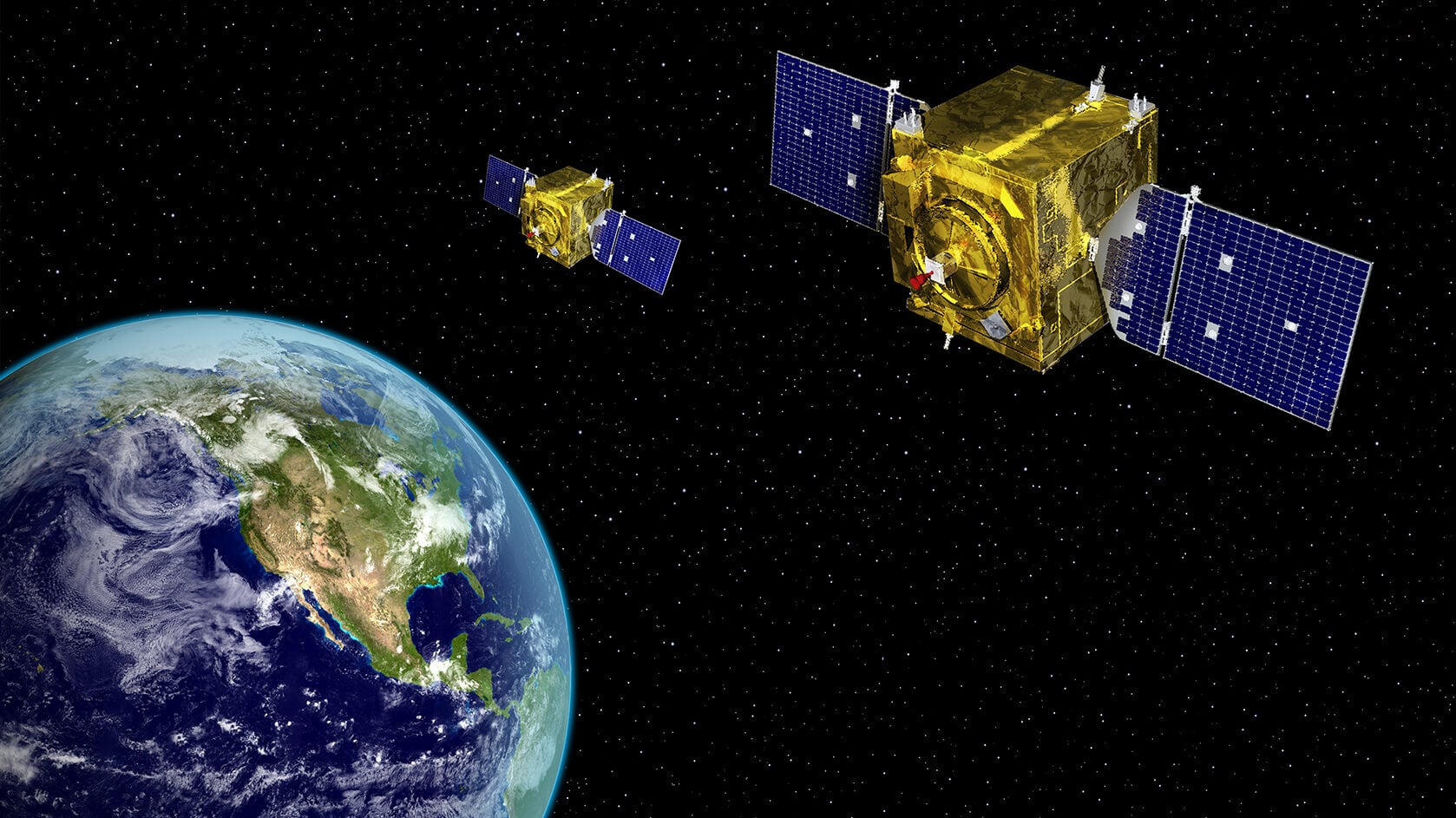
The RG-XX constellation will, at least partially, replace the Geosynchronous Space Situational Awareness Program 'neighborhood watch' satellites (Air Force Space Command archives)
WASHINGTON — The Pentagon’s Defense Innovation Unit (DIU) and the Space Force have joined forces to more rapidly develop and field next-generation, commercially developed satellites to monitor geosynchronous Earth orbit (GEO), according to the service.
Under the joint effort, DIU’s Geosynchronous High-Resolution Optical Space-Based Tactical Reconnaissance (GHOST-R) project is now going to serve as a feeder for the Space Force’s nascent RG-XX program to replace the venerable Geosynchronous Space Situational Awareness Program (GSSAP) satellites.
According to a Sept. 18 Space Systems Command (SSC) announcement, by “collaborating” with DIU the Space Force is “leveraging rapid prototyping” for RG-XX. Two companies have been chosen to develop and fly those prototypes by 2028, the release said: Northrop Grumman and True Anomaly.
“This approach burns down technical risk, drives down lifecycle costs, and gets vital capability to the warfighter faster to ensure a more resilient architecture. Successful prototypes will have a direct path to transition into the program of record,” Col. Bryon McClain, acting SSC portfolio acquisition executive (PAE) for Space Combat Power, said in the release.
The Space Combat Power PAE office is responsible for buying orbital warfare -related tech and capabilities.
DIU announced its GHOST-R effort in February , while SSC stood up the RG-XX effort in April as part of a wider GEO monitoring effort called Andromeda , setting up a pool of 14 vendors to compete for $1.84 billion over the next decade. SSC added another $4.4 billion to Andromeda’s indefinite delivery/indefinite quantity contract vehicle in May , bringing the previous ceiling for awards up to $6.2 billion from $1.8 billion.
Both the original GHOST-R and RG-XX were designed to make use of lower-cost commercial capabilities to develop reconnaissance satellites with better resolution, greater mobility and longer on-orbit staying power than the aging GSSAPs. However, DIU’s stated goal for GHOST-R’s price point was to be even lower than that of RG-XX.
The new joint program “leverages commercially developed space vehicles, buses, and electro-optical payloads to deliver high-resolution space-to-space imagery for characterizing resident space objects in GEO,” according to the SSC announcement.
True Anomaly, in a Sept. 18 press release , elaborated:
“GHOST-R aims to help develop the ground integration cadence, stand up operator command-and-control (C2) training, and codify the tactics, techniques, and procedures for rapid response. The project will build the operational muscle that is required to scale, at speed, to deliver a proliferated reconnaissance layer in GEO for the RG-XX program of record.”
Northrop Grumman, in a release the same day, noted that its GHOST-R “operational prototype will provide commercial augmentation for existing space domain awareness systems, enabling the Space Force to operate a hybrid constellation architecture.”
Neither the SSC release nor the corporate announcements provided the value of the contracts, and an SSC spokesperson did not respond to an inquiry on that issue.
The SSC announcement also did not stipulate whether DIU or the Space Force is funding the two GHOST-R prototype contracts. However, an SSC spokesperson told Breaking Defense the funds were not provided via the Andromeda ID/IQ.
DIU, for its part, did not respond to a Breaking Defense query about either the source of the prototype funding or the value of the contracts by press time.
Both firms are working under earlier Pentagon contracts to demonstrate rendezvous and proximity operators (RPO) that could also support future orbital warfare.
Under the GHOST-R contract, True Anomaly “will deliver its latest Jackal platform” to serve as the prototype, according to the company’s release.
Jackal is already being tested under the ongoing Victus Haze demonstration also managed by McClain’s shop. Victus Haze is focused on honing RPO with uncooperative spacecraft, with Jackal playing hide-and-seek with Rocket Lab’s Puma spacecraft.
While True Anomaly will “initially operate” Jackal along with Space Force operators under GHOST-R, if successful it will eventually transition to government-owned, government-operated status as an “on-orbit asset for the RG-XX program,” the company’s release said.
Northrop Grumman said the company is providing its “ESPASat-L, a spacecraft the size of a small suitcase” that “integrates” with the ESPAStar payload rideshare platform.
The defense behemoth also is in the midst of an RPO demo for the Pentagon under a public-private partnership for the Defense Advanced Research Project Agency’s (DARPA) Robotic Servicing of Geosynchronous Satellites (RSGS) project. The RSGS mission launched July 21 with a Falcon 9 carrying Northrop Grumman’s Mission Robotic Vehicle (MRV) and three Mission Extension Pods.
The MRV sports a series of “ports” that can stow tools, or provide power and/or data, and has been designed to undertake at least four types of on-orbit servicing missions: inspection of anomalies that appear in a satellite’s operations; assistance with adjustments to a satellite’s orbit; correction of mechanical problems; and help with installation of new payloads to upgrade capabilities. It also carries two robotic arms developed by the Naval Research Laboratory.
The extension pods essentially are jet packs that can provide propulsion to extend the life of the client satellites that have run out of their own power.
While neither Victus Haze nor RSGS have stated goals of contributing to orbital warfare, the RPO capabilities being demonstrated are recognized as potentially applicable to on-orbit weapons — including by the Space Force which has raised concerns about similar Chinese programs.
Further, the US just weeks ago publicly acknowledged that it has stationed weapons in space, although has provided no details about the capabilities of those on-orbit weapons.
RG-XX星座将至少部分取代地球同步空间态势感知计划的“邻域监视”卫星(空军太空司令部档案)。
华盛顿——据美国军方消息,五角大楼国防创新部门 (DIU) 和太空部队已联合起来,以更快地开发和部署下一代商业开发的卫星,用于监测地球同步轨道 (GEO)。
在双方的共同努力下,DIU 的地球同步高分辨率光学天基战术侦察 (GHOST-R) 项目现在将作为太空部队新兴的 RG-XX 计划的后备力量,以取代久经考验的地球同步空间态势感知计划 (GSSAP) 卫星。
根据太空系统司令部(SSC)9月18日发布的公告,太空部队正与国防工业部门(DIU)“合作”,利用快速原型技术开发RG-XX无人机。公告称,已选定两家公司负责在2028年前开发并试飞这些原型机:诺斯罗普·格鲁曼公司和True Anomaly公司。
“这种方法可以降低技术风险,降低生命周期成本,并更快地为作战人员提供关键能力,从而确保更具韧性的架构。成功的原型将可以直接过渡到正式项目,”太空作战力量代理SSC项目组合采购执行官(PAE)布莱恩·麦克莱恩上校在新闻稿中表示。
太空作战力量采购办公室负责采购与轨道战争相关的技术和能力。
DIU于2月宣布启动GHOST-R项目,而SSC则于4月启动RG-XX项目,作为名为“仙女座”(Andromeda)的更广泛的地球同步轨道(GEO)监测项目的一部分,该项目汇集了14家供应商,竞标未来十年总额达18.4亿美元的合同。5月,SSC向“仙女座”的无限期交付/无限量合同机制追加了44亿美元,使此前的合同上限从18亿美元提高到62亿美元。
最初的 GHOST-R 和 RG-XX 的设计初衷都是为了利用低成本的商业能力,开发出比老旧的 GSSAP 卫星分辨率更高、机动性更强、在轨续航时间更长的侦察卫星。然而,DIU 为 GHOST-R 设定的价格目标甚至要低于 RG-XX。
根据 SSC 的公告,这项新的联合计划“利用商业开发的航天器、航天器和光电有效载荷,提供高分辨率的太空到太空图像,以表征地球同步轨道上的驻留空间物体”。
True Anomaly在9月18日的新闻稿中详细阐述道:
“GHOST-R项目旨在帮助建立地面一体化节奏,建立操作员指挥控制(C2)训练体系,并规范快速反应的战术、技术和程序。该项目将构建快速扩展所需的作战能力,以便在RG-XX项目框架内提供大规模的地球同步轨道侦察能力。”
诺斯罗普·格鲁曼公司在当天发布的一份声明中指出,其 GHOST-R“运行原型将为现有的太空领域感知系统提供商业增强功能,使太空部队能够运行混合星座架构”。
SSC 的新闻稿和公司公告均未提供合同金额,SSC 发言人也未回应有关该问题的询问。
SSC的公告也没有明确说明是国防情报部门(DIU)还是太空部队为这两份GHOST-R原型合同提供资金。不过,SSC发言人告诉《防务新闻》,这些资金并非来自“仙女座”无限期交付/无限期数量合同(ID/IQ)。
截至发稿时,DIU方面尚未回复Breaking Defense关于原型资金来源或合同金额的询问。
这两家公司都在根据五角大楼早前的合同开展工作,以展示交会和近距离操作员 (RPO),这也可以支持未来的轨道战争。
根据 True Anomaly 公司发布的消息,根据 GHOST-R 合同,该公司“将交付其最新的 Jackal 平台”作为原型。
Jackal火箭目前正在接受McClain公司负责的Victus Haze演示项目的测试。Victus Haze项目旨在提升火箭定位与不配合航天器之间的协同作战能力,Jackal火箭将与火箭实验室的Puma航天器进行对抗演练。
True Anomaly 的新闻稿称,虽然 Jackal 最初将与太空部队操作员一起在 GHOST-R 计划下运行,但如果成功,它最终将过渡到政府所有、政府运营的状态,成为“RG-XX 计划的在轨资产”。
诺斯罗普·格鲁曼公司表示,该公司正在提供其“ESPASat-L,一种小型手提箱大小的航天器”,该航天器可与ESPAStar有效载荷共享平台“集成”。
这家国防巨头目前还在为五角大楼进行RPO(机器人性能优化)演示,这是国防高级研究计划局(DARPA)地球同步卫星机器人服务(RSGS)项目的公私合作项目。RSGS任务于7月21日发射,由一枚猎鹰9号火箭搭载诺斯罗普·格鲁曼公司的任务机器人飞行器(MRV)和三个任务扩展舱。
MRV配备一系列“端口”,可用于存放工具或提供电力和/或数据,其设计至少可执行四种类型的在轨服务任务:检查卫星运行中出现的异常情况;协助调整卫星轨道;修复机械故障;以及协助安装新的有效载荷以升级卫星功能。它还搭载了由海军研究实验室开发的两台机械臂。
扩展舱本质上是喷气背包,可以为耗尽自身能量的客户端卫星提供推进力,从而延长其寿命。
虽然 Victus Haze 和 RSGS 都没有明确表示要为轨道战争做出贡献,但其展示的 RPO 能力被认为有可能适用于在轨武器——包括美国太空部队在内,后者曾对中国类似的计划表示担忧。
此外,就在几周前,美国公开承认已在太空部署了武器,但并未提供有关这些在轨武器性能的任何细节。