DBS, OCBC and UOB shares have fallen. Is it a good time to buy?星展银行、华侨银行和大华银行的股价均已下跌。现在是买入的好时机吗?
OCBC, DBS and UOB shares fall as Citi downgrades OCBC and analysts weigh valuations, earnings outlook and dividend yields. Read more at straitstimes.com.
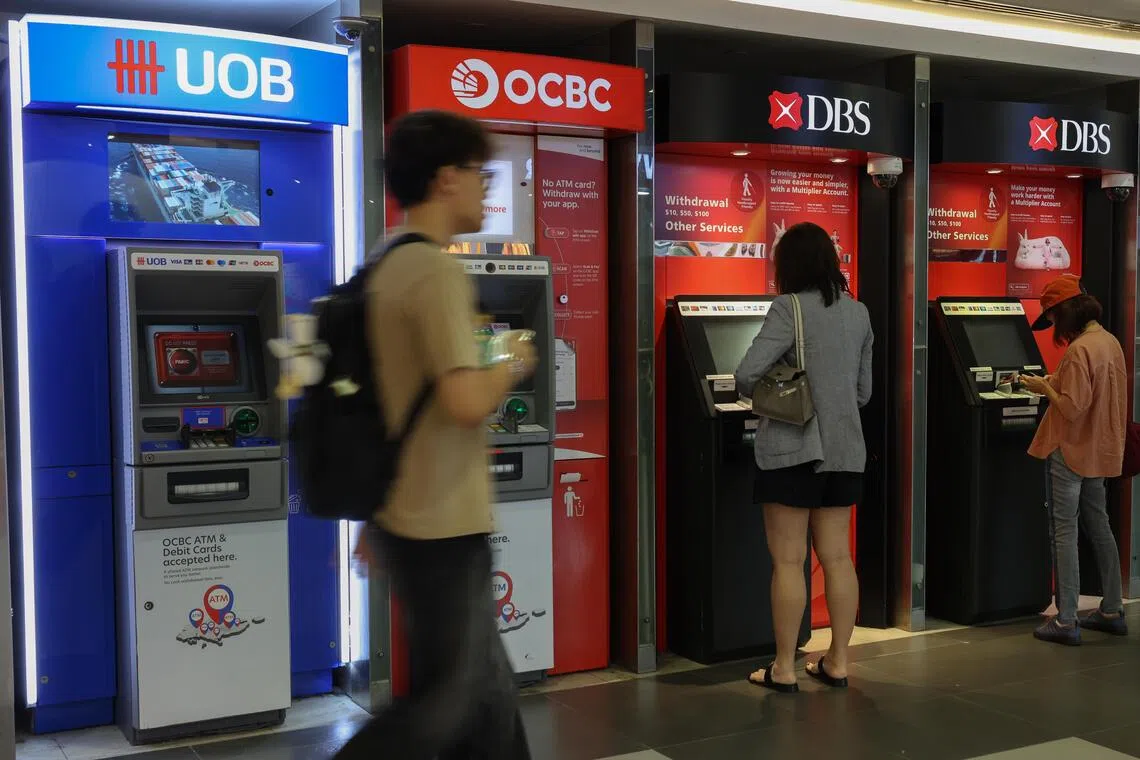
Citi expects OCBC’s Q3 earnings to be flat year on year, and growth optimism for the lender to be derailed.
PHOTO: THE BUSINESS TIMES
Published Oct 07, 2026, 06:35 PM
Updated Oct 07, 2026, 08:37 PM
- OCBC fell 5.9% after Citi downgraded it to “sell” on softer third-quarter 2026 earnings hopes. DBS and UOB also dropped after recent record highs.
- Analysts said the fall may be profit-taking, not weaker bank basics. They expect lending and wealth income to stay firm, but trading and fee income may normalise.
- Broker views differ: Citi is cautious on OCBC, while RHB and others still like Singapore banks. DBS is favoured for dividend safety, and UOB for valuation and higher upside.
SINGAPORE – Shares of OCBC fell more than 5% on Oct 7, after Citi cited softer-than-expected third-quarter 2026 earnings expectations and downgraded the stock to “sell”.
The stock slipped 5.9% to close at $30.30 from the previous day’s close of $32.20.
Its peers DBS and UOB also took a hit. DBS shares slid 1.36% to $77.49 on Oct 7 while UOB dropped 2.93% to end the day at $42.44.
Share prices of the three Singapore banks recently hit record highs – DBS and OCBC’s in early September, and UOB’s in July.
On Oct 7’s sudden pullback, Macquarie Capital head of Asean equity research Jayden Vantarakis said investors may have sold their shares to take profits after recent gains.
“The banks’ share prices have done well this year, especially OCBC, so we are likely seeing profit taking before investors make clear assessments of their views of third-quarter 2026,” he said.
Jefferies Asean research analyst Joanna Cheah said that it is increasingly about expectations and valuation rather than a deterioration in fundamentals, as the sector has had a very strong run.
“OCBC has fallen more because expectations were particularly high after a very strong second quarter and investors are now questioning how much of that trading, insurance and fee-income strength is repeatable,” she said.
Citi downgraded OCBC from “neutral” to “sell” on Oct 6, with a target price of $27.50. It expects flat year-on-year third-quarter earnings for OCBC and growth optimism for the lender to be derailed.
On the outlook for the banks’ third quarter earnings, Cheah said Jefferies does not expect a repeat of the exceptional momentum seen in the second quarter, though performance should stay broadly resilient.
“Loan growth and wealth should stay supportive, while net interest margin (NIM) pressure is becoming less severe. The main normalisation is likely to come from trading and other non-interest income.”
Jefferies has a “buy” rating on DBS with a target price of $91, while rating OCBC “hold” at $35 and UOB “buy” at $48.
NIM is the core profitability metric for banks and measures how much money a bank makes on its loans and investments compared to the interest it pays out on deposits and borrowings.
While Citi turned bearish on the short-term upside for OCBC, other brokerages like RHB remained positive on the lender.
In its Oct 7 note, RHB named OCBC its top pick, citing the bank’s all-round balance sheet strength and strong earnings momentum.
UOB ranked second, supported by its attractive valuations, while DBS remained a core pick for investors seeking dividend safety and attractive yields. RHB rated both UOB and DBS as “buy”, with target prices of $47.60 for UOB and $81.20 for DBS.
Just days earlier, the bank reiterated its buy call on OCBC and raised its target price to $33.70 from $32.85.
“We continue to like OCBC Bank for its solid balance sheet, positive earnings growth momentum (backed by a strong wealth business), relatively decent valuation and dividend yield,” RHB said on Oct 2.
The bank said it turned more optimistic in its NIM outlook on Singapore banks, as the US Fed hikes interest rates by 25 basis points to a target range of 3.75% to 4% on Sept 16 – the first time in three years.
“The trend of rising benchmark rates could support the operating income of Singapore banks with another leg for growth, which has predominantly been carried by non-interest income in recent quarters,” said RHB.
Meanwhile, Citi on Oct 6 maintained a “buy” on DBS and reiterated its sell call on UOB, while citing a preference for UOB over OCBC, “due to relative valuations or positioning”.
CGS International on Oct 1 maintained “neutral” on Singapore banks due to stretched valuations. It expects limited factors to drive earnings in the near term, as growth in wealth management fees is slowing alongside slower deposit growth in Singapore.
It also expects net interest income (NII) to see an uplift from improved NIMs only from fourth-quarter 2026.
CGIS prefers DBS, with a target price of $77.10, because of its attractive dividend yield of 4.3% expected in 2026 and 5.7% expected in 2027. This is supported by its excess capital, which can be returned to shareholders through its capital return initiatives.
It holds a target price of $29.80 for OCBC and $42.60 for UOB.
The sector’s downside risks include deterioration in macroeconomic conditions resulting in higher credit costs, a further slowdown in wealth and capital inflows resulting in subdued fee growth as well as softening investor sentiment that can negatively impact trading income across the banks, said CGIS analysts Tay Wee Kuang and Tan Jie Hui.
Macquarie Equity Research on Oct 1 said it expects favourable rates to support wealth management and NII, with a preference for UOB, followed by DBS, and then OCBC.
The firm has a target price of $46.57 for UOB, $80.74 for DBS and $31.69 for OCBC.
Vantarakis said then that while the Singapore banks stand to benefit from higher Singapore rates, UOB has the most to gain.
About 43 per cent of UOB’s loans are denominated in Singapore dollars, compared with 37 per cent to 38 per cent for DBS and OCBC. UOB also earns more NII in its revenue mix, at 66 per cent, compared with about 58 per cent for its two peers, said Vantarakis.
UOB also trades at a significant valuation discount to DBS and OCBC, and offers higher upside potential at 12%, compared with about 5% for its peers, including dividends, he said.
Meanwhile, DBS is supported by more than 18% return-on-equity, strong capital management and a rising rate environment that benefit both interest and fee income, while OCBC continues to benefit from positive momentum evident in the group’s wealth franchises, he added.
Macquarie expects a further 50-basis-point US Fed rate hike through the first quarter of 2027.
“As the US dollar has been strengthening since the first hike in September, both are positive factors for Singdollar rates. Average Singapore Overnight Rate Average three-month rates rose 10 basis points in the third quarter of 2026, but we are just getting started. Because it’s a compounded index rate, this will continue for several quarters to come,” said Vantarakis.
DBS, OCBC and UOB were among 11 stocks that were selected for board lot size reduction and saw immediate trades in the smaller trade sizes on Oct 5, according to SGX.
From Oct 5, for stocks priced between $10 and $100 a share, the minimum trading quantity was cut from 100 units to 10.
Banks and financial institutions
Private banking/Wealth management
花旗预计华侨银行第三季度盈利将与去年同期持平,该行的增长乐观情绪将受挫。
图片来源:《商业时报》
发布于 2026 年 10 月 7 日下午 6:35
更新于2026年10月7日晚上8:37
- 华侨银行(OCBC)股价下跌5.9%,此前花旗集团将其评级下调至“卖出”,原因是其对2026年第三季度盈利预期疲软。星展银行(DBS)和大华银行(UOB)在近期创下历史新高后也出现下跌。
分析师表示,此次下跌可能是获利回吐,而非银行基本面疲软。他们预计贷款和财富管理收入将保持稳定,但交易和手续费收入可能会恢复正常。
券商观点不一:花旗对华侨银行持谨慎态度,而兴业银行等券商则依然看好新加坡银行业。星展银行因其股息安全性而受青睐,大华银行则因其估值合理且上涨潜力更大而备受青睐。
新加坡——10月7日,华侨银行股价下跌超过5%,此前花旗银行表示,其2026年第三季度盈利预期低于预期,并将该股评级下调至“卖出”。
该股下跌 5.9%,收于 30.30 美元,而前一天的收盘价为 32.20 美元。
其同行星展银行和华侨银行也受到冲击。10月7日,星展银行股价下跌1.36%,收于77.49美元;华侨银行股价下跌2.93%,收于42.44美元。
新加坡三家银行的股价最近都创下了历史新高——星展银行和华侨银行的股价在 9 月初创下历史新高,大华银行的股价在 7 月份创下历史新高。
针对 10 月 7 日的突然回调,麦格理资本东盟股票研究主管 Jayden Vantarakis 表示,投资者可能在近期上涨后抛售股票以获利了结。
“今年银行股股价表现良好,尤其是华侨银行,因此我们可能会看到投资者在对2026年第三季度做出明确评估之前获利了结,”他说。
Jefferies Asean 研究分析师 Joanna Cheah 表示,这越来越与预期和估值有关,而不是基本面恶化,因为该行业已经经历了非常强劲的增长。
她表示:“华侨银行股价下跌幅度更大,是因为在经历了非常强劲的第二季度后,市场预期特别高,投资者现在质疑这种交易、保险和手续费收入的强劲势头有多少能够重现。”
10月6日,花旗银行将华侨银行的评级从“中性”下调至“卖出”,目标价为27.50美元。花旗预计华侨银行第三季度盈利将与去年同期持平,并且该行的增长前景将受到打击。
关于银行第三季度盈利前景,Cheah表示,杰富瑞预计不会重现第二季度的强劲势头,但整体业绩应该会保持韧性。
“贷款增长和财富水平应会继续保持支撑作用,而净息差(NIM)压力正在缓解。主要的正常化可能来自交易和其他非利息收入。”
Jefferies 给予星展银行“买入”评级,目标价为 91 美元;同时给予华侨银行“持有”评级,目标价为 35 美元;给予大华银行“买入”评级,目标价为 48 美元。
净息差是银行的核心盈利能力指标,衡量银行从贷款和投资中获得的收益与支付给存款和借款的利息之间的差额。
尽管花旗银行对华侨银行的短期上涨前景持悲观态度,但其他券商如兴业银行仍对该银行保持乐观。
RHB在10月7日的报告中将华侨银行列为首选,理由是该银行资产负债表整体实力雄厚,且盈利势头强劲。
大华银行(UOB)凭借其诱人的估值位列第二,而星展银行(DBS)仍然是寻求股息安全性和可观收益率的投资者的核心选择。兴业银行(RHB)对大华银行和星展银行均给予“买入”评级,目标价分别为大华银行47.60美元和星展银行81.20美元。
就在几天前,该银行重申了对华侨银行的买入评级,并将目标价从 32.85 美元上调至 33.70 美元。
RHB银行于10月2日表示:“我们继续看好华侨银行,因为它拥有稳健的资产负债表、积极的盈利增长势头(得益于强大的财富管理业务)、相对合理的估值和股息收益率。”
该银行表示,由于美联储将于 9 月 16 日将利率上调 25 个基点至 3.75% 至 4% 的目标区间(这是三年来的首次加息),因此该银行对新加坡银行业净息差前景更加乐观。
RHB表示:“基准利率上升的趋势可能会为新加坡银行业营业收入提供新的增长动力,而近几个季度以来,营业收入主要依靠非利息收入来支撑。”
与此同时,花旗银行于 10 月 6 日维持对星展银行的“买入”评级,并重申对大华银行的“卖出”评级,同时表示由于相对估值或头寸原因,花旗银行更倾向于大华银行而非华侨银行。
10月1日,CGS International维持对新加坡银行业“中性”评级,理由是估值过高。该机构预计,短期内推动银行盈利增长的因素有限,因为新加坡财富管理费用的增长正在放缓,存款增长也随之放缓。
该公司还预计,净利息收入 (NII) 只有从 2026 年第四季度开始,才能从净息差 (NIM) 的改善中获得增长。
CGIS 更看好星展银行,目标价为 77.10 美元,因为其 2026 年和 2027 年的股息收益率分别预计为 4.3% 和 5.7%,极具吸引力。这得益于星展银行的盈余资本,这些盈余资本可以通过其资本回报计划返还给股东。
报告称,华侨银行的目标股价为 29.80 美元,大华银行的目标股价为 42.60 美元。
CGIS分析师Tay Wee Kuang和Tan Jie Hui表示,该行业的下行风险包括宏观经济状况恶化导致信贷成本上升、财富和资本流入进一步放缓导致手续费增长乏力以及投资者情绪疲软,这些都可能对各银行的交易收入产生负面影响。
麦格理股票研究部于 10 月 1 日表示,预计有利的利率将支撑财富管理和净利息收入,其中优先考虑大华银行,其次是星展银行,然后是华侨银行。
该公司给出的目标价为:大华银行 46.57 美元,星展银行 80.74 美元,华侨银行 31.69 美元。
Vantarakis当时表示,虽然新加坡各银行将从新加坡利率上升中受益,但大华银行获益最大。
大华银行约43%的贷款以新加坡元计价,而星展银行和华侨银行的这一比例分别为37%至38%。Vantarakis表示,大华银行的净利息收入占比也更高,达到66%,而其两家同行的这一比例约为58%。
他还表示,大华银行的估值也比星展银行和华侨银行低很多,而且其上涨潜力更高,达到 12%,而同业公司(包括股息在内)的上涨潜力约为 5%。
与此同时,星展银行凭借超过 18% 的股本回报率、强大的资本管理以及有利于利息和手续费收入的利率上升环境而受益,而华侨银行则继续受益于集团财富管理业务的积极发展势头,他补充道。
麦格理预计美联储将在 2027 年第一季度之前进一步加息 50 个基点。
“自9月份首次加息以来,美元持续走强,这对新元汇率而言都是利好因素。新加坡隔夜平均利率和三个月平均利率在2026年第三季度上涨了10个基点,但这仅仅是个开始。由于这是复利指数利率,这种上涨趋势将在未来几个季度持续下去。”Vantarakis表示。
据新加坡交易所称,星展银行、华侨银行和大华银行等 11 只股票被选中缩减交易单位,并于 10 月 5 日立即以较小的交易单位进行交易。
从 10 月 5 日起,股价在每股 10 美元至 100 美元之间的股票,最低交易量从 100 股减少到 10 股。
银行和金融机构
私人银行/财富管理