Caring for her dying father at 17 shaped how this veteran nurse cares for breast cancer patients today17岁时照顾临终父亲的经历,塑造了这位资深护士如今照顾乳腺癌患者的方式。
KKH oncology-trained nurse Teresa Ng learnt early that breast cancer patients and their families need more than medical care. For decades, the 61-year-old has helped women and their families navigate the fear, uncertainty and challenges that come with the disease – even after treatment ends.
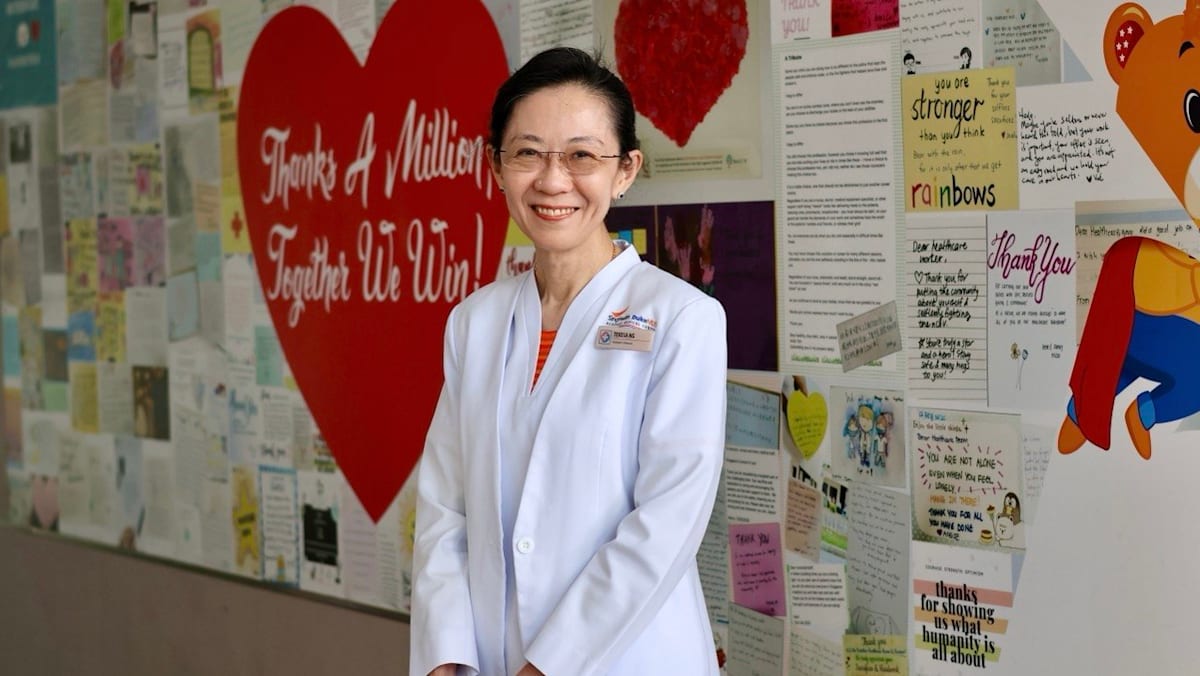
KKH oncology-trained nurse Teresa Ng learnt early that breast cancer patients and their families need more than medical care. For decades, the 61-year-old has helped women and their families navigate the fear, uncertainty and challenges that come with the disease – even after treatment ends.
Oncology-trained nurse Teresa Ng believes that cancer care should go beyond a patient’s diagnosis. (Photo: Eveline Gan)
This audio is generated by an AI tool.
Veteran oncology-trained nurse Teresa Ng was talking to CNA Women about her late father and patients when her voice faltered.
Tears filled her eyes. Dabbing at them, the 61-year-old apologised for the sudden emotion.
After decades in nursing, the assistant director of nursing at KK Women’s and Children’s Hospital (KKH) is no stranger to the emotional weight of caring for cancer patients.
As a teenager, Ng cared for her father who had terminal cancer. She also knows what it feels like to return from a day off to find that a patient receiving palliative care has died.
“Over the years, I tried to divert my attention and do my own debrief, tell myself that illness and death are part and parcel of life, that tomorrow is not guaranteed,” she said.
That ability to care deeply has shaped much of Ng’s work with breast cancer patients at KKH, where she has spent years supporting and advocating for them and their families.
Ng joined KKH as a staff nurse in 1993. After taking time off for postgraduate studies and to start a family, she returned in 2004, working in gynaecological oncology before moving to breast cancer care in 2009.
Ng as a young nurse in 1992. (Photo: Teresa Ng)
“Over the years, I have come to understand that patients need much more than good medical care. They need someone who will listen, explain things honestly and recognise the person behind the diagnosis,” said Ng.
CARING FOR HER FATHER WITH TERMINAL CANCER AT 17
The kind of support Ng now provides is what she wished her family had while navigating her father’s terminal liver cancer in the early 80s.
The eldest of four siblings, she tried her best to help care for her father. She watched how he slowly became weaker and eventually died at home.
Ng remembers the uncertainty and helplessness that came with watching someone she loved at the end of his life. “Sometimes, being near him, I would feel very sad not knowing what I could do for him,” she said.
Watching her father become thin and frail over the course of his illness made her heart ache, Ng said.
“Looking back, I wish that someone had explained to me and my family that that was part and parcel of the disease process, and how to manage at the end of life.”
Her first encounter with oncology nursing was in 1993 when she worked in a ward caring for patients with gynaecological conditions and gynaecological cancer. As she spent time caring for cancer patients, she realised it was something she wanted to do.
Ng remembers the sense of helplessness she felt caring for her terminally ill father when she was 17 and wishes she and her family had had more support. (Photo: Eveline Gan)
“It gave me an appreciation for the human side of medicine and a lasting understanding that caring for a patient also means caring for the people around them,” she said.
SUPPORTING PATIENTS THROUGH DIAGNOSIS AND TREATMENT
Fears about dying, self-blame and burdening their family are common among breast cancer patients, Ng said. She gives them time and space while being honest about what lies ahead.
“I make sure they understand what we know, do not know yet and what the next steps are, without overwhelming them with information all at once. I encourage questions and remind them that they do not have to make sense of everything on the first visit,” Ng said.
Ng also walks breast cancer patients through the potential side effects of treatment, such as fatigue, appetite changes and hair loss , and how pre-treatment medications may help prevent or reduce them. This helps reduce uncertainty and anxiety.
“If we don’t pre-empt them, explain what’s to be expected, they may get very worried (during the treatment),” she said.
Ng was one of the three recipients of the President’s Award for Nurses in 2012. (Photo: KKH Women’s and Children’s Hospital)
For Ng, supporting women with breast cancer also means understanding that treatment may not be their only concern.
She has seen families become anxious to help and want to “fix” things when the patient needs time to process her diagnosis and treatment options.
“Beyond the medical decisions, the patient’s mind was elsewhere too… on her children, on how they would take the news and on how she would ever find the words to tell her own parents,” said Ng.
“What the spouse saw as urgency, the patient experienced as being rushed. What she needed most, before anything else, was simply the space to be heard.”
Ng encourages families to be supportive without taking away the patient’s sense of control.
CARING BEYOND THE HOSPITAL WARD
Ng also heads the Department of Advancing Nursing and Education, which looks after nursing professional development and clinical training. She is also involved in population health projects, helping to raise public awareness on breast health.
Over the years, Ng has started or contributed to initiatives that support women through the practical and emotional toll of breast cancer. These challenges are not always visible, she said.
For younger women, for example, issues such as fertility and sexuality can impact them deeply but do not always receive enough attention.
“Completing treatment does not necessarily mean that a patient feels ‘back to normal’. For me, advocacy means looking at the whole person, not just the cancer,” she said.
The Yarn Wonders are hand-knitted sling bags that allow mastectomy patients to discreetly carry their surgical drainage bottles, preventing painful fluid buildup. (Photo: Eveline Gan)
She has chaired the KK Alpine Blossoms Breast Cancer Support Group since 2009. The group runs a peer support programme called Blossom Buddy, where breast cancer survivors share their experiences with newly diagnosed patients.
Ng has also worked on projects such as The Yarn Wonders and Knitted Knockers.
Knitted Knockers are lightweight, hand-knitted breast prostheses for women who have undergone mastectomies.
The Yarn Wonders are hand-knitted sling bags that allow patients to discreetly carry surgical drainage bottles used after breast cancer surgery. The bags also make it easier for patients to move around without having to hold the bottles, said Ng.
Ng said the handmade gestures tell patients that they are not alone and someone is thinking of them.
“Some patients are surprised that someone has taken the time to make something especially for them, while others become emotional or simply hold onto it as a source of comfort.
“When someone is going through a vulnerable and frightening period, a small, personal gesture can provide a sense of comfort and connection that goes beyond the clinical environment,” she said.
WHAT PATIENTS HAVE TAUGHT HER
For all the support Ng has offered patients, she has also learnt a lot from them, professionally and personally.
“It taught me not to take good health, time with loved ones or the simple things for granted,” she said.
Ng with the knitted sling bags and breast prostheses that patients who have undergone breast cancer surgery receive. (Photo: Eveline Gan)
Ng has seen how powerful love can be in the face of a life-threatening diagnosis. She recalls a young mother who was initially in denial about her cancer diagnosis and delayed treatment.
Eventually, she decided to undergo treatment for the sake of her four young children.
“What struck me was not that she never felt afraid; she was. She reminded me that courage is not the absence of fear, but finding a way to keep going despite it,” said Ng.
“We often think we are there to care for our patients but they teach us just as much how to live.”
The emotional demands of healthcare work can be heavy, but what keeps her going is looking back at the reason why she went into nursing in the first place.
“My father’s experience as a patient had a profound impact on me, and when things feel overwhelming, I think about that… and what it means to be there for someone at their most vulnerable state. That always helps put things back into perspective,” she said.
Looking ahead, Ng hopes to continue developing initiatives that strengthen patient education, support cancer survivors and encourage early detection.
She is especially interested in projects that connect patients with the right resources and address needs that may be overlooked after treatment.
“For me, the most meaningful projects are those that can create a lasting difference in a patient’s journey. Not just medically but also emotionally, socially and in terms of their overall quality of life,” she said.
CNA Women is a section on CNA Lifestyle that seeks to inform, empower and inspire the modern woman. If you have women-related news, issues and ideas to share with us, email CNAWomen [at] mediacorp.com.sg .
A single handpicked story that we think you shouldn't miss. Just one a day.
在KKH医院接受过肿瘤专科培训的护士Teresa Ng很早就意识到,乳腺癌患者及其家人需要的不仅仅是医疗护理。几十年来,这位61岁的护士一直致力于帮助女性及其家人应对疾病带来的恐惧、不确定性和挑战——即使在治疗结束后也是如此。
肿瘤专科护士吴特蕾莎认为,癌症护理不应止步于患者的诊断结果。(图片:伊芙琳·甘)
这段音频由人工智能工具生成。
资深肿瘤科护士 Teresa Ng 在接受 CNA Women 采访时,谈到了她已故的父亲和病人,这时她的声音哽咽了。
她眼眶里噙满了泪水。这位61岁的老人一边擦拭眼泪,一边为自己突如其来的情绪波动道歉。
在护理行业工作数十年后,KK妇女儿童医院(KKH)的护理部副主任对照顾癌症患者的情感压力并不陌生。
吴女士青少年时期曾照顾身患绝症的父亲。她也体会过那种休假回来发现接受临终关怀的病人已经去世的感受。
“多年来,我一直试图转移注意力,进行自我反思,告诉自己疾病和死亡是生命的一部分,明天并不一定到来,”她说。
这种深切关怀的能力塑造了 Ng 在 KKH 为乳腺癌患者所做的许多工作,她多年来一直支持和帮助这些患者及其家人。
吴女士于 1993 年加入 KKH 医院担任护士。在攻读研究生学位和组建家庭后,她于 2004 年重返医院,先在妇科肿瘤科工作,后于 2009 年转至乳腺癌护理科。
1992 年,吴恩达还是一名年轻护士。(照片:Teresa Ng)
“多年来,我逐渐明白,病人需要的不仅仅是良好的医疗护理。他们需要的是一个能够倾听、诚实解释病情并能理解诊断背后那个人的人,”吴医生说。
17岁时照顾身患绝症的父亲
吴女士现在所提供的这种支持,正是她希望自己的家人在 80 年代初父亲罹患晚期肝癌时能够得到的。
作为家中四个孩子中的老大,她尽力照顾父亲。她眼睁睁地看着父亲的身体日渐虚弱,最终在家中去世。
吴女士回忆起看着自己所爱之人走到生命尽头时的那种茫然无助。“有时候,待在他身边,我会感到非常难过,因为我不知道自己能为他做些什么,”她说。
吴女士说,看着父亲在患病期间变得越来越瘦弱,她感到非常心痛。
“回想起来,我希望当时有人能向我和我的家人解释,这是疾病发展过程的一部分,以及如何在生命末期应对。”
她第一次接触肿瘤护理是在1993年,当时她在病房照顾患有妇科疾病和妇科癌症的患者。在照顾癌症患者的过程中,她意识到这是她想做的事情。
吴女士回忆起17岁时照顾身患绝症的父亲时所感受到的无助,她希望当时自己和家人能得到更多支持。(图片:Eveline Gan)
“这让我更加体会到医学的人文关怀,也让我深刻理解到,照顾病人也意味着照顾他们身边的人,”她说。
在诊断和治疗过程中为患者提供支持
吴医生说,乳腺癌患者普遍存在对死亡的恐惧、自责以及担心成为家人负担等情绪。她会给予她们时间和空间,同时也会坦诚地告诉她们未来可能面临的情况。
“我会确保他们了解我们已知的信息、尚不了解的信息以及下一步的步骤,而不会一次性给他们灌输太多信息。我会鼓励他们提问,并提醒他们第一次来访时不必完全理解所有内容,”吴医生说。
吴医生还会向乳腺癌患者讲解治疗可能产生的副作用,例如疲劳、食欲改变和脱发,以及治疗前服用的药物如何帮助预防或减轻这些副作用。这有助于减少患者的不确定感和焦虑情绪。
“如果我们不事先告知他们会发生什么,他们(在治疗过程中)可能会非常担心,”她说。
吴女士是2012年总统护士奖的三位获得者之一。(图片:KKH妇女儿童医院)
对吴来说,支持乳腺癌患者也意味着要理解治疗可能不是她们唯一关心的事情。
她曾目睹一些家庭急于提供帮助,想要“解决”问题,而病人却需要时间来消化诊断结果和治疗方案。
“除了医疗决定之外,病人的心思也放在了别处……她想着自己的孩子,想着他们会如何接受这个消息,想着自己该如何开口告诉父母,”吴医生说。
“配偶眼中的紧迫感,在病人看来却是匆忙。她最需要的,首先是能够倾诉的空间。”
Ng鼓励家属给予支持,但不要剥夺患者的控制感。
超越医院病房的关怀
吴女士还担任护理与教育发展部主任,该部门负责护理专业发展和临床培训。她也参与人口健康项目,致力于提高公众对乳腺健康的认识。
多年来,吴女士发起或参与了多项旨在帮助女性应对乳腺癌带来的实际和情感创伤的公益活动。她表示,这些挑战并非总是显而易见的。
例如,对于年轻女性来说,生育和性等问题可能会对她们产生深刻的影响,但这些问题却往往没有得到足够的重视。
“完成治疗并不一定意味着患者感觉‘恢复正常’。对我而言,倡导意味着关注患者的整体,而不仅仅是癌症,”她说。
Yarn Wonders 是一款手工编织的斜挎包,方便乳房切除术后的患者隐蔽地携带引流瓶,防止因积液而引起的疼痛。(图片:Eveline Gan)
自 2009 年以来,她一直担任 KK Alpine Blossoms 乳腺癌支持小组的主席。该小组开展了一项名为 Blossom Buddy 的同伴支持计划,让乳腺癌幸存者与新确诊的患者分享她们的经验。
Ng 还参与过《纱线奇观》和《针织乳房》等项目。
针织乳房假体是轻便的手工针织乳房假体,专为接受过乳房切除术的女性设计。
“Yarn Wonders”是一款手工编织的斜挎包,方便乳腺癌患者隐蔽地携带术后使用的引流瓶。Ng表示,这种包还能让患者无需手持引流瓶就能更轻松地活动。
吴女士表示,这些手工制作的举动告诉患者,他们并不孤单,有人在想着他们。
“有些病人会惊讶于有人花时间专门为他们制作东西,而另一些病人则会感动落泪,或者只是把它当作安慰的来源。
“当有人经历一段脆弱和恐惧的时期时,一个小小的、个人的举动就能带来超越临床环境的安慰和联系感,”她说。
病人教会了她什么
吴女士在为患者提供各种支持的同时,也从他们身上学到了很多东西,无论是在专业方面还是个人方面。
“它教会了我不要把健康的身体、与亲人相处的时光以及简单的幸福视为理所当然,”她说。
吴女士手持针织吊袋和乳房假体,这些物品是为接受过乳腺癌手术的患者准备的。(图片:Eveline Gan)
吴女士亲眼目睹了爱在面对危及生命的诊断时所展现出的力量。她回忆起一位年轻的母亲,起初她不愿接受自己患癌的事实,并因此耽误了治疗。
最终,为了四个年幼的孩子,她决定接受治疗。
“让我印象深刻的不是她从不感到害怕;她其实很害怕。她让我明白,勇气不是没有恐惧,而是在恐惧中找到继续前进的方法,”吴女士说道。
“我们常常认为自己是去照顾病人的,但他们也教会了我们很多关于生活的事情。”
医疗保健工作的情感压力可能很大,但让她坚持下去的是回顾她当初选择从事护理工作的理由。
“我父亲作为病人的经历对我影响深远,每当感到压力巨大时,我就会想起这件事……想起在别人最脆弱的时候陪伴在他们身边意味着什么。这总能帮助我重新审视一切,”她说。
展望未来,吴希望继续推进各项举措,以加强患者教育,支持癌症幸存者,并鼓励早期发现。
她尤其对那些能将患者与合适的资源联系起来,并解决治疗后可能被忽视的需求的项目感兴趣。
“对我而言,最有意义的项目是那些能够对患者的治疗过程产生持久影响的项目。这种影响不仅体现在医疗方面,也体现在情感、社交以及整体生活质量方面,”她说道。
CNA Women是CNA Lifestyle旗下的一个版块,旨在为现代女性提供信息、赋能和灵感。如果您有与女性相关的新闻、议题或想法想要与我们分享,请发送电子邮件至CNAWomen[at]mediacorp.com.sg。
每天一篇,我们精心挑选一篇您不容错过的精彩故事。