After B-1’s leave England, analysts point to limited options, importance of base defenseB-1轰炸机离开英国后,分析人士指出选择有限,基地防御至关重要。
“Withdrawing these bombers to [the US] will provide an opportunity for more significant maintenance on the aircraft, but it does reduce the potential sustained strike capacity US forces could bring to bear against Iran,” Timothy Walton, a senior fellow at the Hudson Institute, told Breaking Defense.
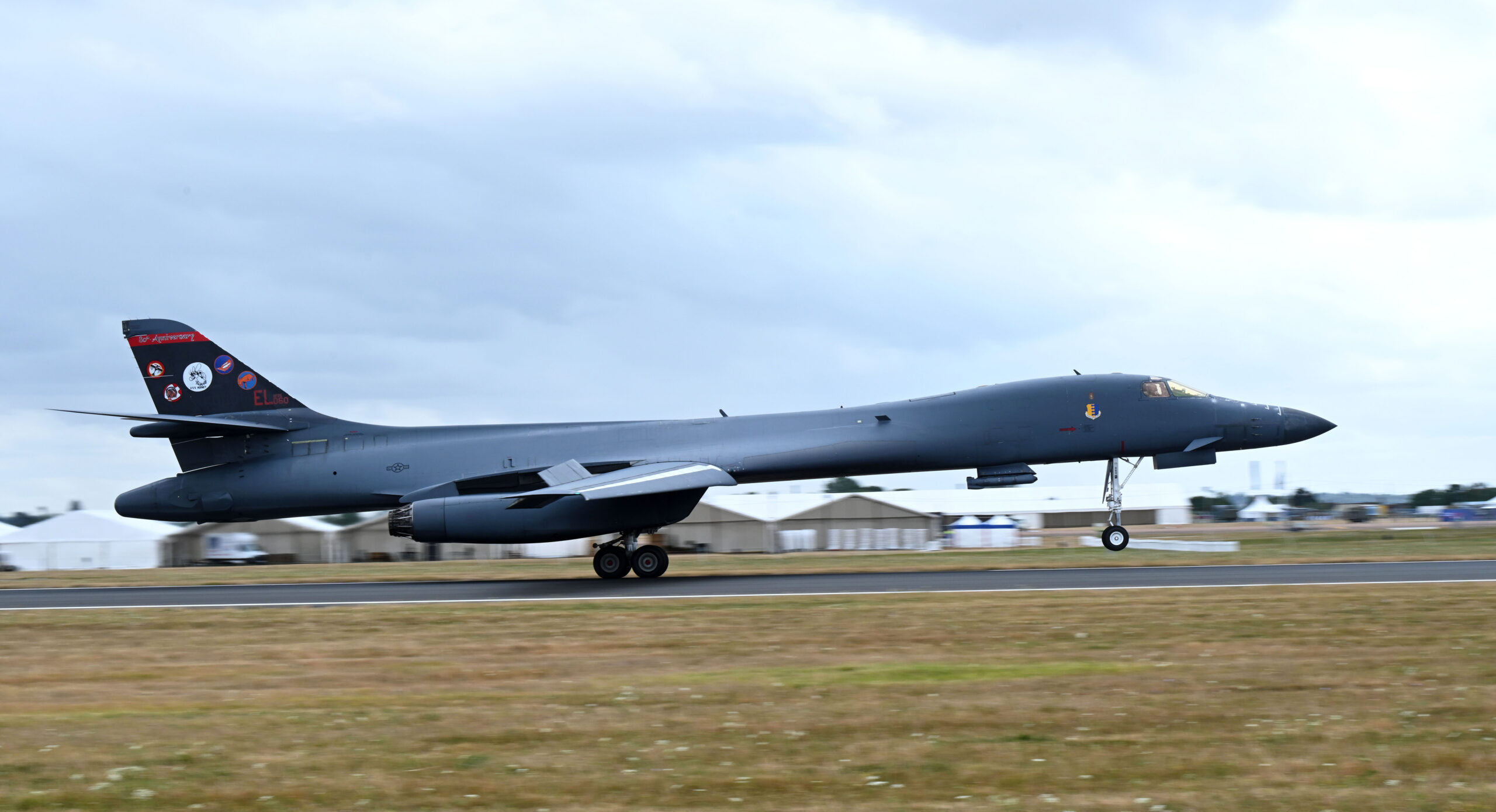
A US Air Force B-1B Lancer assigned to the 37th Bomb Squadron, Ellsworth Air Force Base, S.D., lands at Royal Air Force Fairford, England, to participate in the Royal International Air Tattoo, July 15, 2025. (USAF)
WASHINGTON — The rushed withdrawal of US bombers from a British airfield will likely impact the tempo of strikes America can generate against Iran for the time being, and underscores a dearth of defenses at critical installations, experts told Breaking Defense.
On Sunday, the US abruptly pulled out a dozen B-1 Lancer long-range bombers from RAF Fairford in southern England due to fears of a threat from Iran, according to President Donald Trump . The New York Times reported Monday that the swift exit was prompted by the possibility of a localized drone attack, potentially mirroring a Ukrainian operation last year dubbed “Spider Web” that used cheap drones to destroy Russian strategic aircraft on the ground.
Fairford, located in southwest England, has been a key launch pad for US bombers like the B-1 and B-52 Stratofortress after the outbreak of Operation Epic Fury in February. The base offers a shorter flight path to the Middle East — about 3,000 miles to Iran — relative to installations in the US, reducing strain on aircrews and airframes and offering a relatively quicker turnaround for sustained operations.
The immediate operational impact of the bomber evacuation from Fairford is likely to be limited since the US is not currently flying many missions against Iran, according to Stacie Pettyjohn, senior fellow and director of the defense program at the Center for a New American Security. Still, other experts said future operational planning — especially for any significant resurgence in offensive trikes — will have to be reevaluated.
“Withdrawing these bombers to home airfields in the contiguous United States will provide an opportunity for more significant maintenance on the aircraft, but it does reduce the potential sustained strike capacity US forces could bring to bear against Iran,” Timothy Walton, a senior fellow at the Hudson Institute, told Breaking Defense.
Douglas Barrie, a senior fellow for military aerospace at the International Institute for Strategic Studies, similarly said that having to move aircraft farther from the Middle East “means greater transit times and greater use of tanker aircraft,” increasing strain .
Pointing to potential impacts like lower sortie generation, the loss of convenience offered by access to Fairford could influence “the efficiency and flexibility” that bombers could be employed, said Joshua VerGow, a senior fellow at the Atlantic Council.
Walton said he believed the bombers would return to Fairford in the future, but in the meantime US war planners are likely looking at other options.
Where To Go From Here
Beyond Fairford, VerGow said the US still maintains an “ecosystem of bases, allies, logistics, and intelligence sharing agreements” that can “ensure movements like these can be made while keeping them [the bombers] operationally relevant.”
But options are more limited than they may have looked just a year ago. As for potential locations to host the bombers in Europe, analysts pointed to the resistance of local governments to aid the US strikes against Iran — a stance that has drawn Trump’s ire.
Walton observed that Fairford is specially equipped with infrastructure to host US bombers, and that continental host governments have not granted permission for the aircraft to launch from other suitable locations closer to the region like Incirlik Air Base in Turkey or Morón Air Base in Spain. (Bomber operations from Fairford itself were already a source of political controversy in the United Kingdom, where the government has restricted their missions to “defensive” operations.)
In the Middle East, B-1s operated from Al Udeid Air Base in Qatar prior to the current conflict, “but that is not an option now given the extreme vulnerability of Gulf bases to Iranian drones and missiles,” Pettyjohn said.
Walton noted that American commanders have also run bomber operations from the British territory of Diego Garcia, which lies about 3,000 miles southeast of Iran in the Indian Ocean. The pacific atoll hosts a joint US-UK military base that can support B-1s.
Should the Pentagon have to stick to launching from the US, Mick Mulroy, a former deputy assistant secretary of defense for the Middle East, said it would “more of a challenge,” but the US has other options to strike Iran if need be. For instance, the USS Theodore Roosevelt carrier strike group and other American forces are on their way to the region and expected to arrive by next month.
“That will give the president more options when it comes to escalation,” he told Breaking Defense.
Highlighting The Drone Threat To Bases
Experts largely agreed that the bomber withdrawal underscored a need for a greater mix of defenses for US installations. Similar to events in the American homeland , British installations like RAF Lakenheath have reportedly been the subject of mysterious drone incursions that officials have been largely powerless to stop, raising fears of vulnerability to an attack.
The Air Force and broader US military community “really need to internalize that nowhere offers sanctuary,” Pettyjohn said. “Typically, the US has moved its most valuable and scarce assets farther away to ensure that they are invulnerable. That is no longer an option, which means that the USAF needs more active and passive defenses.”
Walton emphasized that the US needs to “accelerate” base defense initiatives, and noted that some ongoing efforts suggest poor planning. He pointed to the construction of environmental protection shelters at Ellsworth Air Force Base in South Dakota — a home base for the B-1 and first beddown destination for the service’s forthcoming B-21 Raider stealth bomber.
“Although these shelters protect aircraft from weather and environmental exposure, they provide little protection against attack, leaving parked B-21s vulnerable to future Operation Spiderweb-style drone attacks and other threats,” Walton said. “This is a penny-wise, pound-foolish choice.”
The Pentagon and the military services appear very aware of the threat, as they seek to boost bureaucratic authorities when it comes to employing defenses, coordinate better with federal partners and introduce new counter-drone tech to military facilities.
VerGow, for his part, noted that the possibility of adversaries being able to project forces from inside of a supposed sanctuary is itself “nothing new,” adding that it would be “easy to simply conclude that better base-protection measures are needed.” Instead, he said that the B-1 withdrawal highlights the efficacy of “operational resilience” in the military system.
“This type of rapid relocation doesn’t happen without tripwires and deliberate risk-analysis done at multiple levels of command. For me, moving the aircraft is evidence that the system worked,” VerGow said. “Intelligence identified a threat and commanders preserved combat power.”
Tim Martin and Ashley Roque contributed reporting.
Breaking Defense Video
Unpacking Boeing’s F/A-XX win, plus a report from wartime Ukraine
How Hegseth envisions a new Autonomous Warfare Command
What Europe’s military air fleets will look like in 30 years
Riyadh gets closer to F-35s, Damascus presses sovereignty and an expert take on Iran
Drone-hunting on the border, plus turmoil at an Air Force think tank
The future of European airpower might be unmanned
The big news out of AFA, plus a guided tour of the show floor
Why the ‘right to repair’ matters to the Pentagon
What the Pentagon is testing along the US-Mexico border
Chairman Caine talks cislunar ops, plus a window into next-gen airlift
2025年7月15日,隶属于美国南达科他州埃尔斯沃思空军基地第37轰炸机中队的一架美国空军B-1B“枪骑兵”轰炸机降落在英国皇家空军费尔福德基地,参加皇家国际航空展。(美国空军)
华盛顿——专家告诉《防务新闻》,美国轰炸机匆忙从英国机场撤离,可能会在短期内影响美国对伊朗发动打击的节奏,并凸显出关键设施防御的不足。
据美国总统唐纳德·特朗普称,周日,美国突然从位于英格兰南部费尔福德的皇家空军基地撤走了12架B-1“枪骑兵”远程轰炸机,原因是担心伊朗构成威胁。《纽约时报》周一报道称,此次迅速撤离是由于担心伊朗可能发动局部无人机袭击,这可能与去年乌克兰代号为“蜘蛛网”的行动类似,该行动使用廉价无人机摧毁了地面上的俄罗斯战略飞机。
位于英格兰西南部的费尔福德基地,自2月份“史诗狂怒行动”爆发以来,一直是美国B-1和B-52“同温层堡垒”等轰炸机的重要起飞基地。与美国本土的基地相比,该基地飞往中东的航线更短——飞往伊朗仅约3000英里——从而减轻了机组人员和飞机的负担,并为持续作战行动提供了相对更快的周转速度。
据新美国安全中心高级研究员兼国防项目主任斯泰西·佩蒂约翰称,由于美国目前并未对伊朗执行大量任务,因此从费尔福德撤离轰炸机的直接作战影响可能有限。不过,其他专家表示,未来的作战计划——特别是针对进攻性三轮战机可能出现的大规模复飞——必须重新评估。
“将这些轰炸机撤回美国本土机场,将为飞机提供更重要的维护机会,但这确实会降低美军对伊朗可能施加的持续打击能力,”哈德逊研究所高级研究员蒂莫西·沃尔顿告诉《防务新闻》。
国际战略研究所军事航空航天高级研究员道格拉斯·巴里也表示,将飞机从中东更远的地方调动起来“意味着更长的运输时间和更多的加油机使用”,从而加剧了压力。
大西洋理事会高级研究员约书亚·弗戈表示,失去费尔福德机场带来的便利可能会影响轰炸机的“效率和灵活性”,例如降低出动架次。
沃尔顿表示,他相信轰炸机将来还会重返费尔福德,但与此同时,美国战争策划者可能正在考虑其他方案。
接下来该何去何从
VerGow 表示,除了费尔福德之外,美国仍然维持着一个“由基地、盟友、后勤和情报共享协议组成的生态系统”,这可以“确保此类行动能够进行,同时保持轰炸机在作战上的相关性”。
但如今的选择远比一年前要有限得多。至于在欧洲哪些地方可以安置这些炸弹袭击者,分析人士指出,当地政府不愿协助美国打击伊朗——这种立场激怒了特朗普。
沃尔顿指出,费尔福德空军基地配备了专门的基础设施,可以容纳美国轰炸机,而欧洲大陆各国政府并未批准这些飞机从其他更靠近该地区的合适地点起飞,例如土耳其的因吉尔利克空军基地或西班牙的莫龙空军基地。(在英国,从费尔福德空军基地起飞的轰炸机行动本身就已经引发了政治争议,英国政府已将其任务限制在“防御性”行动范围内。)
佩蒂约翰说,在中东,B-1轰炸机在目前的冲突之前曾从卡塔尔的乌代德空军基地起飞作战,“但鉴于海湾基地极易受到伊朗无人机和导弹的攻击,这现在已经不是一个可行的选择了。”
沃尔顿指出,美国指挥官也曾从位于印度洋、伊朗东南约3000英里处的英国属地迪戈加西亚岛指挥轰炸机行动。这个太平洋环礁上设有一个美英联合军事基地,可以为B-1轰炸机提供支持。
如果五角大楼不得不坚持从美国本土发射导弹,前负责中东事务的国防部副助理部长米克·穆尔罗伊表示,这将“更具挑战性”,但美国在必要时还有其他打击伊朗的选项。例如,“西奥多·罗斯福”号航母打击群和其他美军部队正在前往该地区的途中,预计下个月抵达。
“这将使总统在局势升级方面拥有更多选择,”他告诉《防务新闻》。
强调无人机对基地的威胁
专家们普遍认为,轰炸机的撤离凸显了美国军事设施需要更多样化的防御手段。与美国本土的情况类似,据报道,英国皇家空军莱肯希思基地等设施也曾遭受神秘无人机入侵,官方对此束手无策,这引发了人们对这些设施易受攻击的担忧。
佩蒂约翰表示,空军和更广泛的美国军事界“确实需要真正认识到,没有哪个地方可以成为避难所”。“通常情况下,美国会将最宝贵、最稀缺的资产转移到更远的地方,以确保它们不会受到攻击。但这已不再可行,这意味着美国空军需要更多主动和被动防御措施。”
沃尔顿强调,美国需要“加快”基地防御计划,并指出一些正在进行的举措表明规划不周。他以南达科他州埃尔斯沃思空军基地的环境防护掩体建设为例——该基地是B-1轰炸机的驻地,也是即将服役的B-21“突袭者”隐形轰炸机的首个部署地点。
沃尔顿说:“虽然这些掩体可以保护飞机免受天气和环境因素的影响,但它们几乎无法抵御攻击,这使得停放的B-21轰炸机很容易受到未来类似‘蜘蛛网行动’的无人机袭击和其他威胁。这是因小失大。”
五角大楼和各军种似乎非常清楚这一威胁,他们正在寻求加强在运用防御措施方面的官僚权力,更好地与联邦伙伴协调,并将新的反无人机技术引入军事设施。
维尔戈则指出,敌方能够从所谓的安全基地内部投射兵力的可能性本身“并非新鲜事”,并补充说,“很容易就得出需要更好的基地保护措施的结论”。但他表示,B-1轰炸机的撤离凸显了军事体系中“作战韧性”的有效性。
“这种快速调动离不开预警机制和多层指挥部门的周密风险分析。对我而言,飞机的调动证明了这套系统有效,”维尔戈说道。“情报部门识别出了威胁,指挥官们也保留了作战能力。”
Tim Martin 和 Ashley Roque 也参与了报道。
突破性防御视频
深入剖析波音F/A-XX的竞标结果,以及来自战时乌克兰的报道
赫格塞斯设想的新型自主作战指挥部
30年后欧洲军用空军机队会是什么样子
利雅得距离F-35战机更近一步,大马士革强调主权,以及专家对伊朗的看法
边境无人机猎杀行动,以及空军智库的动荡
欧洲空军的未来或许在于无人化。
AFA展会最新动态,以及展会现场导览。
为什么“维修权”对五角大楼如此重要
五角大楼正在美墨边境测试什么?
凯恩主席谈近地月空间作业,以及下一代空运技术展望