COE review: What the proposed changes will likely achieve and what it won’t addressCOE 审查:拟议变更可能实现的目标以及无法解决的问题
COE review: What LTA’s proposed changes could mean for Singapore car buyers and why prices may stay high Read more at straitstimes.com.
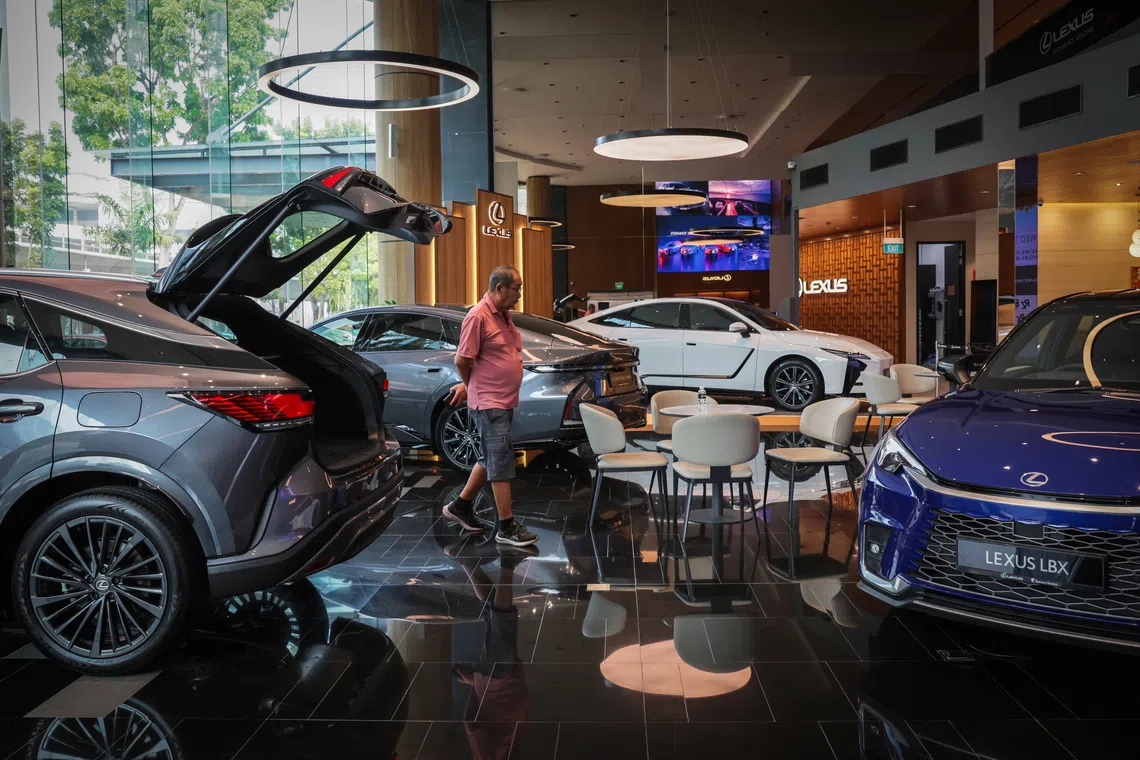
The proposed change will see those buying premium cars paying more for their COEs than for mass-market models.
Published Oct 08, 2026, 05:15 PM
Updated Oct 08, 2026, 05:15 PM
SINGAPORE - There has been much anticipation over how the certificate of entitlement (COE) system will be changed since the Government announced a review in March .
From consumers to motor dealers and academics, the general consensus is that the 36-year-old system is due for a makeover.
The Land Transport Authority (LTA) also saw the need to change the system, but its objective is not quite what many of us are fixated on.
Consumers are hoping that a review will bring COE prices down from the current elevated levels.
Since July 2025, the price of a Category A COE – which is meant for mass-market cars – has been in the six-digit range. At the most recent tender, it ended at $130,001 , compared with $80,501 in 2022.
Some motor dealers were hoping that the review would result in Category A COEs being shielded from luxury car models. The argument is that higher-end cars, with their higher selling price and fatter margins, push up Category A premiums.
The ongoing transition to electric cars worsened the situation, with manufacturers tuning higher-end electric models – from BMW to Tesla – to fit within the requirements of Category A.
This overcrowding of models has fuelled the premium hike, narrowing the price gap between Category A and Category B, which is the intended place for higher-end models.
The Category B COE price hit $130,100 at the latest tender, just $99 more than Category A. The price of a COE in this category was $95,856 in 2022.
This convergence undermines the original intent of the COE system to distinguish between mass-market cars and premium ones, which is what LTA wants to put right in its proposed changes put up for public consultation on Oct 8 .
It said plainly in the consultation paper that COE prices will continue to be determined by demand and the available supply of certificates, and that prices are not the subject of the review.
This is consistent with the statements made since the review was announced.
LTA has proposed merging the two car COE categories, and subjecting the COE premium set during regular tender exercises to an adjustment amount that is based on the car’s open market value (OMV), or base cost before taxes.
A higher-value car will incur a surcharge to its COE premium, while a mass-market one will receive a rebate. Cars banded in the middle tier will see no adjustments to the COE price.
Switching to the OMV is a better benchmark than technical specifications. In the past, engine size and power output thresholds failed to keep up with technical developments and LTA has had to play catch-up.
This included a period more than a decade ago, when luxury models with small engines slipped into Category A, chasing up the premium. In response, LTA introduced the power output threshold in 2014 to keep them out.
The arrival of electric vehicles triggered the tweak to the power threshold in 2022 to allow more mass-market options into Category A.
Using OMV as the benchmark anchors the system to a proven measure, as it is already the basis for vehicle taxes.
The mass versus higher-end distinction is far clearer through the OMV lens: the basic cost of the Tesla Model Y RWD 110 is $45,195 while the mass-market BYD Atto 3 is pegged at $27,889.
Under the current regime, both models are Category A COE models with the same premium, but under the proposed change, the Tesla’s COE will incur a surcharge while the BYD’s gets a rebate.
In this way, the COE cost difference between mass-market and higher-end cars is guaranteed and is unlikely to be distorted down the road by market developments.
Separating mass-market from premium does not mean lower COE prices
The idea to have a single COE category for cars was first mooted in 1999, when the then Government Parliamentary Committee for Communications conducted a review of the Vehicle Quota System – the foundation of the COE system.
The review resulted in the four car COE categories created in 1990 being merged into the familiar Category A and Category B regime.
The committee had wanted to combine them into one big category, and the two-category set-up was meant as an intermediate step following concerns from the public that buyers of bigger and luxury cars will outbid those buying smaller cars if there was only one car category.
The current proposal of having an OMV-based rebate-surcharge amount applied to the COE price could go some way towards preventing premium car buyers from putting up overly high bids, leaving out the mass-market car buyer.
But the truth remains that buyers of higher-end cars, with deeper pockets, will be able to push up the COE price. So even with the applicable rebate to soften the blow, the mass-market car buyer will likely still be bidding within an inflated baseline.
To help balance the scales, the surcharge has to be high enough to discourage luxury car buyers from over-bidding. At the same time, rebate amounts should be significant enough to ensure a meaningful gap for the mass-market car buyer.
LTA said it will take the historical price gaps between Category A and Category B COEs to determine the right amount.
In its proposal, the maximum gap between the highest rebate and the highest surcharge was $30,000. In the middle are cars that pay exactly the COE price, without rebate or surcharge.
As it is, a $15,000 surcharge or rebate either way of the neutral band will have a different significance, depending on whether the COE premium is closer to $130,000 or $90,000.
Having the quantum scale dynamically, as a percentage of the prevailing COE premium, may be a more responsive method. Another option is to use a rolling average of the COE premium over a few months to determine the discount and surcharge, so as to avoid big swings after every tender.
Supply trails demand, significantly
Clearly, COE prices are high because demand exceeds supply. But there is also a bottleneck in the COE supply, largely due to earlier policy decisions.
The supply of COE is set by the LTA, and is mostly driven by the vehicle deregistration rate.
There used to be an allowable growth included in the COE supply. In February 2018, the vehicle growth rate for cars and motorcycles was brought down to zero for 10 years till Jan 31, 2028.
Based on estimates by ST, there will likely be around 55,000 car registrations this year.
This is a modest rise from the 52,381 units in 2025, but nowhere near enough to absorb the demand from the 87,302 car registrations during the 2016 peak. These cars will be in the final year of their 10-year COE lifespan.
Supply is also not keeping pace with demand because LTA is using the four-quarter rolling average vehicle deregistration rate.
This rate, introduced in February 2023 to reduce the quarter-on-quarter volatility in supply as well as to stem the steep drop in vehicle deregistration rate around that time, means there is now a 12-month lag between a vehicle being scrapped and its COE returning to the bidding pool.
Owners usually shop for replacements months ahead of the COE expiry and the new car will take up a fresh COE before the old one is deregistered.
Deregistrations reached 44,364 in the first eight months of 2026, on track to exceed the 49,550 units for the whole of 2025.
While deregistrations are on the rise, these COEs will only appear in the bidding pool a year later. So while demand from existing car owners is now higher because of more cars being due for scrap, there may not be a surge in COE supply coming just yet.
Factoring the OMV into the COE equation fixes the glaring flaw in the current system where luxury cars and mass-market ones can end up having the same price for their certificates.
But drivers holding out for a more affordable COE premium will be disappointed because the COE supply calculation remains unchanged.
So while LTA may have succeeded in making premium car buyers pay a “fairer” share, until something is done to make the COE supply more responsive to deregistrations, drivers in Singapore may still have to pay an outsize price for their cars.
拟议的变更将导致购买高档汽车的消费者支付比购买大众市场车型更高的拥车证费用。
发布于 2026 年 10 月 8 日下午 5:15
更新于2026年10月8日下午5:15
新加坡——自政府3月份宣布对拥车证(COE)制度进行审查以来,人们对拥车证制度将如何改变一直充满期待。
从消费者到汽车经销商再到学者,普遍的共识是,这个已有 36 年历史的系统需要进行改革。
陆路交通管理局(LTA)也意识到了改革制度的必要性,但它的目标与我们许多人所关注的并不完全一致。
消费者希望此次审查能够降低拥车证价格,使其从目前的高位回落。
自2025年7月起,A类拥车证(面向大众市场车型)的价格已维持在六位数。在最近一次招标中,最终成交价为130,001美元,而2022年的价格为80,501美元。
一些汽车经销商希望此次审查能使A类拥车证不受豪华车型的影响。他们的理由是,高端车型售价更高、利润空间更大,会推高A类拥车证的溢价。
随着汽车制造商不断向电动汽车转型,情况变得更加糟糕,从宝马到特斯拉,制造商们都在调整高端电动车型,以符合 A 类要求。
车型过多导致溢价上涨,缩小了 A 类车型和 B 类车型(高端车型的目标市场)之间的价格差距。
在最近一次招标中,B类拥车证价格达到130,100美元,仅比A类高出99美元。2022年,该类别拥车证的价格为95,856美元。
这种融合破坏了拥车证制度区分大众市场汽车和高端汽车的初衷,而这正是陆路交通管理局希望在其 10 月 8 日公开征求意见的拟议变更中纠正的问题。
咨询文件中明确指出,拥车证价格将继续由需求和可用证书供应量决定,价格并非此次审查的主题。
这与审查宣布以来所作的声明一致。
陆路交通管理局提议将两类汽车拥车证合并,并对在常规招标过程中确定的拥车证溢价进行调整,调整金额以汽车的公开市场价值(OMV)或税前基本成本为准。
高价值车辆的拥车证溢价将增加附加费,而大众市场车辆则会获得折扣。中等价位的车辆拥车证价格则保持不变。
改用 OMV 标准比采用技术规格更能准确衡量发动机性能。过去,发动机尺寸和功率输出阈值未能跟上技术发展的步伐,导致陆路交通管理局 (LTA) 不得不奋力追赶。
这其中包括十多年前的一段时期,当时一些搭载小排量发动机的豪华车型被划入A类车辆,追逐溢价。为了应对这一情况,陆路交通管理局于2014年引入了功率输出门槛,以阻止此类车型进入A类车辆市场。
电动汽车的出现促使人们在 2022 年调整了功率门槛,以便让更多大众市场车型进入 A 类。
以 OMV 作为基准,可以将该系统与一个经过验证的衡量标准联系起来,因为它已经是车辆税的基础。
通过 OMV 的视角,大众市场与高端市场的区别就更加清晰了:特斯拉 Model Y RWD 110 的基本成本为 45,195 美元,而大众市场的比亚迪 Atto 3 的定价为 27,889 美元。
在现行制度下,这两款车型均为A类拥车证车型,溢价相同;但在拟议的变更下,特斯拉的拥车证将加收附加费,而比亚迪的拥车证将获得退税。
这样一来,大众市场汽车和高端汽车之间的拥车证成本差异就得到了保证,并且不太可能在未来受到市场发展的影响而发生扭曲。
将大众市场与高端市场区分开来并不意味着拥车证价格会降低。
1999 年,政府国会通讯委员会对车辆配额制度(拥车证制度的基础)进行审查时,首次提出了设立单一汽车拥车证类别的想法。
审查结果是,1990 年创建的四个汽车拥车证类别合并为大家熟悉的 A 类和 B 类制度。
委员会原本希望将它们合并为一个大类别,而两类设置则是为了应对公众的担忧而采取的过渡措施,公众担心如果只有一个汽车类别,购买大型豪华汽车的人会出价高于购买小型汽车的人。
目前提出的将基于 OMV 的回扣附加费应用于拥车证价格的方案,可以在一定程度上防止高端汽车买家出价过高,从而将大众市场汽车买家排除在外。
但事实仍然是,财力雄厚的高端车买家能够推高拥车证价格。因此,即使有相应的折扣来缓解冲击,大众市场购车者最终的出价可能仍然会处于一个虚高的基准范围内。
为了平衡市场供需,附加费必须足够高,以阻止豪华车买家竞价过高。同时,折扣金额也应足够大,以确保大众市场汽车买家能够获得显著的优惠。
陆路交通管理局表示,将参考A类和B类拥车证之间的历史价格差距来确定合适的金额。
在其提案中,最高回扣和最高附加费之间的最大差距为 30,000 美元。中间部分是支付拥车证价格的汽车,既没有回扣也没有附加费。
事实上,15,000 美元的附加费或回扣(无论高于还是低于中性区间)的意义都不同,具体取决于拥车证溢价更接近 130,000 美元还是 90,000 美元。
将量子规模动态调整为现行拥车证溢价的百分比,可能是一种更灵活的方法。另一种选择是使用几个月内拥车证溢价的滚动平均值来确定折扣和附加费,从而避免每次招标后出现大幅波动。
供应远落后于需求。
显然,拥车证价格高企是因为需求超过供应。但拥车证供应也存在瓶颈,这主要是由于早期的政策决定造成的。
拥车证的供应量由陆路交通管理局设定,主要受车辆注销率的影响。
过去拥车证供应量中包含一定的增长限额。2018年2月,汽车和摩托车的车辆增长率被降至零,为期10年,直至2028年1月31日。
根据《海峡时报》的估计,今年汽车注册量可能在55000辆左右。
这比2025年的52381辆略有增长,但远远不足以消化2016年高峰期87302辆汽车注册量的需求。这些车辆将处于其10年拥车证有效期的最后一年。
由于陆路交通管理局采用的是四个季度的滚动平均车辆注销率,因此供应也无法跟上需求。
该费率于 2023 年 2 月推出,旨在减少季度间供应的波动,并遏制当时车辆注销率的急剧下降,这意味着现在车辆报废与其拥车证重新进入竞标池之间存在 12 个月的滞后。
车主通常会在拥车证到期前几个月就开始购买替代车辆,新车会在旧车注销之前获得新的拥车证。
2026 年前八个月的注销登记数量达到 44,364 辆,有望超过 2025 年全年的 49,550 辆。
虽然注销车辆数量不断增加,但这些拥车证(COE)要一年后才会重新进入竞标池。因此,尽管现有车主的需求因更多车辆报废而上升,但拥车证供应量可能暂时不会出现激增。
将 OMV 纳入 COE 方程式可以解决当前系统中一个明显的缺陷,即豪华车和大众市场汽车的 COE 证书价格可能相同。
但那些期待更实惠的拥车证溢价的车主将会失望,因为拥车证供应量的计算方式仍然没有改变。
因此,尽管陆路交通管理局可能已经成功地让高端汽车买家支付了“更公平”的份额,但在采取措施使拥车证供应对注销登记做出更及时的反应之前,新加坡的司机可能仍然不得不为他们的汽车支付过高的价格。