New $170 million aviation maintenance and repair facility in Changi Creek to create over 500 jobs樟宜溪新建的价值1.7亿美元的航空维修设施将创造500多个就业岗位。
New ST Engineering airframe MRO facility in Changi Creek creates over 500 jobs and uses AI, drones and robotics to boost productivity. Read more at straitstimes.com.
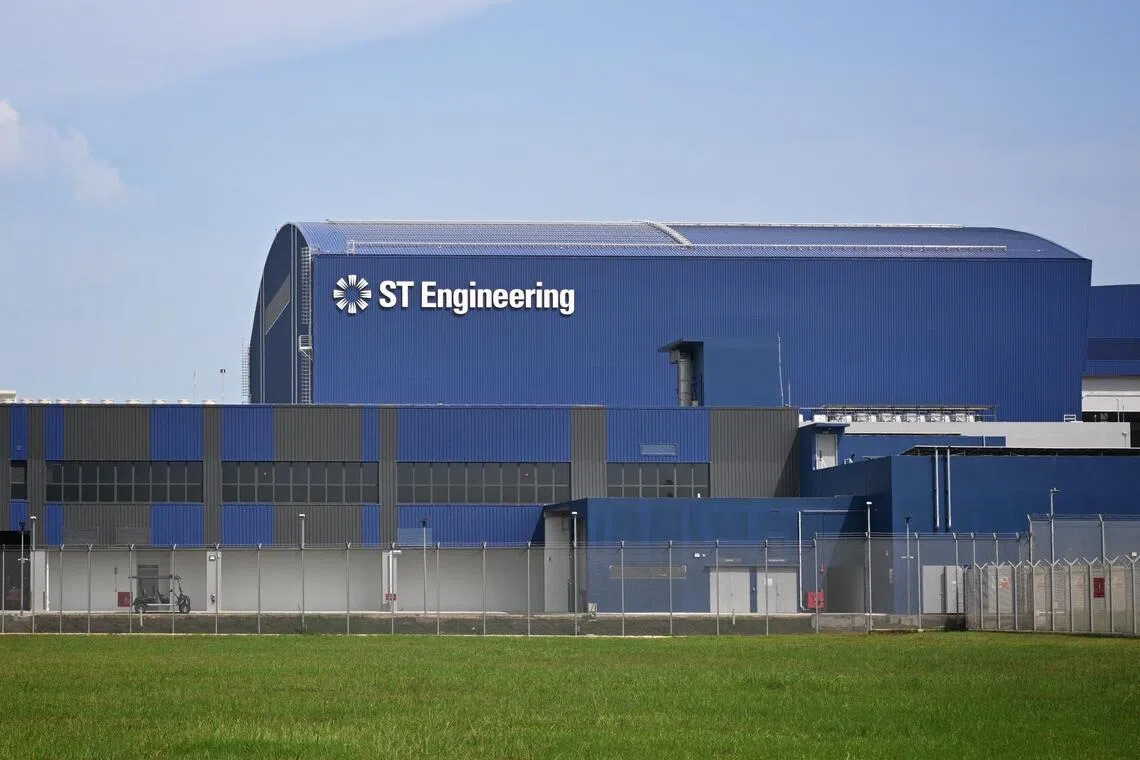
The new ST Engineering airframe MRO facility in Changi Creek.
Published Oct 09, 2026, 04:51 PM
Updated Oct 09, 2026, 04:51 PM
ST Engineering opened a $170 million airframe MRO facility in Changi Creek, creating over 500.
Deputy Prime Minister Gan Kim Yong said the new systems will cut manual work and allow engineers to do higher-value tasks.
The facility aims to raise productivity by 25% and will be able to service around 100 more widebody aircraft in Singapore each year.
SINGAPORE – A new $ 170 million airframe maintenance, repair and overhaul (MRO) facility in Changi Creek will employ more than 500 people and deploy new technologies like drones and robots to improve efficiency.
The facility – the fourth airframe MRO firm operated by ST Engineering in Singapore – will tap innovative technology like humanoid robots, drones and 3D printing, which are expected to ease work processes and boost productivity.
The 84,000 sqm facility features four widebody aircraft bays which, when fully operational, will add 40 percent additional capacity to the firm’s widebody airframe MRO network in Singapore, and translate into about 100 more of these aircraft serviced in Singapore a year.
Deputy Prime Minister and Minister for Trade and Industry (Trade) Gan Kim Yong – in his address at the facility’s opening on Oct 9 – said AI, robotics and automation will complement the capabilities of engineers and technicians, and enable them to take on higher-value work.
Deputy Prime Minister and Minister for Trade and Industry (Trade) Gan Kim Yong touring the hangar at the opening ceremony of ST Engineering's Changi Creek facility in Changi Airport on Oct 9, 2026. ST PHOTO: KEVIN LIM esengineer09 The Straits Times
Deputy Prime Minister and Minister for Trade and Industry (Trade) Gan Kim Yong touring the hangar at the opening ceremony of ST Engineering's Changi Creek facility in Changi Airport on Oct 9, 2026. ST PHOTO: KEVIN LIM esengineer09
He added that ST Engineering has long played an important role in strengthening the capabilities of Singapore enterprises and workforce within the sector.
He said: “The new facility is expected to support the creation of more than 500 jobs in ST Engineering’s airframe MRO business, including licensed aircraft engineers, technicians, and planning and production control specialists.
“ST Engineering is also equipping our people to take up these opportunities through in-house training and partnerships with our Institutes of Higher Learning. Over the past three years, it has trained over 250 local new hires.”
Gan added that he would encourage ST Engineering to expand on these efforts as the company grows, so that more Singaporeans can develop their skills and build rewarding careers in the aerospace sector.
ST Engineering, he said, also continues to work with home-grown small and medium-sized enterprises, and the Singapore research and development ecosystem to develop advanced solutions, help firms beef up their capabilities, improve productivity and build a track record in the aerospace sector.
“For example, ST Engineering is currently collaborating with a number of local robotics companies and A*Star to support the deployment of AI-enabled autonomous mobile robots in its operations.
“One such project will improve process time by over 80%, saving employees from walking more than 20,000 km across the warehouse floor and freeing up about 7,800 man-hours annually,” added Gan.
The robots are part of an automated system that transports aircraft parts, tools and materials from storage to the hangar floor, said ST Engineering in a statement on Oct 9.
EMBARGO: 2.30pm, Friday Oct 9, 2026. From right: Generic photo of the Autonomous Mobile Robots (AMRs) and Physical Al-powered humanoid robots at the ST Engineering airframe MRO facility at Changi Creek taken on Oct 1, 2026. The Straits Times
EMBARGO: 2.30pm, Friday Oct 9, 2026. From right: Generic photo of the Autonomous Mobile Robots (AMRs) and Physical Al-powered humanoid robots at the ST Engineering airframe MRO facility at Changi Creek taken on Oct 1, 2026.
The system also comprises a humanoid robot – still in the testing stages – which can retrieve, sort and transfer items from the storage system.
The humanoid robot can then put the items into a box for the autonomous mobile robots to transport to the hangars.
(EMBARGOED UNTIL 2.30PM ON OCT 9, 2026) The goods issuance and return operations (AI-GIRO), which utilises Bob the robot, on display at the opening ceremony of ST Engineering's Changi Creek facility in Changi Airport on Oct 9, 2026. ST PHOTO: KEVIN LIM esengineer09 The Straits Times
(EMBARGOED UNTIL 2.30PM ON OCT 9, 2026) The goods issuance and return operations (AI-GIRO), which utilises Bob the robot, on display at the opening ceremony of ST Engineering's Changi Creek facility in Changi Airport on Oct 9, 2026. ST PHOTO: KEVIN LIM esengineer09
The technology, defence and engineering group said it plans to introduce this system at its other facilities in Singapore.
As a whole, the new technologies at the Changi Creek facility will “transform” airframe MRO from a traditionally labour-intensive industry reliant on manual tasks into one that is more efficient and data-driven, said ST Engineering.
Kevin Chow, president of commercial aerospace at ST Engineering, speaking to reporters, said the firm’s long-term goal is to improve productivity by 25% by tapping such technological innovations.
For example, drones will be deployed in aircraft inspections at this facility. This reduces the need for technicians to climb onto scaffolding or lifts to conduct manual visual inspections of the top of the aircraft.
EMBARGO: 2.30pm, Friday Oct 9, 2026. Generic photo of the AI-RIS (Al Remote Inspection System) that uses a drone with a camera to inspect aircraft exteriors, complementing or replacing manual visual inspections carried out by technicians which have to reach the top of an aircraft via scaffolding or lifts, at the ST Engineering airframe MRO facility at Changi Creek taken on Oct 1, 2026. The Straits Times
EMBARGO: 2.30pm, Friday Oct 9, 2026. Generic photo of the AI-RIS (Al Remote Inspection System) that uses a drone with a camera to inspect aircraft exteriors, complementing or replacing manual visual inspections carried out by technicians which have to reach the top of an aircraft via scaffolding or lifts, at the ST Engineering airframe MRO facility at Changi Creek taken on Oct 1, 2026.
And AI tools can help analyse the video footage to identify corrosion, pain defects and surface dents.
As a result, the time taken to inspect an aircraft is cut to half a day, with only two engineers needed to review the footage. This is down from 1½ days for manual checks conducted by up to three technicians.
Also key to such aircraft inspections is the use of a camera mounted on a robotic arm, which incorporates AI models to help point out defects and missing components.
EMBARGO: 2.30pm, Friday Oct 9, 2026. Generic photo of the Al-VET (Visual Inspection) that uses a camera mounted on a robotic arm to capture detailed images during initial inspection at the ST Engineering airframe MRO facility at Changi Creek taken on Oct 1, 2026. For illustration purposes, the camera on the robotic arm in this photo is being deployed to inspect an engine part. The tool is, however, being developed to inspect landing gear and airframes. The Straits Times
EMBARGO: 2.30pm, Friday Oct 9, 2026. Generic photo of the Al-VET (Visual Inspection) that uses a camera mounted on a robotic arm to capture detailed images during initial inspection at the ST Engineering airframe MRO facility at Changi Creek taken on Oct 1, 2026. For illustration purposes, the camera on the robotic arm in this photo is being deployed to inspect an engine part. The tool is, however, being developed to inspect landing gear and airframes.
The tool is still being prepared to carry out inspection on landing gears and airframes, but it has been rolled out to help with checks on engine parts.
It will mainly be used to inspect an aircraft’s underside, as drones are unable to capture footage at that angle due to the position of their cameras.
This will cut the time required to inspect a gear or component from about from four hours in the past to 30 minutes now.
Also, an AI-powered monitoring system has been put in place across all four ST Engineering sites in Singapore, giving teams a real-time view of task completion, aircraft status and hangar availability.
Intelligent maintenance operations centre demonstration at the ST Engineering airframe MRO facility at Changi Creek on Oct 1, 2026. Used across ST Engineering?s four airframe maintenance sites in Singapore, this AI-powered monitoring system gives teams a real-time view of task completion, aircraft status and hangar availability. The Straits Times
Intelligent maintenance operations centre demonstration at the ST Engineering airframe MRO facility at Changi Creek on Oct 1, 2026. Used across ST Engineering?s four airframe maintenance sites in Singapore, this AI-powered monitoring system gives teams a real-time view of task completion, aircraft status and hangar availability.
Usually, technicians and engineers needed to sign off on a lot of paperwork, and projects were tracked manually using paper records.
The new system will facilitate the digitalisation of data and provide live visibility of maintenance progress, allowing engineers to make faster and better-informed decisions.
To improve maintenance turnaround time, the facility is also equipped with 3D-printing facilities capable of repairing damaged parts and reproducing components on demand.
3D-printing of aircraft parts displayed at the ST Engineering airframe MRO facility at Changi Creek on Oct 1, 2026. Aircraft parts can be produced quickly on demand with in-house 3D printing functions, by reverse-engineering damaged components to reproduce repaired ones. The Straits Times
3D-printing of aircraft parts displayed at the ST Engineering airframe MRO facility at Changi Creek on Oct 1, 2026. Aircraft parts can be produced quickly on demand with in-house 3D printing functions, by reverse-engineering damaged components to reproduce repaired ones.
Self-driving vehicles will also ply the hangar floor to transport aircraft parts between facilities, replacing manually operated forklifts.
EMBARGO: 2.30pm, Friday Oct 9, 2026. Generic photo of the AI-FAST, an autonomous guided vehicle (AGV), designed to transport heavy materials within the hangar at the ST Engineering airframe MRO facility at Changi Creek taken on Oct 1, 2026. The Straits Times
EMBARGO: 2.30pm, Friday Oct 9, 2026. Generic photo of the AI-FAST, an autonomous guided vehicle (AGV), designed to transport heavy materials within the hangar at the ST Engineering airframe MRO facility at Changi Creek taken on Oct 1, 2026.
Able to carry 500kg of materials, the vehicle uses AI to recognise where items are and how to pick them up.
Two to three such vehicles will be deployed at each of the four ST Engineering airframe MRO sites in Singapore from 2027.
Among the new ST Engineering hires this year is 26-year-old Georgia Lee, a senior project engineer who has been involved in the deployment of drones for aircraft inspections.
As she was always interested in aerospace engineering, Lee said being involved in the project allowed her to get an unmanned aircraft pilot licence to operate drones.
Esther Loi is a journalist at The Straits Times, where she covers transport issues.
Aviation/Aerospace sector
Engineers/Engineering
位于樟宜溪的新加坡科技工程公司新飞机机身MRO设施。
发布于 2026 年 10 月 9 日下午 4:51
更新于2026年10月9日下午4:51
新加坡科技工程公司在樟宜溪开设了一家耗资 1.7 亿美元的飞机机身 MRO 设施,创造了 500 多个就业岗位。
副总理颜金勇表示,新系统将减少人工劳动,使工程师能够从事更高价值的任务。
该设施旨在将生产效率提高 25%,每年将能够为新加坡多维修约 100 架宽体飞机。
新加坡——樟宜溪新建一座耗资 1.7 亿美元的飞机机身维护、修理和大修 (MRO) 设施,将雇用 500 多名员工,并部署无人机和机器人等新技术来提高效率。
该设施是新加坡新科工程公司在新加坡运营的第四家飞机机身维修、修理和大修 (MRO) 公司,将采用人形机器人、无人机和 3D 打印等创新技术,有望简化工作流程并提高生产力。
该设施占地 84,000 平方米,设有四个宽体飞机停机坪,全面投入运营后,将为该公司在新加坡的宽体飞机机身 MRO 网络增加 40% 的产能,相当于每年在新加坡多维修约 100 架此类飞机。
副总理兼贸易工业部长官颜金勇在10月9日该设施的开幕式上致辞时表示,人工智能、机器人和自动化将补充工程师和技术人员的能力,使他们能够承担更高价值的工作。
2026年10月9日,副总理兼贸工部长颜金勇在樟宜机场新科工程樟宜溪工厂开幕仪式上参观机库。(海峡时报照片:KEVIN LIM esengineer09)
2026年10月9日,副总理兼贸工部长颜金勇在樟宜机场新科工程樟宜溪工厂开幕仪式上参观机库。(海峡时报摄影:KEVIN LIM esengineer09)
他还补充说,新加坡科技工程公司长期以来在增强新加坡企业和行业劳动力的能力方面发挥着重要作用。
他表示:“新设施预计将为新加坡科技工程公司的飞机机身维修业务创造 500 多个就业岗位,包括持证飞机工程师、技术人员以及计划和生产控制专家。
“新加坡科技工程公司也通过内部培训和与高等院校的合作,帮助员工把握这些机遇。过去三年,公司已培训了超过250名本地新员工。”
颜先生补充说,随着新加坡科技工程公司的发展,他将鼓励该公司扩大这些努力,以便让更多新加坡人能够发展技能,并在航空航天领域建立有意义的职业生涯。
他表示,ST Engineering 也继续与本土中小企业以及新加坡研发生态系统合作,开发先进的解决方案,帮助企业增强能力、提高生产力,并在航空航天领域建立良好的业绩记录。
“例如,ST Engineering 目前正与多家本地机器人公司和新加坡科技研究局 (A*Star) 合作,以支持在其运营中部署人工智能赋能的自主移动机器人。
甘补充道:“其中一个项目将使流程时间缩短 80% 以上,使员工无需在仓库内行走超过 20,000 公里,每年可节省约 7,800 工时。”
新加坡科技工程公司在 10 月 9 日的一份声明中表示,这些机器人是自动化系统的一部分,该系统负责将飞机零件、工具和材料从仓库运送到机库地面。
禁发日期:2026年10月9日星期五下午2点30分。右图:2026年10月1日拍摄于新加坡科技工程公司樟宜溪飞机机身维修设施的自主移动机器人(AMR)和实体人工智能驱动的人形机器人通用照片。《海峡时报》
禁发日期:2026 年 10 月 9 日星期五下午 2:30。右图:2026 年 10 月 1 日在樟宜溪 ST Engineering 飞机机身 MRO 设施拍摄的自主移动机器人 (AMR) 和物理人工智能驱动的人形机器人的通用照片。
该系统还包括一个人形机器人(目前仍处于测试阶段),它可以从存储系统中检索、分类和转移物品。
然后,人形机器人可以将物品放入箱子中,由自主移动机器人运送到机库。
(2026年10月9日下午2点30分前禁止发布)在2026年10月9日樟宜机场新科工程樟宜溪工厂的开幕仪式上,展示了利用机器人Bob实现的货物收发操作(AI-GIRO)。(海峡时报照片:KEVIN LIM esengineer09)
(2026年10月9日下午2:30前禁止发布)在2026年10月9日樟宜机场新科工程樟宜溪工厂的开幕仪式上,展示了利用机器人Bob实现的货物收发操作(AI-GIRO)。(ST图片:KEVIN LIM esengineer09)
这家科技、国防和工程集团表示,计划在新加坡的其他设施中引入该系统。
新科工程表示,樟宜溪工厂的新技术将使飞机机身维修、修理和大修 (MRO) 行业从传统的劳动密集型、依赖人工操作的行业“转型”为更高效、数据驱动的行业。
新科工程商用航空航天总裁周凯文在接受记者采访时表示,公司的长期目标是利用此类技术创新将生产力提高 25%。
例如,该设施将部署无人机进行飞机检查。这将减少技术人员爬上脚手架或升降机对飞机顶部进行人工目视检查的需要。
禁发日期:2026年10月9日星期五下午2点30分。照片为AI-RIS(人工智能远程检测系统)通用图,该系统使用带有摄像头的无人机对飞机外部进行检测,以补充或取代技术人员通过脚手架或升降机到达飞机顶部进行的人工目视检查。照片拍摄于2026年10月1日,地点为新加坡科技工程公司位于樟宜溪的机身维修、修理和大修(MRO)设施。《海峡时报》
禁发日期:2026 年 10 月 9 日星期五下午 2:30。这是一张通用照片,展示了 AI-RIS(人工智能远程检查系统),该系统使用带有摄像头的无人机来检查飞机外部,以补充或取代技术人员通过脚手架或升降机到达飞机顶部进行的人工目视检查。照片拍摄于 2026 年 10 月 1 日,地点是樟宜溪的 ST Engineering 机身 MRO 设施。
人工智能工具可以帮助分析视频素材,识别腐蚀、油漆缺陷和表面凹痕。
因此,飞机检查时间缩短至半天,只需两名工程师查看录像即可。而此前,人工检查需要多达三名技术人员耗时一天半。
此类飞机检查的关键还在于使用安装在机械臂上的摄像头,该摄像头集成了人工智能模型,可以帮助指出缺陷和缺失的部件。
禁发日期:2026年10月9日星期五下午2点30分。照片为Al-VET(目视检查)通用图,该设备使用安装在机械臂上的摄像头,在新加坡科技工程公司位于樟宜溪的飞机机身MRO设施进行初步检查时拍摄细节图像。照片拍摄于2026年10月1日。为便于说明,照片中机械臂上的摄像头正在用于检查发动机部件。然而,该工具目前正在开发用于检查起落架和机身。《海峡时报》
发布禁令:2026年10月9日(星期五)下午2:30。照片为Al-VET(目视检查)通用图,该设备使用安装在机械臂上的摄像头,在新加坡科技工程公司(ST Engineering)位于樟宜溪的飞机机身MRO设施进行初始检查时拍摄详细图像。照片拍摄于2026年10月1日。为便于说明,照片中机械臂上的摄像头正在用于检查发动机部件。然而,该工具目前正在开发用于检查起落架和机身。
该工具目前仍在准备中,用于对起落架和机身进行检查,但已投入使用,用于辅助检查发动机部件。
它将主要用于检查飞机的底部,因为无人机由于摄像头位置的原因无法从该角度拍摄画面。
这将使检查齿轮或部件所需的时间从过去的大约 4 小时缩短到现在的 30 分钟。
此外,新加坡所有四个 ST Engineering 基地都部署了人工智能监控系统,使团队能够实时了解任务完成情况、飞机状态和机库可用性。
2026年10月1日,新加坡科技工程公司(ST Engineering)位于樟宜溪的飞机机身维修中心进行了智能维护运营中心演示。这套人工智能监控系统已应用于新加坡科技工程公司在新加坡的四个飞机维修基地,可为团队提供任务完成情况、飞机状态和机库可用性的实时信息。《海峡时报》
2026 年 10 月 1 日,新加坡科技工程公司在樟宜溪的机身 MRO 设施进行了智能维护运营中心演示。该人工智能监控系统已在新加坡科技工程公司的四个机身维护基地投入使用,使团队能够实时了解任务完成情况、飞机状态和机库可用性。
通常情况下,技术人员和工程师需要签署大量文件,项目进度也是通过纸质记录进行人工跟踪的。
新系统将促进数据数字化,并提供维护进度的实时可见性,使工程师能够更快地做出更明智的决策。
为了提高维护周转时间,该设施还配备了 3D 打印设备,能够修复损坏的零件并按需复制组件。
2026年10月1日,新加坡科技工程公司位于樟宜溪的飞机机身维修中心展示了飞机零部件的3D打印技术。该中心利用内部3D打印设备,通过对受损部件进行逆向工程,复制修复后的部件,从而能够快速按需生产飞机零部件。《海峡时报》
2026年10月1日,新加坡科技工程公司位于樟宜溪的飞机机身维修设施展示了飞机零件的3D打印技术。该设施利用内部3D打印功能,通过对损坏的部件进行逆向工程,复制修复后的部件,从而可以按需快速生产飞机零件。
自动驾驶车辆还将穿梭于机库地面,在各个设施之间运输飞机部件,取代人工操作的叉车。
发布禁令:2026年10月9日星期五下午2点30分。图片为AI-FAST通用照片,该车是一款自主导引车(AGV),用于在樟宜溪新加坡科技工程公司(ST Engineering)的飞机机身维修、修理和大修(MRO)设施的机库内运输重型材料。照片拍摄于2026年10月1日。《海峡时报》
禁发日期:2026 年 10 月 9 日星期五下午 2:30。AI-FAST 是一款自主导引车 (AGV),设计用于在樟宜溪 ST Engineering 飞机机身 MRO 设施的机库内运输重型材料。照片拍摄于 2026 年 10 月 1 日。
该车辆能够运载 500 公斤的物料,并利用人工智能来识别物品的位置以及如何拾取它们。
从 2027 年起,新加坡科技工程公司在新加坡的四个飞机机身维修保养基地将分别部署两到三辆这样的车辆。
今年新加坡科技工程公司新招的员工中,有一位26岁的高级项目工程师Georgia Lee,她参与了无人机在飞机检查中的部署工作。
李女士一直对航空航天工程很感兴趣,她说参与这个项目让她获得了无人机飞行员执照,可以操作无人机。
埃丝特·罗伊是《海峡时报》的记者,主要报道交通运输问题。
航空航天领域
工程师/工程