Motorists, dealers waiting to see how proposed COE changes will impact car prices车主和经销商都在观望拥车证(COE)变更提案将如何影响汽车价格。
Motorists and dealers weigh proposed COE changes as LTA plans to merge car categories and adjust prices by vehicle value. Read more at straitstimes.com.
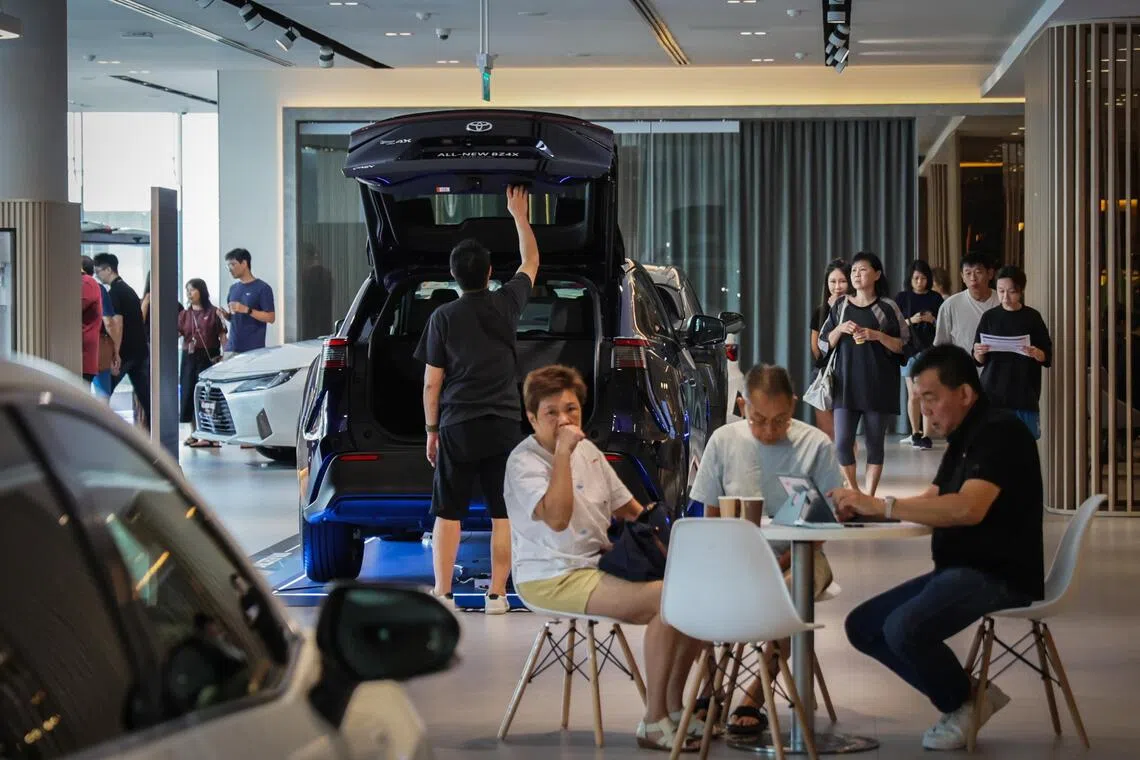
The Land Transport Authority published a consultation paper on Oct 8 outlining proposals to merge Categories A and B in the COE system.
Published Oct 09, 2026, 07:47 PM
Updated Oct 09, 2026, 07:47 PM
Motorists and dealers are waiting for clarity on proposed COE changes, while some buyers may purchase now before current rebate schemes end.
LTA wants to merge COE Categories A and B and use car value to set rebates or surcharges, but dealers doubt prices will fall.
Dealers warn of unclear banding, possible gaming of OMV values, and higher car costs from future EV incentive cuts and VES changes.
SINGAPORE – Car dealers and motorists are taking a wait-and-see approach to the proposed changes to the certificate of entitlement (COE) system, although some buyers are eyeing a car purchase now before current rebate schemes are removed.
Car owners like Gina Koh, for instance, said she was in no rush to buy a car now, especially since it is unclear if there will be changes to the COE renewal scheme.
The 38-year-old, who works in the education sector added that the COE for the Nissan Note she drives now expires at the end of 2027, and she wants to see if it will make more financial sense to renew her COE, or buy a new car.
Similarly, sales manager Ben Tjhin, who is in his 30s and drives a car with a COE that also expires in end-2027, said the proposed changes are unlikely to have much of an impact on him at this stage.
On Oct 8, the Land Transport Authority (LTA) published a consultation paper in which it outlined proposals to merge categories A and B into a single category , and then apply a rebate or surcharge to the prevailing COE price based on the car’s value.
Ron Lim, the sales and marketing head of Tan Chong Motor Sales, said merging Category A and B COEs into a common pool is easy to understand, but it is not so clear how the level of rebate or surcharge based on a car’s value will be determined.
Lim was among 11 motor dealers The Straits Times spoke to who said they do not expect the proposed changes to bring down COE prices. In the latest COE tender exercise on Oct 7 , a Category A certificate cost $130,001 while the Category B premium was $130,100.
LTA suggested two possible banding systems that could be implemented. One has three bands while the other has five.
Under the three-band option, cars in the lowest band get a rebate of $15,000, while those in the highest band incur a $15,000 surcharge.
Cars in the middle band will pay the full COE price with no rebate or surcharges.
The five-band option includes two bands with smaller adjustments – a rebate or surcharge of $7,500, depending on the band the car falls in.
LTA said it will determine the band that the car will fall under based on the median open market value (OMV), which is the price of a car before taxes.
However, the OMV is a fluctuating figure, said Lim, owing to external factors such as foreign currency exchange rates and supply chain changes.
“The current parameters, while insufficient, still have their merits,” he said.
Category A COEs are meant for cars with an engine capacity that does not exceed 1,600cc and a power output of 130bhp, or for electric vehicles (EVs), up to 110kW.
Carmakers have lately started tuning high-end cars to fit into Category A, resulting in premiums for the mass-market category converging with the prices of Category B COEs. This was a key factor that led to the COE review exercise.
Lim said the median OMV of the car model is not a figure that is easily transparent to the public, and its derivation can be skewed.
For instance, a parallel importer can bring in a model with an OMV that is lower than one brought in by an authorised dealer. That will lower the car’s median OMV, he added.
LTA said it will refer to the OMV of the cars registered in the previous year to determine the car’s banding under the proposed system.
Vantage Automotive managing director Adelene Tan – whose dealership distributes BYD in Singapore – said she is wondering how facelifted models will be handled under the proposed regime.
When cars go through mid-life updates, their OMVs can change when different equipment or features are added to the model. So, it would not be accurate to determine the banding based on the median OMV of the pre-facelift model.
With the proposed change, motor dealers might still try to lower the OMVs of their cars to get them into a more favourable band.
For electric vehicles, where the battery is the costliest component, Premium Automobiles managing director Lee Hoe Lone said dealers could turn to offering smaller battery capacity models, and thus reduced operating range.
While this could lower their OMVs, it could also result in an electric car having to get a charge after 300km or so, instead of about 400km now, which seems like a poorer ownership experience, he added.
Several motorists also said they are concerned that those with deeper pockets – who tend to go for cars that fall into Category B – could end up muscling out those looking for mass-market options, if a single passenger car category is created under the mooted plan.
Regional business development manager Patrick Yap, who is a Tesla owner, said: “Combining the two categories will not add COEs, so prices would still depend on supply and demand.”
Mazda Singapore managing director Jason Lim said the COE is not the only component making up the total price of the car.
The impending reduction in incentives for electric vehicles and the corresponding increase in penalties for non-EVs from Jan 1 means that cars will cost more after 2026, even if the COE price remains unchanged, he added.
The Mazda 3, for example, will incur a $7,500 surcharge under the Vehicular Emissions Scheme, up from $0 currently.
Ng Lee Kwang, a veteran who has been in the motor trade for over 30 years, said that if the changes kick in, dealers will need a few rounds to figure out the appropriate COE price.
He said: “This might be a good window to secure a not-so-expensive COE”.
Lee Nian Tjoe is senior transport correspondent at The Straits Times, where he also oversees the Motoring section.
Esther Loi is a journalist at The Straits Times, where she covers transport issues.
Aqil Hamzah is a transport journalist at The Straits Times. He is also interested in issues related to crime and technology.
陆路交通管理局于 10 月 8 日发布了一份咨询文件,概述了合并拥车证制度中 A 类和 B 类的提案。
发布于 2026 年 10 月 9 日晚上 7:47
更新于2026年10月9日晚上7:47
车主和经销商都在等待有关拥车证变更提案的明确信息,而一些买家可能会在目前的回扣计划结束前购买车辆。
陆路交通管理局希望合并拥车证A类和B类,并以车辆价值来设定回扣或附加费,但经销商怀疑价格是否会下降。
经销商警告称,分级制度不明确,OMV 值可能存在造假,而且未来电动汽车激励措施削减和车辆排放标准调整会导致汽车成本上涨。
新加坡——尽管一些购车者正考虑在目前的回扣计划取消之前购买汽车,但汽车经销商和车主对拥车证(COE)制度的拟议变更持观望态度。
例如,像 Gina Koh 这样的车主表示,她现在并不急于买车,尤其是在拥车证续期计划是否会发生变化尚不明确的情况下。
这位 38 岁、在教育行业工作的女士补充说,她现在驾驶的日产 Note 的拥车证将于 2027 年底到期,她想看看续签拥车证还是买辆新车在经济上更划算。
同样,30多岁的销售经理本·金(Ben Tjhin)表示,他驾驶的汽车的拥车证也将在2027年底到期,他表示,拟议的变更目前不太可能对他产生太大影响。
10 月 8 日,陆路交通管理局 (LTA) 发布了一份咨询文件,其中概述了将 A 类和 B 类合并为一类,然后根据汽车价值对现行拥车证价格进行回扣或附加费的提议。
陈唱汽车销售公司销售及市场主管林荣表示,将A类和B类拥车证合并到一个公共池中很容易理解,但如何根据汽车价值确定回扣或附加费的水平却不太清楚。
林先生是《海峡时报》采访的11位汽车经销商之一,他们都表示不认为拟议的改革会降低拥车证(COE)的价格。在10月7日举行的最新一次拥车证招标中,A类拥车证的价格为130,001新元,B类拥车证的价格为130,100新元。
LTA提出了两种可行的频段划分方案。一种方案包含三个频段,另一种方案包含五个频段。
根据三级评级方案,最低档的汽车可获得 15,000 美元的折扣,而最高档的汽车则需缴纳 15,000 美元的附加费。
中等价位的车辆将支付全额拥车证价格,不享受任何折扣或附加费。
五段式选项包括两个调整幅度较小的段式——根据车辆所属的段式,可获得 7,500 美元的退款或附加费。
陆路交通管理局表示,将根据汽车税前价格(即市场中位数价格)来确定汽车所属的等级。
林先生表示,由于外汇汇率和供应链变化等外部因素的影响,OMV是一个波动的数值。
他说:“目前的参数虽然不足,但仍然有其优点。”
A类拥车证适用于发动机排量不超过1600cc、功率输出不超过130马力的汽车,或功率不超过110千瓦的电动汽车。
近来,汽车制造商开始对高端车型进行调整,使其符合A类拥车证的要求,导致大众市场车型的溢价与B类拥车证的价格趋于一致。这是促成拥车证审查的关键因素之一。
林先生表示,汽车型号的OMV中位数并不是一个容易让公众了解的数字,而且其推导过程可能存在偏差。
例如,平行进口商可以进口一款OMV低于授权经销商进口车型的车辆。这将降低该车的OMV中位数,他补充道。
陆路交通管理局表示,将参考上一年注册车辆的官方市场价值(OMV)来确定拟议系统下车辆的等级。
Vantage Automotive 的总经理 Adelene Tan(该公司在新加坡经销比亚迪汽车)表示,她想知道在拟议的制度下,改款车型将如何处理。
汽车进行中期改款时,由于增加了不同的设备或功能,其市场平均价格(OMV)也会发生变化。因此,根据改款前车型的OMV中位数来确定价格区间是不准确的。
即使做出上述改变,汽车经销商可能仍然会试图降低汽车的OMV(官方市场价值),使其进入更有利的区间。
Premium Automobiles 的总经理 Lee Hoe Lone 表示,对于电池成本最高的电动汽车来说,经销商可能会转向提供电池容量较小的车型,从而减少续航里程。
他补充说,虽然这可能会降低电动汽车的市场价值,但也可能导致电动汽车行驶约 300 公里后需要充电,而不是像现在这样行驶约 400 公里,这似乎会降低用户的使用体验。
一些车主也表示,他们担心,如果按照拟议的计划创建一个单一的乘用车类别,那么那些财力雄厚的人(他们倾向于购买 B 类汽车)最终可能会挤走那些寻求大众市场选择的人。
特斯拉车主、区域业务发展经理 Patrick Yap 表示:“将这两类车辆合并不会增加拥车证数量,因此价格仍将取决于供需关系。”
马自达新加坡董事总经理林俊杰表示,拥车证并不是构成汽车总价的唯一组成部分。
他补充说,从1月1日起,电动汽车补贴即将减少,非电动汽车的罚款也将相应增加,这意味着即使拥车证价格保持不变,2026年后汽车的成本也会更高。
例如,根据车辆排放计划,马自达 3 将需缴纳 7,500 美元的附加费,而目前为 0 美元。
在汽车行业从业超过 30 年的资深人士吴利光表示,如果这些变化开始实施,经销商需要几轮才能确定合适的拥车证价格。
他说:“这可能是获得不太昂贵的拥车证的好时机。”
李念祖是《海峡时报》的高级交通记者,同时负责汽车版块。
埃丝特·罗伊是《海峡时报》的记者,主要报道交通运输问题。
阿基尔·哈姆扎是《海峡时报》的交通记者。他也对犯罪和科技相关议题感兴趣。