Accountability or a witch hunt? Doxxing blurs the line, and it's getting more common是追究责任还是政治迫害?人肉搜索模糊了界限,而且这种情况越来越普遍。
From viral call-outs to crowdsourced sleuthing, exposing someone's identity online can quickly have consequences far beyond the original post. Greater awareness is needed of the harm that can follow when people join in public shaming or online vigilantism.
From viral call-outs to crowdsourced sleuthing, exposing someone's identity online can quickly have consequences far beyond the original post. Greater awareness is needed of the harm that can follow when people join in public shaming or online vigilantism.
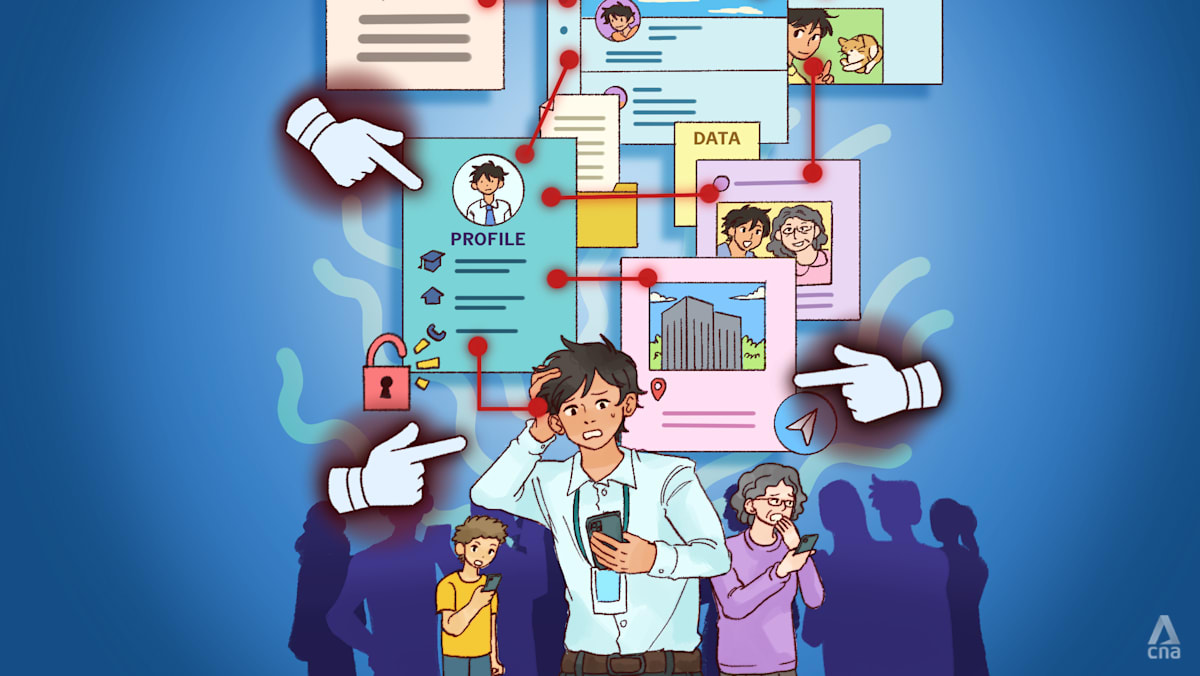
With the proliferation of social media platforms and the wealth of personal data people share about themselves online, doxxing has become easier and more commonplace. (Illustration: CNA/Clara Ho)
This audio is generated by an AI tool.
Hell has no fury like a lover scorned – especially if they have an internet connection and enough of their partner's personal information. That was the case for one 60-year-old man whose extra-marital affair blew up in his face spectacularly.
When the man spurned his mistress early this year, the woman took to Facebook to dox him, laying their sordid affair bare for all and sundry. When he tried to avoid her, she took to calling his office.
And she didn't stop there. The woman also approached the man's wife by pretending to be a customer of her business and befriending her.
Mr Ray Louis, founder of Ray Louis Law Corporation and the lawyer who represented the man, said that his client had to get a court order to stop the doxxing and harassment.
CNA Games Guess Word Crack the word, one row at a time Buzzword Create words using the given letters Mini Sudoku Tiny puzzle, mighty brain teaser Mini Crossword Small grid, big challenge Word Search Spot as many words as you can Show More Show Less
It's the type of case that might come to mind if one were to think about what doxxing means: one party splashing another's identity and personal information online to shame and harass them.
But sometimes, simply venting frustrations publicly can inadvertently mobilise an online mob.
When university student Mabel Kee took to YouTube to unpack her ex-fiance's alleged infidelity in a 50-minute video, there was no intention to dox the parties involved, she told CNA.
In her video, the 22-year-old used nicknames instead of the full names of her ex and the alleged third party, and generic terms such as "Block ABC" to refer to the woman's public housing unit.
Ms Kee, who posted the video after friends and followers had asked about her breakup, expected the talk around her relationship to die down. Instead, her gripping tale, complete with chat logs and Grab receipts, quickly amassed over a million views.
At first, Ms Kee found the online responses validating. She had been second-guessing if the red flags she had spotted in her relationship were normal.
"Everybody kept giving me all the support that I really needed at that time," she said.
Even when someone does not intend to dox or harass another person, it can be difficult to control the public reaction once a post goes viral. (Photo: iStock)
Soon, however, things got out of hand. Despite Ms Kee's attempts to obscure identifying details, people soon figured out the alleged third party's name and address from innocuous clues, such as a dim sum restaurant near the woman's home.
Some two weeks after Ms Kee posted the video, the Online Safety Commission (OSC), a government agency which helps victims of online harms, reached out to inform her that she would have to edit the video if she wanted to keep it live.
Ms Kee said she was told that mentioning the other woman's neighbourhood could be considered doxxing, and that it would need to be removed from the video.
Rather than painstakingly edit every mention of the neighbourhood out – there were many – she decided it would be best to simply take the video down.
Looking back, Ms Kee acknowledged that it was fair for OSC to intervene. "I mean, people did find her (the woman) somehow, through my video, even though I didn't intend it," she said.
"I thought I was being careful, but it wasn't enough."
Indeed, experts said that doxxing has undergone a profound transformation over the years.
In some cases, such as Ms Kee's, a person might not even intend to dox another, but other internet users end up doing the dirty work.
It is a far cry from its origins. An academic said that doxxing began in hacker subcultures.
In its earliest form, in the 1990s, doxxing was used within underground piracy networks to expose individuals who violated community norms.
Associate Professor Brian Lee, from the School of Humanities and Behavioural Sciences at the Singapore University of Social Sciences (SUSS), said: "In those early years, doxxing required a degree of technical competence and was largely confined to niche online communities … The new media landscape today is very different."
Now, with the proliferation of social media platforms and the wealth of personal data people share about themselves online, doxxing has become easier and more commonplace.
Although it can be tempting to think that only those chronically online are at risk, the truth is that anyone can be targeted.
Early data from OSC indicates that online harms in Singapore reach a wide audience, affecting men and women, young and old in equal measure. The commission was launched on Jun 29 .
The youngest victim that OSC had seen was a seven-year-old who was doxxed, while the oldest was a 68-year-old who faced online harassment.
Of the online harms that OSC helps to target – including intimate image abuse, online stalking and online harassment – doxxing has emerged as the top concern so far, making up 44 per cent of reports.
The commission received roughly equal numbers of complaints from men and women.
Lawyers and online harms experts largely agree that existing doxxing laws are sufficient and that creating the OSC helps victims seek some recourse.
But they also believe that doxxing is only going to become a bigger problem in society, because at its root are issues that are difficult to solve.
These include the growing tendency for people to take grievances online and join the internet mobs, playing the role of judge, jury and executioner.
WHAT COUNTS AS DOXXING
The Online Safety (Relief and Accountability) Act 2025 states that doxxing refers to "the publication of any identity information of a person that a reasonable person would conclude was likely to have been intended to cause harassment, alarm, distress or humiliation".
This "identity information" refers to anything that can identify a victim such as photos, videos, names, contact details or even information about their family.
Mr Fong Wei Li, managing director of law firm Forward Legal, said that the "essence" of doxxing has not really changed over the years, even though platforms have.
Men and women have been affected by online harms at nearly equal rates, based on cases handled by the Online Safety Commission so far. (Photo: iStock)
In practice, however, doxxing can serve as an umbrella term for a wide range of situations.
It can be as simple as posting someone's full name online.
This was what happened five years ago to a 32-year-old. She wanted to be known only as Ms C due to her unpleasant experience.
She had picked up an item from a Carousell seller on her friend's behalf. After Ms C told her friend how the seller had left her waiting for more than 20 minutes, her friend left a four-star review on the site.
This was enough to provoke the seller's ire. He posted Ms C's full name in response to the review.
Ms C believed that the seller obtained her name from her PayLah transaction. This was before the payment application concealed names.
"After this, I changed my PayLah name to my initials. I also got all my friends to do the same," she said. "I was afraid he would find my LinkedIn account and my workplace because he had my name."
Even though other internet users did not harass Ms C, the seller's action is still considered doxxing. Fortunately, Carousell took down the comment revealing her full name, she added.
Doxxing can also happen within a closed group.
Mr Louis, the lawyer, is handling a case involving a primary school boy who was falsely accused in a WhatsApp chat group of stealing a girl's pen.
The girl's parents had taken to the chat to identify the boy and harass his parents, Mr Louis said. The boy's parents are considering legal action, he added.
Dr Chew Han Ei, Adjunct Senior Research Fellow at the Institute of Policy Studies (IPS), said that besides the straightforward disclosure of identity information, doxxing today can involve more subtle "detective work".
Someone does not necessarily have to post a home address or phone number. A photograph, workplace, old username or location may be enough. Other people can then search across platforms and join the dots.
"So the risk increasingly comes from 'linkability'," Dr Chew said.
"Little bits of information that look harmless on their own can become very revealing when somebody pieces them together. And once that information has jumped platforms, removing the original post may already be too late."
Sometimes, a post can start innocently enough, but then spiral out of control when other internet users pile on, Dr Chew said. He also sits on the board of SG Her Empowerment, a non-profit organisation that supports doxxing victims, among its other advocacy work.
As Mr Louis and Mr Fong pointed out, the intention to cause harm is a key element of the legal definition of doxxing. Yet, even a well-intentioned post can trigger harm that is remarkably similar to doxxing.
Mr Fong offered a scenario: Suppose a stranger pushes your elderly father to the ground and walks off.
You do not know who the person is, so you post footage of the incident online and ask the public for help identifying the individual. You aim to find the person so that the police can act on the matter. If you have no intention of causing distress, this may not be considered doxxing, he said.
Once the video goes viral, however, strangers may track the person down, post their address and shame them online, Mr Fong noted. "The harm that follows looks exactly like doxxing, even if you never meant it."
Dr Chew said: "The larger lesson is that when we post about another person, we now also have to think about what clues we are leaving behind and what hundreds of other people may do with them."
Little bits of information that look harmless on their own can become very revealing when somebody pieces them together.
In Mr Louis' view, the OSC is a step in the right direction in dealing with social media posts that spread misinformation or trigger harassment.
Under the Online Safety (Relief and Accountability) Act, which was passed on Nov 5, 2025, the commission can direct platforms, page administrators and content creators to take down harmful content.
When platforms receive online harm notices from OSC, they must respond within 48 hours. In more serious cases, such as intimate abuse and child abuse images containing nudity, the deadline is six hours.
Before OSC was set up, victims had to wait five days or more for platforms to remove offending content. This was based on the Online Safety Assessment Report released by the Infocomm Media Development Authority in 2025.
"It's a good thing for platforms to respond quickly and take down content that causes harm. You don't have to pay lawyers to do it," Mr Louis added.
The process also strikes a balance between addressing online harms and maintaining freedom of speech, he said, noting that content creators who disagree with OSC's directions can appeal.
These content creators may first apply to OSC for reconsideration of the initial decision.
However, if the content creator remains dissatisfied, they may appeal to the Online Safety Appeal Panel, which acts independently of the OSC.
VICTIMS LEFT WITH LONG-LASTING SCARS
Those on the receiving end of digital mobs can attest to the damage they cause.
For Ms Cherry Tan, 31, it has been nearly a decade, but when she sees similar doxxing incidents on her feed, the memories come rushing back.
In April 2017, videos spread of a couple arguing with an older man at Toa Payoh Lorong 8 Market and Food Centre over seats and pushing him.
Facebook users somehow misidentified Ms Tan and her then-boyfriend as the couple. Before she knew it, the mob had dug up and publicised her pictures, name and the bank where she worked.
Angry online users even took to her employer's Facebook page, calling on the bank to address the incident and take action against her.
The harassment died down only after Ms Tan clarified that she had nothing to do with the incident and her boyfriend was not even in Singapore at the time.
A court later fined the couple who had been involved in the incident.
Ms Cherry Tan (pictured) said that her experience of being doxxed made her more wary of how quickly online criticism can affect real lives. (Photo: CNA/Lim Li Ting)
Ms Tan, who now runs a coffee shop stall in Woodlands, told CNA: "I know how easy it is for people to hide behind a screen and cyberbully someone ... An innocent person could suddenly face harassment, threats or have their personal information exposed, which can be extremely unfair and traumatic."
She felt so strongly about doxxing that she even spoke up in the wake of the viral incident at Roxy Square in August.
When talk swirled over the identity of the man who pushed an older man to the ground – after the older man patted the younger man's child on the head – Ms Tan took to her TikTok account to urge the frenzied internet mob to exercise temperance and empathy.
For Mrs Rasidah Caudal, a fitness instructor, the trauma is much fresher.
In July, Mrs Caudal was wrongly identified as the woman linked to the resignation of then Minister-in-charge of Muslim Affairs Faishal Ibrahim .
Associate Professor Faishal resigned from politics in July after his interactions with a woman "fell short" of the standards required of a political office holder and member of parliament, Prime Minister Lawrence Wong said at the time.
Mrs Caudal said that the false rumours came out of nowhere and she did not even take them seriously at first.
"From WhatsApp, it went to TikTok, and when it went to TikTok, there were more than 2,000 shares and 400,000 views. I knew I had to do something because my son, who is living in Paris, heard about it."
Mrs Rasidah Caudal, pictured on Oct 8, 2026, was among those whose experience of online scrutiny extended beyond the individual to affect family life. (Photo: CNA/Lim Li Ting)
People were spreading Mrs Caudal's name, photo and information about her family. Trolls also took to her social media accounts, leaving comments that made fun of everything from her looks to her French husband's nationality, she told CNA.
Even though she has issued a statement refuting the rumours, some people continue to think she was the reason Assoc Prof Faishal had to resign.
Her friend's father recently overheard people gossiping about her at a coffee shop and spoke up to defend her, Mrs Caudal said.
"People don't realise the impact something like this has on a person. The reputation that I built for myself as a woman, as a wife, as a mother – they don't think about that."
She approached OSC for help and got the TikTok videos taken down. But it is frustrating because she still does not know who was behind the rumours.
"I'm not a vengeful person, but I think it must make an example of people like this … When people googled me in the past, they would see my work. Now they see this."
Indeed, identifying the people responsible for online harmful activity has been a significant operational challenge for OSC, it said.
In some cases where it successfully identified the people behind " prolonged and repeated online harm", it was able to interview them and serve them with a direction to refrain from committing further online harm.
Still, unmasking them requires "deep capabilities and extensive effort", OSC said, adding that it will continue strengthening its capabilities to do so.
Mrs Caudal and Ms Tan were misidentified by internet vigilantes who did not know them personally.
However, in many cases, the doxxing is done by someone who knows the victim well.
The online doxxing of ex-partners appears to be a choice weapon of retaliation for those who feel they have been treated poorly or even abused. And in such cases, it may be tempting for internet users to pick up their pitchforks with a sense of righteousness.
Yet, even then, the court of public opinion should pause before delivering a verdict and sentence, the experts said.
Mr Fong the lawyer recalled a case involving a young man whose former girlfriend posted about him on Instagram. She named him in full and called him a rapist.
The incident she described was said to have happened many years earlier. No police report had ever been made. He had never been investigated, let alone charged or tried.
What made the case striking was how the line between seeking vindication and speaking responsibly blurred, Mr Fong said.
For some people, he added, social media feels like the only place where they may be heard. Perhaps they may feel let down by formal processes, or feel they will not be believed.
"That need to be heard is real and it deserves respect," Mr Fong said.
"But 'rapist' is a very strong word. It is a legal conclusion that only a court can reach, after a proper investigation and a fair trial. When someone uses that word on social media, the public treats it as a verdict."
This is troubling since no investigator is testing the evidence, no judge is weighing both sides, and there is no presumption of innocence, Mr Fong added.
"(The ex-boyfriend's) name is simply tied to a serious crime for anyone who searches for him."
Mr Fong also said that there is a difference between attaching a label and stating a fact. Calling someone a rapist, a molester or a thief is a label.
He maintained that it is for the court to reach such conclusions after an investigation and a fair trial.
"Until then, I would advise anyone against using those words online.
"Compare that with a post that says, 'Here is CCTV (closed-circuit television) footage of a person taking items from my store without paying'. That is a factual statement you can prove. It lets viewers draw their own conclusions," he added.
Doxxing can range from revealing someone's name or contact details to sharing information that allows others to identify them. (Photo: iStock)
A few months ago, an influencer, who requested anonymity due to the sensitive nature of the allegations, found details of his private life shared on online forum Reddit by a former flame, who accused him of abuse.
Reddit users fanned the flames, sharing the allegations across several Reddit communities.
However, the 29-year-old said that her claims were false and the "proof" she shared was fabricated, with some of it generated by artificial intelligence (AI).
This was before OSC was launched, so the man felt that he had little recourse.
To complicate matters, the woman is not Singaporean and is based overseas, so filing a defamation suit, while possible, would be difficult, he said.
"I had no solutions ready for me. I had to do this by myself."
He made a police report, but was told that the police could not get the post taken down on Reddit, he added.
He approached the moderators of the Reddit community with the police report, but was unsuccessful in removing the post.
Eventually, the person who first posted it deleted it, but the comments remain. The Reddit post was also screen-grabbed and shared on TikTok.
"I filed a case with TikTok. No one did anything about it, so I felt like it was hopeless for me," the influencer said.
"It could have been very easy for me to make my account private, but I just kept going on. I just kept going, posting, as if nothing happened because my conscience is clear."
The incident left him "feeling very, very down", but a part of him also treated it as "a comedy".
He mused: " I'm relevant enough that a lot of people are interested in my life."
Perhaps part of the reason doxxing is hard to eradicate is that some doxxers genuinely believe they hold the moral high ground and are doing something good for society, Assoc Prof Lee from SUSS said.
However, Dr Chew from IPS cautioned that good intentions, such as calling out alleged wrongdoing, do not automatically make a post harmless or lawful.
This remains true even when such posts are shared in private groups, including communities where women exchange information about men whom they have dated.
"The risk here is that peer-to-peer warning becomes trial by social media," Dr Chew said.
"Once names or photographs are sitting beside allegations, who checks whether those allegations are accurate? Does the person get to respond? What happens when something false gets copied out of the group?"
Assoc Prof Lee said that part of this tendency for an online audience to slip into vigilante mode stems from how social media platforms are set up.
The "participatory architecture" of social media platforms transforms audiences from passive consumers into active investigators.
When a post contains enough contextual clues — a neighbourhood, a timeframe, a relationship description — platform users can, and often do, collaborate to fill in the gaps.
"This is the 'crowdsourced surveillance' dynamic, which can be further enhanced by easily accessible online technology or AI tools," Assoc Prof Lee said.
"On top of that, the algorithmic amplification of emotionally charged content ensures that such posts reach far beyond the original poster's intended audience."
A video that a few hundred followers might have seen in a pre-algorithmic era can now reach hundreds of thousands within days, Assoc Prof Lee added.
The scale of exposure vastly exceeds what the original poster may have anticipated or intended.
DO EXISTING PENALTIES HAVE ENOUGH TEETH?
Since Jan 1, 2020, doxxing has been included as an offence under the Protection from Harassment Act. This means that perpetrators may face fines and jail time.
To offer victims more recourse, OSC was launched to help victims of online harms by engaging platforms and removing offending content speedily.
In practice, Mr Fong from Forward Legal said that he has already seen the impact of OSC's work on victims. Now, it is easier for victims of doxxing to get redress quickly without going through a lengthy court process.
"In one of our cases, a harmful post stayed up for two months despite a court order. OSC had it taken down within about a week."
Although this is good progress, Mr Fong believes that the law could be a little more explicit.
"The law should say clearly that doing something the public finds objectionable does not, by itself, make doxxing reasonable.
"Someone may have behaved badly. That still does not give strangers the right to expose their home address, workplace or family," he said.
First, this would give victims more confidence to seek help. Today, many people hesitate because the public may say that they are wrongdoers trying to silence their critics, he explained.
A clear statement in the law would let them balance their right to due process against the fear of public backlash.
Second, it would send a message to those who dox.
"Calling out bad behaviour is one thing. Taking vigilantism too far is another, and the law does not support it," Mr Fong said.
However, the law cannot fully solve this problem. The experts said there is also a need to tackle the root causes of doxxing.
Removing the harmful posts helps, but their impact often remains.
Accusations or personal information may keep spreading, and victims' digital footprints often become indelibly linked to them, even after public clarifications.
The experts interviewed told CNA that public education is key if Singapore does not want the problem to get worse.
Mr Louis, the lawyer, said he sees worrying trends in how the younger generation posts on social media.
"When you are angry, you vent to friends and you calm down. Now, it feels like it's becoming the norm to vent online and for people to be doxxing one another."
He added: "As a parent myself, I think schools and parents should be teaching kids social etiquette."
Individual accountability is also important because the law can deal with the original poster and with the platforms, but it cannot easily control a crowd, Mr Fong said.
For example, in the case of a viral post, even if it is taken down, thousands of people may have saved it. What is to stop them from sharing it again later and harming the victim afresh?
"That is why public education matters as much as legal remedies. People need to understand that every share adds to the harm, even if they did not write the original post," Mr Fong added.
For a glimpse of where unchecked doxxing could lead, Singapore could look to China's supercharged social media culture as a cautionary tale.
The "human flesh search engine” has emerged as a phenomenon in China’s internet culture, in which collective online communities mobilise to identify and expose individuals.
This exemplifies how platform ecosystems in China have enabled crowdsourced surveillance on an unprecedented scale, Assoc Prof Lee from SUSS said.
In some cases, these communities would even launch doxxing campaigns in an attempt to “enforce” what they believe to be justice.
The trouble, of course, is that justice can look different depending on where one is standing.
Mrs Rasidah Caudal, pictured on Oct 8, 2026, has become more cautious about sharing details of her family life online after facing intense public scrutiny. (Photo: CNA/Lim Li Ting)
Nearly a decade since she was doxxed, Ms Tan, the hawker, still feels wary about the online vigilantism she sees online.
"What stayed with me (after the 2017 incident) was the reminder that behind every viral post are real people whose lives can be affected long after the online discussion has moved on.
"That's why I felt strongly about encouraging people to pause and consider whether they actually know the full story before sharing or identifying someone."
For Mrs Caudal, posting about her family life online used to bring her joy and was a way to show her clients that she was more than her career.
After her personal life was subjected to intense scrutiny online, she is now more cautious about sharing content about her children and their schools publicly.
When asked if she had anything to say to the online mob that targeted her, she said: "Before you write anything unkind, please think that this is not just one person you're writing about.
"Behind this person, there is actually a family, a reputation, a job that the person has worked for maybe their whole life. Your simple few words can ruin relationships, marriages and reputations."
Get our pick of top stories and thought-provoking articles in your inbox
Stay updated with notifications for breaking news and our best stories
Join our channel for the top reads for the day on your preferred chat app
从病毒式传播的公开指责到众包式的侦查,在网上曝光他人身份可能会迅速造成远超最初帖子本身的后果。人们需要提高对参与公开羞辱或网络私刑可能造成的危害的认识。
随着社交媒体平台的普及和人们在网上分享的大量个人数据,人肉搜索变得越来越容易,也越来越普遍。(插图:CNA/Clara Ho)
这段音频由人工智能工具生成。
没有什么比被抛弃的恋人更可怕的了——尤其当他们能上网并掌握伴侣的足够个人信息时。一位60岁的男子就遭遇了这样的情况,他的婚外情最终以惨痛的结局告终。
今年年初,这名男子抛弃了情妇,情妇便在脸书上曝光了他的个人信息,将他们肮脏的婚外情公之于众。当他试图躲避她时,她就开始打电话到他的办公室。
她并没有就此罢休。这名女子还假装是男子妻子的顾客,接近并结识了她。
Ray Louis 律师事务所的创始人兼该男子的代理律师 Ray Louis 表示,他的委托人不得不获得法院命令来制止人肉搜索和骚扰。
CNA游戏 猜词游戏 逐行破解单词 流行词游戏 用给定的字母组成单词 迷你数独 小小谜题,挑战你的大脑 迷你填字游戏 小方格,大挑战 单词搜索 尽可能多地找出单词 显示更多 显示更少
如果思考一下“人肉搜索”的含义,你可能会想到这种案例:一方将另一方的身份和个人信息在网上公开,以羞辱和骚扰对方。
但有时,仅仅是公开发泄不满,就可能无意中煽动起网络暴民。
大学生 Mabel Kee 在 YouTube 上发布了一段 50 分钟的视频,揭露了她前未婚夫涉嫌出轨的行为。她告诉 CNA,她并没有想要曝光相关人员的个人信息。
在她的视频中,这位 22 岁的女子使用了昵称而不是她前男友和所谓第三者的全名,并使用了“ABC 街区”等通用术语来指代该女子的公共住房单元。
基女士在朋友和粉丝询问她分手情况后发布了这段视频,她原本以为围绕她这段感情的讨论会逐渐平息。然而,出乎意料的是,她这段扣人心弦的故事,包括聊天记录和打车收据,迅速获得了超过百万的点击量。
起初,基女士觉得网上的回复让她感到安心。她之前一直在怀疑,自己在感情中发现的那些危险信号是否正常。
“当时我最需要大家的支持,”她说。
即使有人并非有意曝光或骚扰他人,一旦帖子疯传,也很难控制公众的反应。(图片:iStock)
然而,事情很快就失控了。尽管基女士试图掩盖身份细节,但人们很快就从一些不起眼的线索中,例如她家附近的一家点心店,查明了所谓的第三方的姓名和地址。
在 Kee 女士发布视频大约两周后,帮助网络伤害受害者的政府机构——网络安全委员会 (OSC) 联系了她,告知她如果想让视频继续保留在网络上,就必须对其进行编辑。
Kee女士表示,她被告知提及另一位女性的居住地可能构成人肉搜索,需要从视频中删除。
与其费力地把视频中所有提及该社区的内容都删掉(有很多这样的内容),她决定最好还是直接把视频撤下来。
事后,基女士承认安大略省体育委员会介入是合理的。“我的意思是,虽然我并非有意为之,但人们还是通过我的视频找到了她(那位女士)。”她说。
“我以为我已经很小心了,但还是不够。”
专家表示,事实上,人肉搜索这些年来已经发生了深刻的变化。
在某些情况下,例如 Kee 女士的案例,一个人可能根本没有意图人肉搜索另一个人,但其他互联网用户最终却做了这种肮脏的事情。
这与它的起源相去甚远。一位学者指出,人肉搜索起源于黑客亚文化群体。
人肉搜索最早出现于 20 世纪 90 年代,当时地下盗版网络利用人肉搜索来曝光违反社区规范的个人。
新加坡社会科学大学(SUSS)人文与行为科学学院副教授李布莱恩表示:“在早期,人肉搜索需要一定的技术能力,而且主要局限于小众的在线社区……如今的新媒体环境已经大不相同了。”
如今,随着社交媒体平台的普及和人们在网上分享的大量个人数据,人肉搜索变得更加容易和普遍。
虽然人们很容易认为只有那些长期上网的人才会面临风险,但事实是任何人都有可能成为攻击目标。
新加坡网络安全委员会(OSC)的早期数据显示,网络危害在新加坡影响范围广泛,男女老少均有受害。该委员会于6月29日成立。
OSC 见过的最小的受害者是一名 7 岁的孩子,他的个人信息被泄露;最大的受害者是一名 68 岁的老人,他遭受了网络骚扰。
在 OSC 帮助打击的众多网络危害中(包括私密图像滥用、网络跟踪和网络骚扰),人肉搜索已成为迄今为止最令人担忧的问题,占报告总数的 44%。
委员会收到的男性和女性投诉数量大致相等。
律师和网络伤害专家普遍认为,现有的曝光个人信息法律已经足够,而设立在线受害者援助委员会(OSC)有助于受害者寻求一些补救措施。
但他们也认为,人肉搜索只会成为社会上更大的问题,因为其根源在于一些难以解决的问题。
其中包括人们越来越倾向于在网上表达不满,并加入网络暴民,扮演法官、陪审团和刽子手的角色。
什么才算人肉搜索
2025 年《网络安全(救济和问责)法案》规定,人肉搜索是指“公布任何个人身份信息,而一个理性的人会认为这种公布行为可能意在造成骚扰、惊吓、痛苦或羞辱”。
这种“身份信息”指的是任何可以识别受害者的信息,例如照片、视频、姓名、联系方式,甚至是有关其家庭的信息。
Forward Legal 律师事务所董事总经理方伟利先生表示,尽管平台发生了变化,但人肉搜索的“本质”多年来并没有真正改变。
根据网络安全委员会迄今为止处理的案例,男性和女性遭受网络伤害的比例几乎相同。(图片:iStock)
但实际上,“人肉搜索”可以作为一个涵盖多种情况的总称。
这可能就像在网上发布某人的全名一样简单。
五年前,一位32岁的女性就遭遇了这样的事情。由于这段不愉快的经历,她希望只以C女士的化名示人。
她替朋友从Carousell网站上的一位卖家那里取了一件商品。C女士告诉朋友卖家让她等了20多分钟后,她的朋友在网站上给了卖家四星差评。
这足以激怒卖家。他在评论下公布了C女士的全名。
C女士认为卖家是从她的PayLah交易记录中获取了她的姓名。当时PayLah支付应用还没有隐藏姓名的功能。
“之后,我把PayLah账户名改成了我的姓名首字母。我还让所有朋友都这么做了,”她说。“我害怕他会找到我的LinkedIn账户和工作单位,因为他知道了我的名字。”
尽管其他网友并未骚扰C女士,但卖家的行为仍然被视为人肉搜索。幸运的是,Carousell已经删除了泄露她全名的评论,她补充道。
人肉搜索也可能发生在封闭的群组内。
律师路易斯先生正在处理一起案件,一名小学生在 WhatsApp 聊天群中被诬告偷了一名女孩的钢笔。
路易斯先生说,女孩的父母在聊天平台上指认了男孩并骚扰了他的父母。他还补充说,男孩的父母正在考虑采取法律行动。
韩国政策研究所(IPS)兼职高级研究员周汉义博士表示,除了直接披露身份信息外,如今的人肉搜索还可能涉及更微妙的“侦查工作”。
不一定非要公布家庭住址或电话号码。一张照片、工作单位、旧用户名或位置信息就足够了。其他人可以跨平台搜索,把这些信息串联起来。
“因此,风险越来越来自‘关联性’,”周博士说。
“一些看似无害的信息碎片,一旦被拼凑起来,就会变得非常具有启发性。而且一旦这些信息在不同平台间传播开来,删除原帖可能就为时已晚了。”
周医生表示,有时候,帖子最初可能只是无伤大雅的玩笑,但当其他网友纷纷加入攻击时,事态就会失控。他同时也是SG Her Empowerment的董事会成员,该非营利组织致力于为网络人肉搜索的受害者提供支持,并开展其他倡导工作。
正如路易斯先生和方先生所指出的,意图造成伤害是“人肉搜索”法律定义中的关键要素。然而,即使是出于好意的帖子,也可能造成与“人肉搜索”极其相似的伤害。
方先生举了一个例子:假设一个陌生人将你年迈的父亲推倒在地,然后扬长而去。
你不知道这个人是谁,所以你把事发时的视频发布到网上,请求公众帮助辨认此人。你的目的是找到这个人,以便警方能够处理此事。他说,如果你没有造成他人困扰的意图,这可能不构成人肉搜索。
方先生指出,一旦视频疯传,陌生人可能会找到当事人,公布其住址,并在网上羞辱他们。“即使你并非有意为之,由此造成的危害也与人肉搜索如出一辙。”
周博士说:“更重要的教训是,当我们发布关于其他人的信息时,我们现在也必须考虑我们留下了哪些线索,以及其他数百人可能会如何利用这些线索。”
单独来看似乎无害的小信息,如果拼凑起来,可能会揭示出非常严重的问题。
路易斯先生认为,OSC 是朝着正确方向迈出的一步,旨在处理传播虚假信息或引发骚扰的社交媒体帖子。
根据 2025 年 11 月 5 日通过的《网络安全(救济和问责)法案》,该委员会可以指示平台、页面管理员和内容创作者删除有害内容。
当平台收到安大略省安全委员会 (OSC) 发出的网络伤害通知时,必须在 48 小时内作出回应。对于更严重的案件,例如涉及性虐待和儿童性虐待(包括裸露内容)的图片,回应期限为 6 小时。
在在线安全中心(OSC)成立之前,受害者必须等待五天或更长时间,平台才会删除侵权内容。这是根据新加坡资讯通信媒体发展局于2025年发布的《网络安全评估报告》得出的结论。
路易斯先生补充说:“平台能够迅速做出反应并删除有害内容是一件好事。你不需要为此聘请律师。”
他还表示,这一过程也在解决网络危害和维护言论自由之间取得了平衡,并指出,不同意安大略省特别检察官办公室指示的内容创作者可以提出上诉。
这些内容创作者可以首先向安大略省最高法院 (OSC) 申请重新考虑最初的决定。
但是,如果内容创作者仍然不满意,他们可以向网络安全申诉小组提出申诉,该小组独立于安大略省证券委员会 (OSC) 行事。
受害者留下长久的伤疤
那些遭受网络暴民攻击的人可以证明网络暴民造成的伤害。
对于 31 岁的 Cherry Tan 女士来说,虽然已经过去了近十年,但当她在社交媒体上看到类似的曝光个人信息事件时,那些记忆就会涌上心头。
2017 年 4 月,一段视频在网上流传,视频中一对夫妇在 Toa Payoh Lorong 8 巴刹与熟食中心与一名老年男子因座位发生争执并推搡他。
Facebook用户不知何故将谭女士和她当时的男友误认为是那对情侣。在她还没反应过来之前,网络暴民就挖出了她的照片、姓名和她工作的银行,并公之于众。
愤怒的网友甚至涌入她雇主的Facebook页面,呼吁银行处理此事并对她采取行动。
直到谭女士澄清说她与此事无关,而且她的男友当时甚至不在新加坡,骚扰才平息下来。
事后,法院对涉事夫妇处以罚款。
陈雪莉女士(图)表示,她遭遇个人信息被曝光的经历让她更加警惕网络批评对现实生活的影响之快。(图片:CNA/林丽婷)
现于兀兰经营咖啡店摊位的谭女士告诉亚洲新闻台:“我知道人们很容易躲在屏幕后面进行网络欺凌……一个无辜的人可能会突然面临骚扰、威胁或个人信息泄露,这极其不公平,而且会造成心理创伤。”
她对人肉搜索事件深恶痛绝,甚至在 8 月份 Roxy Square 发生的网络疯传事件后公开发声。
当人们纷纷议论纷纷,猜测是谁将一名老人推倒在地——此前这名老人拍了拍年轻男子孩子的头——谭女士在她的TikTok账号上呼吁疯狂的网友们保持克制和同情心。
对于健身教练拉西达·考达尔女士来说,创伤仍然历历在目。
7 月,考达尔夫人被错误地认定为与时任穆斯林事务部长费沙尔·易卜拉欣辞职有关的女子。
总理黄循财当时表示,副教授费沙尔在7月份辞去了政治职务,因为他与一名女性的交往“未能达到”政治官员和国会议员应有的标准。
考达尔夫人说,这些谣言完全是凭空出现的,她一开始甚至都没当回事。
“视频先是在WhatsApp上传播,然后又传到了TikTok上,在TikTok上获得了超过2000次分享和40万次观看。我知道我必须做点什么,因为我住在巴黎的儿子听说了这件事。”
图为拉西达·考达尔女士(摄于2026年10月8日),她和其他一些人一样,遭受网络舆论的审视,其影响不仅限于个人,还波及到家庭生活。(图片:CNA/林丽婷)
据CNA报道,人们四处传播科达尔女士的姓名、照片和家庭信息。一些网络喷子还涌入她的社交媒体账号,留言嘲笑她的外貌,甚至连她法国丈夫的国籍都无一幸免。
尽管她已发表声明驳斥了这些传言,但有些人仍然认为她是导致费沙尔副教授辞职的原因。
考达尔夫人说,她朋友的父亲最近在咖啡馆里无意中听到有人在议论她,便站出来维护她。
“人们没有意识到这种事对一个人的影响。我作为女人、妻子、母亲所建立的声誉——他们根本不会考虑这些。”
她向安大略省体育委员会(OSC)寻求帮助,并成功删除了TikTok上的视频。但令人沮丧的是,她仍然不知道是谁在散布谣言。
“我不是个记仇的人,但我认为这件事必须起到警示作用……以前人们在谷歌上搜索我的时候,看到的是我的作品。现在他们看到的却是这个。”
OSC表示,事实上,识别对网络有害活动负责的人一直是OSC面临的一项重大运营挑战。
在一些成功识别出“长期和反复网络伤害”幕后黑手的案例中,该机构能够对他们进行采访,并指示他们停止进一步的网络伤害行为。
不过,OSC表示,揭露这些罪行需要“深厚的能力和广泛的努力”,并补充说,OSC将继续加强自身能力以完成这项工作。
考达尔夫人和谭女士被一些并不认识她们的网上义警错误地认领了身份。
然而,在很多情况下,泄露受害者个人信息的人都是与受害者关系密切的人。
在网上曝光前任伴侣的个人信息,似乎已成为那些觉得自己受到不公平对待甚至虐待的人的一种常用报复手段。在这种情况下,一些网民可能会出于一种正义感而拿起武器,对前任进行攻击。
专家们表示,即便如此,舆论法庭在做出判决之前也应该三思而后行。
律师方先生回忆起一个案例,一名年轻男子的前女友在Instagram上发布了关于他的消息。她公开了他的全名,并称他为强奸犯。
她描述的事件据说发生在很多年前。警方从未立案。他从未被调查,更不用说被起诉或审判了。
方先生说,此案最引人注目之处在于,寻求平反和负责任地发言之间的界限变得模糊不清。
他还补充说,对一些人来说,社交媒体似乎是唯一能让他们发出声音的地方。他们或许会对正规程序感到失望,或者觉得自己不会被相信。
方先生说:“这种被倾听的需求是真实存在的,值得尊重。”
“但是‘强奸犯’是一个非常强烈的词。这是一个法律结论,只有法院在经过适当的调查和公正的审判后才能做出。当有人在社交媒体上使用这个词时,公众会将其视为判决。”
方先生补充说,这很令人担忧,因为没有调查人员检验证据,没有法官权衡双方,也没有无罪推定。
“(前男友的)名字对任何寻找他的人来说,都与一起严重的犯罪案件联系在一起。”
方先生还表示,贴标签和陈述事实是有区别的。称某人为强奸犯、性骚扰者或小偷是一种贴标签的行为。
他坚持认为,此类结论应由法院在调查和公正审判后作出。
“在此之前,我建议大家不要在网上使用这些词语。”
“对比一下这样的帖子:‘这是监控录像,显示有人从我的店里拿走东西而不付款’。这是一个可以证明的事实陈述,可以让观众自己得出结论,”他补充道。
人肉搜索的范围很广,从泄露他人的姓名或联系方式,到分享能够识别其身份的信息,都属于此类。(图片:iStock)
几个月前,一位因指控性质敏感而要求匿名的网红发现,他的前女友在Reddit论坛上分享了他的私生活细节,并指控他虐待。
Reddit 用户火上浇油,在多个 Reddit 社区分享了这些指控。
然而,这位 29 岁的女子表示,她的说法是错误的,她分享的“证据”是捏造的,其中一些是由人工智能 (AI) 生成的。
当时 OSC 尚未成立,所以该男子觉得自己几乎没有办法。
他说,更复杂的是,这名女子并非新加坡公民,而是居住在海外,因此提起诽谤诉讼虽然可行,但却很困难。
“我事先没有任何解决方案。我只能靠自己。”
他补充说,他已向警方报案,但被告知警方无法从Reddit上删除该帖子。
他带着警方报告联系了Reddit社区的版主,但未能成功删除该帖子。
最终,最初发布该帖子的人删除了帖子,但评论仍然存在。这条Reddit帖子也被截图并分享到了TikTok上。
“我向TikTok提交了申诉。但没有人采取任何行动,所以我感觉自己毫无希望了,”这位网红说道。
“我本来可以很容易地把账号设为私密,但我却继续发帖,就好像什么都没发生一样,因为我问心无愧。”
这件事让他“感到非常非常沮丧”,但同时他也把它当作“一场喜剧”。
他沉思道:“我足够有影响力,很多人都对我的生活感兴趣。”
新加坡社会科学大学李副教授表示,人肉搜索难以根除的部分原因可能是,一些人肉搜索者真心认为自己占据了道德制高点,正在为社会做有益的事情。
然而,IPS的周博士警告说,良好的意图,例如指出所谓的错误行为,并不能自动使帖子变得无害或合法。
即使此类帖子在私人群组中分享,包括女性交流与约会对象信息的社群,这一结论仍然成立。
周医生说:“这里的风险在于,同伴间的警告可能会变成社交媒体上的审判。”
“一旦姓名或照片与指控并列出现,谁来核实这些指控是否属实?当事人是否有机会回应?如果虚假信息从群组中传播出去,又该如何处理?”
李副教授表示,网络用户容易陷入“义务警员”模式的部分原因在于社交媒体平台的设置方式。
社交媒体平台的“参与式架构”将受众从被动的消费者转变为积极的探索者。
当帖子包含足够的背景线索(例如所在街区、时间范围、关系描述)时,平台用户可以(而且经常会)合作来填补空白。
李副教授表示:“这就是‘众包监控’的动态,而这种动态可以通过易于获取的在线技术或人工智能工具得到进一步加强。”
“除此之外,算法对情绪化内容的放大作用确保了此类帖子能够触及远远超出原发帖人预期受众的范围。”
李副教授补充说,在算法时代之前,一段可能只有几百个粉丝观看的视频,现在几天之内就能触达数十万人。
曝光规模远远超出了原帖发布者的预期或意图。
现有的处罚措施是否足够有力?
自2020年1月1日起,人肉搜索已被列入《防止骚扰法》的犯罪行为之列。这意味着违法者可能面临罚款和监禁。
为了给受害者提供更多补救措施,OSC 应运而生,旨在通过与平台互动并迅速删除违规内容来帮助网络伤害的受害者。
Forward Legal 的方先生表示,他已经亲眼目睹了安大略省律师公署 (OSC) 的工作对受害者产生的影响。现在,人肉搜索的受害者可以更便捷地获得赔偿,而无需经历漫长的诉讼程序。
“在我们处理过的一个案例中,尽管法院下达了命令,一条有害帖子仍然保留了两个月之久。OSC 在大约一周内就将其删除了。”
虽然这是一个良好的进展,但方先生认为法律可以更加明确一些。
“法律应该明确规定,做公众认为令人反感的事情本身并不能使人肉搜索变得合理。
他说:“有人可能行为不端,但这并不意味着陌生人有权泄露他们的家庭住址、工作单位或家人信息。”
首先,这将增强受害者寻求帮助的信心。他解释说,如今许多人犹豫不决,是因为公众可能会认为他们是试图压制批评者的作恶者。
法律中若有明确规定,就能让他们在享有正当程序权利和害怕公众强烈反对之间取得平衡。
其次,这将对那些泄露他人隐私的人起到警示作用。
方先生说:“谴责不良行为是一回事,但过度诉诸私刑则是另一回事,法律不支持这种行为。”
然而,法律并不能彻底解决这个问题。专家表示,还需要解决人肉搜索的根源问题。
删除有害帖子会有所帮助,但它们的影响往往仍然存在。
指控或个人信息可能会持续传播,即使在公开澄清之后,受害者的数字足迹也往往会与这些指控或个人信息永久地联系在一起。
受访专家告诉亚洲新闻台,如果新加坡不想让问题恶化,公共教育至关重要。
律师路易斯先生表示,他看到年轻一代在社交媒体上发帖的方式出现了令人担忧的趋势。
“生气的时候,你会跟朋友倾诉,然后冷静下来。现在,似乎在网上发泄情绪,甚至互相曝光个人信息,已经成了常态。”
他补充道:“作为一名家长,我认为学校和家长应该教孩子们社交礼仪。”
方先生表示,个人责任也很重要,因为法律可以处理原帖发布者和平台,但很难控制人群。
例如,对于一条病毒式传播的帖子,即使它被删除,也可能已有成千上万人保存了它。如何阻止他们之后再次分享,对受害者造成新的伤害呢?
“这就是为什么公众教育与法律救济同等重要。人们需要明白,每一次转发都会加剧伤害,即使他们并非原帖作者,”方先生补充道。
新加坡若想了解不受控制的人肉搜索会导致什么后果,可以借鉴中国蓬勃发展的社交媒体文化作为前车之鉴。
“人肉搜索引擎”已成为中国互联网文化中的一种现象,在这种现象中,网络社群集体动员起来,识别和曝光个人。
新跃社科大学李副教授表示,这充分体现了中国平台生态系统如何以前所未有的规模实现了众包监控。
在某些情况下,这些群体甚至会发起人肉搜索运动,试图“强制执行”他们认为的正义。
当然,问题在于,正义的面貌会因人们所处的位置而有所不同。
2026年10月8日拍摄的拉西达·考达尔女士在面临公众的密切关注后,变得更加谨慎地在网上分享她的家庭生活细节。(图片:CNA/林丽婷)
尽管距离她个人信息被曝光已经过去了近十年,但小贩谭女士仍然对她在网上看到的网络私刑行为感到警惕。
“(2017 年的事件之后)让我印象深刻的是,每一个爆款帖子背后都是真实的人,他们的生活可能会在网络讨论结束后很久都受到影响。
“正因如此,我强烈希望鼓励人们在分享或指认某人之前,停下来思考一下自己是否真正了解事情的全貌。”
对于考达尔夫人来说,在网上发布她的家庭生活照片曾经给她带来快乐,也是向她的客户展示她除了职业之外还有其他身份的一种方式。
在她的个人生活受到网络上的密切关注之后,她现在在公开分享有关她的孩子和他们学校的内容时更加谨慎了。
当被问及是否想对攻击她的网络暴民说些什么时,她说:“在你们写下任何不友善的话之前,请想想,你们写的不仅仅是一个人。
“这个人背后其实有家庭、有名誉、有工作,或许是他/她毕生努力的成果。你寥寥数语就可能毁掉人际关系、婚姻和名誉。”
订阅我们的邮件,即可获取精选热点新闻和引人深思的文章。
订阅通知,第一时间获取突发新闻和精彩报道。
加入我们的频道,即可在您常用的聊天应用上获取当日热门文章。