My parents speak at least 3 languages each; I can barely manage my mother tongue. What went wrong?我父母每人至少会说三种语言;而我的母语却几乎无法流利使用。到底出了什么问题?
Like her polyglot parents, millennial Jillian Lim has socialised with people of many races and ethnicities all her life. She interrogates why this exposure hasn't made her more proficient with a variety of languages and dialects.
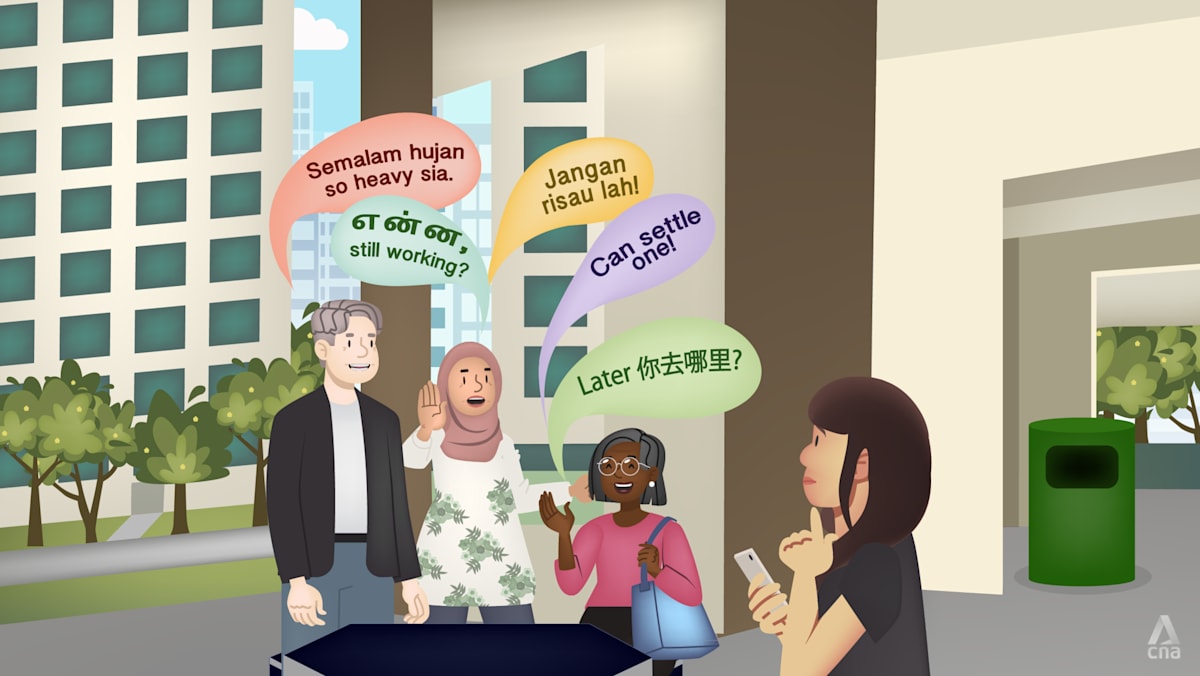
Like her polyglot parents, millennial Jillian Lim has socialised with people of many races and ethnicities all her life. She interrogates why this exposure hasn't made her more proficient with a variety of languages and dialects.
Multilingualism seems to be much more of a norm for older Singaporeans, observes millennial Jillian Lim, compared to those in her generation and younger. (Illustration: CNA/Teha Muhamad)
This audio is generated by an AI tool.
Growing up, my Hainanese father and Eurasian mother would often switch to Malay whenever they didn't want me and my sister to understand what they were saying.
I remember countless car rides with the two of them rattling away in Malay, mostly gossiping about relatives, friends and neighbours. Evidently, there was quite a lot they didn't want us to know.
Eventually, we began understanding quite a bit of the language despite not having any formal education in it. Even today, if I actively listen to a Malay conversation, I can usually understand the gist of it.
Unfortunately, we never moved on to actually practise speaking Malay, so that's where our linguistic development remains stalled.
CNA Games Guess Word Crack the word, one row at a time Buzzword Create words using the given letters Mini Sudoku Tiny puzzle, mighty brain teaser Mini Crossword Small grid, big challenge Word Search Spot as many words as you can Show More Show Less
Bilingual education has long been the norm in Singapore, but by 1987, English was established as the main medium of instruction across schools nationwide.
Going to primary and then secondary school in the 1990s and early 2000s, I have several distinct memories of teachers cutting us kids off firmly to remind us: "If you want to speak another language, save it for recess."
But given the diverse nature of the student population in the schools I attended, relying on break times didn't turn out to be much of a strategy for linguistic diversity.
My own group of close friends in primary/secondary school consisted of an Indian girl, a Malay girl, and two more of mixed-race heritage – Indian-Chinese and Chinese-Italian respectively.
Whenever we were all together, we looked like a poster for a Racial Harmony Day campaign.
With all of us studying different mother tongues, we had only English in common. There was almost no opportunity to speak Chinese, Malay or Tamil.
As a young adult, I became close friends with a girl I met through work who was of Malayali and Filipino heritage.
Her official mother tongue was Malay, but because the majority of her friends during her own childhood were Chinese, her Mandarin fluency and articulation far exceeded mine.
I must confess, I felt really inadequate every time she spoke Chinese around me. I had endured 12 whole years of Chinese lessons and tuition classes! How was I so easily outstripped in my own mother tongue by someone with no formal instruction?
To add insult to considerable academic injury, she also understood basic Tagalog and could converse smoothly in Hokkien.
After one evening where she once again left me speechless with her polyglot powers, I went home to do what any mature adult would do: I blamed my father.
Barging in on him dozing off in front of the television, I demanded: "Dad, we're Hainanese. Why didn't you at least teach me Hainanese?"
He remained maddeningly calm and smug. "Why didn't you learn?"
"How would I have learnt if you never taught me?" I cried.
Levelling me with an unimpressed look, my father said: "Jill, no one taught me Malay, Cantonese or the other dialects. I just mixed around with friends."
LANGUAGE, CULTURE AND IDENTITY
Multilingualism seems to be much more of a norm for older Singaporeans compared to those in my generation and younger.
In my experience, it's much more common to find older Gen X and Boomer Singaporeans who grew up speaking – or at least understanding – at least three languages: English, their family language or what we would now call mother tongue, and one other language or dialect picked up from friends, coworkers or neighbours.
Singapore itself hasn't necessarily grown less diverse. I myself have maintained friendships with people of many races and ethnicities all my life.
But, unlike my parents, this exposure hasn't made me more adventurous with languages. I often felt embarrassed when speaking anything other than English.
Despite Singapore's diversity, why does multilingualism seem to be much more of a norm for older Singaporeans compared to younger generations? (Photo: iStock)
I even avoided speaking my assigned mother tongue, Mandarin, despite having spent more than a decade studying it.
Many of my peers did this too – replying to Chinese language teachers in English, claiming they didn't understand when food stall operators spoke to them in absurdly simple Chinese.
As I grew into adulthood, I would watch older relatives and their generational peers jump effortlessly between English, Malay, and dialects like Cantonese and Hainanese – and I would wonder if I was "less Singaporean" for not being able to do so.
It felt almost like my cultural identity was limited only to what I could express in English.
LANGUAGE AS SOCIAL SKILL
In his National Day Rally speech on Aug 23, Prime Minister Lawrence Wong encouraged Singaporeans to learn Malay and better appreciate Malay culture .
In the wake of his speech, many conversations were sparked on language learning in Singapore. Amid all the dialogue, I found myself dwelling on two questions:
Firstly, when did multilingualism become something we had to be reminded to embrace? And, more importantly, when did language become so attached to race or ethnicity?
My Hainanese father didn't learn Malay or Cantonese in a bid to boost his employability or socioeconomic standing.
His motivations were purely social: he had friends who spoke Malay and Cantonese. He learnt these simply because people around him spoke it.
He likely also did so to curry favour with the coffee shop aunties who always slipped some extra meat onto his plate when he bust out a well-chosen Malay or Cantonese phrase or compliment.
Language proficiency and cultural identity overlap, certainly. But they are not the same thing.
I would watch older relatives jump effortlessly between English, Malay, and dialects like Cantonese and Hainanese – and I would wonder if I was "less Singaporean" for not being able to do so.
You only have to look at younger Singaporeans to see the proof of this everywhere.
I see plenty of youths voluntarily learning Korean by looking up tutorials and learning resources online, and begging their parents to sign them up for classes.
They don't want an A1 in Higher Korean at the O-Level exams. They just want to understand the lyrics to their favourite K-pop songs, Korean shows and interview clips for which English subtitles may be hard to come by.
CONNECTION, NOT CATEGORISATION
In his National Day Rally speech, PM Wong also warned that Singapore " must not become a monolingual society ".
Multilinguists like my parents – and hordes of teen K-pop fans – have taught me a simple but underrated secret: Language thrives most when it is part of everyday life.
If we genuinely want multilingualism to remain core to Singaporean identity, perhaps the shift needs to begin in early childhood.
Now, as a mum of two young children, I find myself wondering: Would it be too much to introduce some elementary Malay into kindergarten curriculums? Not another examinable subject but simple songs, greetings, numbers, food, games and everyday phrases.
As children get older, why not give them opportunities to practise what they've learnt, outside of Racial Harmony Day once a year?
Short courses of Malay classes throughout primary and secondary school, focusing on conversational proficiency rather than written examinations, could go a long way.
The objective behind these efforts shouldn't be producing yet another certificate. It should be producing Singaporeans who aren't afraid to connect with their cultural heritages – both their own and that of their friends.
This, to me, is the true value of encouraging Singaporeans to learn each other's languages.
For those of us long past our schooling days, it's not too late for us to make small efforts in our own daily lives.
Say "terima kasih" instead of "thank you" occasionally. Try ordering food in Chinese even if the stallholder decides to save everyone time by replying in English. Look up the Hokkien phrase your colleague keeps using.
Most importantly, don't let fear of embarrassment or failure prevent us from giving it a shot.
Maybe my father was right after all. You don't have to "learn" – you just have to try.
Jillian Lim has nearly two decades of experience in broadcasting and is now pursuing a degree in business marketing.
Get our pick of top stories and thought-provoking articles in your inbox
Stay updated with notifications for breaking news and our best stories
Join our channel for the top reads for the day on your preferred chat app
和她精通多国语言的父母一样,千禧一代的吉莉安·林从小就与不同种族和民族的人交往。她不禁思考,为什么这种接触并没有让她更精通各种语言和方言。
千禧一代的吉莉安·林观察到,与她这一代及更年轻的人相比,多语能力在新加坡老年人中似乎更为普遍。(插图:CNA/Teha Muhamad)
这段音频由人工智能工具生成。
在我成长的过程中,我的海南裔父亲和欧亚混血母亲经常会在不想让我和妹妹听懂他们说话的时候改用马来语。
我记得无数次和他们俩一起乘车,他们用马来语叽叽喳喳地说个不停,大多是在闲聊亲戚、朋友和邻居。显然,他们有很多事不想让我们知道。
最终,尽管我们没有接受过任何正规的马来语教育,我们还是开始能听懂不少。即使是今天,如果我认真听一段马来语对话,通常也能明白大概意思。
遗憾的是,我们从未真正开始练习说马来语,所以我们的语言发展就此停滞不前。
CNA游戏 猜词游戏 逐行破解单词 流行词游戏 用给定的字母组成单词 迷你数独 小小谜题,挑战你的大脑 迷你填字游戏 小方格,大挑战 单词搜索 尽可能多地找出单词 显示更多 显示更少
双语教育在新加坡由来已久,但到 1987 年,英语被确立为全国学校的主要教学语言。
在 20 世纪 90 年代和 21 世纪初上小学和中学时,我清楚地记得老师们经常严厉地打断我们孩子的话,提醒我们:“如果你们想说另一种语言,请留到课间休息时再说。”
但考虑到我所就读学校的学生群体的多样性,依靠课间休息时间来促进语言多样性并不是一个好策略。
我在小学/中学时的几个好朋友中,有一个印度裔女孩,一个马来裔女孩,还有两个混血女孩——分别是印度裔华人女孩和华裔意大利女孩。
我们聚在一起的时候,看起来就像是种族和谐日活动的宣传海报。
由于我们学习的母语各不相同,我们唯一的共同语言就是英语。几乎没有机会说中文、马来语或泰米尔语。
年轻的时候,我通过工作认识了一位有马拉雅拉姆和菲律宾血统的女孩,并和她成为了好朋友。
她的官方母语是马来语,但由于她童年时期的大多数朋友都是华人,所以她的普通话流利程度和发音远远超过了我。
我必须承认,每次她在我面前说中文,我都觉得自己非常逊色。我可是上了整整12年的中文课和补习班啊!怎么会这么轻易地被一个没有接受过正规教育的人用自己的母语超越呢?
雪上加霜的是,她不仅学业成绩不佳,还懂一些基本的塔加洛语,能用福建话流利地交谈。
那天晚上,她再次用她精通多国语言的能力让我哑口无言。回家后,我做了任何一个成熟的成年人都会做的事:我责怪了我的父亲。
我冲进房间,发现他正对着电视打瞌睡,便质问道:“爸爸,我们是海南人。为什么你至少不教我海南语呢?”
他依旧保持着令人恼火的冷静和自鸣得意。“你为什么就是学不会?”
“如果你从来没教过我,我怎么可能学会呢?”我哭着说。
父亲一脸不屑地看着我,说道:“吉尔,没人教过我马来语、粤语或其他方言。我只是和朋友们混在一起而已。”
语言、文化与身份认同
与我这一代及更年轻的人相比,多语能力在新加坡老年人中似乎更为普遍。
以我的经验来看,新加坡的 X 世代和婴儿潮一代中,年纪较大的人更常说(或者至少能听懂)至少三种语言:英语、他们的家庭语言(也就是我们现在所说的母语),以及从朋友、同事或邻居那里学来的另一种语言或方言。
新加坡本身的多样性并没有减少。我本人一生都与不同种族和民族的人保持着友谊。
但与我的父母不同,这种语言接触并没有让我变得更勇于尝试其他语言。除了英语之外,我常常觉得说其他语言很尴尬。
尽管新加坡是一个多元化的国家,但为什么与年轻一代相比,多语能力在老一辈新加坡人中似乎更为普遍?(图片:iStock)
尽管我学习了十多年汉语,但我甚至避免说我的母语——普通话。
我的很多同龄人也这样做——用英语回复中文老师,声称他们听不懂小贩用极其简单的中文跟他们说话。
随着我长大成人,我看到年长的亲戚和他们的同龄人毫不费力地在英语、马来语以及粤语和海南语等方言之间切换——我不禁怀疑,如果我不能做到这一点,我是不是就“不够新加坡”。
感觉我的文化认同几乎只能局限于我能用英语表达的东西。
语言作为一种社交技能
8月23日,黄循财总理在国庆群众大会演讲中鼓励新加坡人学习马来语,更好地欣赏马来文化。
他的演讲引发了关于新加坡语言学习的诸多讨论。在各种讨论中,我一直在思考两个问题:
首先,我们什么时候需要被提醒去接受多语言能力了?更重要的是,语言什么时候与种族或民族如此紧密地联系在一起了?
我的海南父亲学习马来语或粤语并不是为了提高自己的就业能力或社会经济地位。
他的动机纯粹是社交性的:他有朋友会说马来语和粤语。他学习这些语言仅仅是因为他周围的人都说这些语言。
他这样做很可能也是为了讨好咖啡店的阿姨们,每当他抛出一句恰到好处的马来语或粤语短语或赞美之词时,她们总会偷偷地在他的盘子里加些肉。
语言能力和文化认同固然有重叠之处,但它们并非同一回事。
我会看着年长的亲戚们毫不费力地在英语、马来语以及粤语、海南语等方言之间切换——然后我会想,如果我做不到这一点,是不是就“不够新加坡”。
你只需看看新加坡的年轻人,就能处处看到这一点的证明。
我看到很多年轻人自愿通过上网查找教程和学习资源来学习韩语,并恳求父母给他们报名参加课程。
他们并不想在O水准考试中获得高级韩语A1的成绩。他们只是想听懂自己喜欢的K-pop歌曲、韩国电视节目和采访片段的歌词,而这些内容可能很难找到英文字幕。
关联,而非分类
黄循财总理在国庆群众大会演讲中也警告说,新加坡“绝不能成为单一语言社会”。
像我的父母这样的多语者,以及成群的青少年 K-pop 粉丝,教会了我一个简单但被低估的秘密:语言在日常生活中才能蓬勃发展。
如果我们真心希望多语言现象继续成为新加坡身份认同的核心,那么这种转变或许需要从幼儿时期开始。
现在,作为两个孩子的妈妈,我不禁思考:在幼儿园课程中加入一些基础马来语会不会太过分了?不是另一门考试科目,而是一些简单的歌曲、问候语、数字、食物、游戏和日常用语。
随着孩子们年龄的增长,为什么不给他们机会在一年一度的种族和谐日之外,练习他们所学到的知识呢?
在小学和中学阶段开设马来语短期课程,注重提高会话能力而不是笔试,可能会大有裨益。
这些努力的最终目的不应该是为了颁发又一张证书,而应该是培养那些不惧与自身及朋友文化遗产建立联系的新加坡人。
在我看来,这才是鼓励新加坡人学习彼此语言的真正价值所在。
对于我们这些早已离开学校的人来说,在日常生活中做出一些小小的努力也为时不晚。
偶尔用“terima kasih”(闽南语,意为“谢谢”)代替“thank you”(谢谢)。即使摊主为了节省大家时间用英语回复,也试着用中文点餐。查一下你同事经常用的那句闽南语短语。
最重要的是,不要因为害怕尴尬或失败而不敢尝试。
也许我父亲说得对。你不必“学习”,你只需要尝试。
Jillian Lim拥有近二十年的广播从业经验,目前正在攻读商业营销学位。
订阅我们的邮件,即可获取精选热点新闻和引人深思的文章。
订阅通知,第一时间获取突发新闻和精彩报道。
加入我们的频道,即可在您常用的聊天应用上获取当日热门文章。