Xi, Putin, Kim Jong Un unite at glitzy China military parade习近平、普京、金正恩齐聚中国盛大阅兵式
In his speech, Xi warned that the world was “faced with a choice of peace or war,” adding that “the rejuvenation of the Chinese nation is unstoppable."
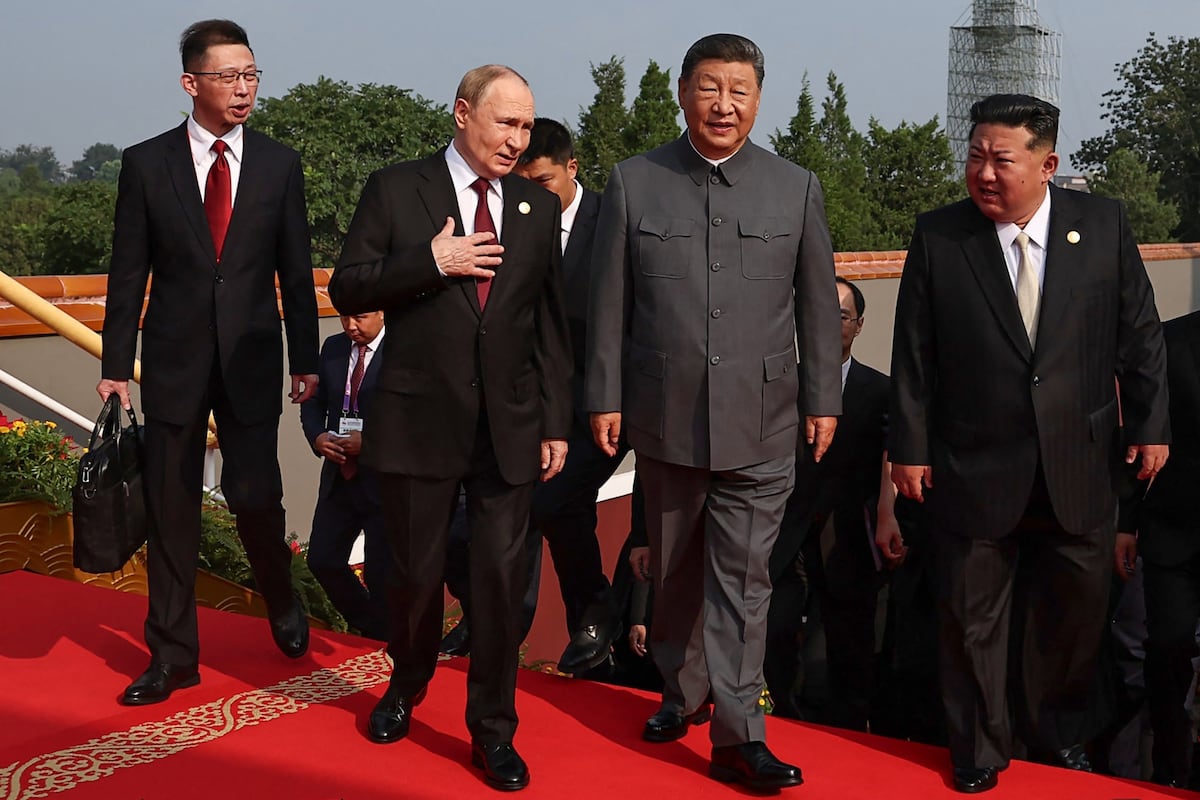
CHRISTCHURCH, New Zealand — China did not disappoint with its massive Sep. 3 military parade through Tiananmen Square, the site of a violent massacre in the heart of Beijing in June 1989, with numerous VIPs from around the world attending.
As China celebrated its victory over “fascist” Japanese forces in 1945, the places of honor at Chairman Xi Jinping’s right and left hands were assigned to authoritarian leaders Vladimir Putin of Russia and Kim Jong Un of North Korea, respectively.
In his speech, Xi warned that the world was “faced with a choice of peace or war,” ominously adding that “the rejuvenation of the Chinese nation is unstoppable.”
President Donald Trump responded to the spectacle of the Xi-Putin-Kim bonhomie on Truth Social, writing, “Give my warmest regards to Vladimir Putin and Kim Jong Un, as you conspire against the United States of America.”
Mick Ryan, a retired major general in the Australian Army, noted that the equipment the People’s Liberation Army (PLA) paraded was generally “more modern than that in the inventories of Western military organizations. Newer does not always mean better, however. While most Western military equipment has been tested in Iraq, Ukraine and elsewhere, none of China’s new kit has.”
There were surprises, including the DF-61 intercontinental ballistic missile carried aboard a 16x16 transporter-erector-launcher. Little is known about the DF-61, which follows on from the DF-41 ICBM unveiled six years ago. However, it is likely a next-generation successor with greater range and speed.
YJ-21 hypersonic anti-ship ballistic missiles are seen during a military parade marking the 80th anniversary of victory over Japan and the end of World War II, in Beijing's Tiananmen Square on Sept. 3, 2025. (Pedro Pardo/AFP via Getty Images)
The DF-61 was accompanied by the JL-1 air-launched nuclear-tipped missile, as well as the JL-3 submarine-launched ballistic missile. This phalanx of missiles demonstrated the PLA Rocket Force now has a complete nuclear-weapon triad.
Another item of interest was the DF-31BJ, which is an ICBM launched from an underground silo. China has been investing heavily in missile silo fields deep in its hinterland. The DF-5C liquid-fueled ICBM rolled past the Tiananmen Square rostrum, too, this silo-launched missile capable of hitting targets anywhere in the world.
Missiles featured prominently in the parade, with another formation containing three types of hypersonic missile: the YJ-21 launched from ships or aircraft, and the land-based DF-26D and DF-17. The YJ-21 has an estimated 1,500km range and it will be a key weapon in keeping American aircraft carriers at arm’s length, especially in the event of any Taiwan invasion.
It’s unclear what modifications the DF-26D possesses compared to preceding versions of the “Guam killer” intermediate-range ballistic missile. Some analysts claim the DF-26D has a 5,000km range.
A Chinese state TV commentator said of hypersonic missiles that “speed is key to victory,” and that they “fly at extremely high speed, excel in breaking through blockades and hitting targets with high precision.”
One wonders what Putin might have been thinking as he observed the might of the PLA roll past his eyes, especially as his own military is decimated by its war of attrition in Ukraine. China was once reliant on Russian technology and weapons, but all the weapons displayed in the parade were of indigenous Chinese origin.
“Long gone are the days were China was reliant on Russia or other foreign systems. This level of indigenous capacity infers high levels of sustainability in any future conflict,” said Ryan, the defense analyst.
Three cruise missiles appeared in the parade, the air-launched CJ-20A, the naval YJ-18C and the truck-launched CJ-1000.
Unmanned systems featured prominently, with multiple examples from the land, air and maritime domains. Autonomous underwater vehicles included vessels for reconnaissance and laying sea mines, as well as an unmanned surface vessel.
A CS-5000T drone is seen during a military parade marking the 80th anniversary of victory over Japan and the end of World War II, in Beijing's Tiananmen Square on Sept. 3, 2025. (Pedro Pardo/AFP via Getty Images)
Unmanned combat drones attracted great interest, with four types appearing. At least some of them are designed to accompany Chinese fifth-generation fighters like the twin-seat J-20S to achieve air dominance.
Illustrating that China has been learning lessons from the Ukraine war, several types of anti-drone systems were on display, including gun, missile, laser and microwave systems to create a layered defensive shield.
Ground combat vehicles included the debut of the Type 100 tank and an accompanying fighting vehicle. These tracked vehicles use a hybrid electric propulsion unit that ensures silent approaches in combat. Crew members also use augmented-reality goggles with these advanced vehicles, and the fighting vehicle version comes with integral drones for reconnaissance.
Air defense was well represented with no fewer than five systems, specifically the HQ-9C, HQ-11, HQ-19, HQ-22A and HQ-29. The latter reportedly can intercept short- and medium-range ballistic missiles and low-orbit satellites thanks to its estimated 6,000km range and 1,500km interception altitude.
Despite China’s spectacle of weapons of war, Ryan cautioned that “parades are not indictors of warfighting effectiveness. Notwithstanding the impressive orchestration of the parade … these have almost zero impact on the measurement of military effectiveness.”
Gordon Arthur is an Asia correspondent for Defense News. After a 20-year stint working in Hong Kong, he now resides in New Zealand. He has attended military exercises and defense exhibitions in about 20 countries around the Asia-Pacific region.
新西兰基督城——9月3日,中国在天安门广场举行了盛大的阅兵式,没有让人失望。天安门广场是1989年6月北京中心地带发生暴力屠杀的地点,来自世界各地的众多贵宾出席了阅兵式。
1945年,中国庆祝战胜“法西斯”日本军队时,习近平主席左右两侧的荣誉位置分别分配给了俄罗斯的弗拉基米尔·普京和朝鲜的金正恩。
习近平在讲话中警告说,世界“面临和平与战争的选择”,并意味深长地补充说,“中华民族伟大复兴势不可挡”。
唐纳德·特朗普总统在 Truth Social 上回应了习近平、普京和金正恩的亲密互动,他写道:“请代我向弗拉基米尔·普京和金正恩致以最热烈的问候,你们正在密谋反对美利坚合众国。”
澳大利亚陆军退役少将米克·瑞安指出,中国人民解放军展示的装备总体上“比西方军事组织的库存装备更现代化。然而,更新并不总是意味着更好。虽然大多数西方军事装备都在伊拉克、乌克兰和其他地方经过了测试,但中国的新装备却没有。”
此次航展不乏惊喜,其中就包括搭载在16×16运输-起竖-发射一体车上的DF-61洲际弹道导弹。人们对DF-61知之甚少,它是六年前亮相的DF-41洲际弹道导弹的后续型号。不过,它很可能是一款射程更远、速度更快的下一代导弹。
2025年9月3日,在北京天安门广场举行的纪念战胜日本和二战结束80周年阅兵式上,可以看到YJ-21高超音速反舰弹道导弹。(图片来源:Pedro Pardo/AFP via Getty Images)
DF-61导弹伴随巨浪-1空射核导弹和巨浪-3潜射弹道导弹一同亮相。这一导弹阵列表明,解放军火箭军现已拥有完整的核武器三位一体。
另一项引人关注的装备是东风-31BJ型洲际弹道导弹,它从地下发射井发射。中国一直在其腹地深处大力投资建设导弹发射井群。东风-5C型液体燃料洲际弹道导弹也经过了天安门广场的检阅台,这种从发射井发射的导弹能够打击世界任何目标。
导弹在阅兵式上占据了显著位置,其中一个方阵展示了三种高超音速导弹:舰载或机载发射的YJ-21,以及陆基DF-26D和DF-17。YJ-21的射程估计为1500公里,它将成为阻止美国航母靠近的关键武器,尤其是在台湾遭到入侵的情况下。
目前尚不清楚DF-26D与之前的“关岛杀手”中程弹道导弹型号相比有哪些改进。一些分析人士称DF-26D的射程为5000公里。
中国国家电视台一位评论员谈到高超音速导弹时说,“速度是胜利的关键”,它们“飞行速度极快,擅长突破封锁,并能高精度地击中目标”。
人们不禁会想,当普京目睹解放军的强大力量从眼前掠过时,他内心作何感想,尤其是在他自己的军队因乌克兰战争的消耗战而遭受重创的情况下。中国曾经依赖俄罗斯的技术和武器,但阅兵式上展示的所有武器都是中国自主研发的。
“中国依赖俄罗斯或其他外国系统的时代早已一去不复返了。这种程度的自主能力意味着在未来的任何冲突中都具有高度的可持续性,”国防分析师瑞安说道。
阅兵式上出现了三种巡航导弹,分别是空射型 CJ-20A、舰载型 YJ-18C 和车载型 CJ-1000。
无人系统占据了重要位置,涵盖陆地、空中和海上领域,并有多个实例。自主水下航行器包括用于侦察和布雷的船只,以及一艘无人水面舰艇。
2025年9月3日,在北京天安门广场举行的纪念战胜日本和二战结束80周年阅兵式上,一架CS-5000T无人机亮相。(图片来源:Pedro Pardo/AFP via Getty Images)
无人作战无人机引起了广泛关注,目前已出现四种型号。其中至少有一些是为配合中国第五代战斗机(例如双座歼-20S)而设计的,旨在实现空中优势。
为了表明中国已经从乌克兰战争中吸取了教训,展出了多种类型的反无人机系统,包括火炮、导弹、激光和微波系统,以构建多层防御屏障。
地面作战车辆包括首次亮相的100式坦克及其配套战斗车辆。这些履带式车辆采用混合动力推进系统,确保在战斗中悄无声息地接近目标。乘员还佩戴增强现实眼镜操控这些先进车辆,而战斗车辆版本则配备了用于侦察的集成无人机。
防空系统方面,共有五套系统亮相,分别是HQ-9C、HQ-11、HQ-19、HQ-22A和HQ-29。据报道,HQ-29的射程约为6000公里,拦截高度约为1500公里,能够拦截短程和中程弹道导弹以及低轨道卫星。
尽管中国举行了盛大的武器装备展示仪式,但瑞安警告说,“阅兵式并不能反映作战效能。尽管阅兵式组织得令人印象深刻……但这些对衡量军事效能几乎没有任何影响。”
戈登·阿瑟是《防务新闻》的亚洲特派记者。在香港工作20年后,他现居新西兰。他曾到访亚太地区约20个国家,参加过军事演习和防务展览。