Gotta grow my own way: Why some S’poreans are choosing the farm life abroad走自己的路:为什么一些新加坡人选择在国外过农场生活
Singaporeans are choosing farm life abroad to embrace self-sufficiency, permaculture, and a slower, more fulfilling lifestyle away from the city. Read more at straitstimes.com.
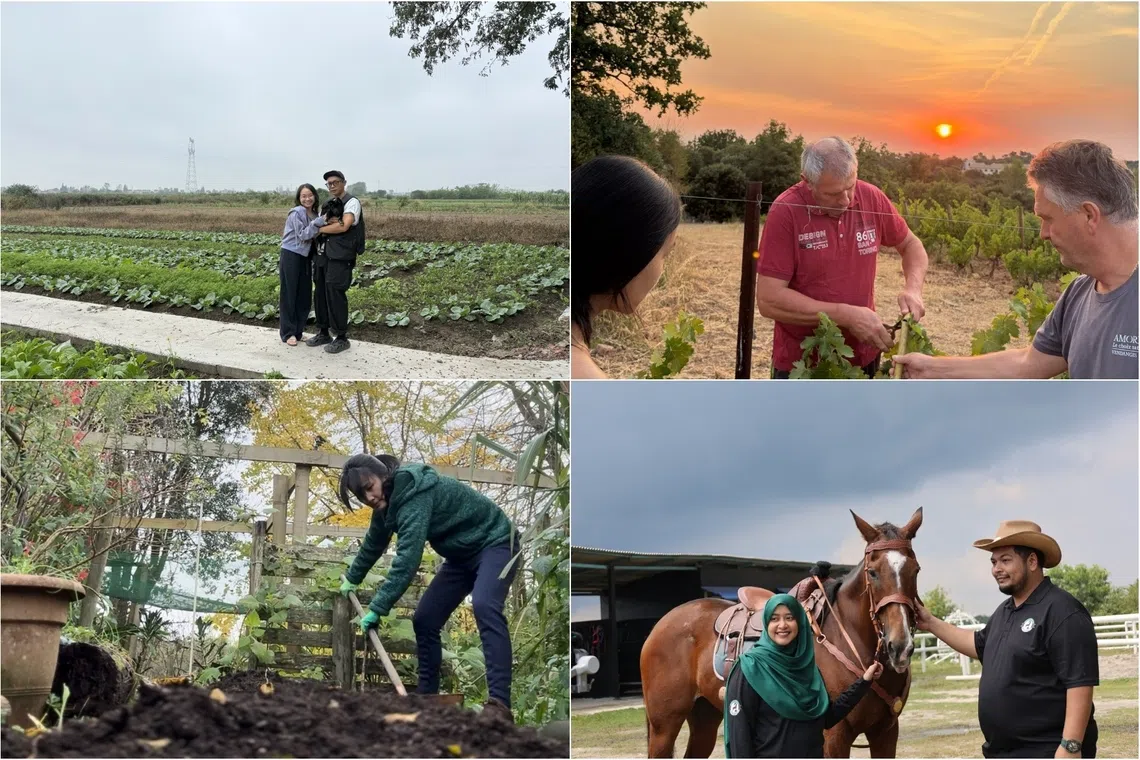
Some Singaporeans are choosing farm life abroad for a slower, more fulfilling lifestyle.
PHOTO: SHALYN THNG, ADELINE LEONG, ESTHER PEH, ALIYAH RIZQ FARM
Published Oct 10, 2026, 08:25 AM
Updated Oct 10, 2026, 08:25 AM
Some Singaporeans are choosing farm life abroad for a slower, more fulfilling lifestyle, embracing self-sufficiency and learning farming skills through hands-on experience.
Many find farming offers peace and connection to nature, contrasting with stressful urban work, as seen in stories from China, New Zealand, France, and Kazakhstan.
Others have turned farming into careers, building successful businesses in Malaysia with sustainable and ethical practices, motivated by health, environment, and market opportunities.
SINGAPORE – Finding a small sweet potato hidden in the dirt was hardly what Singaporean Shalyn Thng was expecting while digging up her front yard.
She had been clearing the roughly 90 sq m plot of land in front of her two-storey rental home in Jianli County, Hube i, w hen her shovel struck something solid in the soil.
She lifted her shovel to find a sweet potato around the size of a tennis ball – remnants of the harvest from a previous season.
“It was really tough flipping the soil but when I found the potato, I got very excited. I remember thinking, ‘so, this is what it feels like to harvest your own vegetables’,” says Thng, 30, who has an advanced diploma in applied linguistics from the Singapore University of Social Sciences.
Her businessman husband was born and raised in Hubei. The couple had decided to move to China to be closer to his family and for a change of pace after living together in Singapore for around two years.
They met on Chinese social media platform Xiaohongshu in early 2023 and got chatting on instant-messaging app WeChat. They started a long-distance relationship while he was working in Hong Kong and she was teaching in a secondary school in Singapore, and eventually tied the knot in late 2023.
They made the move in September, choosing to live in an outskirts village in Jianli County, instead of one of the more developed neighbouring cities like Wuhan or Changsha.
Their decision aligned with the slower, more intentional lifestyle Thng had envisioned for herself after spending seven years teaching art in Singapore.
“Working in an office requires me to be constantly thinking and I don’t have the luxury of just focusing on the physical act of doing things. Sometimes, even after work hours, I’m still thinking about work, whereas living in the countryside offers me a certain peace,” she says.
Singaporean Shalyn Thng moved to Hubei in September and is learning to farm on the plot of land in front of her two-storey rental home. PHOTO: SHALYN THNG
Singaporean Shalyn Thng moved to Hubei in September and is learning to farm on the plot of land in front of her two-storey rental home.
She intends to use this time away from her teaching career as a “trial relocation” and to learn how to farm while living abroad – a lifestyle she became especially drawn to after watching numerous videos of cosy homesteading routines on social media.
Today, she has cleared all the land in front of her home and planted vegetables like cabbages, carrots and radishes. Already, some of her long beans and pumpkins have made it into the stir-fries she whips up for her and her husband’s meals.
Online, this lifestyle is popularised as “cottagecore”, which romanticises a simpler, self-sufficient existence in harmony with nature and away from urban pressures.
Cottagecore found significant popularity in 2020, amid the early waves of the Covid-19 pandemic, and continued to trend throughout the pandemic years as a nostalgic, pastoral escape from the stress of a locked-down world.
Even after its peak trending years, such idyllic social media content continued to attract viewers, reinforcing its appeal as a rejection of hustle culture.
The appeal, according to seven Singaporeans-turned-farmers who spoke to The Straits Times, is that life in Singapore is often optimised for efficiency and productivity. Farming, however, offers an antidote to the things that optimisation has left little room for, such as space, slowness and self-sufficiency.
Like Thng, they agree that their farm experience abroad, whether a short volunteer stint or longer-term career choice, made all their past urban grouses seem small and highlighted the value of an unhurried life.
For Esther Peh, who is in her early 40s, this realisation came after 15 years as an educator in Singapore. In late 2019, she opened a private tuition centre, running it on her own for roughly six years. Prior to that, she had taught English in a secondary school.
“I was at an all-time low (in 2024) and felt very disenchanted. When I saw my students having emotional meltdowns before exams, I really started to ask why I was perpetuating this paper-chasing culture,” says Peh, who has a post-graduate diploma in education from the National Institute of Education in Singapore.
She recalls the immense amount of stress that she shouldered while running the sole proprietorship, which included having to handle marketing, negotiate leases with landlords, plan the curriculum, deal with parents, teach and complete administrative duties.
“There was one time I had an hour’s break on a weekend and went home to lie in bed. When my alarm went off, I couldn’t even push myself into a conscious state – my body was in such exhaustion,” she says, recalling how she made two visits to the hospital over two weeks for panic attacks.
In 2024, she decided to slowly step back from managing her business to pursue something she had always been drawn to but never had the time for: permaculture. She continued to oversee the tuition practice at a smaller scale with just a handful of students until January 2026, when she closed it for good.
Singaporean Esther Peh left her 15-year career in education to learn permaculture in New Zealand in 2014. PHOTO: ESTHER PEH
Singaporean Esther Peh left her 15-year career in education to learn permaculture in New Zealand in 2014.
Peh’s interest in permaculture grew gradually with experiences like a three-day trek through the Gunung Stong forest reserve in Kelantan with her outdoor club at Singapore Management University, where she witnessed nature’s architecture first-hand as an undergraduate.
She continued to research permaculture – a sustainable and holistic agricultural practice that aims to protect and regenerate the environment instead of working against it – and found that its principles resonated with her.
“It’s not just about growing things, it’s also about looking at the land – how the slopes and the hills are formed, where the water collects, where the animals can roam. You have to consider the whole ecosystem, it’s not just for your own value and benefit,” she says.
It was a concept that was particularly hard to grasp while living in Singapore, where agricultural land makes up around just 1% of the city’s total land area.
In December 2024, Peh flew to New Zealand, where she found opportunities to learn permaculture from local farmers via the global volunteer exchange programme World Wide Opportunities on Organic Farms (WWOOF).
Over a year and a half, she volunteered on three farms across the North Island, immersing herself in the demanding daily routines of eco-conscious agriculture. Her tasks ranged from clearing stubborn, overgrown vegetation to managing compost systems to caring for farm animals.
She also learnt organic harvesting techniques and gained first-hand insight into farming practices like crop rotation and weed management. “Clearing out vegetation might sound easy, but it was backbreaking. I did it for a few hours under the sun daily and I’d be knocked out for the rest of the day,” she recalls.
Peh gained first-hand insight into farming practices like crop rotation and weed management. PHOTO: ESTHER PEH
Peh gained first-hand insight into farming practices like crop rotation and weed management.
Despite the physical strain, she found that the lifestyle agreed with her for other reasons.
“When I do something tactile, like putting my feet on the soil and spending time in nature, it regulates my nervous system. So, even though by the end of the day I’m physically tired and just want to sleep, I know it is something I want to keep doing. It’s not stressful to me, it’s fulfilling,” she says.
In February 2026 , she met a New Zealand woman in her 80s who was sharing a strip of her land with the local community to use for farming. Peh says the entire plot is as large as “the whole of Toa Payoh combined”.
This initiative, says Peh, came after massive job cuts during the Covid-19 pandemic left many locals without work and food security. Sharing the land meant that those who maintained the farm would have a share of the produce and meat when read y.
Peh was offered the opportunity to put up a tiny home on the land in return for helping the landowner maintain her farm. Tiny homes typically range from 9 sq m to 37 sq m in size, and can cost anywhere from NZ$55,000 (S$40,165) to NZ$250,000, depending on the size, design and finish.
Ultimately, Peh did not take up the offer. After spending some 18 months in New Zealand, she decided to use her newfound farming knowledge closer to home and grow food to share with her loved ones in Singapore instead.
“I’m still learning. My plan is to explore South-east Asia, like in Thailand and Malaysia, and be in the company of people who have been there and done that. Growing food is a matter of feeding people I love,” says Peh, who returned to Singapore in July.
Since then, she has visited Gentle Farms in Johor – run by a Singaporean couple – to observe how animals are cared for, and completed a four-day natural farming workshop with local farm business A Little Wild. She has also started growing coriander and long beans in planters on the balcony of her parents’ landed home.
Building food literacy
Much like permaculture, self-sufficiency is another concept that can be difficult to grasp in Singapore. Over 90% of food in the Republic, including staples like eggs, vegetables, poultry and dairy products, is imported from countries like Malaysia and Australia.
Thng says she was inspired to find out what it meant to be truly self-sufficient and was presented with the perfect opportunity to do so when she moved to China.
“I wanted to experience a different lifestyle. But beyond that, the concept of eating the food you grow is quite fascinating to me, because in Singapore, we don’t really know where a lot of the food we eat comes from,” says Thng, who enjoys experimenting in the kitchen.
To that end, she sought farming advice from her neighbours and her husband’s family in Jianli County and learnt to navigate unexpected complications along the way.
For instance, she recalls not knowing how to use a hoe or shovel properly, and admits having underestimated the physical labour involved in tilling the land.
“The hardest part about clearing the la nd w as removing the grass because it was deeply rooted in the soil. What we initially did was use the kitchen knife to chop the grass shorter before manually digging the roots out,” she says.
Thng has cabbages, radishes and carrots growing in her front yard. PHOTO: SHALYN THNG
Thng has cabbages, radishes and carrots growing in her front yard.
She and her husband eventually hired a tractor to do the heavy lifting.
While waiting for her new seedlings to fruit, she is slowly adjusting to village life – without modern conveniences, nearby amenities or sheltered walkways – and is documenting her journey on Instagram (@tanghullu.incn).
Similarly, Singaporean Adeline Leong, 23, cultivated a new perspective of food after a four-week volunteering stint at two agricultural sites in France, a vineyard in Provence near the south-eastern edge of the country, and a farm in Burgundy, in east-central France.
Leong, a global studies undergraduate from the National University of Singapore, had found both opportunities on the website of the WWOOF programme, which offers travellers a hands-on experience to learn about organic food, agriculture and sustainable ways of living.
Starting in July, she spent her time in France learning about the farm-to-table philosophy from locals, while carrying out tasks like collecting eggs, harvesting tomatoes and doing produce deliveries.
“When you’ve spent an hour or two plucking zucchinis or tomatoes, and then get to eat them that same day, you feel a stronger connection to your food,” she says.
While working on the farm, she found out that her farmer host owned around 3,000 chickens and roughly 20 cows – numbers she initially found “inconceivable”. Aside from selling eggs, her host also made milk into cream products, cheeses, butter and sweet treats like panna cotta.
Undergraduate Adeline Leong spent four weeks volunteering on a vineyard and a farm in France. PHOTO: ADELINE LEONG
Undergraduate Adeline Leong spent four weeks volunteering on a vineyard and a farm in France.
PHOTO: ADELINE LEONG
“Our hosts told us how strongly they believe in self-sufficiency and eating their own seasonal produce,” she says.
“My perspective changed more from the conversations we had about their relationship with food, especially when I compare it with what little I knew about food from growing up in Singapore.”
Beyond learning about farming and food production, Leong also sees her time volunteering on agricultural plots in France as one way to “touch grass” before adulting hits. She graduates from university in January 2027.
Her farm experience was one of many others she took on to immerse herself in different cultures, such as documenting the lives of the Karen people in the Huay Pakkoot village of Chiang Mai, known for their elephant conservation efforts, over two years.
“I’ve been really privileged to be able to interact with people from different communities in countries like Malaysia, Indonesia, Thailand, Ecuador and France. With that exposure, I get to see how everyone is living life so differently,” Leong says, adding that she defines success differently now.
“Now, I’d define success as being content with life. I feel like what brings me contentment is the time and space to be with family and friends, to continue learning through people and travel, and to feel the feelings I get from experiences like seeing a starry sky without light pollution or watching the sunrise. These are feelings that chasing the rat race all the way wouldn’t be able to give me.”
Travelling with intention is a philosophy that Singaporean Loh Yong Qi, 20, embraced over her 12-day volunteering stint on a remote farm in Kazakhstan in May, just a week after graduating from Temasek Polytechnic.
Singaporean Loh Yong Qi graduated in May and spent around two weeks volunteering on a remote farm in Kazakhstan. PHOTO: LOH YONG QI
Singaporean Loh Yong Qi graduated in May and spent around two weeks volunteering on a remote farm in Kazakhstan.
She wanted to explore Central Asia and found the opportunity on the global cultural exchange and volunteer platform Workaway.
She was required to break thick branches off trees to build a fence line and dig soil to sow seeds. It was no easy feat, she recounts, but it was an experience wholly built around the intentionality she sought on her journey.
“I learnt to be OK with being bored. I realised I didn’t need to constantly stimulate my mind,” Loh says, adding that her daily routine included watching the sun go down behind the mountains in the evenings.
Loh stayed in a yurt and had to adapt to the rugged living conditions on the farm, which included open-air toilets and sleeping with insects. PHOTO: LOH YONG QI
Loh stayed in a yurt and had to adapt to the rugged living conditions on the farm, which included open-air toilets and sleeping with insects.
Still, the less-than-ideal living conditions – which included open-air toilets and nightly visits by creepy-crawlies like cockroaches – were enough to send her packing after 12 days.
She continued her trip with three other volunteering stints teaching in a kindergarten in Kazakhstan, doing housekeeping and front desk roles in a hotel in Kyrgyzstan, and practising English with kids at a summer camp in Uzbekistan.
“It was really out of my comfort zone, and while I eventually got used to the life there, I realise I’m still very much a city girl,” she says.
Some Singaporeans have gone beyond looking to farming as a short-lived lifestyle experience and turned it into longer-term careers.
Married couple Nabilah Bagarib, 39, and Ashraf Bakar, 38, started their business Aliyah Rizq Farm in Mersing , Malaysia, over a decade ago, with just 30 goats and sheep, and a fistful of ambition.
Singaporeans Nabilah Bagarib and Ashraf Bakar have run their farm business for over a decade, and have expanded to destinations such as Indonesia, Kenya and Morocco. PHOTO: ALIYAH RIZQ FARM
Singaporeans Nabilah Bagarib and Ashraf Bakar have run their farm business for over a decade, and have expanded to destinations such as Indonesia, Kenya and Morocco.
PHOTO: ALIYAH RIZQ FARM
They have since built a multimillion-dollar empire that produces 250 tonnes of mutton yearly and handles halal meat distribution to 12 countries, with farms in Kenya and Morocco. Their farm also offers religious qurban and aqiqah services, and eco-tourism activities .
It began as an idea they toyed around with for years alongside Nabilah’s retired mother, now aged 65 and previously the chief editor in the office of the mufti in Brunei, who had long aspired to run her own farm.
It was Ashraf – a former construction, automobile and product manufacturing businessman – who saw it as a promising opportunity to address a gap in the halal meats market in the region.
Roughly 10 years ago, around 13 per cent of the sheep and goat livestock in Malaysia was imported from countries like Australia, Brazil and India, he says.
“We saw that as an opportunity. Business-wise, we had to look at where the market is and what we could provide for the market. We wanted to be able to fill that gap,” he adds.
With Nabilah’s mother’s blessing and her capital investment of around $50,000 from her life savings, the couple started their 0.8ha farm in Mersing in 2015. They named it after her.
“Singapore doesn’t have space (for such a venture) or an active livestock industry. But I think there’s a lot of potential in Malaysia. When we started, Ashraf had to do everything from feeding the animals to cleaning up manure to constructing the pens,” recalls Nabilah. The company now employs a global team of around 300 staff members.
For Singaporean Elena Chua, 29, who co-founded Johor-based Gentle Farms with her husband in 2023, the motivation to go into the farming industry was better health.
Singaporean Elena Chua co-founded Gentle Farms with her husband in 2023. PHOTO: GENTLE FARMS
Singaporean Elena Chua co-founded Gentle Farms with her husband in 2023.
After a health scare where her husband exhibited signs of stroke, the couple committed to incorporating more exercise into their daily routine and paying closer attention to their food intake and nutrition. They also began to look into organic produce, sustainable practices and ethical farming.
“That’s when we wanted to understand more about our food source. How are the animals raised? Who are the farmers? What do they feed the animals?” she says.
Gentle Farms was their effort to create a source of food they could trust – with the hope that other consumers would be able to trust them too. Aside from selling produce like milk and eggs, they also run guided tours where visitors can feed animals and get a more in-depth look at ethical farming.
While Chua admits that running a farm – from cleaning pens to managing manpower – can get tiring, she says she knows farm life is the way for her.
“Of course, there is stress from running a farm because it is still a business. But I think as farm owners, we’re able to manage our stress levels better than when we were working in Singapore,” she says. The couple previously ran a small consultancy for sales and marketing from 2018 to 2024.
“What makes it rewarding is that we’re able to build something of our own and we can see it flourish. That’s what keeps us going.”
Sarah Stanley is a journalist at The Straits Times who covers travel, lifestyle and aviation.
一些新加坡人选择在海外过农场生活,以追求更慢节奏、更充实的生活方式。
照片:SHALYN THNG、ADELINE LEONG、ESTHER PEH、ALIYAH RIZQ FARM
发布于 2026 年 10 月 10 日上午 8:25
更新于2026年10月10日上午8:25
一些新加坡人选择到海外务农,追求更慢节奏、更充实的生活方式,拥抱自给自足,并通过实践学习务农技能。
许多人发现务农能带来平静和与自然的联系,这与压力巨大的城市工作形成鲜明对比,中国、新西兰、法国和哈萨克斯坦的故事就证明了这一点。
另一些人则将务农发展成事业,在马来西亚建立起成功的企业,秉持可持续和符合道德规范的经营方式,其动力源于健康、环境和市场机遇。
新加坡——新加坡居民 Shalyn Thng 在自家前院挖土时,万万没想到会发现藏在土里的小红薯。
她当时正在清理位于湖北省建利县的两层出租房前大约 90 平方米的土地,这时她的铲子碰到了土里坚硬的东西。
她举起铲子,发现一个网球大小的红薯——这是上个季节收成的剩余部分。
“翻土真的很难,但当我找到土豆时,我非常兴奋。我记得当时我想,‘原来这就是收获自己种的蔬菜的感觉’,”30岁的唐说道,他拥有新加坡社会科学大学应用语言学高级文凭。
她的商人丈夫在湖北出生长大。这对夫妇在新加坡共同生活了大约两年后,决定搬到中国,以便离他的家人更近,也想换换生活节奏。
他们于2023年初在中国社交媒体平台小红书上相识,并通过微信开始聊天。当时他在香港工作,她在新加坡的一所中学任教,两人开始了异地恋,最终于2023年底喜结连理。
他们于 9 月份搬家,选择居住在建利县郊区的一个村庄,而不是像武汉或长沙这样较为发达的邻近城市。
他们的决定与唐在新加坡教了七年艺术后所设想的更慢节奏、更有目标的生活方式不谋而合。
“在办公室工作需要我不断思考,我没有时间专注于实际操作。有时,即使下班后,我仍然在想着工作,而住在乡村则能给我带来一种宁静,”她说。
新加坡人莎琳·唐(Shalyn Thng)于九月搬到湖北,正在她租住的两层楼房前的土地上学习务农。照片:莎琳·唐
新加坡人 Shalyn Thng 于 9 月搬到湖北,正在她租住的两层楼房前的土地上学习务农。
她打算利用这段离开教学生涯的时间进行一次“试移”,学习如何在国外务农——在社交媒体上观看了许多温馨的田园生活视频后,她对这种生活方式产生了浓厚的兴趣。
今天,她已经清理了家门前的所有土地,种上了卷心菜、胡萝卜和萝卜等蔬菜。她种的一些长豆角和南瓜已经被她用来为自己和丈夫炒饭了。
在网络上,这种生活方式被称为“田园风”,它浪漫化了一种更简单、自给自足的生活方式,与自然和谐相处,远离城市压力。
在 2020 年新冠疫情初期,田园风迅速走红,并在整个疫情期间持续流行,成为人们逃离封锁世界压力的一种怀旧、田园式的逃离方式。
即使在其流行高峰期过后,这种田园诗般的社交媒体内容仍然吸引着观众,强化了其对奋斗文化的反叛的吸引力。
据《海峡时报》采访的七位新加坡籍农民表示,新加坡的生活方式往往追求效率和生产力,而务农恰恰弥补了这种追求效率和生产力的生活方式所忽略的方面,例如空间、慢节奏和自给自足。
和 Thng 一样,他们也认为,无论是短期的志愿者经历还是长期的职业选择,他们在国外的农场经历都让他们觉得过去在城市里遇到的所有烦恼都微不足道,并凸显了悠闲生活的价值。
对于年过四十的白思豪(Esther Peh)来说,这种领悟是在她新加坡从事教育工作十五年后才形成的。2019年底,她开办了一家私人补习中心,独自经营了大约六年。在此之前,她曾在中学教英语。
“2024年的时候,我跌入了人生的低谷,感到非常失望。当我看到我的学生在考试前情绪崩溃时,我开始认真反思,为什么我要助长这种唯成绩论的文化,”拥有新加坡国立教育学院教育研究生文凭的白女士说道。
她回忆起自己经营独资企业时所承受的巨大压力,其中包括处理市场营销、与房东谈判租赁事宜、制定课程计划、与家长沟通、教学以及完成行政工作。
“有一次周末我休息了一个小时,就回家躺在床上。闹钟响的时候,我连让自己清醒过来都做不到——我的身体太疲惫了,”她回忆说,两周内她曾两次因恐慌症发作而去医院就诊。
2024年,她决定逐步减少对公司管理的投入,去追求她一直以来都非常向往却苦于没有时间去做的事情:永续农业。她继续以较小的规模教授课程,只招收少数学生,直到2026年1月彻底关闭了课程。
新加坡人白思豪(Esther Peh)放弃了15年的教育事业,于2014年前往新西兰学习永续农业。照片:白思豪
新加坡人白思豪 (Esther Peh) 于 2014 年放弃了 15 年的教育事业,前往新西兰学习永续农业。
Peh 对永续农业的兴趣逐渐增长,这源于她在新加坡管理大学户外俱乐部参加的一次为期三天的吉兰丹州 Gunung Stong 森林保护区徒步旅行,她在本科期间亲眼目睹了大自然的建筑。
她继续研究永续农业——一种旨在保护和恢复环境而不是与之对抗的可持续的整体农业实践——并发现其原则与她产生了共鸣。
“这不仅仅是种植作物的问题,还要观察土地——坡地和山丘是如何形成的,水在哪里汇集,动物在哪里漫游。你必须考虑整个生态系统,这不仅仅是为了你自己的价值和利益,”她说。
在新加坡生活时,这个概念尤其难以理解,因为农业用地仅占该市土地总面积的 1% 左右。
2024 年 12 月,佩飞往新西兰,在那里她通过全球志愿者交流项目“世界有机农场机会组织”(WWOOF)找到了向当地农民学习永续农业的机会。
在一年半的时间里,她曾在北岛的三个农场做志愿者,全身心投入到生态农业繁重的日常工作中。她的工作包括清理顽固的杂草、管理堆肥系统以及照料农场动物。
她还学习了有机收割技术,并亲身实践了作物轮作和杂草管理等农业实践。“清理植被听起来容易,但实际上非常累人。我每天在烈日下干几个小时,然后一整天都累得筋疲力尽,”她回忆道。
Peh亲身实践了作物轮作和杂草管理等农业实践。照片:ESTHER PEH
Peh 亲身了解了作物轮作和杂草管理等农业实践。
尽管身体上很辛苦,但她发现这种生活方式在其他方面很适合她。
“当我做一些需要触觉的事情,比如把脚放在泥土上,花时间亲近大自然时,我的神经系统就会得到调节。所以,即使一天下来我身体很累,只想睡觉,但我知道这是我想要继续做的事情。这对我来说不是压力,而是满足,”她说。
2026年2月,她遇到了一位80多岁的新西兰老妇人,这位老妇人将自己的一块土地与当地社区共享,用于耕种。佩说,整块土地的面积相当于“整个大巴窑加起来的面积”。
佩赫表示,这项举措的出台是因为新冠疫情期间大规模裁员导致许多当地人失业,粮食安全受到威胁。土地共享意味着,那些耕作农场的人可以在收获时分享农产品和肉类。
作为交换,佩赫有机会在这块土地上建造一座微型住宅,条件是她要帮助土地所有者维护农场。微型住宅的面积通常在9平方米到37平方米之间,根据面积、设计和装修的不同,造价从55,000新西兰元(40,165新加坡元)到250,000新西兰元不等。
最终,白女士没有接受这份工作。在新西兰待了大约18个月后,她决定将新学到的农业知识运用到离家更近的地方,种植粮食与新加坡的亲人分享。
“我还在学习。我的计划是探索东南亚,比如泰国和马来西亚,并与那些去过那里、有过相关经验的人在一起。种植粮食是为了养活我爱的人,”佩女士说道,她于7月返回新加坡。
此后,她参观了位于柔佛州的“温柔农场”(Gentle Farms),该农场由一对新加坡夫妇经营,她观察了农场如何照料动物,并参加了当地农场企业“小野趣”(A Little Wild)举办的为期四天的自然农耕工作坊。她还在父母家阳台的花盆里种植了香菜和长豆角。
培养食品素养
与永续农业类似,自给自足也是新加坡人难以理解的概念。新加坡超过90%的食品,包括鸡蛋、蔬菜、家禽和乳制品等主食,都依赖从马来西亚和澳大利亚等国家进口。
Thng表示,她受到启发,想要了解真正自给自足的意义,而移居中国后,她获得了实现这一目标的绝佳机会。
“我想体验一种不同的生活方式。除此之外,吃自己种的食物这个概念也让我很着迷,因为在新加坡,我们其实并不知道我们吃的很多食物来自哪里,”喜欢在厨房里做实验的唐说道。
为此,她向邻居和丈夫在建利县的家人寻求务农方面的建议,并学会了如何应对过程中遇到的各种意想不到的困难。
例如,她回忆说自己以前不知道如何正确使用锄头或铲子,并承认低估了耕地所需的体力劳动。
“清理土地最难的部分是清除杂草,因为草根扎得很深。我们最初的做法是用厨房刀把草割短,然后再手工挖出根,”她说。
Thng家前院种着卷心菜、萝卜和胡萝卜。照片:SHALYN THNG
Thng家前院种着卷心菜、萝卜和胡萝卜。
她和丈夫最终租了一辆拖拉机来搬运重物。
在等待新种的幼苗结果的同时,她也慢慢适应了乡村生活——没有现代化的便利设施、附近的便利设施或遮雨的走道——并在 Instagram (@tanghullu.incn) 上记录着她的旅程。
同样,23 岁的新加坡人梁爱玲 (Adeline Leong) 在法国的两个农业地点进行了为期四周的志愿服务后,对食物有了新的看法。这两个地点分别是法国东南部边缘普罗旺斯的一个葡萄园和法国中东部勃艮第的一个农场。
来自新加坡国立大学全球研究专业的本科生梁同学在世界有机农场机会组织 (WWOOF) 的网站上找到了这两个机会。WWOOF 为旅行者提供亲身实践的机会,让他们了解有机食品、农业和可持续的生活方式。
从七月开始,她便在法国向当地人学习从农场到餐桌的理念,同时从事收集鸡蛋、采摘西红柿和运送农产品等工作。
“当你花一两个小时采摘西葫芦或西红柿,然后当天就能吃到它们时,你会对食物产生更强烈的感情,”她说。
在农场工作期间,她发现她的农场主主人养了大约3000只鸡和20头奶牛——这个数字起初让她觉得“难以置信”。除了卖鸡蛋,她的农场主主人还把牛奶加工成奶油、奶酪、黄油和意式奶冻等甜点。
本科生梁爱琳在法国的葡萄园和农场做了四周的志愿者。照片:梁爱琳
本科生梁爱琳在法国的一个葡萄园和一个农场做了四周的志愿者。
照片:梁爱玲
她说:“我们的主人告诉我们,他们非常相信自给自足,并且坚持食用自己种植的当季农产品。”
“我的观点随着我们关于他们与食物关系的对话而发生了更大的改变,尤其是当我将它与我在新加坡长大时对食物的浅薄认知进行比较时。”
除了学习农业和食品生产知识外,梁女士还把在法国农田做志愿者的经历视为在真正步入成年之前“感受一下草地”的一种方式。她将于2027年1月大学毕业。
她的农场经历只是她众多体验之一,旨在让自己沉浸在不同的文化中,例如,她花了两年时间记录清迈怀帕库特村克伦族人的生活,该村以其大象保护工作而闻名。
“我非常荣幸能够与来自马来西亚、印度尼西亚、泰国、厄瓜多尔和法国等国家不同社区的人们交流。通过这样的经历,我看到了每个人生活方式的差异,”梁女士说道,并补充说她现在对成功的定义也发生了变化。
“现在,我对成功的定义是满足于生活。我觉得能让我感到满足的是拥有时间和空间陪伴家人朋友,通过与人交往和旅行不断学习,以及感受诸如在没有光污染的星空下欣赏星空或观看日出等体验所带来的美好感受。这些都是我为了追逐名利而疲于奔命所无法获得的。”
新加坡人罗永琪(Loh Yong Qi)今年 20 岁,她从淡马锡理工学院毕业仅一周后,便在 5 月份前往哈萨克斯坦的一个偏远农场进行了为期 12 天的志愿服务,践行了“有目的的旅行”这一理念。
新加坡学生罗永琪(Loh Yong Qi)于五月毕业,并在哈萨克斯坦一个偏远农场做了大约两周的志愿者。照片:罗永琪
新加坡人罗永琪于五月毕业,并在哈萨克斯坦一个偏远农场做了大约两周的志愿者。
她想探索中亚,并在全球文化交流和志愿者平台 Workaway 上找到了机会。
她需要折断树上的粗枝来修建篱笆,还要挖土播种。她回忆说,这绝非易事,但这段经历完全契合了她在人生旅途中所追求的使命感。
“我学会了接受无聊。我意识到我不需要不断地刺激我的大脑,”罗女士说,并补充道,她每天的例行活动包括傍晚观看太阳落山。
罗永琪住在蒙古包里,不得不适应农场艰苦的生活条件,包括露天厕所和与昆虫为伴。照片:罗永琪
罗住在蒙古包里,不得不适应农场艰苦的生活条件,包括露天厕所和与昆虫同眠。
尽管如此,不太理想的居住条件——包括露天厕所和蟑螂等令人毛骨悚然的小虫子每晚光顾——还是让她在住了 12 天后就离开了。
她继续她的旅程,又进行了三次志愿服务,包括在哈萨克斯坦的一所幼儿园教书,在吉尔吉斯斯坦的一家酒店做客房清洁和前台接待工作,以及在乌兹别克斯坦的一个夏令营里和孩子们一起练习英语。
“这真的让我很不适应,虽然我最终习惯了那里的生活,但我意识到我仍然是个十足的都市女孩,”她说。
一些新加坡人不再将务农视为一种短暂的生活方式体验,而是将其发展成为一项长期的职业。
39 岁的纳比拉·巴加里布和 38 岁的阿什拉夫·巴卡尔夫妇十多年前在马来西亚丰盛港创办了 Aliyah Rizq 农场,当时他们只有 30 只山羊和绵羊,以及满腔的雄心壮志。
新加坡人纳比拉·巴加里布和阿什拉夫·巴卡尔经营农场已有十余年,业务已拓展至印度尼西亚、肯尼亚和摩洛哥等地。图片:ALIYAH RIZQ FARM
新加坡人 Nabilah Bagarib 和 Ashraf Bakar 经营农场生意已有十多年,并将业务拓展到印度尼西亚、肯尼亚和摩洛哥等地。
照片:ALiyah Rizq 农场
他们此后建立了一个价值数百万美元的商业帝国,每年生产250吨羊肉,并向12个国家分销清真肉类,在肯尼亚和摩洛哥拥有农场。他们的农场还提供宗教宰牲仪式和新生儿命名仪式服务,以及生态旅游活动。
这个想法源于他们多年来与纳比拉退休的母亲一起反复琢磨的事情。纳比拉的母亲现年 65 岁,曾是文莱穆夫提办公室的总编辑,她一直渴望经营自己的农场。
阿什拉夫(Ashraf)曾是一名建筑、汽车和产品制造商人,他认为这是一个填补该地区清真肉类市场空白的有希望的机会。
他说,大约 10 年前,马来西亚约有 13% 的绵羊和山羊是从澳大利亚、巴西和印度等国家进口的。
“我们把这看作是一个机会。从商业角度来看,我们必须考察市场在哪里,以及我们能为市场提供什么。我们希望能够填补这个市场空白,”他补充道。
在纳比拉母亲的祝福和她从毕生积蓄中拿出的约 5 万美元投资后,这对夫妇于 2015 年在丰盛港开办了他们 0.8 公顷的农场。他们以她的名字命名了这座农场。
“新加坡没有足够的空间(开展这样的项目),也没有活跃的畜牧业。但我认为马来西亚潜力巨大。我们刚起步的时候,阿什拉夫什么都得做,从喂牲畜、清理粪便到建造畜栏,”纳比拉回忆道。如今,该公司已拥有一支约300人的全球团队。
29岁的新加坡人Elena Chua于2023年与丈夫共同创立了位于柔佛州的Gentle Farms农场,她投身农业的动力是为了追求更健康的身体。
新加坡人蔡怡娜 (Elena Chua) 于 2023 年与丈夫共同创立了 Gentle Farms。图片:GENTLE FARMS
新加坡人Elena Chua于2023年与丈夫共同创立了Gentle Farms。
在丈夫出现中风症状后,这对夫妇经历了一次健康危机,之后他们决定在日常生活中增加运动量,并更加关注饮食和营养。他们也开始研究有机食品、可持续的耕作方式和符合伦理的农业模式。
“那时我们就想更多地了解我们的食物来源。这些动物是如何饲养的?农场主是谁?他们给动物喂什么?”她说道。
Gentle Farms是他们努力打造值得信赖的食品来源的尝试,他们希望其他消费者也能对他们产生信任。除了销售牛奶和鸡蛋等农产品外,他们还提供导览服务,游客可以喂养动物,并深入了解符合伦理道德的养殖方式。
蔡女士承认,经营农场——从清理畜栏到管理人力——可能会让人疲惫,但她说她知道农场生活是她适合的生活方式。
“当然,经营农场会有压力,因为它毕竟也是一门生意。但我认为,作为农场主,我们现在比在新加坡工作时更能控制压力,”她说道。这对夫妇此前曾于2018年至2024年经营一家小型销售和市场营销咨询公司。
“最令人欣慰的是,我们能够创建属于自己的事业,并看到它蓬勃发展。这就是我们坚持下去的动力。”
Sarah Stanley 是《海峡时报》的一名记者,主要报道旅游、生活方式和航空方面的新闻。