Food Opera at Ion Orchard gets $5m makeover to preserve local food cultureION Orchard美食广场获得500万美元翻新,旨在保护当地饮食文化
Food Opera at Ion Orchard reopens after a $5 million revamp, with themed stalls and new concepts to preserve local food culture. Read more at straitstimes.com.
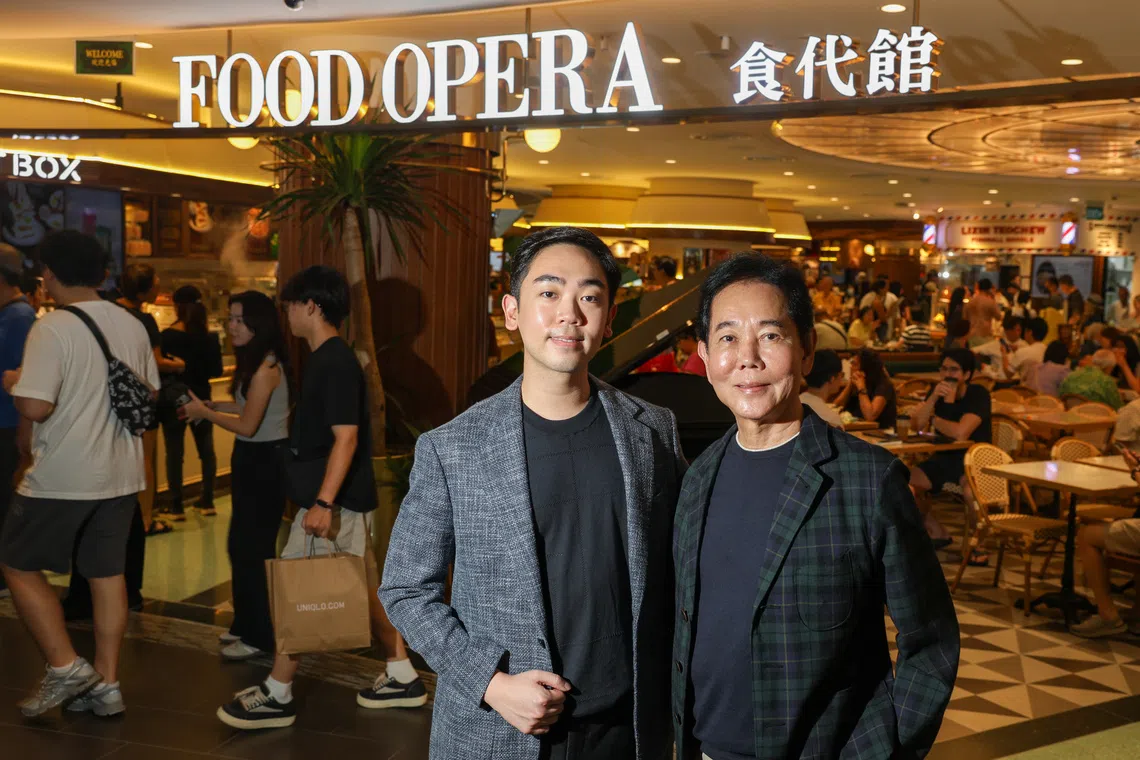
BreadTalk Group chief executive Jonathan Quek (left) and his father, BreadTalk Group’s chairman George Quek, at Food Opera.
Published Oct 10, 2026, 09:55 AM
Updated Oct 10, 2026, 12:15 PM
BreadTalk Group spent $5 million revamping Food Opera at Ion Orchard, reopening with 24 stalls and 18 new tenants, each themed around 1970s non-food businesses.
The makeover aims to preserve local food culture by turning dining into an experience, with live cooking, a piano, and new retail and bakery concepts for locals and tourists.
BreadTalk says it must keep reinventing as competition grows, while Jonathan Quek uses data, technology and careful curation to protect the group's legacy and keep heritage food popular.
SINGAPORE – At the revamped Food Opera at Ion Orchard, Ming Chung White Lor Mee stall doles out steaming Henghua delights from a facade designed to resemble an old-fashioned cobbler’s shop. There are rows of wooden shoe lasts, shelves of shoe brushes and tins of polish.
Over at Hakka Bond Express, handmade yong tau foo is served from what looks like a 1970s post office, complete with wooden pigeonhole mail-sorting racks filled with envelopes.
Berempah Bros is decked out as a 1970s hair salon, with an oversized hairdryer, comb and scissors decorating its signboard. Below the service counter is a lit glass display shelf showing vintage hair-misting bottles.
The shopfronts are part of BreadTalk Group’s $5 million revamp of the sprawling 600-seat Food Opera, which reopened on Sept 28 after a three-month renovation.
While themes are not new to BreadTalk Group’s foodcourts, this is the first time the idea has been applied to individual stalls, each with its own identity based on a non-food business from the 1970s.
Jonathan Quek, 31, group chief executive of BreadTalk Group, says the aim is not to recreate the era literally, but to capture its sense of aspiration, when people were beginning to want more than the basics, such as dressing better, listening to music and going out.
He says diners today have a similar appetite for discovering new experiences and places.
BreadTalk Group chairman George Quek, 69, came up with the name Food Opera when it opened at Ion Orchard in 2009. For him, the culinary arts involve performance and showmanship.
With that in mind, Toast Box at Food Opera now offers diners a full view of the roasting and grinding of Colombian Supremo coffee beans for its new premium Nanyang Supremo Kopi Blend, with a cup of Kopi O starting at $3.50. The blend is exclusive to Food Opera.
Diners can watch fishballs being made at LiXin Teochew Fishball Noodles. A baby grand piano takes up space which could otherwise accommodate about 10 diners. Customers can play it and there are plans to engage pianists for live performances.
New to the foodcourt is Orchid Gallery, a retail and lifestyle section which sells local snacks, souvenirs and other home-grown products aimed at both tourists and locals, while Treasure Bakery is a new British-Nanyang bakery concept by BreadTalk Group.
The Treasure Bakery stall at Food Opera. ST PHOTO: JASEL POH
The Treasure Bakery stall at Food Opera.
Foodcourts under BreadTalk Group have evolved over the three decades since the elder Quek opened his first Food Junction at Bishan’s Junction 8 in 1993.
This was two years after he returned to Singapore following an 11-year sojourn in Taiwan.
There, he had started Singa, a food kiosk selling Singaporean fare. He favoured locations in the basement food streets of departmental stores. The business grew to 21 outlets in Taipei, Kaohsiung and Taichung.
Back in Singapore, he saw an opportunity in the foodcourt business, which kicked off in 1985 with the opening of the first air-conditioned foodcourt in Singapore at Scotts Shopping Centre. He boldly approached the management of Junction 8 with his proposal and opened Food Junction with 19 stalls in a space of close to 11,000 sq ft.
The elder Qu ek w anted a concept that would stand out and hit upon the theme of a 1960s American diner.
To offer diners a different food mix, he brought in teppanyaki, conveyor-belt sushi and Thai mini steamboat, along with local fare such as Hockchew fishballs and nasi padang served on banana leaves.
He believed mallgoers would be willing to pay more for comfort and quality food in an air-conditioned foodcourt.
The plan was to offer more than just basic meals. The foodcourt was meant as a lifestyle concept.
BreadTalk Group now operates 45 foodcourts across Singapore, Malaysia, Hong Kong, Taiwan and China, with 35 Food Republic outlets, nine Food Junctions and one Food Opera.
Food Junction is found mainly in suburban malls and is more fuss-free, while Food Republic is a thematic food-hall concept, in locations such as Jewel Changi Airport and Suntec City.
Food Opera is the group’s only foodcourt under that name and was created to suit Ion Orchard, a more upmarket mall.
Staying ahead of the competition
George Quek and his son, Jonathan, place importance on design and aesthetics. ST PHOTO: JASEL POH
George Quek and his son, Jonathan, place importance on design and aesthetics.
The elder Quek says increased competition means the group has to keep changing.
“To stand out from the competition, we focus on branding. We have to keep improving and reinventing,” he says. “We travel, we observe the trends. Every day, we are absorbing and learning.”
His son, Jonathan, who became group chief executive in October 2024, grew up following his parents to work. Weekends were filled with store visits. During his school holidays, he worked in the group for basic pay.
In 2018, on a holiday back home while studying at Cass Business School in London, he spent time in the finance department and did a three-week stint as an operations intern at Food Republic in Suntec City. There, his work included quality control, clearing trays and dishwashing.
He graduated with a bachelor of science in management in 2019. He capped it with a master of science in real estate in 2020, which he completed online after returning to Singapore in March that year during the Covid-19 pandemic, before borders closed.
He could see his parents grappling with the toll of the pandemic. Foodcourts with hundreds of seats were reduced to takeaway operations and, later, to limited seating with safe distancing measures.
Food Opera was one of the group’s badly affected outlets. Business fell to as low as 20% of 2019’s pre-pandemic numbers.
He joined BreadTalk Group full-time in September 2020 as an operations executive and went through six months of intensive operations training.
At BreadTalk in Tampines Mall, he manned the cashier, handled product displays and learnt to shape bread.
He also rotated through the central kitchen and Toast Box. His shifts ran from 7am to 4pm or from 1pm until closing at 10pm, and he worked overtime.
His father says: “I wanted him to taste the hardship to understand the heartbeat of the business, so that he will cherish the employees who put in the hard work.”
Jonathan adds: “His advice to me was, ‘Roll up your sleeves and get your hands dirty.’”
A year later, he became assistant general manager and was subsequently promoted to general manager of BreadTalk and Toast Box, then managing director in 2022.
As chairman of the group , Quek had mentored and trained other chief executives and was heartened by his children joining him. His elder daughter, Joselle Quek , 33, is senior director of research and development for the bakery division , while his younger son, Matthew Quek , 29, is general manager of Taiwanese restaurant chain Din Tai Fung. BreadTalk Group operates the Din Tai Fung franchise in Singapore.
Leadership and strategy
When deciding who should lead the company, he looks for three qualities.
The first is character. A leader, he says, must be trustworthy and hardworking, with integrity, and cannot be arrogant or selfish.
The second is passion for the food and beverage business. “It is a difficult industry to be in, so you need passion as fuel,” he says.
The third is taste. “The person must have an eye for beauty, appreciate culture and have a flair for aesthetics.”
Jonathan, chosen for the position, has introduced technology and data as part of the company’s way forward.
As part of its digital transformation, the group now uses Geographic Information System tools for site selection. Enterprise resource planning systems, finance automation and artificial intelligence are used to simplify routine work.
The elder Quek supports the change. In the past, he says, business development, including assessing potential sites for new foodcourts or other outlets, was based largely on experience, gut feel, footfall and observations of consumer behaviour. Now, decision-making is further backed by data.
Much thought goes into the design and tenant mix at Food Opera. ST PHOTO: JASEL POH
Much thought goes into the design and tenant mix at Food Opera.
Jonathan says his thinking about growth has also changed since he joined the company.
“When I first joined the business in 2020, my instinct was to do more: more promotions, more campaigns, more product launches. We were chasing growth, but we might have ended up spreading ourselves too thin in the process.”
Over time, he realised that strategy is not just about deciding what to do, but also having the discipline to decide what not to do.
He adds: “Instead of asking, ‘How do we sell more?’, we began asking, ‘How do we create an experience customers will remember and want to return to?’”
At Food Opera, that means going beyond simply filling up the tenant list. Much thought goes into the tenant mix. Some are places the Quek family has patronised over the years.
Jonathan remembers going to Ming Chung Restaurant in Maude Road with his family when he was young.
He suggested getting Ming Chung and Berempah Bros to take up stalls at Food Opera. It was his team that approached and persuaded them to come on board. It is the first time the two brands, which have hawker outlets, entered a foodcourt.
He says: “We have to become curators of great food, great operators and even things people haven’t discovered yet.”
For him, keeping local food culture alive also means ensuring people still want to eat local fare.
“The best way to preserve our food culture is to keep people eating it. Heritage has to stay alive, not sit behind glass,” he says.
His father now concentrates mainly on board-level matters, but Jonathan does not hesitate to approach him for advice when needed . They dine together as a family at a foodcourt about once a month and continue to observe operations when they visit outlets, even entering the dishwashing area to check on hygiene levels.
Asked how he feels about handing over day-to-day leadership of the business he built, Quek says: “I feel more relaxed. I have more free time.”
But Jonathan feels the responsibility as a torchbearer. A Chinese saying that wealth does not last beyond three generations is always at the back of his mind.
“I better not mess this up,” he says good-humouredly.
He also does not believe preserving what his father built means leaving it unchanged. In fact, his father is behind the group’s philosophy of seeking the new, embracing change and daring to differentiate.
“The most respectful thing we can do with a legacy is not to freeze it in time, but to keep having the courage to reinvent it,” he says.
5 dishes to try at Food Opera
Where: Food Opera at Ion Orchard, B4-04 Ion Orchard, 2 Orchard Turn Open: 10am to 10pm
Hakka Bond Express’ Handmade Yong Tau Foo with Dry Noodles Set. ST PHOTO: JASEL POH
Hakka Bond Express’ Handmade Yong Tau Foo with Dry Noodles Set.
At Hakka Bond’s first express outlet in a foodcourt, order its five-piece Handmade Yong Tau Foo ($10.90), with fried tau pok, fried mushroom, fried beancurd, steamed cabbage and fried tau kwa. Each piece is stuffed with a mixture of minced meat and fish instead of the fish-paste-only filling commonly found elsewhere.
Parkson Bak Kut Teh’s Original White Pepper Bak Kut Teh (Dry). ST PHOTO: JASEL POH
Parkson Bak Kut Teh’s Original White Pepper Bak Kut Teh (Dry).
The home-grown brand’s Original White Pepper Bak Kut Teh (Dry, $10.80) is inspired by the dry-style herbal bak kut teh commonly found in Malaysia. The stall uses Australian pork and Sarawak white peppercorns, which are slowly roasted over low heat to bring out their aroma.
The dish includes pork ribs, intestines, pork leg and sliced pork coated in a peppery sauce.
Ming Chung White Lor Mee
Ming Chung White Lor Mee’s Heng Hua Fried Bee Hoon. ST PHOTO: JASEL POH
Ming Chung White Lor Mee’s Heng Hua Fried Bee Hoon.
While the 93-year-old brand is known for its white lor mee, its Heng Hua Fried Bee Hoon ($8.80 for small, $12.80 for medium) is worth ordering too.
Extra-thin Heng Hwa rice vermicelli imported from China is wok-fried until fragrant and savoury, then topped with fresh prawns, lala and braised pork. The combination gives the dish both seafood sweetness and meaty richness.
Wah Eng Beef Noodle’s Mixed Beef Noodle Soup (right), and Mixed Beef Noodle Dry. ST PHOTO: JASEL POH
Wah Eng Beef Noodle’s Mixed Beef Noodle Soup (right), and Mixed Beef Noodle Dry.
The Mixed Beef Noodle Soup ($13.90) comes loaded with beef slices, beef brisket, honeycomb tripe and handmade beef balls. The broth is slow-simmered with beef knuckle bones and a secret blend of eight herbs and spices for a full-bodied, aromatic flavour. No additional monosodium glutamate is used, allowing the flavours of the beef and herbs to shine.
Berempah Bros’ Signature Ayam Berempah. ST PHOTO: JASEL POH
Berempah Bros’ Signature Ayam Berempah.
The signature Ayam Berempah ($10) features a boneless chicken thigh brined for juiciness, then marinated overnight in a blend of 16 ingredients, including fennel, cumin and coriander, before being fried.
The dish comes with berempah crumbs made with toasted coconut and aromatic rempah, including ingredients such as lemongrass, shallots, garlic, turmeric and chilli. Coconut rice, fried egg and achar complete the plate.
Hedy Khoo is senior correspondent at The Straits Times. She covers food-related news, from reviews to human interest stories.
面包新语集团首席执行官郭明錤(左)和他的父亲,面包新语集团董事长郭明錤在美食歌剧节上。
发布于 2026 年 10 月 10 日上午 9:55
更新于2026年10月10日下午12:15
面包新语集团斥资 500 万美元对 ION Orchard 的 Food Opera 进行了翻新,重新开业后设有 24 个摊位和 18 个新租户,每个摊位都以 20 世纪 70 年代的非食品企业为主题。
此次改造旨在通过将用餐变成一种体验来保护当地的饮食文化,包括现场烹饪、钢琴演奏,以及为当地居民和游客提供新的零售和烘焙概念。
面包新语表示,随着竞争加剧,它必须不断创新;而郭建中则利用数据、技术和精心策划来保护集团的传统,并保持传统食品的流行。
新加坡——在经过翻新的ION Orchard美食广场,明忠白卤面摊位以其仿照老式修鞋店设计的店面,供应热气腾腾的恒化美食。店内摆放着一排排木制鞋楦、鞋刷架和鞋油罐。
在客家邦德快餐店,手工制作的酿豆腐在一个看起来像 20 世纪 70 年代邮局的地方供应,里面甚至还有装满信封的木制鸽笼式邮件分拣架。
Berempah Bros 的装潢风格仿照 20 世纪 70 年代的理发店,招牌上装饰着超大的吹风机、梳子和剪刀。服务台下方是一个带灯的玻璃展示架,上面摆放着复古的喷雾式护发产品。
这些店面是面包新语集团斥资 500 万美元对拥有 600 个座位的庞大美食歌剧院进行翻新改造的一部分,该餐厅在经过三个月的翻新后于 9 月 28 日重新开业。
虽然主题对于面包新语集团的美食广场来说并不新鲜,但这是第一次将这一理念应用于单个摊位,每个摊位都以 20 世纪 70 年代的非食品行业为主题,拥有自己的独特风格。
31岁的面包新语集团首席执行官郭建国表示,他们的目标不是完全重现那个时代,而是捕捉当时人们的渴望,那时人们开始想要的不仅仅是基本的东西,比如穿得更好、听音乐和外出。
他表示,如今的食客们对探索新体验和新地方有着类似的渴望。
面包新语集团主席郭明錤(69岁)在2009年于ION Orchard购物中心开设餐厅时,想出了“美食歌剧”这个名字。对他来说,烹饪艺术包含表演和展示技巧。
鉴于此,Food Opera 的 Toast Box 餐厅现在为食客提供全程观看哥伦比亚 Supremo 咖啡豆烘焙和研磨的过程,用于制作其全新高端南洋 Supremo Kopi Blend 咖啡,一杯 Kopi O 咖啡起价 3.50 美元。这款咖啡仅在 Food Opera 供应。
在利新潮州鱼丸面店,食客可以观看鱼丸的制作过程。店内摆放着一架小型三角钢琴,占据了原本可以容纳约10位食客的空间。顾客可以弹奏这架钢琴,店家还计划邀请钢琴家进行现场演奏。
美食广场新入驻了兰花廊,这是一个零售和生活方式区,出售当地小吃、纪念品和其他本土产品,目标客户是游客和当地人;而宝藏面包坊则是面包新语集团推出的全新英式南洋面包坊概念。
美食歌剧节上的宝藏面包店摊位。海峡时报摄影:Jasel Poh
美食歌剧节上的宝藏面包店摊位。
自老郭先生于 1993 年在碧山 Junction 8 开设第一家美食广场以来,面包新语集团旗下的美食广场在过去的三十年中不断发展演变。
这是他在台湾生活11年后返回新加坡两年后的事。
他在那里创办了“新佳”(Singa),一家售卖新加坡美食的小吃亭。他偏爱百货公司地下美食街的店面位置。后来,这家店发展到在台北、高雄和台中拥有21家分店。
回到新加坡后,他看到了美食广场行业的商机。1985年,他在史各士购物中心开设了新加坡第一家空调美食广场,由此开启了他的美食广场事业。他大胆地向Junction 8的管理层提出了自己的方案,并在那里开设了拥有19个摊位、占地近11000平方英尺的Food Junction。
老郭先生想要一个与众不同的概念,并抓住 20 世纪 60 年代美国餐馆的主题。
为了给食客提供不同的食物组合,他引进了铁板烧、传送带寿司和泰式迷你火锅,以及当地美食,如福州鱼丸和用香蕉叶盛装的巴东饭。
他认为,在有空调的美食广场里,顾客愿意为舒适的环境和优质的食物支付更高的价格。
该计划旨在提供的不仅仅是基本餐食。美食广场的目标是打造一种生活方式理念。
面包新语集团目前在新加坡、马来西亚、香港、台湾和中国大陆经营着 45 家美食广场,其中包括 35 家美食共和国门店、9 家美食枢纽和 1 家美食歌剧门店。
Food Junction 主要位于郊区购物中心,购物体验更加便捷;而 Food Republic 则是一个主题美食广场概念,位于樟宜机场星耀樟宜和新达城等地。
Food Opera 是该集团旗下唯一一家以此命名的美食广场,其创建是为了迎合 Ion Orchard 这家更高端的购物中心。
保持竞争优势
郭先生和他的儿子郭先生都非常重视设计和美学。海峡时报摄影:贾塞尔·波
郭先生和他的儿子郭先生都非常重视设计和美学。
老郭先生说,日益激烈的竞争意味着该团体必须不断变革。
“为了在竞争中脱颖而出,我们专注于品牌建设。我们必须不断改进和创新,”他说道。“我们四处旅行,观察潮流趋势。我们每天都在吸收和学习。”
他的儿子乔纳森于2024年10月成为集团首席执行官,从小就跟随父母上下班。周末时间都用来巡视门店。学生时代,他也会在集团打工,领取基本工资。
2018年,在伦敦卡斯商学院就读期间,他利用假期回国,在财务部门实习了一段时间,并在新达城的Food Republic餐厅做了三周的运营实习生。在那里,他的工作包括质量控制、清理托盘和洗碗。
他于 2019 年获得管理学理学士学位。2020 年,他在新冠疫情期间于当年 3 月返回新加坡,并在边境关闭前通过在线方式完成了房地产理学硕士学位。
他能感受到父母承受着疫情带来的巨大压力。原本拥有数百个座位的美食广场先是改为外卖服务,后来又改为限制堂食座位并采取保持安全距离的措施。
Food Opera是该集团受影响最严重的门店之一。其营业额一度跌至2019年疫情前水平的20%。
他于 2020 年 9 月全职加入面包新语集团,担任运营主管,并接受了六个月的强化运营培训。
在淡滨尼购物中心的 BreadTalk 面包店,他担任收银员、负责产品陈列,并学习了面包的制作。
他还轮岗于中央厨房和吐司盒餐厅。他的班次是从早上7点到下午4点,或者从下午1点到晚上10点关门,而且他经常加班。
他的父亲说:“我希望他能尝到苦头,了解企业的脉搏,这样他就会珍惜那些辛勤工作的员工。”
乔纳森补充道:“他给我的建议是,‘卷起袖子,亲力亲为。’”
一年后,他升任助理总经理,随后晋升为面包新语和吐司盒的总经理,并在 2022 年成为董事总经理。
作为集团主席,郭先生曾指导和培训其他首席执行官,并欣慰地看到子女加入集团。他的大女儿郭女士(33岁)是烘焙部门的高级研发总监,小儿子郭先生(29岁)是台湾连锁餐厅鼎泰丰的总经理。面包新语集团在新加坡经营鼎泰丰的特许经营权。
领导力和战略
在决定谁应该领导公司时,他会考虑三个品质。
首先是品格。他说,领导者必须值得信赖、勤奋努力、正直诚信,不能傲慢自大或自私自利。
第二点是对餐饮行业的热情。“这是一个竞争激烈的行业,所以你需要热情作为动力,”他说。
第三点是品味。“这个人必须有鉴赏美的眼光,懂得欣赏文化,并且具有审美天赋。”
被选中担任该职位的乔纳森,将技术和数据引入公司的发展方向。
作为数字化转型的一部分,该集团目前使用地理信息系统工具进行选址。企业资源规划系统、财务自动化和人工智能则用于简化日常工作。
老郭先生支持这一变革。他表示,过去,包括评估新建美食广场或其他门店的潜在选址在内的业务拓展,主要依赖于经验、直觉、客流量和对消费者行为的观察。而现在,决策更多地依赖于数据。
Food Opera的设计和租户组合都经过深思熟虑。ST PHOTO:JASEL POH
Food Opera 的设计和租户组合都经过了深思熟虑。
乔纳森说,自从他加入公司以来,他对增长的看法也发生了变化。
“我2020年刚加入公司时,本能地想做得更多:更多的促销活动、更多的营销活动、更多的产品发布。我们当时一心追求增长,但结果可能反而分散了精力。”
随着时间的推移,他意识到战略不仅仅是决定做什么,还要有纪律决定不做什么。
他补充道:“我们不再问‘我们如何才能卖出更多产品?’,而是开始问‘我们如何创造一种让顾客铭记并想要再次体验的体验?’”
在美食歌剧餐厅,这意味着不仅仅是简单地填满租户名单。餐厅在选择租户组合方面经过深思熟虑。其中一些是郭氏家族多年来一直光顾的餐厅。
乔纳森记得小时候和家人一起去过茂德路的明忠餐馆。
他建议邀请明忠和Berempah Bros在美食广场入驻。正是他的团队联系并说服了他们。这是这两个拥有小贩摊位的品牌首次进驻美食广场。
他说:“我们必须成为优质美食、优秀经营者,甚至是人们尚未发现的事物的策展人。”
对他来说,保持地方饮食文化的活力也意味着要确保人们仍然想吃当地美食。
他说:“保护我们饮食文化的最佳方法就是让人们继续食用它。文化遗产必须鲜活地传承下去,而不是被束之高阁。”
他的父亲现在主要专注于董事会层面的事务,但乔纳森在需要时仍会毫不犹豫地向他寻求建议。他们一家人大约每月会一起在美食广场用餐一次,并且在走访各个门店时也会继续观察运营情况,甚至会进入洗碗区检查卫生状况。
当被问及将自己一手创建的企业的日常管理权移交给他人有何感想时,郭先生表示:“我感觉更轻松了,也有了更多空闲时间。”
但乔纳森觉得自己肩负着传承的责任。中国有句谚语说财富无法传承三代,这句谚语始终萦绕在他的心头。
“我最好别搞砸了,”他笑着说。
他也不认为传承父亲的事业意味着墨守成规。事实上,他父亲正是集团追求创新、拥抱变革、勇于标新立异理念的幕后推手。
他说:“我们能对一份遗产做的最尊重的事情,不是把它冻结在某个时间点,而是要有勇气去重塑它。”
美食歌剧院五道必尝菜肴
地点:ION Orchard 美食广场,B4-04,2 Orchard Turn 营业时间:上午10点至晚上10点
客家邦德快餐手工酿豆腐配干面套餐。海峡时报摄影:贾塞尔·波
客家邦德快餐的手工酿豆腐配干面套餐。
在客家邦德位于美食广场的首家快餐店,您可以点一份五件套手工酿豆腐(10.90 新元),内含炸豆腐泡、炸蘑菇、炸豆腐、蒸白菜和炸豆干。每件酿豆腐的馅料都是肉末和鱼肉的混合物,而不是其他地方常见的纯鱼肉馅。
百盛肉骨茶原味白胡椒肉骨茶(干)。 ST 照片:JASEL POH
百盛肉骨茶原味白胡椒肉骨茶(干)。
这家本土品牌的原味白胡椒肉骨茶(干煸,10.80 新元)灵感源自马来西亚常见的干煸药材肉骨茶。摊位选用澳洲猪肉和砂拉越白胡椒粒,以低温慢烤的方式充分释放其香气。
这道菜包括猪肋排、猪肠、猪腿和裹着胡椒酱的猪肉片。
明忠白卤面
明忠白卤面的兴华炒米粉。 ST 照片:JASEL POH
明忠白卤面的恒化炒米粉。
虽然这家拥有 93 年历史的品牌以其白卤面而闻名,但其恒化炒米粉(小份 8.80 美元,中份 12.80 美元)也值得一试。
从中国进口的恒华特细米粉,经翻炒至香气四溢、鲜香可口,再配以鲜虾、啦啦和红烧肉。这道菜融合了海鲜的鲜甜和肉的浓郁,口感层次丰富。
华英牛肉面的什锦牛肉汤面(右)和什锦牛肉干面。海峡时报摄影:贾塞尔·波
华英牛肉面的什锦牛肉面汤(右)和什锦牛肉干面。
这道什锦牛肉面(13.90美元)配料丰富,包括牛肉片、牛腩、蜂窝肚和手工牛肉丸。汤底用牛膝骨和秘制八种草药香料慢火熬制,味道浓郁醇厚。汤中不添加味精,让牛肉和草药的鲜美滋味得以充分展现。
Berempah Bros 的招牌 Ayam Berempah。 ST 照片:JASEL POH
Berempah Bros 的招牌 Ayam Berempah。
招牌菜香料鸡(10 美元)选用无骨鸡腿肉,先用盐水腌制使其多汁,然后在茴香、孜然和香菜等 16 种配料的混合物中腌制过夜,最后油炸。
这道菜配有用烤椰丝和香料粉制成的香料碎,香料粉的成分包括香茅、红葱头、大蒜、姜黄和辣椒。椰香米饭、煎蛋和腌菜也为这道菜锦上添花。
Hedy Khoo是《海峡时报》的资深记者。她报道与食品相关的新闻,包括食品评论和人物故事。