Tasting menus below $100 per person: How restaurants are putting affordable luxury on the menu人均100美元以下的品尝菜单:餐厅如何将平价奢华搬上菜单
Fine-dining chefs are making their creations more accessible through cheaper menus and casual concepts. Read more at straitstimes.com.
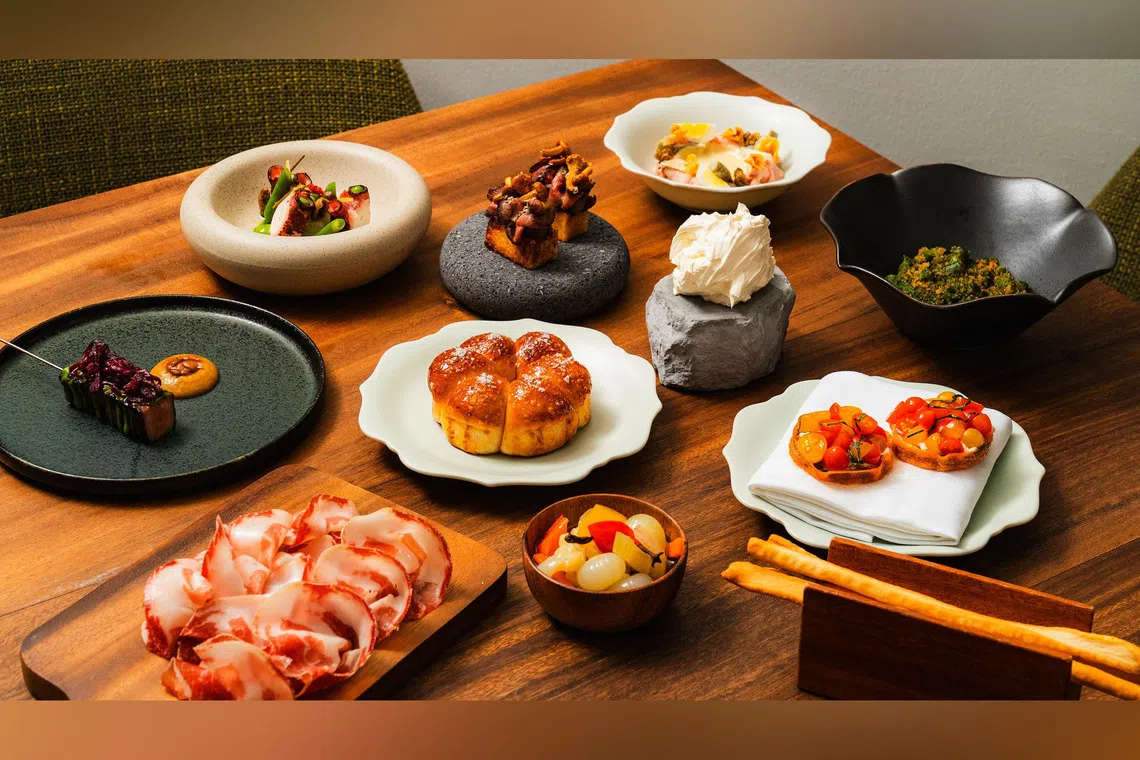
Dishes from Assaggi.
Published Oct 10, 2026, 08:55 AM
Updated Oct 10, 2026, 08:55 AM
Assaggi offers a semi-fine dining Italian tasting menu at $88++, blending premium ingredients with a relaxed atmosphere.
Several restaurants in Singapore now provide tasting menus below $100, meeting demand for affordable luxury.
Chefs are balancing fine dining with casual options, using a la carte and set menus to offer variety and affordability, reflecting changing customer preferences for flexible dining experiences.
SINGAPORE – At $88++ per person, it might be a stretch to call Assaggi, a tasting menu-only Italian establishment in Neil Road, affordable.
And yet, the restaurant, which opened in August, is fully booked until the end of 2026, attracting even younger patrons.
It occupies a curious space in the local food scene. Neither fine dining nor casual, but somewhere in between. In other words: premium produce but no caviar; refined wood tables but no tablecloths; attentive staff but no stuffy uniforms, just aprons and sneakers.
Unlike Buona Terra, a one-Michelin-starred restaurant where a six-course dinner is priced at $248++, the kitchen here is not striving for absolute perfection. “We try to validate the humble ingredient. That’s what Italian cuisine is about,” says chef-owner Denis Lucchi, 45, who runs both restaurants.
“We believe that even with humble ingredients and without spending a bomb, we can do a nice five-course menu that people can come and enjoy.”
Assaggi opened in Neil Road in August and is run by a team of young chefs. PHOTO: ASSAGGI
Assaggi opened in Neil Road in August and is run by a team of young chefs.
He initially toyed with the idea of opening another Locanda – his casual Italian restaurant in Rowell Road – because the market seemed to favour comfort food and a la carte menus, but realised that a high-volume system would not work in this 30-seater space, located on the second floor of a shophouse.
“The kitchen is a little too small to do a la carte, so we decided to do something in between, something that almost gives you the feeling of a fine dining, but at a friendlier price,” he adds.
Cheaper, but not cheap
So, what does semi-fine dining taste like?
A whole lot of pasta, apparently. The Pasta Journey menu ($88++) is a carbivore’s dream come true, plunging diners deep into the heart of Italian cooking with four to five pasta courses, such as tubetti with anchovies and aglio olio linguine with mussels and dry tomato.
Alternatively, those desirous of greater variety – as most diners are, according to Lucchi – can opt for the Signature Journey, which costs the same. It comes with six to seven courses, including a pasta dish – pick between osobucco pappardelle and fusilli with red prawns – and a main of either roasted duck or stone bass.
Paccheri Amatriciana from Assaggi. PHOTO: ASSAGGI
Paccheri Amatriciana from Assaggi.
While Lucchi is heartened by the rousing response Assaggi has received so far, he is aware that, owing to the ephemeral nature of social media hype, he is “living in a bubble now”.
He says: “The real test will come next year when this bubble bursts and we see if regulars come back and people enjoy the place. Then we’ll know if we’re really doing a good job.”
Assaggi is part of a growing handful of restaurants rolling out tasting menus priced below $100. This category includes Sushi Dan in Raffles City, where an omakase lunch in the restaurant’s private room starts at $98++, and Na-Oh in Bulim Link, where a hearty four-course seasonal Korean meal can be had for $88++.
Despite being located in a Jurong West car factory, a seat at Na-Oh remains infamously difficult to snag, even two years into operations. It suggests that appetite for this sort of “affordable” luxury remains alive and well. Perhaps what consumers seek then is not an inexpensive meal per se, but one that feels worth it.
Tiramisu from Loulouca. PHOTO: LOULOUCA
Tiramisu from Loulouca.
After all, a $28++ tiramisu is hardly considered cheap, and yet, such prices have not stemmed the flow of patrons at Loulouca, a 20-seater dessert atelier that opened in July.
Footfall so far has been healthy, says owner and pastry chef Louisa Lim, 34. “It’s pretty bustling, especially after dinner. We’ve been quite lucky. Usually we’re full.”
Like Assaggi, Loulouca’s value crystallises most clearly in contrast. “The guests who know what I did in Odette will go: ‘Yeah, actually this is very affordable.’ But those who are maybe used to more mainstream pastries will wonder why we’re charging so much,” she says.
Lim honed her craft through seven years at French restaurant Odette in National Gallery Singapore, where she led the pastry programme. Dinner at the three-Michelin-starred establishment will set you back by $498++.
It follows that the tiramisu she serves at Loulouca is no regular cake. Her version has been elevated with sobacha ice cream, coffee-doused biscuit cuillere, coffee praline, caramelised pecans and a delicate buckwheat tuile. Other creations feature seasonal ingredients like Shizuoka Melon ($32++) and Yamanashi Peach ($35++).
“Throughout my career, I’ve worked with quality ingredients, so that’s something I won’t compromise on. To create something delicious, you need quality ingredients,” she says. “Diners are very discerning these days. They’re willing to spend if they know that what they’re paying for is bang for the buck.”
Louisa Lim, chef-owner of Loulouca, formerly worked as pastry chef at Odette. PHOTO: LOULOUCA
Louisa Lim, chef-owner of Loulouca, formerly worked as pastry chef at Odette.
Loulouca also has a more affordable day menu, with desserts like the matcha pistachio kaya ($15++), her loose take on a Mont Blanc, reimagined with Singapore flavours.
No elaborate tasting menus here, though. “I like eating desserts in small amounts. Omakase can sometimes be a little bit intimidating for me. It’s a lot in one go, which can be a bit much,” she says. “It isn’t something you’d do every weekend.”
Like Lim, some chefs have ditched the tasting menu altogether and fully embraced a la carte dining through new ventures.
Chefs Louis Han and Park Su-ji at Osteria Da Su in Telok Ayer. ST PHOTO: JASON QUAH
Chefs Louis Han and Park Su-ji at Osteria Da Su in Telok Ayer.
ST PHOTO: JASON QUAH
Come end-October, South Korean chef Louis Han, 36, will open a casual Italian osteria next door to his one-Michelin-starred Korean fine dining restaurant Nae:um in Telok Ayer Street.
Named Osteria Da Su, it will be helmed by his former culinary school classmate Park Su-ji, 37, and serve simple Italian dishes with subtle Korean flourishes. For instance: vongole with Asari clams and pasta amatriciana with gochujang-glazed guanciale chips. Pastas will be priced between $20 to $30.
“We’re trying to be artisan, but also very affordable. So when you walk into the restaurant, you’ll see it’s cosy and relaxed, but also with a high quality of ingredients and food,” says Han.
Having already opened a fine-dining restaurant and a contemporary grill – Guum in Keong Saik Road, where premium cuts cost up to $248++ for 300g of Hanwoo beef) – he wanted to offer customers something more pocket-friendly. “We’re trying to match customer expectations,” he says.
Osteria Da Su’s pasta dishes will be priced between $20 and $30. ST PHOTO: JASON QUAH
Osteria Da Su’s pasta dishes will be priced between $20 and $30.
Patience for long two- to three-hour meals is fast dwindling and customers increasingly prize the freedom to pick and choose dishes that suit their various dietary requirements. So although Nae:um’s fortunes have started to fluctuate in 2026, casual Italian food, he is confident, is evergreen – just look at how well pizza and pasta chain Casa Vostra is doing.
Likewise, Takeshi Araki, former head chef of the now-defunct one-Michelin-starred modern Kappo restaurant Esora, is focusing his efforts on casual dining. In September, the culinary director of Cloud Restaurant Group opened AO, a restaurant in Orchard Towers that channels his refined Japanese techniques into modestly priced dishes.
Takeshi Araki, former head chef of Esora, is now culinary director of Cloud Restaurant Group, which runs AO Restaurant PHOTO: AO RESTAURANT
Takeshi Araki, former head chef of Esora, is now culinary director of Cloud Restaurant Group, which runs AO Restaurant
PHOTO: AO RESTAURANT
“I am quite a simple person, and I enjoy the simple things in life,” says the 39-year-old chef.
After Esora closed, he spent some time in Japan with his children, revisiting old haunts and rediscovering the joy of eating simply. “Watching my children enjoy sushi as much as I do also reminded me that food can bring different generations together. After so many years working in fine dining, this made me think about what I wanted to explore next. I became interested in cooking for a wider range of people, in a more relaxed setting, with food that could be shared around the table.”
Sakura-dai Sea Bream Ramen from AO. PHOTO: AO RESTAURANT
Sakura-dai Sea Bream Ramen from AO.
AO’s menu is anchored by mains like the “Sakura-dai” Sea Bream Ramen ($28++) – a creamy noodle dish with swordfish chashu – and Yuzukosho Teriyaki Chicken ($32++) served with celeriac kinpira, charred Padron peppers and burnt lemon. Some dishes, like the Grilled Chicken Wings With Black Truffle Mochi Rice ($22++) and Sukiyaki Wagyu Maki Roll ($28++), are best enjoyed in a group.
“The atmosphere at AO may be more casual, but the discipline behind the cooking is still very important to me. We pay a lot of attention to the ingredients, preparation and balance of each dish,” he adds.
As the fine-dining scene continues to evolve, restaurants have started adding a la carte options to their menus.
1887 by Andre is retaining its la carte menu. PHOTO: RAFFLES HOTEL SINGAPORE
1887 by Andre is retaining its la carte menu.
PHOTO: RAFFLES HOTEL SINGAPORE
Take 1887 by Andre, for example. Despite making its Michelin debut in August with two glittering stars, the restaurant has no plans to do away with its a la carte menu.
“From the beginning, I wanted choice to be an important part of the experience at 1887 by Andre,” says Taiwanese chef Andre Chiang, the chef-patron of the 42-seat restaurant at Raffles Hotel, which opened in March.
“Fine dining has increasingly become associated with a fixed tasting menu, where the restaurant determines the entire journey for the guest. I wanted to revisit a different way of dining, where guests can decide what they are in the mood for, how much they would like to eat and how they want the meal to unfold.”
He was in part motivated by historical precedent.
“A la carte dining was part of the grand dining room tradition that 1887 by Andre draws from, so bringing that sense of choice back felt relevant to both the concept and the way I wanted guests to experience the restaurant today,” adds the 50-year-old.
Le Vert Verdant Forest from 1887 by Andre. PHOTO: RAFFLES HOTEL SINGAPORE
Le Vert Verdant Forest from 1887 by Andre.
Guests can order individual dishes from the a la carte menu – the Raffles Laksa Paella ($128++) perhaps, or the Blanquette de “Bak Kut Teh” ($68++) – or opt for one of the sets, priced upwards of $198++ a person.
However, it seems like the a la carte menu, in this case, is being retained in the name of autonomy rather than affordability. As of September, a minimum spend of $200 per guest applies to all lunch and dinner bookings to “provide an opportunity to balance quality and experience, allowing guests to continue to have the flexibility to choose from the a la carte menu and shape their dining experience according to their preferences”, according to a spokesperson from Raffles Hotel Singapore.
Likewise, Akane Eno, executive chef of Orchard Road Kappo restaurant Ichigo Ichie, says her a la carte offerings were “not created as a pricing-driven concept, but rather as an additional dining option for guests”. The 48-year-old adds that demand for this menu has continued to grow since its launch in 2025 and estimates that 5% to 10% of guests now order its seasonal dishes, priced upwards of $18++.
A5 Miyazaki wagyu sirloin with Japanese fig and organic cacao sauce from Ichigo Ichie’s a la carte menu. PHOTO: ICHIGO ICHIE
A5 Miyazaki wagyu sirloin with Japanese fig and organic cacao sauce from Ichigo Ichie’s a la carte menu.
Meanwhile, Restaurant Jag, a one-Michelin-starred contemporary French establishment that moved to Robertson Quay in October 2023, says its a la carte menu was the result of popular demand.
“When we opened our doors here, we asked our neighbours what they wished from us,” says owner Anant Tyagi, 40. “They wanted to return more often, to make Jag part of their weekly rhythm, not only their seasonal celebrations. The full tasting menu, beautiful as it is, felt too ceremonial for spontaneous evenings.”
Current autumn offerings start at $18++ for a side of sweet potato brioche with pumpkin spice butter, and climb up to $178++ for pan-seared whole Brittany blue lobster.
So far, it has proven a worthwhile investment. Tyagi says that since the Light Experience (the restaurant’s cheapest tasting menu, which costs $198++) and a la carte menus were introduced, the total number of diners has risen by 20%.
A la carte menus are not for everyone, however. Han, for one, feels a tasting menu best allows him to showcase his craft. “Nae:um is a very experience-driven restaurant. My guests come for food, but they also like to see me working in the restaurant. So if I make it a la carte, I cannot fully deliver the experience.”
Chef-partner Fernanda Guerrero says Araya’s Rapido lunch menu is popular among guests. ST PHOTO: TARYN NG
Chef-partner Fernanda Guerrero says Araya’s Rapido lunch menu is popular among guests.
It was not what guests wanted from Araya in Mondrian Singapore Duxton either. The one-Michelin-starred Chilean restaurant introduced an a la carte menu in late 2024 but it proved short-lived.
“Most of the guests still came for the set menus,” says chef partner and pastry chef Fernanda Guerrero, 39. “For us, the space doesn’t cater much to a la carte because you need a bigger table for that, and most of our seats are along the counter. We also don’t specialise in large-format sharing portions.”
The restaurant has since replaced the a la carte slate with a $58++ lunch menu aptly titled Rapido. It comes with bread, a starter like chicken salad with avocado and celery, and a main dish such as duck with seared foie gras and aged cacao sauce. Dessert can be added at extra cost.
Duck with aged cacao sauce from Araya’s Rapido lunch menu. ST PHOTO: CHERIE LOK
Duck with aged cacao sauce from Araya’s Rapido lunch menu.
ST PHOTO: CHERIE LOK
Around 80% of lunch guests now opt for the Rapido menu. It is a pretty tight budget to keep within for a fine-dining restaurant that imports 40% of its produce from South America, but Guerrero and her team have found a way to make it work with some suggestions from their supplier. It also helps that most guests upgrade their meal with a pricier main dish or dessert.
Plus, she points out that the lunch menu often serves as a taster, luring potential regulars back to the restaurant for a weekend dinner or a celebration, where they enjoy the full experience with one of Araya’s dinner sets (starting at $178++ a person).
“It’s still the same quality of work, just for a different occasion,” she says.
Cherie Lok covers food and culture for The Straits Times. She occasionally writes book reviews too.
Restaurants/Eateries
Food and beverage sector
来自 Assaggi 的菜肴。
发布于 2026 年 10 月 10 日上午 8:55
更新于2026年10月10日上午8:55
Assaggi 提供半精致的意大利美食品尝菜单,价格为 88 美元++,将优质食材与轻松的氛围完美融合。
新加坡多家餐厅现在提供价格低于 100 美元的品尝菜单,满足了人们对价格适中的奢华体验的需求。
厨师们正在努力平衡精致餐饮和休闲餐饮的选择,通过单点和套餐菜单来提供多样化和实惠的价格,以反映顾客对灵活用餐体验不断变化的偏好。
新加坡——位于尼尔路的意大利餐厅 Assaggi 只提供品尝菜单,每人收费 88 新元++,称其价格实惠可能有些牵强。
然而,这家8月份开业的餐厅已经预订到2026年底,吸引了更多年轻的顾客。
它在当地餐饮界占据着一个独特的位置。既非高级餐厅,也非休闲餐厅,而是介于两者之间。换句话说:食材上乘,却不提供鱼子酱;摆放着精致的木桌,却不铺桌布;服务周到,却不穿拘谨的制服,只穿着围裙和运动鞋。
与米其林一星餐厅Buona Terra(六道菜晚餐价格为248++美元)不同,这家餐厅的厨房并不追求绝对的完美。“我们努力展现食材本身的魅力。这才是意大利菜的精髓所在。”45岁的主厨兼老板丹尼斯·卢奇(Denis Lucchi)说道,他同时经营着这两家餐厅。
“我们相信,即使使用普通的食材,不花大价钱,我们也能做出美味的五道菜菜单,让人们前来享用。”
Assaggi餐厅于8月在尼尔路开业,由一群年轻的厨师经营。图片:ASSAGGI
Assaggi 于 8 月在尼尔路开业,由一群年轻的厨师经营。
他最初曾考虑再开一家 Locanda——他在罗威尔路的那家休闲意大利餐厅——因为市场似乎更青睐家常菜和单点菜单,但他意识到,在这个位于店屋二楼、只有 30 个座位的空间里,高客流量的系统行不通。
“厨房太小,无法提供单点菜肴,所以我们决定采取一种折中的方案,既能让你感受到高级餐厅的氛围,又能让你以更亲民的价格享用美食,”他补充道。
价格更低,但并不便宜
那么,半高级餐饮的味道如何呢?
显然,这里有很多意面。“意面之旅”菜单(88++美元)是碳水爱好者的梦想成真,它让食客们沉浸在意大利烹饪的精髓中,包含四到五道意面,例如凤尾鱼管面和贻贝干番茄蒜蓉橄榄油扁面。
此外,卢奇表示,大多数食客都希望品尝更多菜肴,因此他们可以选择“招牌之旅”套餐,价格相同。该套餐包含六至七道菜,包括一道意面(可选择大虾宽面或红虾螺旋面)以及烤鸭或石斑鱼主菜。
来自 Assaggi 的 Paccheri Amatriciana。照片:阿萨吉
来自 Assaggi 的 Paccheri Amatriciana。
尽管卢基对《阿萨吉》迄今为止所获得的热烈反响感到鼓舞,但他意识到,由于社交媒体热潮的短暂性,他现在“生活在一个泡沫之中”。
他说:“真正的考验将在明年到来,届时泡沫将会破裂,我们将看看老顾客是否会回来,人们是否还喜欢这里。到那时,我们才能知道我们是否真的做得好。”
Assaggi 是少数几家推出价格低于 100 美元的品尝菜单的餐厅之一。其他同类餐厅包括莱佛士城的 Sushi Dan,其包间内的厨师发办午餐起价为 98 美元++;以及 Bulim Link 的 Na-Oh,其丰盛的四道菜时令韩式套餐起价为 88 美元++。
尽管Na-Oh餐厅位于裕廊西的一家汽车工厂内,但开业两年后,依然一位难求。这表明人们对这种“价格适中”的奢华体验的需求依然旺盛。或许,消费者追求的并非仅仅是价格低廉的餐食,而是物有所值的体验。
来自卢卢卡的提拉米苏。照片:卢卢卡
Loulouca的提拉米苏。
毕竟,一份价值 28 美元以上的提拉米苏算不上便宜,然而,这样的价格并没有阻止 Loulouca 的顾客络绎不绝。Loulouca 是一家 20 座的甜品工作室,于 7 月开业。
店主兼糕点师路易莎·林(34岁)表示,目前客流量状况良好。“店里非常热闹,尤其是在晚餐后。我们很幸运,通常情况下我们都是满座的。”
与 Assaggi 一样,Loulouca 的价值也最能体现在对比之中。“了解我在 Odette 餐厅工作的客人会说:‘是啊,其实这家店很实惠。’但那些可能习惯了更主流糕点的人会纳闷我们为什么卖得这么贵,”她说道。
林女士曾在新加坡国家美术馆内的法国餐厅Odette工作七年,磨练技艺,并负责该餐厅的甜点项目。在这家米其林三星餐厅用餐,人均消费约为498新元++。
由此可见,她在Loulouca餐厅供应的提拉米苏绝非普通的蛋糕。她的版本加入了荞麦冰淇淋、浸透咖啡的饼干碎、咖啡果仁糖、焦糖山核桃和精致的荞麦薄脆,使其更加美味。其他创意提拉米苏则选用时令食材,例如静冈蜜瓜(32++新元)和山梨桃(35++新元)。
“我的职业生涯中一直坚持使用优质食材,这一点我绝不会妥协。要想做出美味佳肴,就必须使用优质食材,”她说道。“如今的食客眼光非常挑剔。如果他们知道自己花的钱物有所值,他们就愿意花钱。”
Loulouca餐厅的主厨兼老板Louisa Lim,此前曾在Odette餐厅担任糕点师。图片:LOULOUCA
Loulouca 的主厨兼老板 Louisa Lim 曾是 Odette 的糕点师。
Loulouca 还提供价格更亲民的日间菜单,甜点如抹茶开心果咖椰(15++ 美元),这是她对蒙布朗的自由演绎,融入了新加坡风味。
这里没有花哨的品鉴菜单。“我喜欢少量享用甜点。厨师发办(Omakase)对我来说有时有点吓人。一次吃这么多,可能会有点吃不完,”她说。“这不是那种你会每个周末都吃的菜。”
与林一样,一些厨师已经完全放弃了品尝菜单,并通过新的尝试完全拥抱了单点餐饮。
位于直落亚逸的Osteria Da Su餐厅主厨Louis Han和Park Su-ji。(海峡时报摄影:JASON QUAH)
位于直落亚逸 (Telok Ayer) 的 Osteria Da Su 的厨师 Louis Han 和 Park Su-ji。
《海峡时报》摄影:JASON QUAH
到 10 月底,36 岁的韩国厨师 Louis Han 将在直落亚逸街开设一家休闲意大利小酒馆,就在他获得米其林一星的韩国高级餐厅 Nae:um 隔壁。
这家名为Osteria Da Su的餐厅将由他37岁的前烹饪学校同学朴秀智(Park Su-ji)主理,供应带有微妙韩式风味的简约意大利菜肴。例如:蛤蜊意面配阿萨里蛤蜊,以及阿马特里切意面配韩式辣酱腌猪颊肉片。意面的价格在20至30美元之间。
“我们力求做到既有匠心独运,又价格亲民。所以当你走进餐厅,你会发现这里既温馨舒适,又食材和食物品质上乘,”韩说道。
他此前已开设了一家高级餐厅和一家现代烧烤店——位于恭锡路的Guum(那里300克韩牛的高级部位售价高达248新元++)——如今,他想为顾客提供更经济实惠的选择。“我们努力满足顾客的期望,”他说。
Osteria Da Su餐厅的意面价格在20至30美元之间。(ST PHOTO:JASON QUAH)
Osteria Da Su 的意大利面价格在 20 美元到 30 美元之间。
人们对长达两到三个小时的用餐耐心正在迅速减少,顾客越来越重视能够自由选择符合自身不同饮食需求的菜肴。因此,尽管Nae:um餐厅在2026年的经营状况开始出现波动,但他仍然坚信,休闲意大利菜永不过时——看看披萨和意面连锁店Casa Vostra的成功就知道了。
同样,曾任米其林一星现代割烹料理餐厅 Esora 主厨的荒木武志(现已歇业)也正将重心转向休闲餐饮。今年九月,这位云餐饮集团的烹饪总监在乌节大厦开设了 AO 餐厅,将他精湛的日式烹饪技艺融入价格亲民的菜肴中。
曾任Esora餐厅主厨的荒木武史,现任Cloud Restaurant Group餐饮集团的烹饪总监,该集团旗下拥有AO餐厅。(图片:AO餐厅)
曾任Esora餐厅主厨的荒木武史,现任Cloud Restaurant Group的烹饪总监,该公司旗下拥有AO餐厅。
照片:AO餐厅
“我是一个很简单的人,喜欢生活中简单的事物,”这位39岁的厨师说道。
Esora餐厅关门后,他带着孩子们在日本待了一段时间,重访了一些老地方,重新发现了简单饮食的乐趣。“看着孩子们和我一样喜欢寿司,也让我意识到食物能够将不同世代的人们联系在一起。在高级餐厅工作多年后,这让我开始思考接下来想要探索什么。我开始对为更广泛的人群烹饪感兴趣,希望在一个更轻松的环境中,提供可以围坐在餐桌旁分享的美食。”
AO餐厅的樱台鲷鱼拉面。图片:AO餐厅
AO 的樱花台鲷鱼拉面。
AO餐厅的招牌菜包括“樱台”鲷鱼拉面(28++新元)——这道拉面口感顺滑,搭配剑鱼叉烧——以及柚子胡椒照烧鸡(32++新元),佐以芹菜根金平、烤帕德龙辣椒和焦香柠檬。有些菜肴,例如黑松露麻糬饭配烤鸡翅(22++新元)和寿喜烧和牛卷(28++新元),则更适合多人享用。
“AO餐厅的氛围可能更轻松随意,但烹饪背后的严谨性对我来说仍然非常重要。我们非常注重每道菜的食材、烹饪方法和味道平衡,”他补充道。
随着高级餐饮行业的不断发展,餐厅开始在菜单中增加单点菜品。
1887 by Andre 餐厅保留了其单点菜单。图片:新加坡莱佛士酒店
1887 by Andre 保留了其单点菜单。
照片:新加坡莱佛士酒店
以 1887 by Andre 为例。尽管该餐厅在 8 月份首次亮相便荣获米其林二星,但它并没有取消单点菜单的计划。
“从一开始,我就希望选择成为 1887 by Andre 体验的重要组成部分,”台湾厨师 Andre Chiang 说。他是莱佛士酒店内这家拥有 42 个座位的餐厅的主厨兼老板,该餐厅于 3 月开业。
“高级餐饮越来越倾向于固定的品尝菜单,餐厅会为客人安排好整个用餐流程。我想重新探索一种不同的用餐方式,让客人可以根据自己的心情决定想吃什么、想吃多少以及用餐过程如何进行。”
他的部分动机源于历史先例。
“单点菜肴是 1887 by Andre 餐厅所借鉴的高级餐厅传统的一部分,因此,将这种选择感带回来,对于餐厅的理念以及我希望顾客今天体验餐厅的方式来说,都具有现实意义,”这位 50 岁的餐厅老板补充道。
安德烈·莱佛士 (Andre Le佛士) 于 1887 年创作的《翠绿森林》(Le Vert Verdant Forest)。图片:新加坡莱佛士酒店
安德烈 (Andre) 于 1887 年创作的 Le Vert Verdant 森林。
客人可以从单点菜单中点选单道菜——例如莱佛士叻沙海鲜饭(128++ 新元)或肉骨茶白汁(68++ 新元)——或者选择套餐,每人起价 198++ 新元。
然而,在这种情况下,单点菜单的保留似乎是为了保障客人的自主选择权,而非降低价格。新加坡莱佛士酒店的一位发言人表示,自9月起,所有午餐和晚餐预订均需满足每位客人200新元的最低消费要求,此举旨在“平衡品质与体验,让客人能够继续灵活地从单点菜单中选择菜品,并根据自身喜好打造专属的用餐体验”。
同样,乌节路割烹料理餐厅 Ichigo Ichie 的行政主厨榎野茜表示,她的单点菜品“并非以价格为导向,而是为顾客提供更多用餐选择”。这位 48 岁的厨师补充道,自 2025 年推出以来,该菜单的需求持续增长,她估计目前有 5% 到 10% 的顾客会点购价格在 18 新元以上的时令菜肴。
来自 Ichigo Ichie 餐厅单点菜单的 A5 宫崎和牛西冷牛排配日本无花果和有机可可酱。图片:ICHIGO ICHIE
来自 Ichigo Ichie 的单点菜单上的 A5 宫崎和牛西冷牛排配日本无花果和有机可可酱。
与此同时,于 2023 年 10 月迁至罗伯逊码头的米其林一星现代法式餐厅 Jag 表示,其单点菜单是应广大顾客的要求而推出的。
“我们刚开业的时候,问过邻居们希望我们做什么,”40岁的店主阿南特·蒂亚吉说。“他们希望更频繁地光顾,让Jag成为他们每周生活的一部分,而不仅仅是季节性庆祝活动的一部分。完整的品尝菜单虽然很精致,但对于随意的夜晚来说,感觉太正式了。”
目前秋季供应的菜品价格从 18 美元起,包括一份配南瓜香料黄油的甜薯奶油面包,最高可达 178 美元,包括一份香煎布列塔尼蓝龙虾。
到目前为止,这笔投资已被证明是值得的。Tyagi表示,自从推出“轻食体验”(餐厅最便宜的品尝菜单,价格为198美元++)和单点菜单以来,用餐人数总数增长了20%。
然而,单点菜单并非适合所有人。韩先生就认为,品鉴菜单最能展现他的厨艺。“Nae:um 是一家非常注重体验的餐厅。我的客人来这里是为了品尝美食,但他们也喜欢看到我在餐厅里忙碌。所以,如果采用单点菜单,我就无法完整地呈现这种体验。”
主厨兼合伙人费尔南达·格雷罗表示,Araya餐厅的Rapido午餐菜单深受顾客欢迎。(海峡时报摄影:塔琳·吴)
主厨兼合伙人费尔南达·格雷罗表示,Araya 的 Rapido 午餐菜单深受顾客欢迎。
这也不是蒙德里安新加坡达士敦酒店的Araya餐厅能给客人带来的体验。这家米其林一星智利餐厅于2024年底推出了单点菜单,但很快就停止了。
“大多数客人还是来点套餐的,”39岁的主厨兼糕点师费尔南达·格雷罗说道。“对我们来说,这个空间不太适合单点,因为单点需要更大的桌子,而我们的大部分座位都在吧台边。我们也不擅长制作大份的分享菜。”
这家餐厅已将原有的单点菜单替换为名为“Rapido”(快捷)的58美元++午餐套餐。套餐包含面包、一份开胃菜(例如鸡肉沙拉配牛油果和芹菜)以及一份主菜(例如鸭肉配煎鹅肝和陈年可可酱)。甜点需另行付费。
Araya餐厅Rapido午餐菜单上的鸭肉配陈年可可酱。ST摄影:CHERIE LOK
来自 Araya's Rapido 午餐菜单的鸭肉配陈年可可酱。
《海峡时报》照片:洛克·谢丽
现在大约80%的午餐客人选择Rapido套餐。对于一家40%食材都从南美进口的高级餐厅来说,控制预算相当困难,但Guerrero和她的团队在供应商的建议下找到了解决办法。此外,大多数客人还会选择价格更高的主菜或甜点来升级套餐,这也有助于餐厅的盈利。
此外,她指出,午餐菜单通常起到试吃的作用,吸引潜在的常客在周末晚餐或庆祝活动时回到餐厅,享受完整的用餐体验,例如 Araya 的晚餐套餐(每人 178++ 美元起)。
“工作质量还是一样,只是场合不同而已,”她说。
Cherie Lok是《海峡时报》的美食和文化专栏作家,她偶尔也撰写书评。
餐厅/餐馆
食品饮料行业