Shrinking EV incentives, not proposed COE overhaul, drive car buyers to showrooms电动汽车补贴缩减,而非拥车证改革方案,才是促使购车者转向实体店的真正原因。
Singapore car buyers rush to secure EV rebates ahead of COE overhaul and incentive cuts, dealers say Read more at straitstimes.com.
新闻视频
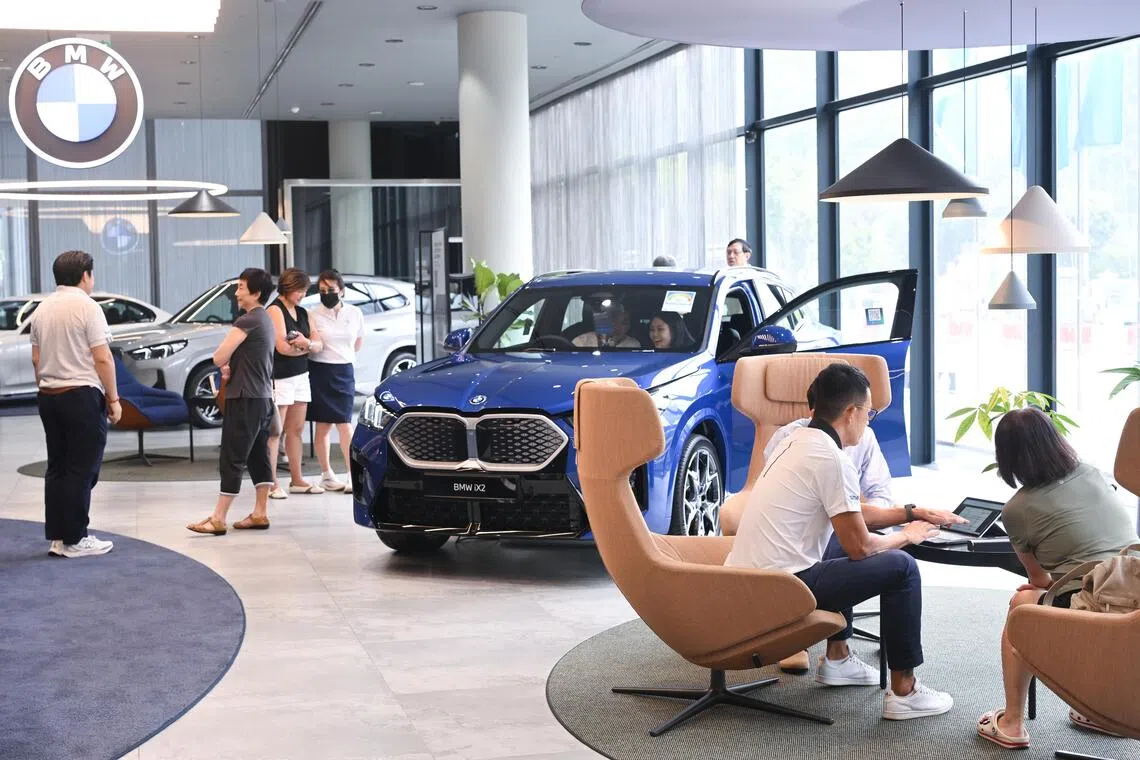
Some car buyers said that their immediate concern was another deadline – the upcoming rollback of incentives for EV adoption from Jan 2027.
ST PHOTO: LIM YAOHUI
Published Oct 10, 2026, 06:00 PM
Updated Oct 10, 2026, 06:00 PM
Car showrooms in Singapore stayed busy on Oct 10, as buyers looked to make purchases before EV incentives are cut, not because of the LTA’s proposed COE overhaul.
Buyers said the main pressure is the end of the EEAI and a lower VES rebate in 2027, which could reduce EV rebates from up to $30,000 to $20,000.
The LTA plans to merge COE Categories A and B and add rebates or surcharges by car value, but dealers and buyers fear higher prices and more confusion, especially for luxury cars.
SINGAPORE – It was business as usual for car showrooms on Oct 10, the first weekend since the Land Transport Authority (LTA) proposed a major overhaul of the certificate of entitlement (COE) system .
Rather than rush to buy or hold off amid uncertainty over the proposed changes to the 36-year-old framework, some car buyers told The Straits Times that their immediate concern was another deadline – the upcoming rollback of incentives for electric vehicle (EV) adoption from Jan 2027.
One of them was Bryan Koh, 39, who works in finance and is looking to buy his first car.
Having one would make it easier to ferry his elderly parents to and from medical appointments, and make family outings on weekends with his two-year-old son more convenient, he said.
While still undecided on a specific make and model, he said it would be remiss not to consider buying an EV now, when buyers can receive a combined rebate of up to $30,000 under the EV Early Adoption Incentive (EEAI) and Vehicular Emissions Scheme (VES).
The EEAI will expire on Jan 1, 2027, while the VES will be scaled down, meaning those purchasing EVs in 2027 will see their maximum rebate drop to $20,000.
The drive to secure these incentives comes as the LTA consults the public on proposed changes to the COE system . In a consultation paper published on Oct 8, it mooted the idea of merging categories A and B into a single category, and then applying a rebate or surcharge to the prevailing COE price based on the car’s value.
To determine the amounts, cars would be placed into different bands based on their median open market value, which is the price of a car before taxes.
LTA had suggested two options. One is a three-band system, in which cars in the lowest band get a rebate of $15,000, while those in the highest band incur a $15,000 surcharge.
Those in the middle band will pay the full COE price with no rebates or surcharges applied.
A second option is to have five bands, including two bands with smaller rebates or surcharges of $7,500, depending on the band a car is placed in.
The move aims to address the converging premiums of Category A and B COEs. At the most recent bidding exercise on Oct 7 , the premiums stood at $130,001 and $130,100 respectively.
At these levels, the prices are far too high, especially for those who require a car for family needs, said retiree Steven Gao, 65, who was eyeing an electric BMW iX2 at Performance Motors’ BMW showroom in Alexandra Road.
The former general manager of a shipping company described six-figure COE prices as “crazy” and felt the proposed changes may complicate things further.
Motor dealers said the impending reduction in EV incentives has been prompting buyers to make decisions sooner, even as the proposed COE changes added uncertainty.
Raymond Yeo, the sales and product manager for Changan Singapore, said footfall at the Chinese carmaker’s showroom in Alexandra Road has been steady. He noted that policy announcements regarding cars often cause a “knee-jerk reaction” among some buyers.
Pointing to the Changan Nevo Q05, which was recently introduced, he said the compact electric sport utility vehicle will likely be placed in a lower band when ever the proposed COE refresh takes place .
“Assuming it gets the $15,000 rebate, customers will only end up shaving off $5,000 at the end of the day. You need to factor in the fact that the EV rebates are less.”
At a dealership that sells high-end cars, a saleswoman who declined to be named said she noticed that some buyers considering Category B cars were adopting a wait-and-see approach, having already factored in higher prices.
Those looking at Category A models, meanwhile, are seemingly more proactive, said the saleswoman who was not authorised to speak to the media.
A hybrid model that qualifies for a Category A COE currently costs about $275,000, she said.
An additional $7,500 surcharge imposed through the VES on non-electric models, on top of the proposed surcharge through the revised COE system, would push the car’s price to almost $300,000 in 2027.
“If it hits that price, then customers will just step away. The (hybrid) model was launched to chase the Category A market, but the proposed COE changes are not beneficial to luxury brands,” she said.
Aqil Hamzah is a transport journalist at The Straits Times. He is also interested in issues related to crime and technology.
一些购车者表示,他们眼下最关心的是另一个截止日期——从 2027 年 1 月起,电动汽车推广激励措施即将取消。
ST 照片:林耀辉
发布于2026年10月10日下午6:00
更新于2026年10月10日下午6:00
10 月 10 日,新加坡的汽车展厅依然繁忙,因为买家希望在电动汽车补贴削减之前购买车辆,而不是因为陆路交通管理局提议的拥车证改革。
买家表示,主要压力来自 EEAI 的结束以及 2027 年 VES 退税额的降低,这可能会将电动汽车退税额从最高 30,000 美元减少到 20,000 美元。
陆路交通管理局计划合并拥车证 A 类和 B 类,并根据汽车价值增加回扣或附加费,但经销商和买家担心价格上涨和更加混乱,尤其是对于豪华车而言。
新加坡——10 月 10 日,汽车展厅的生意一切如常。这是陆路交通管理局 (LTA) 提议对拥车证 (COE) 系统进行重大改革后的第一个周末。
一些购车者告诉《海峡时报》,他们并没有急于购买或因对已有 36 年历史的框架的拟议变更的不确定性而推迟购买,而是关注另一个截止日期——即将于 2027 年 1 月取消对电动汽车 (EV) 采用的激励措施。
其中一人是 39 岁的 Bryan Koh,他在金融行业工作,正打算购买他的第一辆车。
他说,有了这辆车,接送年迈的父母去看病就方便多了,周末带两岁的儿子出游也更方便了。
虽然他还没有决定具体的品牌和型号,但他表示,现在购买电动汽车不考虑购买电动汽车就太可惜了,因为根据电动汽车早期采用激励计划 (EEAI) 和车辆排放计划 (VES),购买者可以获得高达 30,000 美元的综合补贴。
EEAI 将于 2027 年 1 月 1 日到期,而 VES 将缩减规模,这意味着 2027 年购买电动汽车的人将看到其最高补贴降至 20,000 美元。
在陆路交通管理局就拥车证(COE)制度的拟议变更征询公众意见之际,该机构正积极推动落实这些激励措施。在10月8日发布的咨询文件中,陆路交通管理局提出了将A类和B类拥车证合并为一类,然后根据车辆价值对现行拥车证价格进行折扣或附加费调整的方案。
为了确定金额,汽车将根据其公开市场价值的中位数(即税前价格)分成不同的等级。
陆路交通管理局提出了两种方案。一种是三级收费系统,最低级别的车辆可获得 15,000 美元的回扣,而最高级别的车辆则需缴纳 15,000 美元的附加费。
中等价位的车主将支付全额拥车证价格,不享受任何折扣或附加费。
第二种选择是设置五个等级,其中两个等级的折扣或附加费较小,为 7,500 美元,具体取决于车辆所在的等级。
此举旨在解决A类和B类拥车证溢价趋同的问题。在10月7日最近一次的竞标中,A类和B类拥车证的溢价分别为130,001美元和130,100美元。
65岁的退休人士史蒂文·高(Steven Gao)在亚历山大路Performance Motors的宝马展厅里看中了一辆电动宝马iX2,他说:“以这样的价格来看,汽车的价格太高了,尤其是对于那些需要用车满足家庭需求的人来说。”
一家航运公司的前总经理形容六位数的拥车证价格“太疯狂了”,并认为拟议的变更可能会使情况进一步复杂化。
汽车经销商表示,电动汽车补贴即将减少,这促使买家提前做出购买决定,而拟议的拥车证变更又增加了不确定性。
长安汽车新加坡销售及产品经理Raymond Yeo表示,位于亚历山大路的长安汽车展厅客流量一直稳定。他指出,有关汽车的政策公告往往会在部分购车者中引发“过激反应”。
他以最近推出的长安Nevo Q05为例表示,这款紧凑型电动运动型多用途车在拟议的拥车证更新时可能会被归入较低的档次。
“假设车辆能获得 15,000 美元的补贴,最终消费者只能省下 5,000 美元。你需要考虑到电动汽车的补贴金额较低。”
在一家销售高端汽车的经销店,一位不愿透露姓名的女销售员表示,她注意到一些考虑购买 B 类汽车的买家采取了观望态度,因为他们已经考虑到了更高的价格。
一位不愿透露姓名的销售员表示,与此同时,那些关注 A 类车型的顾客似乎更加积极主动。
她表示,目前符合 A 类 COE 标准的混合动力车型售价约为 275,000 美元。
如果通过车辆排放标准 (VES) 对非电动车型额外征收 7,500 美元的附加费,再加上通过修订后的拥车证 (COE) 系统提出的附加费,到 2027 年,汽车的价格将上涨至近 30 万美元。
“如果价格真的降到那个程度,顾客就会直接放弃。推出(混合型)车型是为了抢占A级车市场,但拟议的拥车证改革对奢侈品牌来说并不有利,”她说道。
阿基尔·哈姆扎是《海峡时报》的交通记者。他也对犯罪和科技相关议题感兴趣。