‘Wish Papa was here’: The pain of long-distance parenting for S’pore’s foreign workers“真希望爸爸在这里”:新加坡外籍劳工异地育儿的痛苦
Some organisations have started free programmes to help them with long-distance parenting. Read more at straitstimes.com.
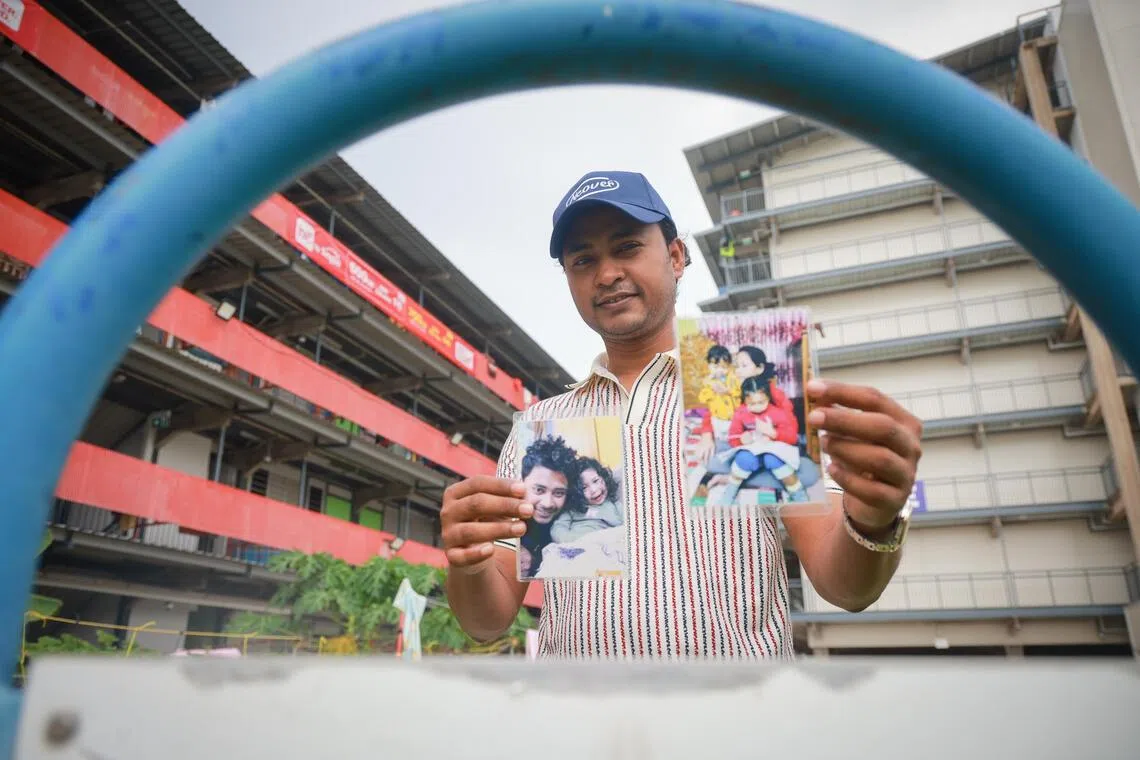
Sayeed Md Abu, a migrant worker who joined the I.C.A.N. Fathering Workshop, with photos of his family. He has two daughters aged 6 and 10.
ST PHOTO: JASON QUAH
Published Oct 11, 2026, 05:00 AM
Updated Oct 11, 2026, 05:00 AM
Migrant workers in Singapore face pain and guilt from long-distance parenting, as many miss key moments in their children’s lives and struggle to stay connected from afar.
Charities and dorm operators have started support programmes, including the I.C.A.N. Fathering Workshop and an online course for mothers, to teach better communication and emotional support.
Experts say regular calls, shared activities and understanding employers can ease the strain, improve well-being and help children back home feel less alone.
SINGAPORE - While working here for the last 13 years, Bangladeshi migrant worker Sayeed Md Abu missed the birth of both his daughters.
The ache of being apart from his two girls, who are now six and 10, has only grown with time.
“Whenever they are enjoying the moment or having fun, they keep saying ‘wish Papa was here’,” said the 36-year-old wistfully in an interview with The Straits Times in September.
Migrant worker parents like Sayeed shoulder not just the duty of earning a living , but the weight of raising their children from afar. Many grapple with guilt, worry and helplessness, feelings they tend to keep to themselves.
Foreign workforce numbers have risen from 1.2 million in 2021 to 1.65 million in June 2026 . While there is no official count of how many migrant workers and domestic workers here are parents, the figures point to a growing number who are leaving their families behind to work in Singapore.
Against this backdrop, some organisations have started free programmes to help foreign workers with long-distance parenting. One is the I.C.A.N. Fathering Workshop run by local charity Centre for Fathering.
The acronym stands for Involvement, Consistency, Awareness and Nurturance, traits the programme encourages fathers to practise, no matter how far they are from their child.
Over 80 migrant workers from three dormitories - PPT Lodge 1A in Seletar, Westlite Ubi and ASPRI-Westlite Papan, near Jurong Island - have attended the workshop since 2025. Among them was Sayeed, an air-conditioning and refrigeration supervisor.
Earlier in 2023, PPT Lodge 1A’s operator Tee Up had started a peer support group called Dads in Dorms after noticing that some workers were stressed about family issues, said Ong Jia Hao, its senior executive of resident engagement.
Migrant worker charity HealthServe later connected the dorm with Centre for Fathering, which brought the workshop to the Dads in Dorms group , while The Salvation Army helped bring the workshop to ASPRI-Westlite Papan.
Heart-to-heart talks
Steven Say, one of the workshop trainers, said migrant worker dads struggle with being an “absentee father”. Some also mistakenly believe that nurturing children is solely their wives’ responsibility.
Fathers play an important role in a child’s upbringing, and there is value in building emotional connection with children even when they cannot be physically present, said Say, 63, a grandfather of three.
Workers are encouraged to contact their families frequently through video call, text or letters.
The I.C.A.N workshop guided migrant worker fathers from PPT Lodge 1A on long-distance parenting skills. PHOTO: CENTRE FOR FATHERING
The I.C.A.N workshop guided migrant worker fathers from PPT Lodge 1A on long-distance parenting skills.
PHOTO: CENTRE FOR FATHERING
For Sayeed, the workshop prompted him to reflect on how his behaviour affected his daught ers and how he could communicate better with them during their limited time on video calls.
When his elder daughter repeatedly made mistakes in her mathematics exams, he gently explained the importance of being thorough, instead of losing his temper.
“I used to scold her: ‘Why do you have to score like this? You should be better.’ But I realised I have to help her,” said Sayeed. “I need to talk to her heart to heart.”
Construction tiler Pallikondaperumal Jeyasekar, 46, who has two daughters aged seven and 13 living in Tamil Nadu with his wife, feels a pang of sadness when he cannot attend their school functions.
He learnt through the workshop that fatherhood is more than financial provision. Listening to his children’s feelings matters, too.
Recently, he bought them bicycles as he realised they wanted to cycle like other children. Previously, he had opposed the idea out of concern that they might get hurt .
Construction tiler Pallikondaperumal Jeyasekar, 46, who has two daughters aged seven and 13 living in Tamil Nadu with his wife, feels a pang of sadness when he cannot attend their school functions. ST PHOTO: JASON QUAH
The emotional toll of separation can take on a different form for mothers.
Evelyn Obillo, 47, a Filipina domestic helper (left) and Marie Kretz Di Meglio, the founder of Uplifters (Singapore) Limited (USL). ST PHOTO: JASON QUAH
Evelyn Obillo, 47, a Filipina domestic helper (left) and Marie Kretz Di Meglio, the founder of Uplifters (Singapore) Limited (USL).
Guilt is the main feeling haunting them, said Marie Kretz Di Meglio, the founder of Uplifters (Singapore) Limited (USL), a charity which supports migrant domestic workers.
“We have heard so many stories of domestic workers hiding in the toilets to cry while they were playing with a newborn or toddler, as it reminds them of their own toddler that they had to leave at home,” said Di Meglio.
Evelyn Obillo, 47, a Filipina domestic helper and mother of four who has worked in Singapore for 24 years, put the conflict in words : “We’re guilty that we’re looking after somebody’s child while somebody is looking after ours.
“We ask ourselves, are we bad mothers or what?”
The guilt can make some women accede to their family’s requests for money, as they try to stay connected to their children, said Di Meglio. This may then lead to money management issues.
To help these women and their children, USL piloted an online long-distance parenting programme in 2026. About 20 women including Obillo joined the pilot, which will last till the end of 2026 , before the course officially launches in 2027.
Uplifters (Singapore) Limited's new online long-distance parenting programme for migrant domestic workers comprises 14 online lessons on topics such as emotional wellbeing, conflict prevention and self-care. PHOTO: UPLIFTERS (SINGAPORE) LIMITED
Uplifters (Singapore) Limited's new online long-distance parenting programme for migrant domestic workers comprises 14 online lessons on topics such as emotional wellbeing, conflict prevention and self-care.
PHOTO: UPLIFTERS (SINGAPORE) LIMITED
The programme comprises 14 online lessons on topics such as emotional wellbeing, conflict prevention and self-care. It includes real stories of domestic workers to encourage them that they are not alone, and they do not need to make decisions out of guilt.
One segment offers advice on explaining to children of different ages why their mothers decide to work overseas, such as reassuring young kids that they are not the cause for their mothers’ absence and separation is only temporary.
Mothers are encouraged to bond with their children over shared activities . Those with young children can mail an activity book back home and complete colouring pages together, for instance, via video call.
Obillo, a single mother and a grandmother of three, remembers her parenting difficulties when she first worked here in the early 2000s. She had no days off and was not allowed to call home, leaving letters as her only means of communication.
When she first returned home after four years, her children were cold and aloof. “The bond was almost gone,” said Obillo.
She worked to rebuild the relationship over the years, sending regular messages once she had a mobile phone and returning home for milestones, including her children’s graduations.
The new programme would have been a “survival guide” during those early years, said Obillo, now a mentor for other domestic workers at USL.
Employers can help foreign workers maintain family ties by encouraging regular calls home and being understanding when important family matters arise, said HealthServe’s chief executive Benjamin Kuan.
Proactively ask domestic workers about their families, discuss suitable call times and plan home leave in advance, said USL’s Di Meglio.
She added: “These steps don’t need to be big, but they can make a real difference to a worker’s well-being, their financial stability and their children back home.”
Christine Tan is a correspondent at The Straits Times reporting on social affairs and issues of justice in Singapore.
Migrants/Migration (legal)
赛义德·穆罕默德·阿布是一名外来务工人员,他参加了ICAN父亲培训班,照片中是他的家人。他有两个女儿,分别6岁和10岁。
《海峡时报》摄影:JASON QUAH
发布于2026年10月11日 上午5:00
更新于2026年10月11日上午5:00
在新加坡的移工面临着异地育儿的痛苦和内疚,因为许多人错过了孩子生命中的关键时刻,并且难以与远方的孩子保持联系。
慈善机构和宿舍运营商已经启动了支持计划,包括 ICAN 父亲工作坊和面向母亲的在线课程,旨在教授更好的沟通和情感支持。
专家表示,定期通话、共同活动和理解的雇主可以减轻压力,改善身心健康,并帮助家里的孩子感到不那么孤单。
新加坡——孟加拉国移民工人赛义德·穆罕默德·阿布在新加坡工作了 13 年,错过了两个女儿的出生。
与两个女儿(现在分别是6岁和10岁)分离的痛苦与日俱增。
“每当他们享受当下或玩得开心的时候,他们总是说‘真希望爸爸在这里’,”这位36岁的母亲在9月份接受《海峡时报》采访时满怀憧憬地说道。
像赛义德这样的外来务工人员父母,不仅要承担养家糊口的重担,还要远距离抚养子女。许多人饱受内疚、担忧和无助的折磨,而这些感受往往被他们独自埋藏。
外籍劳工人数已从2021年的120万增至2026年6月的165万。虽然目前没有官方统计数据表明有多少外籍劳工和家庭佣工是父母,但这些数据表明,越来越多的人为了在新加坡工作而将家人留在家乡。
在此背景下,一些机构开始提供免费项目,帮助外籍劳工应对异地育儿问题。其中之一是由当地慈善机构“父亲中心”(Centre for Fathering)运营的ICAN父亲工作坊。
该缩写代表参与、坚持、觉察和培育,该计划鼓励父亲们无论与孩子相距多远,都要践行这些品质。
自 2025 年以来,来自三个宿舍——实里达的 PPT Lodge 1A、裕廊岛附近的 Westlite Ubi 和 ASPRI-Westlite Papan——的 80 多名外籍劳工参加了该研讨会。其中一位是空调和制冷主管 Sayeed。
PPT Lodge 1A 的运营商 Tee Up 在 2023 年初注意到一些员工因家庭问题而感到压力,该公司住户关系高级主管翁嘉豪表示,Tee Up 成立了一个名为“宿舍里的爸爸们”的同伴互助小组。
后来,移工慈善机构 HealthServe 将宿舍与“父亲中心”联系起来,该中心将研讨会带到了“宿舍里的爸爸们”小组,而救世军则帮助将研讨会带到了 ASPRI-Westlite Papan。
促膝长谈
培训师之一史蒂文·赛表示,外来务工父亲常常因为“缺席父亲”的身份而感到困扰。一些父亲还错误地认为,养育孩子完全是妻子的责任。
63岁的赛伊(Say)是三个孩子的祖父,他说:“父亲在孩子的成长过程中扮演着重要的角色,即使他们不能在孩子身边,与孩子建立情感联系也很有价值。”
我们鼓励员工经常通过视频通话、短信或信件与家人联系。
ICAN 工作坊为来自 PPT Lodge 1A 的外籍劳工父亲们讲授了异地育儿技巧。图片:父亲中心
ICAN 工作坊指导了 PPT Lodge 1A 的外来务工父亲们掌握远程育儿技巧。
照片:父亲中心
对于赛义德来说,这次研讨会促使他反思自己的行为对女儿们的影响,以及如何在有限的视频通话时间里更好地与她们沟通。
当他的大女儿在数学考试中屡次出错时,他没有发脾气,而是温和地向她解释了认真仔细的重要性。
“我以前总是责备她:‘你为什么总是得这样的分?你应该做得更好。’但我意识到我必须帮助她,”赛义德说。“我需要和她好好谈谈。”
46岁的建筑瓦工帕利孔达佩鲁马尔·杰亚塞卡尔和妻子在泰米尔纳德邦有两个女儿,分别7岁和13岁。当他无法参加女儿们的学校活动时,他感到一阵悲伤。
他通过研讨会了解到,为人父不仅仅是提供经济支持,倾听孩子的感受也同样重要。
最近,他意识到孩子们也想和其他孩子一样骑车,于是给他们买了自行车。此前,他一直反对这个想法,担心他们会受伤。
46岁的建筑瓦工帕利孔达佩鲁马尔·杰亚塞卡尔(Pallikondaperumal Jeyasekar)与妻子在泰米尔纳德邦育有两个女儿,分别7岁和13岁。每当他无法参加女儿们的学校活动时,都会感到一阵难过。(海峡时报摄影:杰森·夸)
分离带来的情感创伤对母亲来说可能呈现出不同的形式。
图为47岁的菲律宾籍家庭佣工伊芙琳·奥比洛(左)和Uplifters(新加坡)有限公司(USL)创始人玛丽·克雷茨·迪·梅格利奥。(海峡时报摄影:JASON QUAH)
47 岁的菲律宾家庭佣工 Evelyn Obillo(左)和 Uplifters (Singapore) Limited (USL) 的创始人 Marie Kretz Di Meglio。
“内疚是困扰她们的主要情绪,”支持外籍家政工人的慈善机构 Uplifters (Singapore) Limited (USL) 的创始人 Marie Kretz Di Meglio 说。
迪梅格利奥说:“我们听过很多这样的故事:家政工人在和新生儿或幼儿玩耍时躲在厕所里哭泣,因为这会让她们想起自己不得不留在家里的孩子。”
47 岁的菲律宾籍家庭佣工伊芙琳·奥比洛 (Evelyn Obillo) 是四个孩子的母亲,她在新加坡工作了 24 年。她用言语表达了这种冲突:“我们有罪,因为我们在照顾别人的孩子,而别人也在照顾我们的孩子。
“我们不禁自问,我们是不是糟糕的母亲?”
迪梅格利奥表示,内疚感可能会让一些女性为了维系与子女的关系而答应家人的要钱要求。这可能会导致她们出现理财问题。
为了帮助这些妇女和她们的孩子,USL 于 2026 年试行了一项在线远程育儿计划。包括 Obillo 在内的约 20 名妇女参加了该试点项目,该项目将持续到 2026 年底,之后该课程将于 2027 年正式启动。
Uplifters (Singapore) Limited 为外籍家政工人推出的全新在线远程育儿课程包含 14 节在线课程,主题涵盖情绪健康、冲突预防和自我关爱等。图片:UPLIFTERS (Singapore) LIMITED
Uplifters (Singapore) Limited 为外籍家庭佣工推出的全新在线远程育儿课程包含 14 节在线课程,主题涵盖情绪健康、冲突预防和自我关爱等。
照片:UPLIFTERS(新加坡)有限公司
该项目包含14节在线课程,主题涵盖情绪健康、冲突预防和自我关怀等。课程中穿插了家政工人的真实故事,旨在鼓励她们知道自己并不孤单,也不必因为内疚而做出决定。
其中一部分提供了一些建议,教你如何向不同年龄段的孩子解释他们的母亲为什么决定出国工作,例如安抚年幼的孩子,告诉他们这不是母亲离开的原因,而且分离只是暂时的。
鼓励母亲们通过共同活动与孩子增进感情。例如,家有幼儿的母亲可以把活动手册寄回家,然后一起完成涂色页,或者通过视频通话进行互动。
奥比洛是一位单身母亲,也是三个孩子的祖母。她回忆起2000年代初刚来这里工作时,育儿方面遇到的种种困难。她没有休息日,也不被允许打电话回家,只能通过写信与家人联系。
她四年后第一次回家时,孩子们冷漠疏远。“亲情几乎荡然无存,”奥比洛说。
多年来,她努力重建这段关系,有了手机后就定期发信息,并在孩子们毕业等重要时刻回家参加。
奥比洛说,这项新计划在那些早期岁月里本可以成为一本“生存指南”。奥比洛现在是 USL 其他家政工人的导师。
HealthServe 首席执行官 Benjamin Kuan 表示,雇主可以通过鼓励外国工人定期给家里打电话,并在出现重要的家庭事务时给予理解,来帮助外国工人维系家庭关系。
USL的迪梅格里奥表示,要主动询问家政工人的家庭情况,讨论合适的通话时间,并提前计划回家休假。
她补充说:“这些措施不必很大,但它们可以真正改善工人的福祉、经济稳定以及他们家中的孩子的生活。”
克里斯汀·谭是《海峡时报》的记者,报道新加坡的社会事务和司法问题。
移民/移徙(合法)