Recalling The Nazis’ Bizarre Piggyback Bombers 80 Years After They Went To War回顾纳粹的奇特“背驮式”轰炸机,距战争结束已过去80年
In the last months of the war, Germany flew missions using manned fighters attached to unmanned explosive-packed bombers. In the last months of the war, Germany flew several missions using manned fighters to guide unmanned bombers full of explosives.
Published Jun 30, 2024 3:57 PM EDT
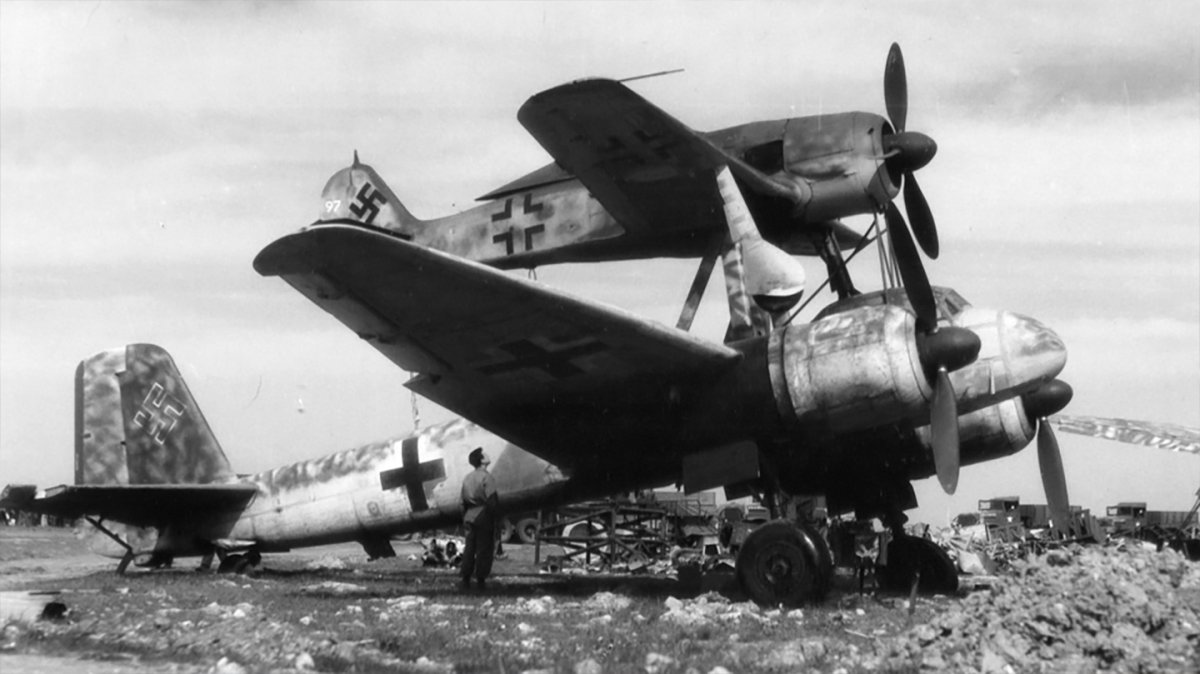
A Mistel combination (Ju 88 and Fw 190) captured by U.S. troops at an abandoned air base somewhere in France, May 4, 1945. U.S. Air Force
Eighty years ago this week, a truly bizarre air-to-ground weapon was successfully employed in combat for the first time. It was so strange, in fact, that the Allied pilots who first encountered it in the skies over Normandy were not entirely sure what it really was.
Among a string of unorthodox — and sometimes highly sophisticated — weapons hastily fielded in the last months of World War II, Germany’s Mistel composite aircraft were among the most extraordinary. However, these combinations of unmanned bombers packed with explosives and manned fighters to guide them toward their target were destined not to have any effect on the course of the war.
The basic concept of strapping one aircraft to another to create a composite was not new. During the interwar period, it emerged as a way of extending the range of aircraft during peacetime. In particular, there was a focus on composite seaplanes and flying boats, to extend the reach of commercial services across oceans. Solutions like the British Short Mayo Composite involved launching a small, long-range seaplane from the top of a larger carrier aircraft, while in flight, to extend the overall range.
The heavily loaded mail plane Mercury launched from the back of the lightly loaded Maia after the Short Mayo Composite had climbed to cruising level. Flying trials began in early 1938 with the first separation on February 6 and the first long-distance flight on July 20. Photo by WATFORD/Mirrorpix/Mirrorpix via Getty Images Mirrorpix
However, the first experiments with aerial refueling suggested a much more practical answer to the problem of long-distance flights and the outbreak of World War II rendered commercial composite aircraft obsolete.
By 1942 it was clear to German planners that the course of the war was not in their favor and there began a wide variety of efforts to develop new and innovative weapons that might have a chance of stopping Allied advances, which would enter crisis mode once a new front was opened up in the West.
Under the plan known as Mistel (meaning mistletoe, a parasitic plant that grows on a tree), war-weary Junkers Ju 88 bombers would be adapted to become pilotless missiles, onto which would be attached piloted Messerschmitt Bf 109 or Focke-Wulf Fw 190 fighters. The composite aircraft would launch entirely under the control of the fighter and be brought to the target, after which the bomber/missile component would be released on the correct trajectory, leaving the fighter free to (hopefully) return to base.
The overall idea also highlighted one glaring omission in the Luftwaffe order of battle, since — in contrast to the Americans and British — long-range heavy bombers had been a very low priority. Since the Mistel Ju 88 was now on a one-way mission, its full fuel load could be expended en route to the target, a journey that would be achieved without the fighter component having to use its own fuel. German reports suggested that a range of 1,500 miles was technically feasible.
As well as its long range, the concept promised to deliver enormous destructive effect for relatively low cost and would use up bomber airframes that were no longer fit for more traditional missions. While this was the original concept, the desperate situation in the war ultimately led to factory-fresh Ju 88s also being completed as Mistel components and being delivered as such to the Luftwaffe.
A good view of a Mistel combination (Ju 88 and Fw 190) that was moved to the United Kingdom after the war for study and is seen here at the Royal Aircraft Establishment, Farnborough, England. Photo by Fox Photos/Getty Images Fox Photos
The key to the destructive power of the Mistel lay in the massive hollow-charge warhead that replaced the cockpit section of the Ju 88. A hollow charge, also known as a shaped charge, essentially features a large open cavity between the main explosive charge and the front of the projectile. An inverted cone-shaped metal liner is inserted into the explosive charge — in the case of the Mistel, either copper or aluminum. When the charge goes off, it expands outward, turning the liner into something like a high-speed metal dart that then punches through the target.
Today, hollow-charge warheads are best known for their use in much smaller-sized applications, like anti-tank missiles and rockets.
In the Mistel, however, the hollow-charge warhead weighed close to 4,000 pounds and was expected to be able to punch through multiple feet of reinforced concrete after being triggered by a long standoff fuse. In tests, the warhead achieved remarkable results: It was reportedly able to defeat 26 feet of steel or 66 feet of ferro-concrete.
This would make the Mistel especially suitable for attacking major warships, in particular those of the British Royal Navy, the size and strength of which meant it was a continuous thorn in the side of the German war machine.
U.S. soldiers look over a Mistel combination (Ju 88 and Fw 190) on a captured airfield at Bernberg, central Germany, in around May 1945. U.S. Air Force U.S. Air Force
The first Mistel experiments involved smaller-scale aircraft, initially with a Klemm Kl 35A light sports plane on the back of a DFS 230A glider, a combination which required a Junkers Ju 52/3m transport to tow it into the air.
As the concept was refined, successively bigger upper components were tested, the Klemm giving way to a Focke-Wulf Fw 56 Stösser fighter trainer and then a Bf 109. Once the powerful fighter was included, the experimental Mistel combination was even able to take off solely under the power of the fighter’s single engine, although it’s likely that this was without the warhead fitted.
The all-important release mechanism was also mastered. The struts supporting the fighter were of sufficient length that its propeller wouldn’t impact the Ju 88 and electrically detonated explosive ball joints were used to separate the two aircraft. The rear strut was designed to collapse just before this happened, lifting the nose of the fighter to ensure it was at the right attitude to climb away safely.
This photo of a Mistel combination (Ju 88 and Bf 109) provides a good view of the collapsible rear support strut as well as the long fuse, which is fitted on this occasion, suggesting a mission was imminent. Public Domain
Bigger problems were experienced with fitting the equipment needed to pass control and throttle inputs to the Ju 88 into the fighter’s small cockpit. Flight controls had to be duplicated, with control inputs delivered to the Ju 88 using electric cables. The throttles for the bomber, meanwhile, were controlled using mechanical actuators.
Somewhat surprisingly, given the risks involved, it was apparently decided to remove the brakes from the Ju 88 to save weight and reduce complexity. This was all very well if the mission was completed successfully, but an aborted takeoff must have been a terrifying prospect for the pilot in the upper component.
Once Mistel combinations began to be fielded by the Luftwaffe, in May 1944, the initial target selected was the Royal Navy anchorage at Scapa Flow, the United Kingdom’s chief naval base, off the Scottish coast.
These plans were rapidly superseded by D-Day and the Mistel force was now prepared to be used against the Allied invasion force off the coast of Normandy. Here, the big challenge would be Allied airpower, dominant over the beachhead and deep into Normandy. Daylight Mistel operations would be highly risky but were not unheard of.
Two Mistel composite aircraft are intercepted by U.S. Army Air Forces P-51 fighters. The P-51s were a flight of four aircraft strafing ground targets east of Hamburg when they encountered three Mistel combinations that were being redeployed to Denmark, on February 3, 1945. All were shot down. U.S. Air Force
On the evening of June 14, a Mistel that had been tasked with targeting the Allied fleet ran into resistance in the skies over northern France and provided Allied aircrew with one of their first glimpses of the composite aircraft.
The incident was recalled by Flt. Lt. Walter Dinsdale , who had been flying a Royal Canadian Air Force Mosquito fighter-bomber, in Robert Forsyth’s book Luftwaffe Mistel Composite Bomber Units .
“It was a very awkward thing, and it lumbered along like an old hippo at about 150 mph. I recognized it as a Ju 88 but couldn’t figure out what the thing on top was. I thought it was one of their glider bombs mounted іп a new way. It was on top, mounted between the rudder and the main wing. My first short burst hit the starboard wing and cockpit of the Junkers. I thought I had killed the pilot, but, of course, there was no pilot as the whole thing is controlled from the fighter on top. Carrying on for a few minutes, circling to port with the fire increasing, he then dropped away and crashed behind the German lines. The explosion lit up the countryside for miles around.”
A Mosquito Mk XIII of the type that Flt. Lt. Walter Dinsdale was flying when he and his navigator shot down a Mistel on June 14, 1944. Public Domain
The first successful Mistel mission known to have been launched was on the night of June 24/25, 80 years ago this week.
According to a detailed account of the mission from Forsyth, five of the 12 Mistel combinations then available were prepared, together with manned Ju 88 pathfinder aircraft and fighter escorts.
The target was the Allied convoy in the Bay of the Seine, which was expected to include the Royal Navy battleship HMS Nelson , which had been bombarding German positions inland and providing fire support to advancing Allied troops, but which had, by this point, sailed away.
The battleship HMS Nelson fires its 16-inch guns during gunnery trials. Crown Copyright
In the same source, Oberleutnant Horst Rudat, commander of Einsatzstaffel KG 101, recalled the mission:
“Four aircraft took off successfully in the early evening, when encounters with the enemy’s day fighters were no longer expected and before night-fighters made their appearance. The entire operation was cloaked in secrecy. German anti-aircraft batteries along our route were only informed of our mission at the very last minute and were ordered not to fire. It was my bad luck that one of these batteries had not been informed in time. We were still climbing when, at a height of 1500 meters [4,900 feet], we came under fire. My left engine was hit and stopped. I remember the feeling of sitting on top of an enormous warhead and being shot at by our own flak. Because I was unable to feather the propeller of the dead engine, I lost speed rapidly and was unable to keep up with the other three Mistel. In the meantime, it had grown dark.”
A map showing the Normandy invasion area including channels cleared of mines, location of vessels engaged in bombardment, and targets on shore. The Bay of the Seine is located on the extreme right. Public Domain
“West of Le Havre, I noticed a British night-fighter and I became conscious of the fact that I had no means of defending myself — my guns had been removed. Because my Ju 88 tended to want to turn continually to the left, I decided to make a direct attack on the numerous landing craft saturating the coastline. Something would definitely be destroyed, even though I could not claim success for the destruction of a designated target. After aiming the Ju 88, I separated and immediately turned inland to escape the night-fighter.”
Another of the pilots experienced control difficulties and was forced to release the bomber component early, the Ju 88 plummeting into the sea.
At least one Ju 88 was launched successfully, however. Released from a height of 800 feet, it exploded close to the Royal Navy frigate HMS Nith , anchored off Gold Beach. The attack killed nine crew and injured 27 more, while the starboard side of the ship was caved in and peppered with steel fragments, although it wasn’t sunk.
An official wartime postcard depicting the River class frigate HMS Nith , which displaced around 1,830 long tons when loaded. Crown Copyright
Later, another plan was made to use the Mistel force to attack the Royal Navy at Scapa Flow and elements were deployed to Denmark in anticipation of this. However, the sinking of the German battleship Tirpitz by the British changed the overall maritime balance of power and made this mission redundant.
For a time, the Mistel force was barely used but, in the meantime, it was brought under the control of the Luftwaffe’s special missions unit, KG 200, which was engaged in a wide range of clandestine work, including flying captured Allied aircraft that were used for, among others, dropping agents behind enemy lines.
A rare photo of a captured B-17 in Luftwaffe markings, operated by Kampfgeschwader 200. Public Domain
By early 1945 the tide of the war had well and truly turned against the Germans and the Mistel force was called upon again. With the Allies in the west poised to cross the Rhine and the Soviets in the east pressing toward Berlin, thought turned to attacks on long-range strategic targets, specifically power stations around Moscow and Gorky. These challenging missions would involve an outward flight of around 10 hours, the release of the bomber component, followed by the fighter flying another five or so hours to the relative safety of Latvia. The mission was known as Operation Eisenhammer but was stopped in its tracks when U.S. bombers destroyed 18 Mistel combinations on the ground at the airfield of Rechlin, northwest of Berlin.
A Mistel combination (Ju 88 and Fw 190) on the ground at an airfield captured by U.S. troops. Efforts have been made to camouflage the aircraft to protect them against aerial attack. The location was Gardelegen, central Germany, around May 1945. U.S. Air Force
At this point, the Mistel was selected for a new target set, namely the bridges that were vital for the Allied advances that were now driving into the heart of the Reich from east and west.
With the Red Army less than 50 miles from Berlin, it was decided to use the Mistel to strike bridges over the Oder and Neisse rivers on the eastern approaches to Germany. A Mistel attack was launched against the bridge over the Oder at Görlitz. Although a malfunction forced one pilot to jettison their Ju 88 early, another two scored direct hits, and a fourth a near miss.
An unusual view of a camouflaged Mistel combination (Ju 88 and Fw 190) on the ground. There appears to be an auxiliary fuel tank mounted between the fighter and the bomber as well as an additional bomb (or perhaps another fuel tank) slung below the bomber component. Public Domain
Ultimately, however, the Mistel combination was proving too costly for the hard-pressed German military. The raid on the bridge at Görlitz had consumed six Ju 88s, two Bf 109 fighters, and, most critically, an enormous amount of fuel. While the bridge was damaged, it only held up the advancing Soviet troops by two days.
Other, sporadic missions continued in an effort to slow down the Soviet advances over the Oder, Neisse, and Warthe rivers during the last weeks of the war, but with mixed results. In total, around 250 Mistel combinations were completed, many of them never used.
Before the end of the war, the Allies also put to use surplus bombers as one-way attack aircraft.
Most notably, the U.S. Army Air Forces (USAAF) modified time-expired Boeing B-17s and other bombers, packing them with explosives and operating them under remote control from other aircraft once the pilot and co-pilot bailed out. Much like the Mistel, the project proved expensive and ultimately unsuccessful — as well as being notably hazardous for the crews involved.
Nicknamed The Careful Virgin , this USAAF B-17F was among the aircraft later modified as a remote-controlled one-way attack aircraft as part of Operation Aphrodite. It was launched against the German V-3 large-caliber gun in Pas-de-Calais, France, in August 1944, but came down short of its target. U.S Air Force
For both the Allies and the Germans, it was clear by the end of the war that far more promise lay in the potential of purpose-designed standoff air-to-ground weapons, like the German Henschel Hs 293 and the U.S. VB-3 Razon , both of which were radio-guided glide bombs that would prove highly influential on subsequent developments.
Like so much in the German war effort , the Mistel program was too little, too late.
Meanwhile, the concept of composite aircraft has never fully disappeared, especially in the realm of space exploration. On several occasions, the Space Shuttle prototype Enterprise was released in mid-air from NASA’s 747 Shuttle Carrier Aircraft , as you can read about here . Today, it’s left to the remarkable Stratolaunch Roc — the world’s largest plane in terms of wingspan — to continue the composite aircraft legacy, hauling rockets and other payloads up to altitude before they continue into space.
Contact the author: thomas@thewarzone.com
Comments couldn’t be loaded. Please refresh the page.
发布于美国东部时间2024年6月30日下午3:57
1945年5月4日,美军在法国某处废弃空军基地缴获了一架“槲寄生”组合式飞机(Ju 88和Fw 190)。美国空军
八十年前的这周,一种极其奇特的空对地武器首次在实战中成功运用。事实上,它如此怪异,以至于在诺曼底上空首次遭遇它的盟军飞行员们,甚至都无法完全确定它究竟是什么。
在二战最后几个月匆忙部署的一系列非常规——有时甚至是高度精密——的武器中,德国的“槲寄生”(Mistel)复合飞机是最为奇特的武器之一。然而,这些由装满炸药的无人轰炸机和引导它们攻击目标的有人驾驶战斗机组成的组合,注定不会对战争的进程产生任何影响。
将一架飞机捆绑在另一架飞机上形成复合飞机的基本概念并非新概念。在两次世界大战之间的时期,这种技术应运而生,成为和平时期延长飞机航程的一种方法。尤其值得关注的是复合式水上飞机和飞艇,旨在拓展商业服务的跨洋航线。例如,英国的肖特·梅奥复合飞机就采用了这样的方案:在飞行中,从一架大型载机的顶部发射一架小型远程水上飞机,从而延长整体航程。
满载邮件的“水星”号飞机在“肖特·梅奥”复合式飞机爬升至巡航高度后,从轻载的“玛雅”号飞机尾部起飞。飞行试验于1938年初开始,首次分离于2月6日进行,首次长途飞行于7月20日进行。照片由WATFORD/Mirrorpix/Mirrorpix通过Getty Images Mirrorpix提供。
然而,空中加油的首次试验表明,对于长途飞行问题,空中加油是一种更实用的解决方案,而第二次世界大战的爆发使得商用复合材料飞机过时了。
到 1942 年,德国策划者已经清楚地认识到战争的进程对他们不利,于是开始广泛努力开发新的创新武器,以期阻止盟军的推进。一旦在西线开辟新的战线,盟军就会进入危机状态。
根据名为“槲寄生”(Mistel,一种寄生在树上的植物)的计划,疲惫不堪的容克Ju 88轰炸机将被改装成无人导弹,并搭载有人驾驶的梅塞施密特Bf 109或福克-沃尔夫Fw 190战斗机。这种组合式飞机将完全由战斗机控制起飞并抵达目标,之后轰炸机/导弹组件将按照预定弹道脱离,战斗机则可以(希望如此)返回基地。
这一总体思路也凸显了德国空军作战序列中一个明显的疏漏,因为与美国和英国不同,远程重型轰炸机在德国空军的优先级一直很低。由于“槲寄生”Ju 88轰炸机此次执行的是单程任务,其全部燃料可以在飞往目标的途中耗尽,而战斗机部分无需消耗自身燃料即可完成这段航程。德国方面的报告表明,1500英里的航程在技术上是可行的。
除了航程远之外,该概念还承诺以相对较低的成本产生巨大的破坏力,并能充分利用那些不再适合执行传统任务的轰炸机机身。虽然这是最初的设想,但战争的严峻形势最终导致一些全新的Ju 88轰炸机也被改装成“槲寄生”导弹的部件,并交付给德国空军。
这张照片清晰地展示了一架“槲寄生”(Ju 88 和 Fw 190 的组合飞机),战后它被运往英国进行研究,照片拍摄于英国范堡罗皇家飞机研究院。照片由 Fox Photos/Getty Images 提供。
“槲寄生”导弹威力强大的关键在于其巨大的空心装药弹头,该弹头取代了Ju 88的驾驶舱部分。空心装药,也称聚能装药,其本质是在主装药和弹体前端之间留出一个巨大的空腔。一个倒锥形的金属内衬被插入主装药中——“槲寄生”导弹的内衬通常由铜或铝制成。当装药引爆时,它会向外膨胀,将内衬变成类似高速金属飞镖的东西,从而穿透目标。
如今,空心装药弹头最广为人知的应用是小型武器,例如反坦克导弹和火箭。
然而,在“槲寄生”导弹中,空心装药弹头重达近4000磅,预计在长距离引信引爆后,能够穿透数英尺厚的钢筋混凝土。在测试中,该弹头取得了显著成果:据报道,它能够击穿26英尺厚的钢板或66英尺厚的钢筋混凝土。
这使得“槲寄生”号特别适合攻击大型军舰,尤其是英国皇家海军的军舰,英国皇家海军的军舰规模庞大、实力雄厚,一直是德国战争机器的一根眼中钉。
大约在1945年5月,美军士兵在德国中部贝尔恩贝格一处被占领的机场上查看一架“槲寄生”组合式飞机(Ju 88和Fw 190)。美国空军
第一个 Mistel 实验涉及较小规模的飞机,最初是在 DFS 230A 滑翔机的后部安装一架 Klemm Kl 35A 轻型运动飞机,这种组合需要一架 Junkers Ju 52/3m 运输机将其拖到空中。
随着概念的完善,测试的上部组件也越来越大,克莱姆战斗机被福克-沃尔夫Fw 56 Stösser战斗教练机取代,然后又被Bf 109取代。一旦强大的战斗机加入其中,实验性的“槲寄生”组合甚至可以仅靠战斗机的单引擎动力起飞,尽管这很可能是在没有安装弹头的情况下进行的。
至关重要的分离机制也已研制成功。支撑战斗机的支柱长度足够,确保其螺旋桨不会撞击Ju 88,并使用电爆式爆炸球形接头将两架飞机分离。后支柱的设计使其在分离发生前瞬间折断,从而抬起战斗机的机头,确保其处于合适的姿态,以便安全爬升脱离。
这张“槲寄生”组合飞机(Ju 88 和 Bf 109)的照片清晰地展示了可折叠的后部支撑杆以及当时安装的长引信,表明任务即将执行。公共领域
更大的难题在于如何将向Ju 88传递控制和油门输入所需的设备安装到战斗机狭小的座舱内。飞行控制系统必须进行复制,通过电缆将控制输入传递给Ju 88。与此同时,轰炸机的油门则由机械作动器控制。
考虑到其中的风险,令人颇感意外的是,为了减轻重量和简化结构,Ju 88 似乎决定拆除刹车系统。如果任务成功完成,这当然无可厚非,但起飞中止对上部机组的飞行员来说无疑是极其可怕的。
1944 年 5 月,当德国空军开始部署 Mistel 组合导弹时,最初选定的目标是位于苏格兰海岸附近的英国主要海军基地斯卡帕湾的皇家海军锚地。
这些计划很快就被诺曼底登陆日所取代,米斯特尔部队随即准备投入诺曼底海岸,对抗盟军的入侵部队。此时,最大的挑战将是盟军强大的空中力量,他们不仅在滩头阵地上空占据绝对优势,而且深入诺曼底腹地。白天进行米斯特尔部队的作战行动风险极高,但并非史无前例。
1945年2月3日,两架“槲寄生”(Mistel)组合式飞机被美国陆军航空队的P-51战斗机拦截。当时,这四架P-51战斗机正在汉堡以东扫射地面目标,遭遇了三架正准备重新部署到丹麦的“槲寄生”组合式飞机。所有飞机均被击落。美国空军
6 月 14 日晚,一架奉命攻击盟军舰队的“槲寄生”战斗机在法国北部上空遭遇抵抗,使盟军飞行员得以首次见到这种复合型飞机。
皇家加拿大空军的蚊式战斗轰炸机飞行员沃尔特·丁斯代尔中尉在罗伯特·福赛斯的著作《德国空军槲寄生复合轰炸机部队》中回忆了这起事件。
“那东西非常笨重,像一头老河马一样以大约150英里的时速蹒跚而行。我认出那是一架容克Ju 88,但搞不清楚它顶部的那个东西是什么。我以为是他们用一种新方式安装的滑翔炸弹。它装在顶部,位于方向舵和主翼之间。我的第一轮短促射击击中了容克飞机的右翼和座舱。我以为我击毙了飞行员,但当然,飞机上没有飞行员,因为整个飞机都是由上面的战斗机控制的。它继续飞行了几分钟,向左盘旋,火力越来越猛,然后突然脱离控制,坠毁在德军防线后方。爆炸照亮了周围数英里的乡村。”
1944年6月14日,沃尔特·丁斯代尔中尉驾驶的蚊式Mk XIII型战斗机,与他的领航员一起击落了一架“槲寄生”战斗机。(公共领域)
据记载,第一次成功的“槲寄生”号探测器任务是在 6 月 24 日/25 日夜间发射的,距今已有 80 年。
根据福赛斯对该任务的详细描述,当时可用的 12 套“槲寄生”组合中有 5 套被准备就绪,同时还配备了有人驾驶的 Ju 88 探路者飞机和战斗机护航。
目标是塞纳湾的盟军护航船队,预计其中包括皇家海军战列舰“纳尔逊”号,该舰此前一直在炮击内陆的德军阵地,并为推进的盟军部队提供火力支援,但此时已经驶离。
战列舰“纳尔逊”号在炮术试验中发射其16英寸主炮。版权所有
在同一消息来源中,KG 101 特别行动队指挥官霍斯特·鲁达特中尉回忆起这次任务:
“傍晚时分,四架飞机顺利起飞。那时预计不会再遇到敌方的昼间战斗机,夜间战斗机也尚未出现。整个行动高度保密。沿途的德军防空阵地直到最后一刻才得知我们的任务,并被命令不得开火。不幸的是,其中一个阵地没有及时接到通知。我们仍在爬升,在1500米(4900英尺)的高度,突然遭到炮火攻击。我的左侧发动机被击中停止运转。我至今仍记得那种感觉:仿佛坐在一个巨大的弹头上,被自己的高射炮火击中。由于无法将失效发动机的螺旋桨桨叶调整顺桨,我的速度迅速下降,无法跟上其他三架“槲寄生”战斗机。与此同时,天色已经暗了下来。”
一张显示诺曼底登陆区域的地图,包括已清除水雷的航道、参与炮击的舰船位置以及岸上目标。塞纳湾位于最右侧。公共领域
“在勒阿弗尔以西,我注意到一架英国夜间战斗机,这才意识到自己毫无自卫能力——我的机炮已被拆除。由于我的Ju 88总是倾向于向左偏转,我决定直接攻击海岸线上密集的登陆艇。即使无法击中特定目标,也肯定能有所破坏。瞄准目标后,我驾驶Ju 88脱离战斗,立即转向内陆,躲避夜间战斗机。”
另一名飞行员遇到了控制困难,被迫提前释放轰炸机部件,Ju 88 坠入大海。
然而,至少有一枚Ju 88导弹成功发射。这枚导弹从800英尺(约244米)的高空投放,在停泊于黄金海滩附近的英国皇家海军护卫舰“尼思”号(HMS Nith)附近爆炸。袭击造成9名船员死亡,27人受伤,舰艇右舷被炸毁,并被炸出大量钢片,但并未沉没。
一张官方战时明信片,描绘了“河”级护卫舰“尼思”号(HMS Nith),满载排水量约为1830长吨。版权所有。
后来,英国又制定了一项计划,打算利用“米斯特尔”号舰队袭击斯卡帕湾的英国皇家海军,并为此向丹麦部署了部分兵力。然而,英国击沉德国战列舰“提尔皮茨”号改变了海上力量平衡,使得这项任务变得多余。
一段时间内,“槲寄生”部队几乎没有被使用,但与此同时,它被置于德国空军特种任务部队 KG 200 的控制之下,该部队从事各种秘密工作,包括驾驶缴获的盟军飞机,这些飞机被用于(除其他用途外)向敌后投放特工。
一张罕见的B-17轰炸机照片,机身涂有德国空军标志,隶属于第200轰炸机联队。公共领域
到1945年初,战争的局势已彻底对德国不利,“槲寄生”战斗机联队再次被启用。西线的盟军准备渡过莱茵河,东线的苏军则向柏林逼近,因此德军开始考虑攻击远程战略目标,特别是莫斯科和高尔基附近的发电站。这些极具挑战性的任务需要先飞行约10小时,然后释放轰炸机,之后战斗机再飞行约5小时抵达相对安全的拉脱维亚。这项任务被称为“铁锤行动”,但行动却因美军轰炸机在柏林西北部的雷希林机场摧毁了18架停在地面的“槲寄生”战斗机而被迫中止。
一架“槲寄生”组合式轰炸机(Ju 88 和 Fw 190)停放在美军占领的机场地面上。为了防止空中袭击,飞机都做了伪装。地点位于德国中部加尔德莱根,时间大约在 1945 年 5 月。美国空军
此时,“槲寄生”号被选为新的攻击目标,即对盟军从东西两线向帝国腹地推进至关重要的桥梁。
由于红军距离柏林不足50英里,美军决定使用“槲寄生”轰炸机袭击奥得河和尼斯河上的桥梁,这些桥梁位于德国东部的入口处。美军对格尔利茨的奥得河大桥发动了“槲寄生”攻击。虽然一名飞行员因故障被迫提前弃机,但另有两名飞行员直接命中目标,还有一架飞机近失弹。
一张罕见的伪装“槲寄生”组合(Ju 88 和 Fw 190)地面照片。战斗机和轰炸机之间似乎安装了一个辅助油箱,轰炸机下方还挂载了一枚额外的炸弹(或者可能是另一个油箱)。公共领域
然而,最终,对于疲于奔命的德军来说,“槲寄生”组合战术的代价实在太高。对格尔利茨大桥的袭击消耗了六架Ju 88轰炸机、两架Bf 109战斗机,以及最关键的——大量的燃料。虽然大桥遭到破坏,但它仅仅阻挡了苏军推进两天。
在战争的最后几周,为了减缓苏军沿奥得河、尼斯河和瓦尔特河的推进速度,其他一些零星的任务仍在继续,但收效甚微。总共完成了约250套“槲寄生”组合,其中许多从未投入使用。
战争结束前,盟军还将剩余的轰炸机用作单程攻击机。
最引人注目的是,美国陆军航空队(USAAF)改装了过期的波音B-17轰炸机和其他轰炸机,在机上装满炸药,并在飞行员和副驾驶跳伞后,由其他飞机远程操控。与“槲寄生”轰炸机类似,该项目耗资巨大,最终以失败告终,而且对机组人员来说极其危险。
这架绰号为“谨慎的处女”的美国陆军航空队B-17F轰炸机,是后来被改装成遥控单向攻击机的飞机之一,参与了“阿芙罗狄蒂行动”。1944年8月,它被派往法国加来海峡攻击德国V-3大口径火炮,但未能击中目标。
对于盟军和德国人来说,战争结束时,很明显,更有前景的是专门设计的防区外空对地武器,例如德国的亨舍尔Hs 293和美国的VB-3 Razon,它们都是无线电制导滑翔炸弹,对后来的发展产生了巨大的影响。
就像德国战争中的许多其他举措一样,“槲寄生”计划力度不够,也为时已晚。
与此同时,复合材料飞机的概念从未完全消失,尤其是在太空探索领域。正如您在此处阅读到的,航天飞机原型机“企业号”曾多次从NASA的747航天飞机运输机上脱离。如今,传承复合材料飞机传统的重任落在了卓越的“平流层发射火箭”(Stratolaunch Roc)——世界上翼展最大的飞机——身上,它将火箭和其他有效载荷运送到一定高度,然后再送入太空。
联系作者:thomas@thewarzone.com
评论加载失败,请刷新页面。