Air Force Wanted To Turn Skunk Works’ Mach 3 Capable Recon Drone Into A Nuclear Bomber美国空军曾希望将臭鼬工厂研发的具备3马赫飞行能力的侦察无人机改装成核轰炸机。
The concept would have given the service a penetrating high-speed strike asset, something it is still interested in to this day.
新闻视频
By Joseph Trevithick
Updated Dec 1, 2019 6:41 AM EST
A newly declassified document shows that, during the Cold War, the U.S. military considered turning Lockheed’s D-21 Tagboard supersonic spy drone into an unmanned strike platform. The plan would have given the U.S. Air Force a high-speed, deep-penetrating, air-launched strike weapon and it’s a capability the service is still interested in acquiring today .
In January 1971, John McLucas , then both Undersecretary of the Air Force and Director of the National Reconnaissance Office (NRO), sent a memo to Deputy Defense Secretary David Packard about the armed D-21 proposal. NRO, the very existence of which remained classified until 1992, released this record and nearly 100 other documents related to the Tagboard program as part of its continued transparency efforts, on Mar. 21, 2019 .
“With respect to your question about whether TAGBOARD should be considered as a drone/bomber, we have done some investigation and discussed this with the Air Staff and SAC [Strategic Air Command],” McLucas wrote. “I will be glad to do any additional analysis or other work which you might suggest.”
But Tagboard’s origins, and nearly two decades of development and operational activities up to that point, were rooted almost exclusively in intelligence collection. To rewind a bit, after the Soviet Union shot down Gary Powers flying a U-2 Dragon Lady spy plane over their territory in 1960, there was a considerable impetus to develop less vulnerable intelligence gathering assets that could penetrate far into denied areas with limited risk.
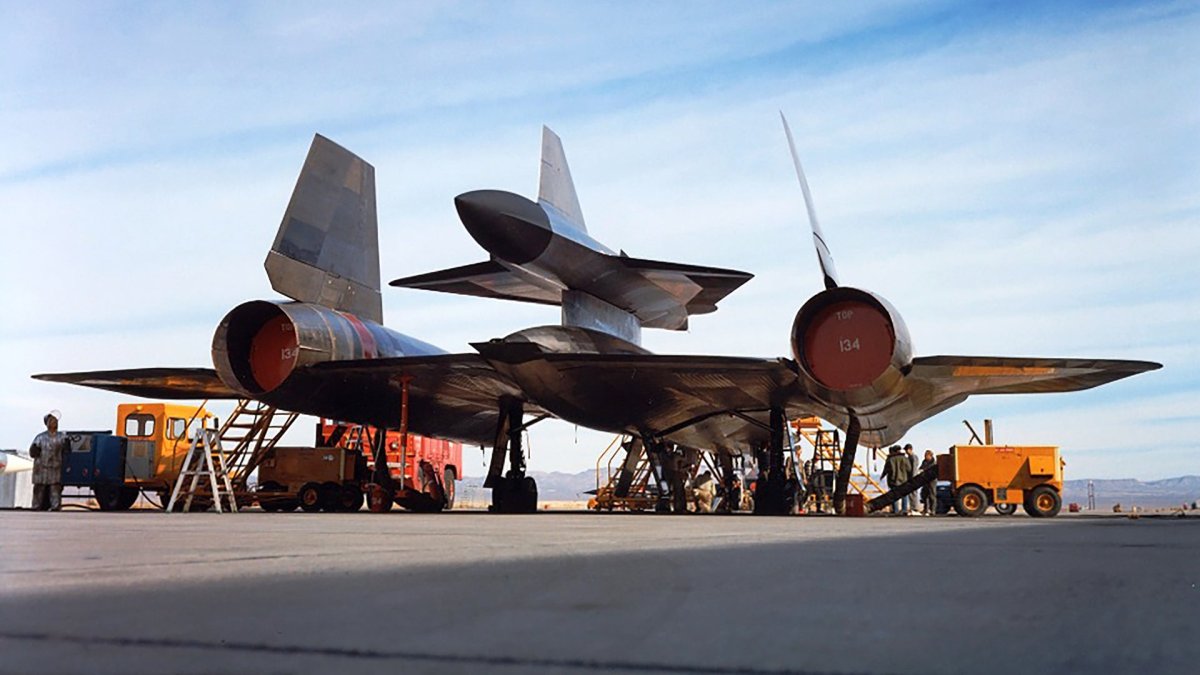
Lockheed, which had designed and built the U-2, was already in the process of developing a successor, known as the A-12 Oxcart at the time. This aircraft subsequently evolved into the Air Force’s famous SR-71 Blackbird .
SR-71s under construction., Lockheed
The A-12 could fly at over three times the speed of sound at around 90,000 feet, but there were still reservations within the U.S. government about sending any manned aircraft on high-risk missions over hostile countries, such as the Soviet Union. At the same time, NRO was pushing ahead with the first generations of spy satellites , which, at the time, offered a way to spy on these areas with virtual impunity.
The problem with early spy satellites was that they could only carry limited amounts of wet film, reducing their capacity to cover large areas and do so over a protracted period of time. In addition, they had limited repositioning flexibility once they entered their orbits. On top of all this, it was a complex process to prepare additional satellites for launch, making it difficult to ensure one was ready to go on short notice in response to new developments.
A graphic describing the general features of the KH-4B Corona spy satellite, which NRO declassified more than a decade ago as part of a separate release of records. Note that this satellite, the first which the United States launched in 1967, still had an average mission life of fewer than 20 days. , NRO
So, the U.S. government had sought out additional alternative intelligence gathering platforms that were less vulnerable than manned aircraft, but more flexible than a satellite. The Central Intelligence Agency, which controlled the A-12 fleet, approached Lockheed and its Skunk Works advanced projects division in 1962 to ask for new options.
One concept that Skunk Works proposed envisioned using a modified A-12 as a mothership to carry and launch a rocket booster with a small satellite on top into low orbit. You can read more about this project here .
Another idea involved a modified A-12 as a launch platform for an air-breathing, high-altitude supersonic unmanned spy drone. CIA passed on this proposal, but NRO picked it up, ultimately giving the project the codename Tagboard. At that time, there were no plans to turn the unmanned aircraft into a strike platform.
The delta-wing unmanned aircraft, constructed primarily of titanium, was more than 40 feet long and had a wingspan of 20 feet. A modified Marquardt RJ43 ramjet engine, also found on the CIM-10 Bomarc surface-to-air missile and AQM-60 Kingfisher target drone, could propel the D-21 to speeds over Mach 3 at altitudes of around 100,000 feet – higher than the A-12’s service ceiling.
A declassified technical drawing of the D-21 drone., Lockheed via NRO
Tagboard needed its modified two-seat A-12 motherships, which became known as M-21s, to get it to sufficiently high speed for the ramjet to operate efficiently. After release from the M-21, the drone would fly a pre-programmed route totaling more than 3,000 miles using an automated stellar navigation system, something you can read about more here . The drone carried a single Hycon HR 335 camera that could capture images of areas up to between 14 and 16 miles wide, depending on altitude, as it screamed across enemy territory.
A declassified technical drawing of the M-21 mothership with the D-21 drone on top., Lockheed via NRO
After conducting its mission, its route would take it back out to neutral territory, where it would eject the film canister, which would then deploy a parachute. The D-21 was not reusable and was configured to self-destruct after releasing its payload.
A specially modified JC-130 Hercules cargo aircraft would snatch the film out of the air using a complex trapeze before reeling it in inside and transporting it back to base for processing. The Air Force, with the help the CIA and NRO, had devised this concept first in the 1950s to catch falling film pods that spy satellites released. This continued to be the standard practice for retrieving film and other data from satellites until technology had advanced to the point where it was practical to transmit imagery and other information wirelessly straight to a ground station.
A JC-130 Hercules practices a maneuver to catch falling film canisters near Edwards Air Force Base in 1969., USAF
Given Tagboard’s general performance characteristics and other features, it’s not hard to see how Strategic Air Command would have looked at the drone and seen a very viable weapons platform, and one that could help it maintain relevant in the age of intercontinental ballistic missiles (ICBM). If Tagboard could carry a camera and film along a specific route before releasing a film canister at a precise moment, it certainly could have carried a nuclear bomb and dropped it over a designated target area.
By the late 1950s, it was already apparent to that American strategic bombers, the B-52 in particular, would be extremely vulnerable to Soviet air defenses and combat aircraft during an all-out conflict. As a result, the Air Force had already initiated work on an air-launched nuclear-tipped ballistic missile, GAM-87 Skybolt , and a long-range nuclear-armed cruise missile, the GAM-77 Hound Dog , as stand-off options for the B-52.
The Hound Dog, which was supposed to be an interim weapon until the Skybolt was ready, had a maximum range of 785 miles and a top speed of just over Mach 2. The Skybolt could hit targets up to 1,150 miles away and, since it flew in a ballistic trajectory, would come screaming down on its targets at hypersonic speeds over Mach 12.
Skybolt suffered significant delays in testing and, in 1962, President John F. Kennedy canceled the program in favor of a combination of submarine-launched Polaris ballistic missiles and land-based Minuteman ICBMs . Hound Dog, which had entered service in 1960, would remain operational until 1978.
An armed version of Tagboard would have offered more than three times the range of Skybolt and be able to cover that distance at an even greater top speed. Without the need for the drone to return to a safe area to deposit the film canister, it could have struck targets out to its full range of more than 3,000 miles – far enough to hit Moscow from a launch point in the middle of the North Atlantic.
Depending on the exact configuration of the weaponized drone, it could have possibly dropped multiple bombs at various points over a particular route. The Air Force could have simply employed it as more of a missile, carrying a single warhead straight to a target. A mix of both options might have allowed it to strike multiple objectives along the way to a final destination, where it would have detonated one last warhead.
In addition, just as Tagboard was more flexible than launching spy satellites, a “bomber” version of the drone, which was how NRO Director McLucas described it to Deputy Defense Secretary David Packard, would have offered many of those same advantages over IBCMs. The unmanned aircraft’s high speed could have made it useful for striking time-sensitive targets at shorter ranges, as well.
The launching aircraft would have retained all of the benefits a bomber brings to the table, too. These include the ability to fly on alert closer to the target area during a crisis, offering a visible deterrent whether it launches its payload or not. Bombers are also easier to recall than a ballistic missile, able to fly right to the edge of enemy air space before having to release an actual weapon, giving commanders more time to respond to new developments and potentially abort the mission. All of this remains the case today and are among the main arguments for keeping the B-52H in service through 2050.
Unfortunately, Tagboard and its M-21 motherships quickly proved to be complex and finicky. The physical interactions between the M-21 and the D-21, which the manned aircraft carried on top of its fuselage, were downright dangerous.
An M-21 carrying a D-21 during a flight test., USAF
In the first test flight of the M-21/D-21 combination on Mar. 5, 1966, the drone remained worryingly close to the mothership aircraft after release before flying away safely. The next two tests involved uneventful separations, even though the drone malfunctioned later in its flight in both cases.
The fourth test on July 30, 1966 came to a tragic end when the D-21 suffered an engine problem during release, struck the tail end of the M-21 as it fell away, and destroyed both aircraft in the process. Pilot Bill Park and Launch Control Officer Ray Torrick ejected as their plane went crashing into the Pacific Ocean off the coast of California. Park survived, but Torrick unfortunately drowned.
Lockheed Skunk Works’ legendary boss Kelly Johnson was so distraught over the accident, he initially refused to work on the program any further and offered to refund the money the U.S. government had already paid. However, NRO and others insisted on continuing the program, so Johnson offered to mate the D-21 to an alternative launch platform, a B-52H bomber.
The resulting configuration consisted of a B-52H fitted with two heavy pylons , on under each wing, similar to the ones the bombers used to carry Hound Dog missiles, but each carrying a single D-21 instead. Since the lumbering bombers couldn’t reach supersonic speeds themselves, Lockheed modified the drones to incorporate a rocket booster to propel them before the ramjet could take over. These new D-21Bs also had a command self-destruct feature, in case of a serious malfunction.
A B-52H carries a pair of D-21B drones on its underwing pylons., USAF
A close up of a D-21B under the wing of a B-52H., USAF
The Air Force stood up the 4200th Support Squadron at Area 51 to support the initial test program, which involved six test flights, between January and June 1968, nicknamed Captain Hook I through VI, according to a now declassified history of the unit that NRO released. On Nov. 9, 1969, a B-52H flying from Andersen Air Force Base on Guam launched the first operational D-21B mission, which sent the drone flying over China’s Lop Nor nuclear test site, as part of Project Senior Bowl.
A grainy shot of a D-21B with its booster still attached after launch., NRO
That drone never returned, reportedly flying on into the Soviet Union and crashing. In February 1970, the 4200th conducted another test flight, nicknamed Long Drive, on the Pacific Missile Range off Hawaii to validate a number of fixes.
After that, there were three more Senior Bowl missions over China. Of the two that actually returned as planned, both experienced issues with releasing the film canisters, which were subsequently lost. On the final operational flight, on Mar. 20, 1971, the drone crashed inside China. The remnants are now on display in that country.
The remains of the D-21 that crashed in southern China on display in that country., N Ezov via Wikimedia
By January 1971, when NRO Director McLucas responded to Deputy Defense Secretary Packard’s inquiry, there was clearly a growing disappointment with Tagboard, as well as its cost. In his memo, McLucas noted that each Tagboard drone, of which there around 20 at the time, had cost $2.5 million – more than $15 million in today’s dollars, but still cheaper than the cost of the latest iterations of the MQ-9 Reaper – and that he wasn’t sure exactly how much more it would take to convert them into a strike platform.
The exact cost of the program remains unclear, especially since it included funding from various black budgets, but reportedly would have been valued in the billions in present-day dollars. Regardless, Packard was clearly struck by these figures.
“Johnny, you have answered my question,” he hand-wrote on the memo in return. “This cost is too high – it is probably too high even for [its] present mission.”
The full memo from NRO Director John McLucas to Deputy Defense Secretary David Packard, with Packard’s handwritten response., NRO
The armed Tagboard drone never came to be. The Nixon Administration canceled the entire program in July 1971. The 17 remaining D-21s went into storage first at Norton Air Force Base in California and then at the boneyard at Davis-Monthan Air Force Base, where they became visible to the public. The program remained officially classified until the 1980s.
Today, there are 12 D-21s on display, 11 in the United States and the one in China. The sole surviving M-21 mothership is in the Museum of Flight in Seattle Washington.
A surviving D-21 on display., Alan Wilson via Wikimedia
It’s important to note that even as the D-21 program was getting underway, the Air Force was already beginning to very seriously investigate radar-evading stealth technology . As those efforts progressed and general concept became more viable in the 1970s, stealth steadily replaced speed as the primary means of penetrating an enemy’s air defense network.
But the general concept behind the D-21 has lived on in many ways. In the 2000s, Skunk Works worked with the U.S. Navy to design an advanced supersonic cruise missile as part of the Revolutionary Approach To Time Critical Long Range Strike ( RATTLRS ) program.
The resulting BGM-178 missile was very reminiscent of the D-21. It featured a Rolls Royce YJ102R turbojet engine, a high-axial flow design that would have been able to propel the weapon, armed with a penetrating high explosive warhead or a payload of small submunition bomblets, to speeds around Mach 4. This means it could have reached its maximum range of more than 500 miles in around 30 minutes.
A mockup of the BGM-178 RATTLRS missile., ONR via F-16.net
Similar to how an armed D-21 might have operated, the Navy envisioned RATTLRS as a sea-launched weapon that would have been able to penetrate deep into denied areas and do so quickly in order to be able to strike time-sensitive targets on short notice. This program disappeared from the public eye at the end of the 2000s before any flight tests occurred, but the missile’s development may have, at least, helped inform the development of a more advanced and top-secret supersonic weapon, known as Sea Dragon, which you can read about more here .
But whatever happened to RATTLRS, the demand for improved capabilities to allow the U.S. military to hit critical targets at extended ranges quickly hasn’t dissipated. Quite the opposite has happened and there has been an explosion of interest in hypersonic aircraft and missile designs as of late. Even the B-52 is being eyed again as the ideal vehicle to haul and launch outsized high-speed missiles, much like how it was used for the D-21 program.
At the same time, potential American opponents, especially Russia and China, have been hard at work developing improved radars and other sensors so that they can detect and possibly engage stealth aircraft. This has only further placed a renewed premium on speed, not just to be able to hit targets promptly, but in order to reduce the vulnerability of aircraft and missiles to enemy air defenses in the process.
So, while the D-21 never achieved success in the intelligence gathering role, and never transformed into a strike platform, it certainly helped blaze the trail for new developments that we may come to fruition in the near future.
Contact the author: jtrevithickpr@gmail.com
Comments couldn’t be loaded. Please refresh the page.
作者:约瑟夫·特雷维西克
更新于美国东部时间2019年12月1日上午6:41
一份新近解密的文件显示,冷战期间,美军曾考虑将洛克希德公司的D-21 Tagboard超音速间谍无人机改装成无人打击平台。该计划将使美国空军拥有高速、纵深穿透的空射打击武器,而美国空军至今仍对这项能力抱有浓厚的兴趣。
1971年1月,时任空军副部长兼国家侦察局(NRO)局长的约翰·麦克卢卡斯向国防部副部长戴维·帕卡德发送了一份关于武装D-21提案的备忘录。国家侦察局的存在直到1992年才被公开,该机构于2019年3月21日公布了这份记录以及近100份与Tagboard计划相关的其他文件,作为其持续透明度努力的一部分。
麦克卢卡斯写道:“关于您提出的TAGBOARD是否应被视为无人机/轰炸机的问题,我们已经进行了一些调查,并与空军参谋部和战略空军司令部进行了讨论。我乐于进行您可能建议的任何其他分析或其他工作。”
但Tagboard的起源,以及此前近二十年的发展和运营活动,几乎完全根植于情报收集。回顾一下,1960年苏联击落了驾驶U-2“龙夫人”侦察机的加里·鲍尔斯之后,人们迫切需要开发更不易受损、能够深入敌方控制区域且风险较低的情报收集工具。
洛克希德公司设计并制造了U-2侦察机,当时已经在研发其后继机型,即后来的A-12“牛车”。这款飞机后来发展成为美国空军著名的SR-71“黑鸟”侦察机。
SR-71正在建造中。洛克希德公司
A-12攻击机能在约9万英尺的高空以超过三倍音速的速度飞行,但美国政府仍然对派遣任何载人飞机执行飞越敌对国家(例如苏联)的高风险任务有所顾虑。与此同时,国家侦察局(NRO)正在大力推进第一代间谍卫星的研发,这些卫星在当时提供了一种几乎可以不受惩罚地监视这些地区的手段。
早期间谍卫星的问题在于它们携带的湿膜数量有限,这限制了它们覆盖大面积区域和长时间监视的能力。此外,一旦进入轨道,它们的重新定位灵活性也十分有限。更重要的是,准备发射更多卫星的过程十分复杂,难以确保在接到新情况通知后能够迅速部署卫星。
这张图表描述了KH-4B“日冕”间谍卫星的总体特征。该卫星的解密文件由美国国家侦察局(NRO)于十多年前作为另一批文件的一部分予以解密。值得注意的是,这颗美国于1967年发射的第一颗卫星,其平均任务寿命仍然不足20天。
因此,美国政府一直在寻找比有人驾驶飞机更安全、比卫星更灵活的替代情报收集平台。1962年,负责管理A-12机队的中央情报局找到洛克希德公司及其臭鼬工厂先进项目部门,寻求新的方案。
臭鼬工厂提出的一个方案设想使用改装后的A-12作为母舰,携带并发射一枚顶部搭载小型卫星的火箭助推器进入近地轨道。您可以在这里阅读更多关于该项目的信息。
另一个方案是将A-12改装成发射平台,搭载一种吸气式高空超音速无人侦察机。中央情报局否决了这项提议,但国家侦察局接手了,最终将该项目命名为“Tagboard”(追踪板)。当时,并没有将这种无人机改装成攻击平台的计划。
这款三角翼无人机主要由钛合金制造,机身超过40英尺长,翼展20英尺。它搭载了一台改进型的马夸特RJ43冲压发动机,该发动机也用于CIM-10“博马克”地对空导弹和AQM-60“翠鸟”靶机,能够推动D-21在约10万英尺的高空达到3马赫以上的速度——比A-12的飞行高度还要高。
一份解密的D-21无人机技术图纸,洛克希德公司通过美国国家侦察局提供。
Tagboard无人机需要经过改装的双座A-12母机(后被称为M-21)才能达到足够高的速度,从而使冲压发动机高效运转。从M-21母机上脱离后,无人机将使用自动星体导航系统(更多信息请点击此处)沿预先设定的航线飞行,总航程超过3000英里。无人机携带一台Hycon HR 335相机,根据飞行高度的不同,可以拍摄14至16英里宽的区域图像,并高速飞越敌方领空。
一份解密的技术图纸,展示了M-21母舰及其上方搭载的D-21无人机。(洛克希德公司通过NRO发布)
完成任务后,它将返回中立地带,在那里抛出胶片盒,随后降落伞将打开。D-21 是一次性使用的,其设计目的是在释放有效载荷后自毁。
一架经过特殊改装的JC-130“大力神”运输机将利用复杂的吊索装置从空中捕获胶片,然后将其收回机舱内,运回基地进行冲洗。早在20世纪50年代,美国空军在中央情报局和国家侦察局的协助下,就已构思出这一方案,用于回收间谍卫星释放的坠落胶片舱。在技术发展到能够将图像和其他信息无线传输到地面站之前,这一直是回收卫星胶片和其他数据的标准方法。
1969年,一架JC-130大力神运输机在爱德华兹空军基地附近进行拦截坠落胶卷盒的演练。(美国空军)
鉴于Tagboard的总体性能特征和其他特性,不难理解战略空军司令部为何会将这款无人机视为一种极具潜力的武器平台,并认为它有助于其在洲际弹道导弹(ICBM)时代保持竞争力。如果Tagboard能够携带摄像机和胶卷沿特定路线飞行,并在精确时刻释放胶卷盒,那么它当然也能携带核弹并将其投掷到指定目标区域。
到了20世纪50年代末,人们已经清楚地认识到,在全面战争中,美国战略轰炸机,特别是B-52轰炸机,将极易受到苏联防空系统和战斗机的攻击。因此,美国空军已经开始研发空射核弹头弹道导弹GAM-87“天箭”(Skybolt)和远程核巡航导弹GAM-77“猎犬”(Hound Dog),作为B-52轰炸机的防区外打击选项。
“猎犬”导弹原本是作为“天箭”导弹研制完成前的过渡武器,其最大射程为 785 英里,最高速度略高于 2 马赫。“天箭”导弹的射程可达 1150 英里,并且由于其飞行轨迹为弹道轨迹,因此会以超过 12 马赫的超音速高速俯冲攻击目标。
“天箭”导弹的测试遭遇了严重的延误,1962年,约翰·F·肯尼迪总统取消了该项目,转而支持潜射“北极星”弹道导弹和陆基“民兵”洲际弹道导弹的组合方案。“猎犬”导弹于1960年服役,一直服役到1978年。
如果Tagboard无人机配备武器,其射程将是Skybolt的三倍以上,并且能够以更高的最高速度飞行相同的距离。由于无需返回安全区域投放胶片盒,它可以打击3000多英里(约4800公里)范围内的目标——足以从北大西洋中部发射点打击莫斯科。
根据武装无人机的具体配置,它可能在特定航线上的多个地点投掷多枚炸弹。空军也可以将其当作导弹使用,携带一枚弹头直接飞向目标。两种方案的结合或许能让它在飞往最终目的地的途中打击多个目标,并在最终目的地引爆最后一枚弹头。
此外,正如Tagboard无人机比发射间谍卫星更灵活一样,国家侦察局局长麦克卢卡斯向国防部副部长戴维·帕卡德描述的那种“轰炸机”版本的无人机,也比IBCM(集成作战指挥管理系统)具有许多相同的优势。这种无人机的高速性能也使其能够有效地打击近距离的时效性目标。
发射飞机也将保留轰炸机的所有优势。这些优势包括在危机期间能够以警戒状态飞近目标区域,无论是否发射有效载荷,都能起到明显的威慑作用。轰炸机也比弹道导弹更容易召回,能够在实际投放武器之前飞到敌方领空边缘,从而为指挥官争取更多时间来应对新的情况,并有可能中止任务。所有这些优势至今依然存在,也是B-52H轰炸机服役至2050年的主要论据之一。
不幸的是,Tagboard及其M-21母机很快就被证明是复杂且难以操控的。M-21与D-21(由有人驾驶飞机搭载在其机身顶部)之间的物理交互极其危险。
美国空军一架M-21运输机正在进行飞行测试,机上搭载着一架D-21导弹发射车。
1966年3月5日,M-21/D-21组合体首次试飞时,无人机在脱离母机后仍与母机保持着令人担忧的近距离,最终才安全飞离。接下来的两次试飞分离过程都很顺利,尽管无人机在飞行后期都出现了故障。
1966年7月30日进行的第四次测试以悲剧告终。D-21在释放过程中发动机发生故障,坠落时撞上了M-21的尾部,两架飞机均损毁。飞行员比尔·帕克和发射控制官雷·托里克弹射逃生,飞机坠入加利福尼亚海岸附近的太平洋。帕克幸存,但托里克不幸溺水身亡。
洛克希德·马丁公司臭鼬工厂的传奇老板凯利·约翰逊对这起事故极为痛心,起初他拒绝继续参与该项目,并提出退还美国政府已支付的款项。然而,国家侦察局和其他机构坚持要求继续该项目,于是约翰逊提出将D-21火箭与另一种发射平台——B-52H轰炸机——对接。
最终的配置是在一架B-52H轰炸机的机翼下方各安装两个重型挂架,类似于轰炸机用来挂载“猎犬”导弹的挂架,但每个挂架挂载的却是一架D-21无人机。由于笨重的轰炸机本身无法达到超音速,洛克希德公司对无人机进行了改装,加装了火箭助推器,以便在冲压发动机启动前提供动力。这些新型D-21B还配备了指令自毁装置,以应对可能发生的严重故障。
一架B-52H轰炸机在其机翼下方的挂架上挂载了两架D-21B无人机。(美国空军)
一架D-21B飞机停放在B-52H轰炸机机翼下方的特写镜头,美国空军
为了支持最初的测试计划,美国空军在51区组建了第4200支援中队。根据美国国家侦察局(NRO)现已解密的部队历史资料,该计划包括1968年1月至6月间的六次试飞,代号分别为“胡克船长一号”至“胡克船长六号”。1969年11月9日,一架从关岛安德森空军基地起飞的B-52H轰炸机执行了首次D-21B作战任务,将无人机送往中国罗布泊核试验场上空,这是“高级碗计划”(Project Senior Bowl)的一部分。
一张D-21B发射后助推器仍与机身连接的模糊照片。(NRO)
那架无人机一去不返,据报道飞入苏联境内坠毁。1970年2月,第4200无人机大队在夏威夷附近的太平洋导弹靶场进行了另一次试飞,代号“长途飞行”,以验证多项改进措施。
此后,又进行了三次飞越中国的“高级碗”任务。其中两次按计划返回,但都出现了胶片盒释放问题,导致胶片盒丢失。在1971年3月20日的最后一次飞行中,无人机在中国境内坠毁。残骸现陈列于中国。
坠毁于中国南方的D-21轰炸机残骸在中国展出。(图片来自Wikimedia,N Ezov摄)
到1971年1月,当国家侦察局局长麦克卢卡斯回复国防部副部长帕卡德的询问时,人们对Tagboard无人机及其成本的失望情绪显然日益加剧。麦克卢卡斯在备忘录中指出,当时大约有20架Tagboard无人机,每架造价250万美元——按今天的美元价值计算超过1500万美元,但仍然比最新型的MQ-9“死神”无人机便宜——而且他也不确定将它们改装成打击平台究竟还需要多少成本。
该项目的确切成本尚不清楚,尤其因为它包含了来自各种秘密预算的资金,但据报道,按今天的美元价值计算,其价值将达数十亿美元。无论如何,帕卡德显然对这些数字感到震惊。
“约翰尼,你已经回答了我的问题,”他在备忘录上手写回复道。“这个代价太高了——即使对于它目前的任务来说,可能也太高了。”
国家侦察局局长约翰·麦克卢卡斯致国防部副部长戴维·帕卡德的完整备忘录,以及帕卡德的手写回复。
武装型Tagboard无人机最终未能问世。尼克松政府于1971年7月取消了整个项目。剩余的17架D-21无人机先是被封存在加利福尼亚州的诺顿空军基地,后又被送往戴维斯-蒙森空军基地的飞机坟场,在那里它们才得以公开亮相。该项目一直处于官方保密状态,直到20世纪80年代才解禁。
如今,共有12架D-21飞机展出,其中11架在美国,1架在中国。唯一幸存的M-21母机则收藏于华盛顿州西雅图的飞行博物馆。
一架幸存的D-21轰炸机正在展出。(图片来自Wikimedia,作者:Alan Wilson)
值得注意的是,早在D-21项目启动之时,美国空军就已经开始认真研究雷达规避隐身技术。随着这些研究的进展,以及20世纪70年代总体概念的日趋成熟,隐身性能逐渐取代速度,成为突破敌方防空网络的主要手段。
但D-21背后的总体概念在很多方面都得以延续。在2000年代,臭鼬工厂与美国海军合作,作为“革命性时间关键型远程打击方法”(RATTLRS)计划的一部分,设计了一种先进的超音速巡航导弹。
最终研制出的BGM-178导弹与D-21导弹非常相似。它采用了一台罗尔斯·罗伊斯YJ102R涡轮喷气发动机,这种高轴流设计能够将装有穿甲高爆弹头或小型子弹药的有效载荷的导弹推进到约4马赫的速度。这意味着它可以在大约30分钟内达到500多英里的最大射程。
BGM-178 RATTLRS导弹模型,图片来自ONR via F-16.net
与武装版D-21的作战方式类似,海军设想RATTLRS导弹是一种海基发射武器,能够深入敌方控制区域并快速抵达目标,以便在短时间内打击时间紧迫的目标。该项目在2000年代末期,即任何飞行测试进行之前,便从公众视野中消失。但该导弹的研发至少可能为一种更先进、高度机密的超音速武器——“海龙”(Sea Dragon)的研发提供了借鉴,您可以在这里了解更多信息。
但无论“火箭炮”(RATTLRS)项目最终结果如何,美军对提升远程快速打击关键目标能力的需求并未消退。恰恰相反,近来人们对高超音速飞机和导弹设计的兴趣激增。甚至连B-52轰炸机也再次被视为运载和发射超大型高速导弹的理想载体,就像它曾被用于D-21导弹项目一样。
与此同时,美国的潜在对手,尤其是俄罗斯和中国,一直在努力研发更先进的雷达和其他传感器,以便探测并可能拦截隐形飞机。这使得速度的重要性更加凸显,不仅是为了能够迅速打击目标,也是为了降低飞机和导弹在敌方防空系统面前的脆弱性。
因此,尽管 D-21 在情报收集方面从未取得成功,也从未转型为打击平台,但它无疑为我们可能在不久的将来实现的新发展铺平了道路。
联系作者:jtrevithickpr@gmail.com
评论加载失败,请刷新页面。