The Nobel Prize-winning science of optogenetics荣获诺贝尔奖的光遗传学科学
The ability to switch on and off the brain's nerve cells with light has enabled research into many areas of medicine.
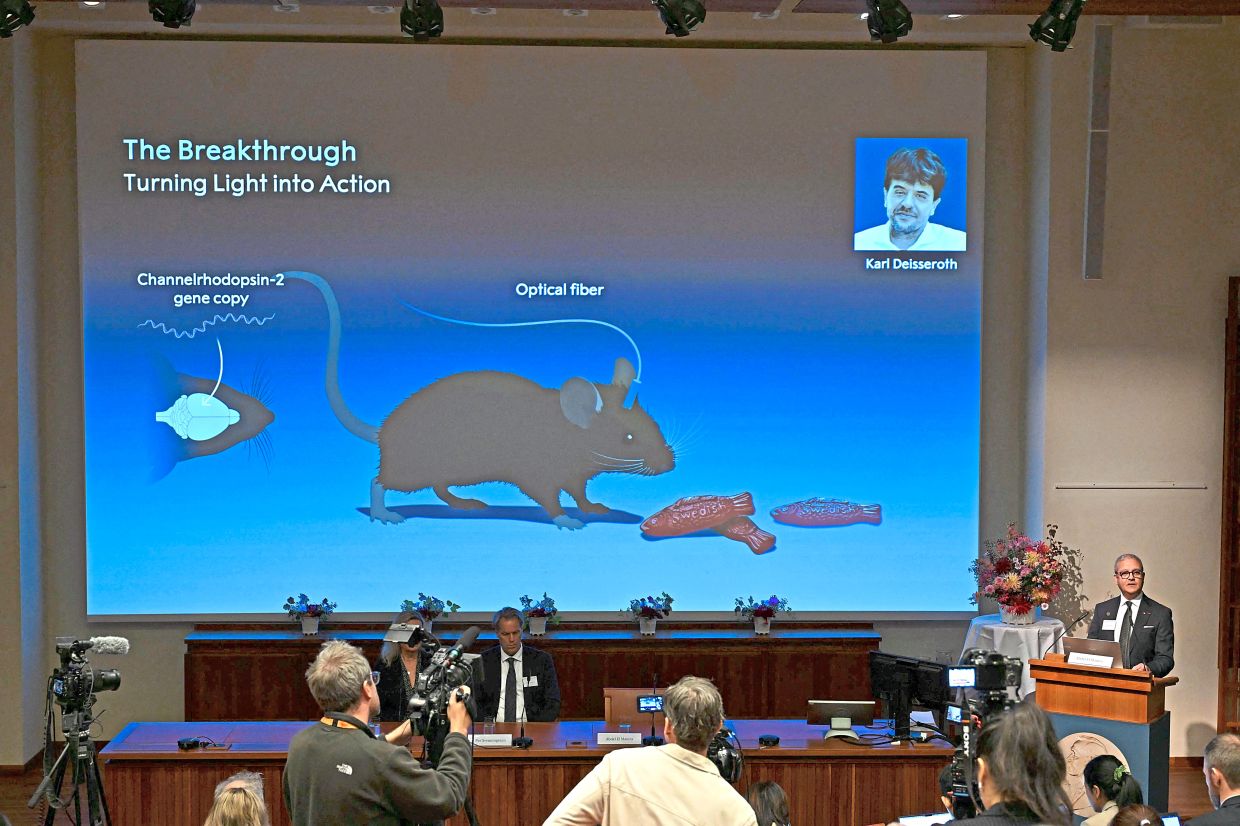
Prof El Manira (right) speaks in front of a screen illustrating light-gated ion channels and displaying a portrait of Prof Deisseroth during the announcement of the 2026 Nobel Prize in Physiology or Medicine winners at the Karolinska Institute in Stockholm last Monday. — AFP
In optogenetics, scientists control neurons by stimulating them with light, potentially unlocking breakthroughs for conditions such as dementia, depression and blindness.
Three scientists won the 2026 Nobel Prize in Physiology or Medicine last Monday (Oct 5, 2026) for their work in the field: American neurologist and Stanford University professor Dr Karl Deisseroth, 54; German biophysicist and Humboldt University of Berlin professor Dr Peter Hegemann, 71; and German biophysicist and University of Wuerzburg professor Dr Georg Nagel, 73.
Thank you for your report!
The Nobel Prize-winning science of optogenetics
Sabah must leverage science and technology to boost resource value, says deputy minister
Life sciences firm Danaher to launch AI-powered autonomous research lab in 2027
上周一,在斯德哥尔摩卡罗林斯卡学院举行的2026年诺贝尔生理学或医学奖颁奖典礼上,埃尔·马尼拉教授(右)在展示光控离子通道和戴瑟罗斯教授肖像的屏幕前发表讲话。——法新社
在光遗传学中,科学家通过光刺激来控制神经元,这有可能为痴呆症、抑郁症和失明等疾病带来突破。
三位科学家于上周一(2026 年 10 月 5 日)因其在该领域的工作而荣获 2026 年诺贝尔生理学或医学奖:美国神经学家、斯坦福大学教授卡尔·戴瑟罗斯博士(54 岁);德国生物物理学家、柏林洪堡大学教授彼得·黑格曼博士(71 岁);以及德国生物物理学家、维尔茨堡大学教授格奥尔格·纳格尔博士(73 岁)。
感谢您的报告!
荣获诺贝尔奖的光遗传学科学
沙巴副部长表示,沙巴必须利用科技来提升资源价值。
生命科学公司丹纳赫将于2027年推出人工智能驱动的自主研究实验室。