More properties going under the hammer, but don’t expect dirt-cheap buys更多房产即将拍卖,但别指望能捡到便宜。
Singapore property auctions: why seized homes are not always bargain buys Read more at straitstimes.com.
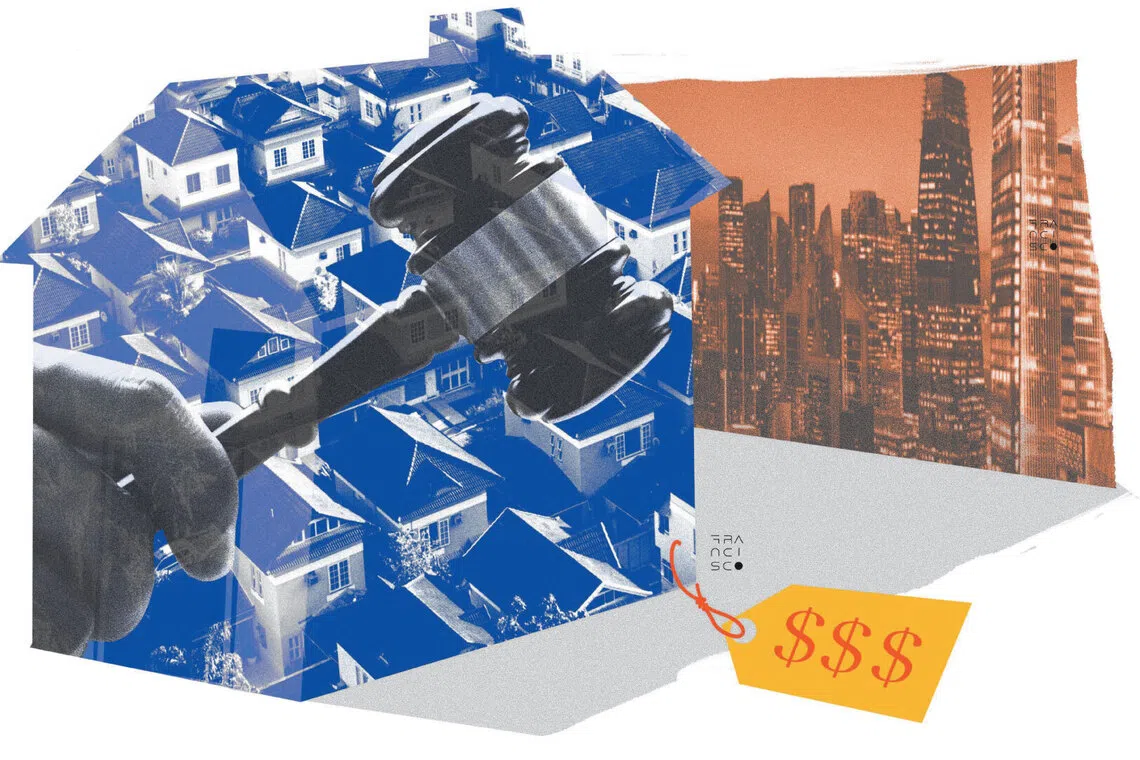
It is a buyer’s responsibility to check for any dues and liabilities associated with the auctioned property.
ST ILLUSTRATION: MANNY FRANCISCO
Published Oct 11, 2026, 05:00 AM
Updated Oct 11, 2026, 05:45 AM
SINGAPORE – For Singapore home buyers staring at million-dollar price tags, an auction may sound like a chance to snag a home below market price. But this is not necessarily the case.
Take the September auctions of 25 high-end properties seized in the $3 billion money laundering case as an example.
They attracted interest from genuine buyers, owners of nearby developments getting a feel of the market, and curious bystanders wanting a peek into the lifestyle of the criminals.
Only four condominiums – two each at Martin Modern and Wallich Residence – found buyers at the SRI auction on Sept 23.
The other properties were withdrawn either because they failed to meet their reserve prices or did not attract any bids.
Separate auctions held by Edmund Tie and Company (ETC) and Knight Frank concluded with no sales for the same reason.
The reserve price is the minimum price the seller has authorised for a sale at auction. It is usually confidential and should not be assumed to be identical to the advertised guide price or opening bid.
If the bidding does not meet the reserve price, the property generally remains unsold at that auction.
The mixed results come as Singapore’s property auction market prepares for a larger supply of listings, with more than 80 units confiscated in the money laundering case to be sold till mid-2027.
Auction listings rose for a fifth consecutive quarter in the second quarter to 157. They reflect a range of circumstances, including mortgagee and estate sales, liquidations, and owners seeking an alternative route to market. Not all listings were for luxury homes.
Joy Tan, head of auction and sales at ETC, a member of Realion Group, says sellers and buyers increasingly see auctions as a transparent way to transact. Buyers can deal directly with serious sellers and compete fairly for properties.
Auctions also appeal to buyers and investors seeking quality properties. Those with collective sale potential, freehold tenure or prime locations near popular schools, amenities or MRT stations are likely to continue attracting bidders and fetching premium prices despite market challenges, she says.
More buyers in their 30s and 40s are joining auctions, many to buy their first home or to upgrade.
Price conscious and well-informed, they see auctions as a way to get competitively priced properties, widening the buyer pool for mass-market and mid-tier homes.
Auction bargain myth
As mortgagee or bank sales account for a large share of auction listings here, auctions are often naturally associated with bargains. We imagine a distressed seller, savvy buyers and a property at a knock-down price.
But Tan Tee Khoon, head of auction and sales at Knight Frank Singapore, says buyers should not assume that a property being sold by a bank, an estate, a company or the authorities will be cheap.
Properties at auction come with guide prices, which take into account recent comparable transactions, prevailing market conditions, the property’s location, tenure and condition, as well as the seller’s instructions and reference to valuations in some cases.
“Even in a mortgagee sale, the lender has a duty to act in good faith and take reasonable care to obtain a proper market price at the time of sale. Recovering the outstanding loan does not, by itself, justify accepting any price,” Knight Frank’s Tan says.
His advice is to judge a potential bargain against recent comparable transactions and the total cost of ownership.
A large reduction from the asking price does not necessarily make a property good value, he warns.
Also, never confuse an auction guide price with the property’s fair value. A guide price is not a valuation. It is an indication of where bidding may start or where the seller expects the property to attract interest, says Nicholas Mak, chief research officer of Mogul.sg, a local property portal.
Only four condominiums – two each at Martin Modern and Wallich Residence (above) – found buyers at the SRI auction on Sept 23. ST PHOTO: AZMI ATHNI
Only four condominiums – two each at Martin Modern and Wallich Residence (above) – found buyers at the SRI auction on Sept 23.
ST PHOTO: AZMI ATHNI
Mak says buyers should conduct all the necessary due diligence, such as visiting and viewing the property units before attending the auction, just like any normal buyer would do before buying any resale property unit.
They should check the condition of the units, including looking out for any wear and tear and necessary repairs or renovations.
Suppose you find a property with a market value of $2 million and manage to secure it at auction for $1.9 million. At first glance, you have saved $100,000.
But now suppose the property requires $50,000 to address defects you had not anticipated, on top of the $100,000 renovations you had budgeted for. Suddenly, your $100,000 “discount” has disappeared.
So, when deciding on your bid, your calculation should include the purchase price, taxes and duties where applicable, legal fees, financing costs, renovation, repairs, maintenance and a contingency reserve.
The buffer is especially crucial for “as-is, where-is” sales without physical viewings.
Due diligence is harder as buyers must assess the asset using available information and conditions in the surrounding area rather than inspecting it themselves, ETC’s Tan says. Such a sale can leave the buyer responsible for defects, clearance or rectification work, Knight Frank’s Tan adds.
He says the sale description helps buyers understand who is selling and why, and determines the buyer’s rights and obligations.
In an owner sale, the seller may simply prefer an auction and may not be in financial trouble.
In a mortgagee or bank sale, a lender is usually selling a repossessed property after the borrower defaults. Buyers should check the lender’s authority to sell and the protections in the contract.
In a distressed sale, the seller is under financial pressure, but the label does not identify who is legally selling. It could be the owner, a mortgagee, a trustee or another authorised seller.
There are also involuntary, government-enforced or court-ordered sales, such as the auctions of properties seized from the money laundering criminals, which were handed over by the police to audit firm Deloitte for liquidation in August 20 25 , with the proceeds going into the Government’s consolidated fund.
In all property auctions, the biggest risk is what you cannot see. Photographs and viewings may not reveal defects, illegal structures, tenancy problems, ownership issues, restrictions or unpaid bills. The risks vary by property and, importantly, the auction’s conditions of sale.
That is why reading the auction documents is a necessary due diligence. A buyer who is unfamiliar with property transactions should seriously consider getting a conveyancing lawyer to review the relevant documents before bidding.
Likewise, if the condition of the property is uncertain, professional inspection can be money well spent, than discovering an expensive problem after you have won the auction.
Before you bid, get your funds ready
Another common mistake is to think about financing only after deciding which property you want. The order should be reversed.
Know your financing capacity first.
An approval in principle should not be treated as an unconditional guarantee that the bank will fund the purchase, Knight Frank’s Tan says. A bank’s willingness to lend is also not the same thing as your ability to comfortably afford the property.
For a Singaporean buyer, affordability needs to take into account the cash and CPF requirements, applicable stamp duties, legal costs, renovation and ongoing expenses, as well as the mortgage.
Do not test your finances against today’s interest rate alone. Ask yourself: What happens if the mortgage becomes significantly more expensive?
If the answer is that you would have to cut essential spending, empty your emergency fund or depend on an annual bonus to make repayments, the property is probably too expensive. This matters particularly at auction because the process can move quickly. You do not want to discover after winning that the financing you expected is unavailable or insufficient.
Buyers must look beyond the price when bidding for a home at auction. They need to have the funds ready on time, says Alfred Chia, chief executive of financial advisory firm SingCapital.
For a typical private home resale, buyers pay a 1% option fee and another 4% when exercising the option to purchase. At auction, the immediate deposit is usually 5% or 10% of the winning bid, depending on the sale conditions.
The completion deadline is also set by the auction contract, typically at eight to 12 weeks, rather than negotiated with the seller. This can put pressure on buyers who need to sell an existing property to fund the purchase.
“Before bidding, they should confirm the deposit requirement, completion deadline and when their bank loan and eligible CPF funds can be released,” Chia says.
Beyond these funding requirements, Knight Frank’s Tan highlights three other considerations:
Buyer’s premiums and fees: Confirm in writing any buyer’s premium, administration charge or separately agreed buyer-agent fee. Any premium would be additional to the bid price.
Other purchase costs: Budget for legal fees, financing costs, repairs and applicable stamp duties. Buyer’s stamp duty and additional buyer’s stamp duty are generally calculated on the higher of the purchase price or market value, so a lower auction price does not necessarily produce equivalent tax savings.
Default risks : Late completion of the sale may incur interest. Depending on the contract and applicable law, failure to complete could lead to the buyer losing his deposit and further claims for resale losses and expenses. The potential loss can exceed the deposit.
And if you are buying an investment property, there is another calculation: How much income will it actually generate after expenses?
Know what you are bidding for
The upcoming sales of properties forfeited in the money laundering case will undoubtedly generate headlines, curiosity and competition. But the September sales have shown that an auction is simply another way to buy an asset – there is no guarantee of a bargain.
These are not ordinary distressed sales, after all, but a way to turn those assets into cash. The properties’ history does not automatically make them bargains or undesirable purchases.
Buyers should assess their market value, sale conditions, ownership costs and financing, just as they would any other property.
In short, buy the property, not the story.
买家有责任核实与拍卖房产相关的任何费用和债务。
插图:曼尼·弗朗西斯科
发布于2026年10月11日 上午5:00
更新于2026年10月11日 上午5:45
新加坡——对于那些眼看着房价高达百万美元的新加坡购房者来说,拍卖听起来似乎是以低于市场价购房的机会。但事实并非总是如此。
以9月份拍卖的25处高端房产为例,这些房产是在30亿美元的洗钱案中查获的。
它们吸引了真正买家的兴趣,附近开发商想了解市场行情,以及好奇的旁观者想一窥犯罪分子的生活方式。
9 月 23 日,SRI 拍卖会上只有四套公寓找到了买家——Martin Modern 和 Wallich Residence 各两套。
其他房产要么因为未能达到底价而撤回,要么因为无人出价而撤回。
Edmund Tie and Company (ETC) 和 Knight Frank 分别举行的拍卖会也因同样的原因而无一成交。
底价是卖方在拍卖中设定的最低成交价。底价通常是保密的,不应假定其与广告中的指导价或起拍价相同。
如果出价未达到保留价,则该房产通常会在该次拍卖中流拍。
新加坡房地产拍卖市场正准备迎接更多房源,结果喜忧参半。在洗钱案中被没收的 80 多套房产将于 2027 年年中之前出售。
第二季度拍卖挂牌房源数量连续第五个季度增长,达到157套。这些房源反映了多种情况,包括抵押权人和遗产拍卖、清算以及业主寻求其他出售途径。并非所有挂牌房源都是豪宅。
Realion集团旗下ETC拍卖及销售主管Joy Tan表示,买卖双方越来越将拍卖视为一种透明的交易方式。买家可以直接与诚意卖家洽谈,并公平地竞购房产。
她表示,拍卖也吸引着那些寻求优质房产的买家和投资者。那些具有集体出售潜力、永久产权或位于热门学校、便利设施或地铁站附近黄金地段的房产,即便面临市场挑战,也可能继续吸引竞标者并拍出高价。
越来越多的 30 多岁和 40 多岁的买家参与拍卖,其中许多人是为了购买他们的第一套房产或升级住房。
他们注重价格,消息灵通,认为拍卖是获得价格具有竞争力的房产的一种方式,可以扩大大众市场和中档住宅的买家群体。
拍卖讨价还价神话
由于抵押权人或银行出售的房产在本地拍卖列表中占很大比例,因此拍卖往往与低价房产联系在一起。我们想象着一位急于出售房产的卖家、精明的买家,以及一套价格低得惊人的房产。
但莱坊新加坡拍卖及销售主管陈迪坤表示,买家不应认为银行、地产公司、企业或政府出售的房产会很便宜。
拍卖房产均有指导价,指导价会考虑近期类似交易、当前市场状况、房产位置、产权和状况,以及卖方的指示和某些情况下的估价。
“即使在抵押权人出售的情况下,贷款人也有义务诚信行事,并采取合理措施在出售时获得适当的市场价格。收回未偿贷款本身并不能成为接受任何价格的理由,”莱坊的谭先生表示。
他的建议是,要根据近期类似交易和总拥有成本来判断潜在的交易是否划算。
他警告说,大幅降价并不一定意味着房产物有所值。
此外,切勿将拍卖指导价与房产的公允价值混淆。指导价并非估值,而是表明竞价可能从何处开始,或卖方预期房产会吸引多少关注,本地房地产门户网站Mogul.sg的首席研究员Nicholas Mak表示。
9月23日,在SRI的拍卖会上,仅有四套公寓售出,分别是Martin Modern和Wallich Residence(上图)各两套。ST PHOTO:AZMI ATHNI
9 月 23 日,SRI 拍卖会上,只有四套公寓——Martin Modern 和 Wallich Residence(上图)各两套——找到了买家。
ST 摄影:AZMI ATHNI
Mak表示,买家应该像任何普通买家在购买任何二手房产之前一样,在参加拍卖会之前进行所有必要的尽职调查,例如参观和查看房产单元。
他们应该检查房屋状况,包括查看是否有磨损、需要维修或翻新的地方。
假设你找到一处市场价值 200 万美元的房产,并在拍卖会上以 190 万美元的价格将其拍下。乍一看,你似乎省了 10 万美元。
但现在假设这处房产除了你预算的10万美元翻新费用外,还需要5万美元来修复你未预料到的缺陷。突然间,你那10万美元的“折扣”就消失了。
因此,在决定出价时,您的计算应包括购买价格、适用的税费、法律费用、融资成本、翻新、维修、维护和应急储备金。
对于不提供实地看房的“按现状出售”而言,缓冲期尤其重要。
ETC的谭先生表示,由于买家必须利用现有信息和周边地区的情况来评估资产,而不是亲自进行实地考察,因此尽职调查的难度更大。莱坊的谭先生补充道,这样的交易可能使买家承担缺陷、清理或整改工作的责任。
他表示,销售说明有助于买家了解卖方是谁以及原因,并确定买家的权利和义务。
在业主自售的情况下,卖方可能只是更喜欢拍卖,而且可能并没有财务困难。
在抵押贷款或银行拍卖中,贷款机构通常是在借款人违约后出售被收回的房产。买家应核实贷款机构的出售权限以及合同中的保障条款。
在强制出售中,卖方面临财务压力,但标签上并未标明合法卖方的身份。卖方可能是业主、抵押权人、受托人或其他授权卖方。
此外,还有非自愿的、政府强制的或法院命令的出售,例如从洗钱罪犯手中查获的财产的拍卖,这些财产于 2025 年 8 月由警方移交给审计公司德勤进行清算,所得款项进入政府的综合基金。
在所有房产拍卖中,最大的风险在于你无法看到的方面。照片和实地看房可能无法揭示房产缺陷、违章建筑、租赁问题、所有权纠纷、限制条款或未付账单。风险因房产而异,更重要的是,还取决于拍卖的销售条款。
因此,仔细阅读拍卖文件是必要的尽职调查。不熟悉房产交易的买家应认真考虑在出价前聘请产权律师审核相关文件。
同样,如果房产状况不确定,花钱请专业人员进行检查是值得的,总比在竞拍成功后才发现昂贵的问题要好得多。
竞标前请准备好资金。
另一个常见的错误是,在决定购买哪处房产之后才考虑融资问题。正确的顺序应该是先确定房产类型,再考虑融资问题。
首先要了解自己的融资能力。
莱坊的谭先生表示,原则性批准不应被视为银行一定会提供贷款的无条件保证。银行的贷款意愿也不等同于您有能力轻松负担该房产。
对于新加坡买家来说,购房能力需要考虑现金和公积金要求、适用的印花税、法律费用、装修和持续费用以及抵押贷款。
不要仅仅根据今天的利率来评估你的财务状况。问问自己:如果房贷成本大幅上涨,会发生什么?
如果答案是您需要削减必要开支、动用应急资金或依靠年终奖金来偿还贷款,那么这处房产可能太贵了。这一点在拍卖中尤为重要,因为拍卖流程可能很快。您肯定不希望在竞拍成功后才发现预期的贷款无法获得或金额不足。
新加坡金融咨询公司SingCapital的首席执行官Alfred Chia表示,买家在竞拍房屋时,不能只关注价格。他们需要按时准备好资金。
在典型的私人住宅二手交易中,买家需支付1%的期权费,并在行使购买选择权时再支付4%。在拍卖中,根据销售条款,即时定金通常为中标价的5%或10%。
拍卖合同也规定了交易完成的最后期限,通常为八到十二周,而不是与卖方协商确定。这可能会给需要出售现有房产来筹集购房资金的买家带来压力。
Chia表示:“在投标之前,他们应该确认保证金要求、完工期限以及他们的银行贷款和符合条件的公积金何时可以发放。”
除了这些资金需求之外,莱坊的谭先生还强调了其他三个需要考虑的因素:
买方佣金及费用:请以书面形式确认任何买方佣金、管理费或另行约定的买方代理费。所有费用均需在竞标价之外另行支付。
其他购置成本:预算应包括律师费、融资费用、维修费和适用的印花税。买方印花税和额外买方印花税通常按购买价格或市场价值中较高者计算,因此较低的拍卖价格并不一定能带来同等的税收优惠。
违约风险:交易逾期完成可能产生利息。根据合同及适用法律,未能完成交易可能导致买方损失定金,并可能面临进一步的转售损失和费用索赔。潜在损失可能超过定金金额。
如果你购买的是投资性房产,还有另一个计算:扣除费用后,它实际能产生多少收入?
了解你竞标的是什么
即将举行的洗钱案中被没收房产拍卖无疑会引发媒体关注、好奇和竞争。但9月份的拍卖表明,拍卖仅仅是购买资产的另一种方式——并不能保证一定能买到便宜货。
毕竟,这些并非普通的低价甩卖,而是将这些资产变现的一种方式。房产的历史并不一定意味着它们就便宜或不值得购买。
买家应该像评估其他任何房产一样,评估其市场价值、销售条件、持有成本和融资情况。
简而言之,买的是房产本身,而不是它背后的故事。