Russia Releases “Tsar Bomba” Test Footage Of The Most Powerful Nuclear Bomb Blast Ever俄罗斯公布“沙皇炸弹”试验视频,这是有史以来威力最大的核弹爆炸。
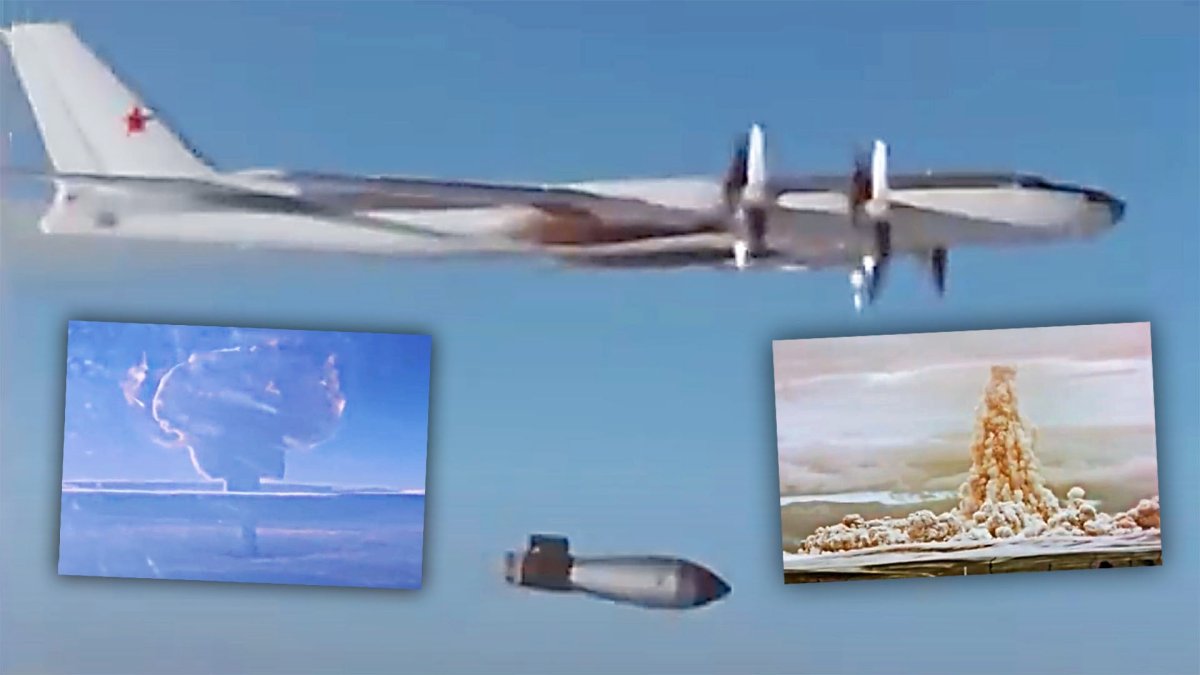
This previously classified film provides a new and fascinating glimpse into the 50-megaton Cold War nuclear test that occurred nearly six decades ago.
Updated Nov 27, 2020 6:27 PM EST
The nuclear bomb , codenamed “Ivan,” that was dropped by the Soviet Union over Novaya Zemlya in the Arctic Ocean on October 30, 1961, was the largest device of its kind ever detonated. The monstrous weapon had a yield of around 50 megatons — equivalent to 50 million tons of TNT. Until now, the available imagery of that test has been strictly limited, consisting of short, grainy clips and poor-quality stills.
The colossal Ivan device was developed under a program known as izdeliye 202 (meaning “product 202”, otherwise known simply as “V”). Years later, when more details became known about it in the West, the weapon would be dubbed “Tsar Bomba.”
On August 20, 2020, the Rosatom State Atomic Energy Corporation — the Russian state concern responsible for nuclear enterprises, including nuclear weapons — released a 30-minute documentary film on its official YouTube channel showing the test in unprecedented detail, from the initial transport of the device itself to the mushroom cloud that later rose some 6.2 miles over the Arctic archipelago. The release of the film coincides with the 75th anniversary of Russia’s nuclear industry — although a thermonuclear bomb popularly described in the West as a “doomsday weapon” was perhaps an unusual choice for the commemoration. Regardless, it was a remarkable technological achievement.
An engineer checks over the Ivan device before its transport to Olenya Air Base., ROSATOM
While the style of the documentary is pure Soviet propaganda, it reveals plenty of fascinating details about the test. After the “Top Secret” titles, one anachronistic scene shows the fully assembled Ivan bomb moved at one stage by a steam train. Its destination was Olenya Air Base near Olenegorsk on the Kola Peninsula in northwestern Russia, where the bomb was unloaded and then moved onward by truck. Remarkably, variants of the four-engine Tu-95 Bear bomber, the type that carried the devastating cargo aloft for the flight over the Barents Sea, remain in service today, though in much-modernized form. The particular aircraft used for the October 1961 test was the Tu-95V, a special adaptation of the first-generation Bear-A nuclear bomber, with an enlarged and reinforced bomb bay for semi-recessed weapon carriage. Like many other strategic bombers of its era, the Tu-95V featured an anti-nuclear-flash white scheme, although in this case it was extended to cover the propeller blades, too.
The documentary shows us inside the cockpit of the Tu-95V, where aircrew don protective goggles before we see the 26.5-ton bomb falls away gently under a parachute towards its intended target — the Russian Defense Ministry’s State Testing Site No. 6 — close to Novaya Zemlya’s Matochkin Strait. The detonation itself is recorded from several different aspects, including from the air. The Tu-95V was accompanied for at least some of its mission by at least two other aircraft, including a twin-jet Tu-16 bomber serving as a “flying laboratory,” equipped with cameras, radio-telemetry equipment, oscilloscopes to determine the power of the explosion, and pressure recorders to measure the intensity of the shock wave. Other measuring equipment was installed on the Tu-95V itself, including sensor probes that replaced the usual tail gunner’s position. One scene from the documentary shows a model indicating a formation of five aircraft in total, at least at the start of the mission.
The Tu-95V receives a coat of white paint on its contrarotating propellers. , ROSATOM
The mission itself was controlled from an underground bunker at Belyusha Bay, 162 miles south of the test site. Closer to the site of the detonation itself was D-8, 56 miles from the test area, which housed further measuring and recording equipment, plus an underground command post, with warships being used as a communications relay between the two stations. State Testing Site No. 6 itself didn’t feature any buildings or vehicles to assess the damage, but was equipped with additional automated testing gear: cameras and filming equipment, and below-ground oscilloscopes.
The bomb was dropped from the Tu-95V flying at an altitude of 34,449 feet, and detonation occurred at 13,123 feet above the ground — an airburst — which would have substantially reduced the radiation produced, and this may be the reason the documentary refers to the weapon as a “clean hydrogen bomb.” But of course, everything is relative when it comes to the world’s most powerful nuclear device.
The mushroom cloud is seen from one of the aircraft involved in the mission., ROSATOM
According to the video, the Tu-95V was 28 miles away from the release point, and the detonation produced a fireball visible 621 miles away, despite cloudy conditions. “The explosion was accompanied by a bright flash of unusual strength,” the narrator explains. Within seconds, a column of dust had risen to a height of around 6 miles.
The footage then moves to one of the Tu-16 aircraft, at a distance of 155 miles from the detonation and we see the huge fireball, rising slowly and expanding to reach a maximum of 12 miles across. Forty seconds after the detonation, the fireball has reached a height of approximately 19 miles, after which a mushroom cloud begins to form, reaching a maximum height of 37-40 miles and a diameter of 56 miles.
We see the Tu-95V returning home, with the mushroom cloud still visible at a distance of 497 miles, before we take to the ground “a few hours” after the explosion, to see the destruction wrought on Novaya Zemlya. Scientists are seen arriving onboard a specially-equipped Mi-4 helicopter radiation reconnaissance systems, disembarking unprotected, since “even in the very center of the site, [radiation] was insignificant.” Some of the team then put on protective gear and head by closer to the center of the test site, apparently using a GT-series tracked vehicles designed primarily for operations in snowy conditions. Here, for “dozens of kilometers” in every direction, the earth has been scorched, most of the snow vaporized, and the few structures that existed above the surface have been obliterated.
A Mi-4 helicopter lands on the test site in the aftermath of the nuclear blast. , ROSATOM
The Soviet Union’s path towards the 50-megaton test of October 1961 had begun with the country’s first nuclear detonation, which took place on August 29, 1949, involving an experimental device known as the RDS-1. This was followed by a first air-delivered bomb, the 30-kiloton RDS-3 Maria, dropped on October 18, 1951, by a specially adapted Tu-4 bomber, itself an unlicensed copy of the B-29 Superfortress.
By 1953, the Soviets had developed nuclear bombs for larger-scale production and was able to field the 30-kiloton RDS-4T Tatyana that could be carried by a twin-engine Il-28 Beagle jet bomber. The same year, the Soviet Union detonated its first thermonuclear bomb, the RDS-6S Sloyka, in a ground test that took place on August 12.
Ivan was the brainchild of Soviet Premier Nikita Khrushchev and was authorized in July 1961 at an especially frosty period in East-West relations that culminated in the Berlin Crisis and the city’s permanent partition by the Berlin Wall .
With typical bombast, Khrushchev had demanded his engineers develop a thermonuclear weapon with an unprecedented yield of 100 megatons, requiring a three-stage warhead, rather than the usual two. It seems the team responsible had concerns about the radiation risk and decided to reduce the yield to 50 megatons — still equivalent to around 3,800
Hiroshima bombs. The documentary notes that the bomb casing itself was sized to carry a 100-megaton charge.
The Ivan bomb descends under a huge parachute after being dropped over Novaya Zemlya. , ROSATOM
By contrast, the largest nuclear device ever detonated by the United States was the one it set off during the Castle Bravo test at Bikini Atoll in the Marshall Islands in the Pacific on March 1, 1954. Unlike the Soviet test, this yield was achieved by accident, after a miscalculation by the designers. Nevertheless, the yield produced — 15 megatons as opposed to the planned 5-6 megatons — still fell well short of the Ivan test. The Castle Bravo device was mounted in a “shot cab” on an artificial island, rather than being air-dropped, but it was later developed into the Mk 21 bomb that could be carried by a U.S. Air Force B-36 Peacemaker or B-47 Stratojet bomber.
Meanwhile, Ivan’s detonation was destined to be a high watermark in atmospheric nuclear testing. Amid mounting concern about the fallout generated by above-ground tests, the Partial Test Ban Treaty was signed in 1963 by the governments of the Soviet Union, the United Kingdom, and the United States . Thereafter, all tests were required to be conducted underground.
One of the bomber crew wearing tinted goggles to protect against nuclear flash., ROSATOM
The Ivan bomb was ultimately too large to be of practical military use — both in terms of delivery and finding targets that warranted its use. However, the Soviet Union remained heavily engaged in developing freefall nuclear bombs alongside missiles and other delivery systems.
Nuclear weapons are still assigned considerable importance for today’s Russian armed forces and most Russian combat aircraft are capable of delivering nuclear bombs. While details of modern Russian freefall nuclear bombs remain highly classified, their equivalent practice bombs provide some indication of their appearance and are issued to tactical fixed-wing units for use in exercises. The release of this Cold War-era documentary is a sobering reminder of the lingering presence of these weapons and their awesome destructive power.
Contact the author: thomas@thedrive.com
Comments couldn’t be loaded. Please refresh the page.
更新于美国东部时间2020年11月27日下午6:27。
1961年10月30日,苏联在北冰洋新地岛上空投下了代号为“伊万”的核弹,这是人类历史上引爆过的威力最大的同类装置。这枚威力巨大的武器当量约为5000万吨TNT当量。此前,关于这次核试验的影像资料非常有限,仅有一些模糊不清的短片和质量低劣的照片。
巨型伊万炸弹是在名为“izdeliye 202”(意为“202号产品”,也简称“V”)的计划下研制的。多年后,当西方了解更多细节时,这种武器被冠以“沙皇炸弹”之名。
2020年8月20日,俄罗斯国家原子能公司(Rosatom)——负责包括核武器在内的俄罗斯核企业的国有企业——在其官方YouTube频道发布了一部30分钟的纪录片,以前所未有的细节展现了此次核试验,从最初的装置运输到随后升腾至北极群岛上空约6.2英里(10公里)的蘑菇云。这部纪录片的发布恰逢俄罗斯核工业诞生75周年——尽管选择一枚在西方被普遍称为“末日武器”的热核炸弹作为纪念活动或许有些不同寻常。但无论如何,这都是一项非凡的技术成就。
一名工程师在“伊万”装置运往奥列尼亚空军基地前对其进行检查。(俄罗斯国家原子能公司)
这部纪录片的风格虽然带有浓厚的苏联宣传色彩,却揭示了此次试验的诸多引人入胜的细节。在“绝密”字样之后,一个略显时代错置的场景展现了组装完毕的伊万原子弹在某个阶段由蒸汽火车运输。它的目的地是位于俄罗斯西北部科拉半岛奥列涅戈尔斯克附近的奥列尼亚空军基地,在那里,原子弹被卸下,然后用卡车运往下一个目的地。值得注意的是,用于将这枚威力巨大的炸弹送上巴伦支海上空的四引擎图-95“熊”式轰炸机的改进型至今仍在服役,尽管已经过多次现代化改造。1961年10月试验中使用的飞机是图-95V,它是第一代“熊-A”核轰炸机的特殊改进型,拥有更大更坚固的弹舱,可以半隐藏式地挂载武器。与当时许多其他战略轰炸机一样,图-95V 采用了反核闪光白涂装方案,不过在这种情况下,这种涂装也延伸到了螺旋桨叶片上。
这部纪录片带领我们进入图-95V轰炸机的驾驶舱,机组人员戴上防护眼镜后,我们看到一枚26.5吨重的炸弹在降落伞的牵引下缓缓落向预定目标——位于新地岛马托奇金海峡附近的俄罗斯国防部第六国家试验场。爆炸过程从多个角度被记录下来,包括空中视角。图-95V在执行任务的至少部分时间里,至少有两架飞机伴随飞行,其中包括一架双引擎图-16轰炸机,它被用作“飞行实验室”,配备了摄像机、无线电遥测设备、用于测量爆炸威力的示波器以及用于测量冲击波强度的压力记录仪。图-95V本身也安装了其他测量设备,包括取代通常尾炮手位置的传感器探头。纪录片中的一个场景展示了一个模型,表明至少在任务开始时,总共有五架飞机编队飞行。
图-95V的反向旋转螺旋桨被涂上了一层白色油漆。(俄罗斯国家原子能公司)
此次任务由位于试验场以南162英里(约260公里)的别柳沙湾地下掩体控制。距离爆炸地点更近的是D-8站,距离试验区56英里(约90公里),该站设有更多测量和记录设备以及一个地下指挥所,军舰被用作两个站点之间的通信中继。6号国家试验场本身没有任何用于评估破坏的建筑物或车辆,但配备了额外的自动化测试设备:摄像机和录像设备以及地下示波器。
这枚炸弹由图-95V轰炸机在34449英尺(约10500米)的高空投下,并在离地13123英尺(约4000米)的高度引爆——这是一次空中爆炸——这大大降低了辐射的产生,或许这就是纪录片将其称为“清洁氢弹”的原因。当然,对于世界上威力最大的核装置而言,一切都是相对的。
蘑菇云是从参与此次任务的一架飞机上拍摄到的。(俄罗斯国家原子能公司)
根据视频显示,图-95V轰炸机当时距离爆炸点28英里,尽管当时阴云密布,爆炸产生的火球在621英里外都能看到。“爆炸伴随着一道异常强烈的闪光,”解说员解释道。短短几秒钟内,一股尘埃柱就升至约6英里高。
画面随后切换到一架图-16轰炸机,该飞机距离爆炸点155英里。我们看到巨大的火球缓缓升起并不断扩大,最大直径达到12英里。爆炸发生40秒后,火球高度达到约19英里,之后开始形成蘑菇云,最大高度达到37-40英里,直径达到56英里。
我们看到图-95V轰炸机返航,蘑菇云在497英里(约790公里)外依然清晰可见。爆炸发生“几小时”后,我们降落到地面,目睹新地岛遭受的破坏。科学家们乘坐一架配备特殊辐射侦察系统的米-4直升机抵达,他们下机时并未穿戴防护装备,因为“即使在试验场中心,辐射也微乎其微”。随后,部分团队成员穿上防护装备,前往试验场中心附近,他们似乎驾驶的是GT系列履带式车辆,这种车辆主要用于雪地作业。在这里,方圆“数十公里”内,大地已被烧焦,大部分积雪蒸发殆尽,地表上仅存的少量建筑物也已化为灰烬。
核爆炸过后,一架米-4直升机降落在试验场上。(俄罗斯国家原子能公司)
苏联通往 1961 年 10 月 5000 万吨级核试验的道路始于该国的首次核爆炸,该爆炸发生在 1949 年 8 月 29 日,使用的是名为 RDS-1 的实验装置。随后,苏联于 1951 年 10 月 18 日投下了第一枚空投炸弹——30000 吨级的 RDS-3“玛丽亚”核弹,该炸弹由一架经过特殊改装的图-4轰炸机投下,而图-4本身是未经授权仿制的 B-29“超级堡垒”轰炸机。
到1953年,苏联已经研制出可大规模生产的核弹,并能够部署当量为30千吨的RDS-4T“塔季扬娜”核弹,这种核弹可由双引擎伊尔-28“猎犬”喷气式轰炸机携带。同年8月12日,苏联进行了首次地面核试验,引爆了其第一颗热核炸弹——RDS-6S“斯洛伊卡”。
伊万是苏联最高领导人尼基塔·赫鲁晓夫的创意,于 1961 年 7 月获得批准,当时正值东西方关系异常冷淡的时期,最终导致了柏林危机和柏林墙对这座城市的永久分割。
赫鲁晓夫以他一贯的夸张言辞要求工程师们研制一种当量空前(1亿吨)的热核武器,需要三级弹头,而不是通常的两级弹头。负责研制的团队似乎对辐射风险有所顾虑,最终决定将当量降低到5000万吨——仍然相当于约3800吨。
广岛原子弹。纪录片指出,炸弹外壳本身的设计容量足以容纳1亿吨当量的装药。
伊万炸弹在投掷到新地岛上空后,借助巨大的降落伞缓缓降落。(俄罗斯国家原子能公司)
相比之下,美国引爆过的最大核装置是1954年3月1日在太平洋马绍尔群岛比基尼环礁进行的“城堡行动”(Castle Bravo)核试验。与苏联的试验不同,这次试验的当量是设计人员计算失误造成的意外。尽管如此,实际产生的当量——1500万吨,而非计划的500万至600万吨——仍然远低于“伊万行动”(Ivan)的当量。“城堡行动”的核装置被安装在人工岛上的“发射舱”中,而不是空投,但后来被改进为Mk 21型核弹,可由美国空军的B-36“和平缔造者”或B-47“同温层喷气”轰炸机携带。
与此同时,伊万的爆炸注定成为大气层核试验的一个里程碑。由于人们越来越担心地面核试验产生的放射性尘埃,苏联、英国和美国政府于1963年签署了《部分禁止核试验条约》。此后,所有核试验都被要求在地下进行。
轰炸机机组人员之一戴着有色护目镜,以抵御核爆闪光。(俄罗斯国家原子能公司)
伊万原子弹最终体积过大,无论从投送还是寻找合适的作战目标来看,都无法实际用于军事用途。然而,苏联仍然大力研发自由落体核弹以及导弹和其他运载系统。
核武器在当今俄罗斯武装部队中仍然占据着举足轻重的地位,大多数俄罗斯作战飞机都具备投掷核弹的能力。虽然现代俄罗斯自由落体核弹的细节仍然高度机密,但其对应的训练弹能够展现其外观,并配发给战术固定翼部队用于演习。这部冷战时期纪录片的上映,令人警醒地提醒我们,这些武器仍然存在,并且拥有惊人的破坏力。
联系作者:thomas@thedrive.com
评论加载失败,请刷新页面。