MIT Lincoln Lab’s Storied 707 Military Testbed Jet Is Now At The Boneyard麻省理工学院林肯实验室那架传奇的707军用试验机如今已进入飞机坟场。
For almost 30 years, the aircraft supported a wide variety of radar, communications, and other flight test programs in cooperation with the Air Force.
新闻视频
By Joseph Trevithick
Updated Nov 27, 2020 6:02 PM EST
Recently, a very unique and heavily modified Boeing 707 aircraft arrived at the U.S. Air Force’s famous boneyard at Davis Monthan Air Force Base in Arizona. For nearly three decades, Lincoln Laboratory had operated this aircraft, most recently nicknamed Shashambre , as a flying testbed for various advanced sensors, electronics, and more, as part of a collaborative effort with the Air Force.
Shashambre touched down at the boneyard on Oct. 26, 2020. The Lincoln Laboratory , a Department of Defense-funded research and development center housed within the Massachusetts Institute of Technology (MIT) and first founded in 1951, had previously announced that the aircraft, which also carried the U.S. civil registration code N404PA and has been referred to in the past as the Lincoln Multifunction Intelligence, Surveillance, and Reconnaissance Testbed, or LiMIT, had flown its last test mission on Sept. 15.
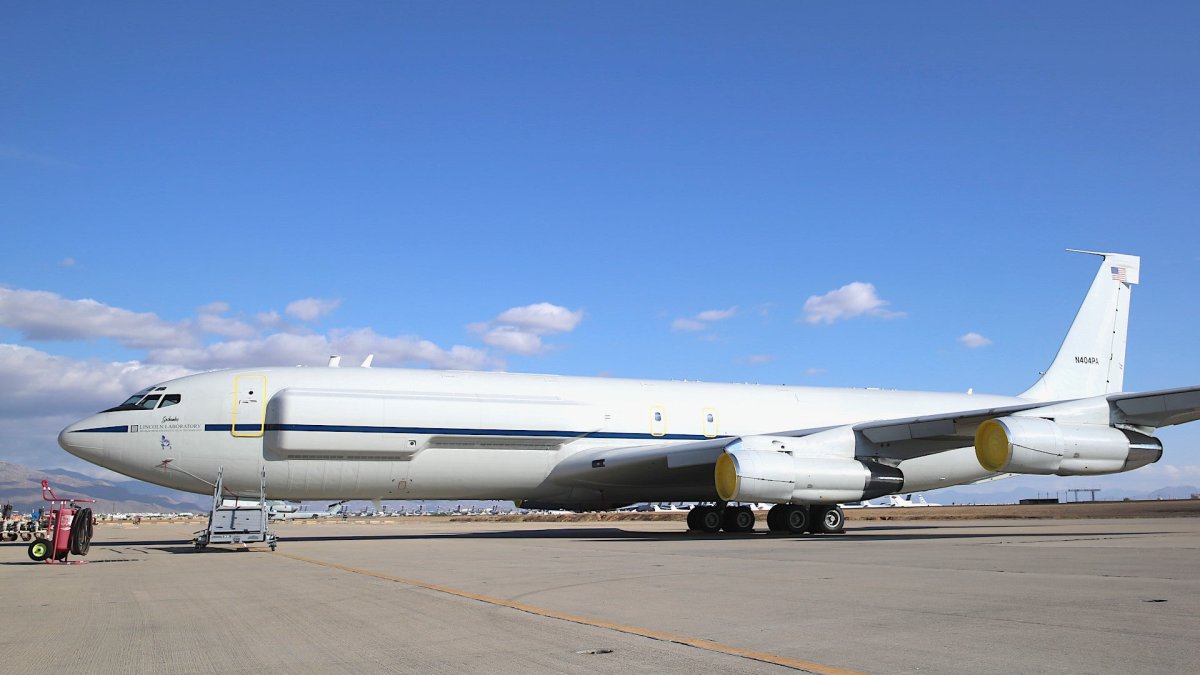
The War Zone has now obtained pictures, seen at the top of this story and below, of the aircraft as it appears now at Davis Monthan AFB. One of the jet’s two distinctive cheek fairings, which could hold radars, as well as other sensors and payloads during testing, is still prominently visible in the photos.
N404PA at the Boneyard., USAF
The nickname Shashambre is visibly painted on the nose of N404PA., USAF
However, a large dorsal hump at the rear of the fuselage, typically associated with wideband satellite communications systems , and a smaller dome on top of the fuselage above the cockpit, as seen in the videos below, which had been fitted the aircraft on and off since at least 2009, are now missing.
Multiple platter-type antennas that had been fitted on various occasions to each side of the center of the fuselage, and which are also commonly associated with ultra-high-frequency satellite communications systems, have notably been removed, as well. The aircraft does still has various other smaller antennas on top of and below its fuselage, as well as one on the tip of its tail.
A picture of N404PA prior to the installation of the two dorsal radomes, but with three of the six platter-type antennas on the side of the central part of the upper fuselage visible., Lincoln Laboratory
The Lincoln Laboratory first acquired this aircraft in 1988, in order to support a specific program “that explored electromagnetic influences” on electronics, according to an official news item about Shashambre’s retirement. “The Boeing 707 platform was chosen because of its size, availability, low purchase cost, and the extensive experience on the part of the Air Force and others in modifying the airframe,” according to a separate Lincoln Laboratory document .
The laboratory subsequently found a suitable example in a Florida boneyard, where it had been sitting in storage for some time. The jet in question had first rolled off Boeing’s line in 1965 and was among the first batch of 707s to be powered by Pratt & Whitney JT-3D turbofan engines, also known as the TF-33. This is the same engine still found on the Air Force’s B-52 bombers and also powered various variants of that service’s C-135 family , including certain KC-135 tankers and RC-135 spy planes .
The evolution of N404PA, from its service with Pan Am, at top, to the Florida Boneyard, in the center, and then to its time as flying testbed, at the bottom. The picture of the aircraft at the bottom was take in 2009 and shows the two major dorsal radomes, as well as four patter-type antennas on the side of the fuselage, along with various other antennas. The rear dorsal dome would eventually find its way onto the Navy’s fleet of E-6B Mercury TACAMO aircraft., via the Lincoln Laboratory
It initially entered service with Pan American airlines with the name Clipper Seven Seas . Before its retirement from airline duties, “the aircraft had been leased by several regional carriers, shuttling college students to Daytona Beach for spring break, among other duties,” according to the Lincoln Laboratory.
“There are lots of stories about the overhaul process: we discovered cracks in the wing spars that needed repair; the engines were from an airline in China, so all the service data and manuals were in Chinese, forcing us to strip the engines down and essentially ‘zero time’ them [start from scratch],” David Kettner, who headed up the program the aircraft was initially purchased to support, said in the Lincoln Laboratory’s piece on its recent retirement. “I sometimes wondered if we were ever going to get all the work done.”
The jet eventually made its way to E-Systems in Greenville, Texas, a firm well-known for its involvement in various Air Force intelligence, surveillance, and reconnaissance (ISR) projects and other specialized aircraft modification and conversion programs dating back to the 1960s. E-Systems has changed hands multiple times since then and is now a division of L3Harris.
This Air Force RC-135V/W Rivet Joint spy plane emerged with an unusual dorsal antenna from L3Harris’ facility in Greenville, Texas last year, underscoring the kind of specialized modification and conversion work that still goes on there., Dan Stijovich
The final converted 707 finally arrived at Hanscom Air Force Base in Massachusetts in 1991. The Lincoln Laboratory had established a small flight test center at the base, which remains there to this day, and at the time, it was also home to the Electronic Systems Division of Air Force Systems Command. The following year, that unit was redesignated as the Electronic Systems Center and became part of the restructured Air Force Materiel Command (AFMC).
The jet, originally nicknamed Paul Revere , after the famous Revolutionary War patriot and Massachusetts icon, continued to support the electromagnetic research effort until 1999. After that program ended, the Lincoln Laboratory decided to continue operating the jet together with the Air Force to support various other test programs. Over the years, a number of additional improvements and modifications to the aircraft were made.
“An extensive fiber-optic network backbone was installed along with two workstation tables, each capable of hosting six operators with computer access to the network,” according to the Lincoln Laboratory. “The power system was upgraded, several additional radomes were installed to handle communications antennas, and a liquid-cooling system was installed to cool power-hungry electronics.”
The aircraft, which subsequently received the nicknames and Hannah and then Shashambre , the exact origins of which are unclear, also got upgrades focused on giving it an increasingly more modular, plug-and-play architecture to allow for different test payloads to be more rapidly installed and removed. “We like to think of this flying laboratory as a Mr. Potato Head,” Dr. Joe Chapa, a Lincoln Laboratory researcher, said in 2004. “We can put a different nose or a different eye on.”
The interior of N404PA as of 2017, showing various modular equipment racks., USAF
All told, “N404PA has capabilities not available in other test aircraft, which allow the laboratory to rapidly prototype and demonstrate solutions to the hard communication and ISR challenges facing the nation,” Stephen McGarry, a member of the laboratory’s senior staff and former assistant leader of its Tactical Networks Group, said in the official story on the aircraft’s retirement.
A full list of the projects the former airliner took part in is unknown and many likely remain classified. “In 2001, the aircraft was assigned to an Air Force–sponsored program that was developing and demonstrating an intelligence, surveillance, and reconnaissance (ISR) platform that would be interoperable with other aircraft,” which “contributed to the modernization of military airborne command and control flight platforms that are still in use today,” according to the Lincoln Laboratory.
In 2002, it supported work “to develop and demonstrate a next-generation multi-sensor command and control airborne test platform.” It’s not clear what that program might have been, but the following year, a team consisting of Northrop Grumman, Boeing, and Raytheon received a contract from the Air Force to begin development of what would become known as the E-10A Multi-Sensor Command and Control Aircraft (MC2A), which was to be based on the Boeing 767-400ER.
An artist’s conception of the E-10A Multi-Sensor Command and Control Aircraft (MC2A)., USAF
This was an ambitious effort meant to eventually replace the service’s E-3 Sentry Airborne Warning And Control System (AWACS) radar planes and E-8C Joint Surveillance Target Attack Radar System (JSTARS) battle management aircraft, as well as its E-4B Nightwatch “doomsday” command and control jets and RC-135V/W Rivet Joint spy planes. In 2007, the Air Force canceled the project. Boeing sold the E-10A prototype to Bahrain, after which it was converted into a VIP aircraft.
In the early 2000s, N404PA supported a program to test new software algorithms designed to improve Ground Moving Target Indicator (GMTI) and Synthetic Aperture Radar (SAR) data processing in support of Discoverer II space-based radar program, a program the Defense Advanced Research Projects Agency (DARPA) conducted together with the Air Force and the secretive National Reconnaissance Office (NRO). “GMTI from space brought on challenges beyond those for airborne systems because of the very high velocities of satellites (approximately 40 times that of airplanes),” according to one Lincoln Laboratory document .
“The Laboratory developed and optimized the performance of a set of space-time adaptive processing (STAP) algorithms specifically for space radar,” it continued. “However, without a space-based radar, it was difficult to carry out two key steps in the Laboratory development approach: field testing and demonstration of operational utility.”
Lincoln Laboratory personnel subsequently installed a “scaled system [that] consists of a small multichannel antenna, similar to the antenna architecture for the space radar” in the nose of their modified 707. ” In this role, LiMIT has participated in a number of enterprise-level field exercises to demonstrate the ISR potential of space-based radar.”
A picture of the radar that was installed in the nose of N404PA in support of the Discoverer II program inside an anechoic chamber, at top, and an image showing the Ground Moving Target Indicator (GMTI) tracks the system collected during one of the subsequent tests. , Lincoln Laboratory
In 2004, in cooperation with the Air Force, the aircraft also demonstrated various communications and data-sharing capabilities during a Joint Forcible Entry Exercise (JFEX). A previous Air Force news item described the plane’s participation in that event as follows:
“Task Force Paul Revere, an airborne battle management command, control and communications application, helps makes testing machine-to-machine capabilities and global communication experiments possible by sending and receiving data between other airborne and space sensors and the Combined Air and Space Operations Center. This capability could allow United States and coalition warfighters from all services to simultaneously communicate from around the globe.” “Currently, aircraft such as the Rivet Joint, Joint Surveillance Target Attack Radar System, U-2 or Airborne Warning and Control System take in information that is saved on disks, analyzed and manually sent to warfighters and planners. Today’s output bandwidth from these aircraft is limited. Task Force Paul Revere experiments with the capability of taking in information from ground, space and air assets and simultaneously and instantly sending the information back out on a global network that includes the CAOC.” “During JEFX, Task Force Paul Revere is connecting information to Washington and routing it back through the base here.”
“Task Force Paul Revere, an airborne battle management command, control and communications application, helps makes testing machine-to-machine capabilities and global communication experiments possible by sending and receiving data between other airborne and space sensors and the Combined Air and Space Operations Center. This capability could allow United States and coalition warfighters from all services to simultaneously communicate from around the globe.”
“Currently, aircraft such as the Rivet Joint, Joint Surveillance Target Attack Radar System, U-2 or Airborne Warning and Control System take in information that is saved on disks, analyzed and manually sent to warfighters and planners. Today’s output bandwidth from these aircraft is limited. Task Force Paul Revere experiments with the capability of taking in information from ground, space and air assets and simultaneously and instantly sending the information back out on a global network that includes the CAOC.”
“During JEFX, Task Force Paul Revere is connecting information to Washington and routing it back through the base here.”
The aircraft also supported work on in similar veins in the mid-to-late 2000s, all of which notably took place around the time of the development of the Air Force’s Battlefield Airborne Communications Node (BACN) communications gateway. You can read more about BACN in this past War Zone feature .
In 2004, the modified 707 had played the role of an airborne radar with synthetic aperture and ground-moving-target indicator capabilities during a U.S. Navy exercise nicknamed Silent Hammer, which helped prove out various concepts of operation related to that service’s converted Ohio class guided missile submarines. You can read more about those specialized boats in detail, as well as that transformational exercise, in this past War Zone feature .
A diagram showing how N404PA supported the Silent Hammer exercise., Lincoln Laboratory
Starting in 2011, the modified 707 began supporting Air Force Nuclear Weapons Center projects, including the Family of Advanced Beyond-Line-of-Sight Terminals communications program, as well. The Lincoln Laboratory says that the jet has also been involved in the testing various radars, including phased arrays and a laser radar called Jigsaw, over the years.
A logo for the Family of Advanced Beyond-Line-of-Sight Terminals program seen on the nose of Shashambre at the Boneyard., USAF
“The teams who work through this test bed [sic] have truly put some of the best technology in the hands of the warfighter, and we really appreciate what you all have done,” Eric Evans, the Lincoln Laboratory’s Director, said at a retirement ceremony at Hanscom for N404PA in October.
“We achieved things with that aircraft that… definitely advanced both our understanding and our appreciation, and helped raise the spirit of why we do what we do each and every day,” Niles Cocanour, a retired Air Force Colonel who had worked with the Lincoln Laboratory team operating N404PA, also said at the event.
Despite Shashambre’s retirement, the Lincoln Laboratory will continue to provide flight test support for U.S. military programs with its other aircraft, a fleet that presently includes Dassault Falcon 20 and Gulfstream business jets, DHC-6 Twin Otter turboprops, and Cessna 206 single-engine plane. The MIT research center also works with other U.S. government agencies on flight test work, including experiments utilizing NASA’s unique WB-57F aircraft, which you can read about more here .
Of course, none of the Lincoln Laboratory’s remaining aircraft are nearly as eye-catching or uniquely capable as its now-retired heavily modified Boeing 707.
Contact the author: joe@thedrive.com
Comments couldn’t be loaded. Please refresh the page.
作者:约瑟夫·特雷维西克
更新于美国东部时间2020年11月27日下午6:02
近日,一架经过大幅改装、极为独特的波音707飞机抵达了位于亚利桑那州戴维斯-蒙森空军基地的美国空军著名飞机坟场。近三十年来,林肯实验室一直运营着这架飞机,它最近的绰号是“沙沙姆布雷”(Shashambre),作为与美国空军合作项目的一部分,用于测试各种先进传感器、电子设备等。
2020 年 10 月 26 日,Shashambre 降落在飞机坟场。林肯实验室(Lincoln Laboratory)是国防部资助的研究和开发中心,位于麻省理工学院 (MIT) 内,成立于 1951 年。该实验室此前宣布,这架飞机(也曾使用美国民用注册代码 N404PA,过去被称为林肯多功能情报、监视和侦察试验台,或 LiMIT)于 9 月 15 日完成了最后一次测试任务。
《战区》网站现已获得该飞机目前在戴维斯-蒙森空军基地的照片(见本文顶部及下方)。照片中,该喷气式飞机两个独特的侧面整流罩之一仍然清晰可见,这些整流罩在测试期间可以容纳雷达、其他传感器和有效载荷。
美国空军N404PA飞机已进入飞机坟场。
美国空军N404PA号飞机的机头上清晰地喷涂着“Shashambre”的绰号。
然而,机身后部一个通常与宽带卫星通信系统相关的巨大背部隆起,以及驾驶舱上方机身顶部一个较小的圆顶(如下方视频所示),至少从 2009 年起就断断续续地安装在飞机上,现在都消失了。
机身中部两侧曾多次安装的多根碟形天线(通常用于超高频卫星通信系统)也已被拆除。飞机机身顶部和底部以及尾翼尖端仍然保留着一些较小的天线。
这是N404PA在安装两个背部雷达罩之前的照片,可以看到机身上部中央侧面的六根圆盘状天线中的三根。(林肯实验室)
据一份关于沙沙姆布雷退休的官方新闻稿称,林肯实验室于1988年首次购入这架飞机,用于支持一项“探索电磁效应对电子设备影响”的特定项目。另一份林肯实验室文件指出,“之所以选择波音707平台,是因为它的尺寸、可用性、低廉的购置成本,以及空军和其他机构在改装该机型方面积累的丰富经验。”
实验室随后在佛罗里达州的一个飞机坟场找到了一架合适的飞机,它已经在那里存放了一段时间。这架飞机于1965年首次从波音公司生产线下线,是首批搭载普惠JT-3D涡扇发动机(也称TF-33)的707飞机之一。这款发动机至今仍在空军的B-52轰炸机上使用,也曾为空军C-135系列运输机的多种型号提供动力,包括部分KC-135加油机和RC-135侦察机。
N404PA 的演变历程:从最初在泛美航空服役(上图),到最终被送往佛罗里达飞机坟场(中图),再到作为飞行测试平台(下图)。下图拍摄于 2009 年,展示了两个主要的背部雷达罩,以及机身两侧的四个模式天线和其他各种天线。后背部雷达罩最终被美国海军的 E-6B 水星 TACAMO 飞机采用。(图片来自林肯实验室)
这架飞机最初以“七海快船号”(Clipper Seven Seas)的名称在泛美航空公司投入使用。据林肯实验室称,在退役之前,“这架飞机曾被多家地区性航空公司租赁,用于接送大学生前往代托纳海滩过春假等任务。”
“关于大修过程有很多故事:我们发现机翼翼梁上有裂缝需要修复;发动机来自中国的一家航空公司,所以所有的维修数据和手册都是中文的,迫使我们把发动机拆解开来,基本上是从零开始,”大卫·凯特纳(David Kettner)在林肯实验室关于这架飞机近期退役的文章中说道。他负责最初购买这架飞机是为了支持该项目。“我有时怀疑我们是否能完成所有的工作。”
这架喷气式飞机最终被送到了位于德克萨斯州格林维尔的E-Systems公司。该公司因参与美国空军的各种情报、监视和侦察(ISR)项目以及其他专业飞机改装和转换项目而闻名,其历史可以追溯到20世纪60年代。此后,E-Systems几经易手,现在是L3Harris公司的一个部门。
这架空军RC-135V/W“铆钉联合”侦察机去年从位于德克萨斯州格林维尔的L3Harris工厂亮相,其背部天线造型独特,凸显了该工厂至今仍在进行的专业改装和改造工作。——丹·斯蒂约维奇
最后一架改装后的707飞机于1991年抵达马萨诸塞州汉斯科姆空军基地。林肯实验室在该基地设立了一个小型飞行测试中心,该中心至今仍在运营。当时,这里也是空军系统司令部电子系统分部的所在地。次年,该分部更名为电子系统中心,并成为重组后的空军装备司令部(AFMC)的一部分。
这架喷气式飞机最初以美国独立战争时期著名的爱国者和马萨诸塞州的标志性人物保罗·里维尔的名字命名为“保罗·里维尔”,它一直为电磁学研究项目提供支持,直到1999年。该项目结束后,林肯实验室决定与空军合作,继续运营这架飞机,以支持其他各种测试项目。多年来,这架飞机又进行了一系列改进和改装。
林肯实验室表示:“我们安装了覆盖范围广泛的光纤网络主干,以及两张工作站,每张工作站可容纳六名操作员,并可通过计算机访问网络。此外,我们还升级了电力系统,增设了几个雷达罩用于容纳通信天线,并安装了液冷系统来冷却耗电的电子设备。”
这架飞机后来先后获得了“汉娜”(Hannah)和“沙沙姆布雷”(Shashambre)的昵称,但其确切由来尚不清楚。飞机还进行了一系列升级,旨在使其架构更加模块化、即插即用,以便更快地安装和拆卸不同的测试载荷。林肯实验室的研究员乔·查帕博士在2004年表示:“我们喜欢把这架飞行实验室比作土豆先生,我们可以给它换个不同的机头或不同的眼睛。”
2017年拍摄的N404PA内部照片,展示了各种模块化设备机架。(美国空军)
总而言之,“N404PA 具备其他测试飞机所不具备的能力,这使得实验室能够快速地对国家面临的严峻通信和 ISR 挑战进行原型设计和演示解决方案,”实验室高级职员、前战术网络小组助理组长 Stephen McGarry 在关于该飞机退役的官方声明中说道。
这架退役客机参与过的所有项目的完整清单尚不清楚,而且其中许多项目可能仍属机密。林肯实验室表示:“2001年,这架飞机被分配到一个由空军资助的项目,该项目旨在开发和演示一种可与其他飞机互操作的情报、监视和侦察(ISR)平台”,该项目“为军用空中指挥和控制飞行平台的现代化做出了贡献,这些平台至今仍在服役”。
2002 年,它支持了“开发和演示下一代多传感器指挥控制机载测试平台”的工作。目前尚不清楚该计划的具体内容,但第二年,由诺斯罗普·格鲁曼公司、波音公司和雷神公司组成的团队从美国空军获得了一份合同,开始开发后来被称为 E-10A 多传感器指挥控制飞机 (MC2A) 的飞机,该飞机将以波音 767-400ER 为基础。
这是艺术家绘制的美国空军E-10A多传感器指挥控制飞机(MC2A)的概念图。
这是一项雄心勃勃的计划,旨在最终取代空军的E-3“哨兵”空中预警与控制系统(AWACS)雷达飞机、E-8C联合监视目标攻击雷达系统(JSTARS)作战管理飞机、E-4B“夜视”末日指挥控制飞机以及RC-135V/W“铆钉联合”侦察机。2007年,空军取消了该项目。波音公司将E-10A原型机出售给了巴林,之后该机被改装为VIP专机。
在21世纪初,N404PA支持了一项旨在测试新型软件算法的项目,这些算法旨在改进地面移动目标指示器(GMTI)和合成孔径雷达(SAR)的数据处理,以支持“发现者二号”天基雷达项目。该项目由美国国防高级研究计划局(DARPA)与空军和神秘的国家侦察局(NRO)联合开展。林肯实验室的一份文件指出:“由于卫星速度极高(大约是飞机的40倍),来自太空的GMTI带来了比机载系统更大的挑战。”
“实验室专门针对空间雷达开发并优化了一套空时自适应处理(STAP)算法的性能,”声明继续说道。“然而,如果没有天基雷达,实验室开发方法中的两个关键步骤——现场测试和运行效用演示——就难以实施。”
林肯实验室的工作人员随后在他们改装的707飞机机头安装了一个“缩比系统,该系统由一个小型多通道天线组成,类似于空间雷达的天线架构”。在此过程中,LiMIT参与了多项企业级实地演习,以展示天基雷达的ISR潜力。
上图为安装在N404PA飞机机头、用于支持“发现者II”计划的雷达在消声室内的照片;下图为在后续测试中采集的地面移动目标指示器(GMTI)跟踪系统的图像。(林肯实验室)
2004年,该飞机与美国空军合作,在一次联合强制进入演习(JFEX)中展示了多种通信和数据共享能力。此前美国空军的一篇新闻稿对该飞机参与此次演习的情况进行了如下描述:
“保罗·里维尔特遣队”是一款空中作战管理指挥、控制和通信应用系统,它通过与其他机载和太空传感器以及联合空中和太空作战中心(CAOC)之间收发数据,助力测试机器对机器通信能力和开展全球通信实验。这项能力将使美国及其盟军各军种的作战人员能够同时在全球范围内进行通信。“目前,诸如铆钉联合系统(Rivet Joint)、联合监视目标攻击雷达系统(JTS-ATRA)、U-2侦察机或机载预警与控制系统(Airborne Warning and Control System)等飞机接收的信息会被保存到磁盘上,经过分析后再手动发送给作战人员和计划人员。这些飞机目前的输出带宽有限。“保罗·里维尔特遣队”正在试验从地面、太空和空中资产接收信息,并同时即时地将信息发送到包括CAOC在内的全球网络的能力。“在联合工程演习(JEFX)期间,“保罗·里维尔特遣队”正在将信息连接到华盛顿,并通过该基地将其路由回华盛顿。”
“保罗·里维尔特遣队”是一款空中作战管理指挥、控制和通信应用系统,它通过与其他空中和太空传感器以及联合空天作战中心之间收发数据,帮助测试机器对机器能力和开展全球通信实验。这项能力可以让美国及其盟军各军种的作战人员在全球范围内同时进行通信。
“目前,诸如铆钉联合侦察系统、联合监视目标攻击雷达系统、U-2侦察机或机载预警与控制系统等飞机接收的信息会被保存到磁盘上,经过分析后再手动发送给作战人员和计划人员。这些飞机目前的输出带宽有限。保罗·里维尔特遣部队正在试验从地面、太空和空中资产接收信息,并同时即时地将信息发送到包括联合空中作战中心(CAOC)在内的全球网络上的能力。”
“在 JEFX 演习期间,保罗·里维尔特遣队正在将信息传递到华盛顿,并通过这里的基地将其反馈回来。”
该飞机在2000年代中后期也支持了类似的研发工作,所有这些工作都恰好发生在空军战场机载通信节点(BACN)通信网关的开发时期。您可以在之前的《战区》专题报道中阅读更多关于BACN的信息。
2004年,改装后的707型飞机在代号为“寂静之锤”(Silent Hammer)的美国海军演习中扮演了机载雷达的角色,具备合成孔径雷达和地面移动目标指示器功能。此次演习旨在验证与美国海军改装的俄亥俄级导弹潜艇相关的各种作战概念。您可以在之前的“战区”(War Zone)专题报道中阅读更多关于这些特种潜艇以及那次意义重大的演习的详细信息。
一张图表展示了N404PA如何支持“无声铁锤”演习。(林肯实验室)
自2011年起,改装后的707飞机开始为美国空军核武器中心的项目提供支持,其中包括先进超视距终端系列通信项目。林肯实验室表示,多年来,该机型还参与了多种雷达的测试,包括相控阵雷达和名为“拼图”(Jigsaw)的激光雷达。
在飞机坟场,可以看到“先进超视距终端系列”(Family of Advanced Beyond-Line-of-Sight Terminals)项目的标志,该标志位于“沙沙姆布雷”(Shashambre)飞机的机头上。(美国空军)
“参与这项测试的团队确实将一些最好的技术交到了作战人员手中,我们非常感谢你们所做的一切,”林肯实验室主任埃里克·埃文斯在10月份于汉斯科姆举行的N404PA退役仪式上说道。
“我们用那架飞机取得的成就……无疑增进了我们对它的理解和欣赏,也提升了我们每天工作的意义所在,”曾与林肯实验室团队合作操作 N404PA 的退役空军上校奈尔斯·科卡努尔在活动中说道。
尽管沙沙姆布雷退休,林肯实验室仍将继续利用其其他飞机为美国军方项目提供飞行测试支持。目前,林肯实验室的机队包括达索猎鹰20和湾流公务机、DHC-6双水獭涡轮螺旋桨飞机以及塞斯纳206单引擎飞机。麻省理工学院的这家研究中心还与其他美国政府机构合作开展飞行测试工作,包括利用NASA独特的WB-57F飞机进行实验,您可以在这里了解更多信息。
当然,林肯实验室剩下的飞机都远不如它那架已经退役并经过大幅改装的波音 707 那样引人注目或功能独特。
联系作者:joe@thedrive.com
评论加载失败,请刷新页面。