F-35 Pilots Dress For Chemical and Biological Warfare For The First TimeF-35飞行员首次穿戴化学和生物战防护服
There is nothing easy or comfortable about fighting in a weapons of mass destruction environment, and F-35 pilots are getting that ability with this new getup.
新闻视频
Updated Jul 5, 2020 6:56 PM EDT
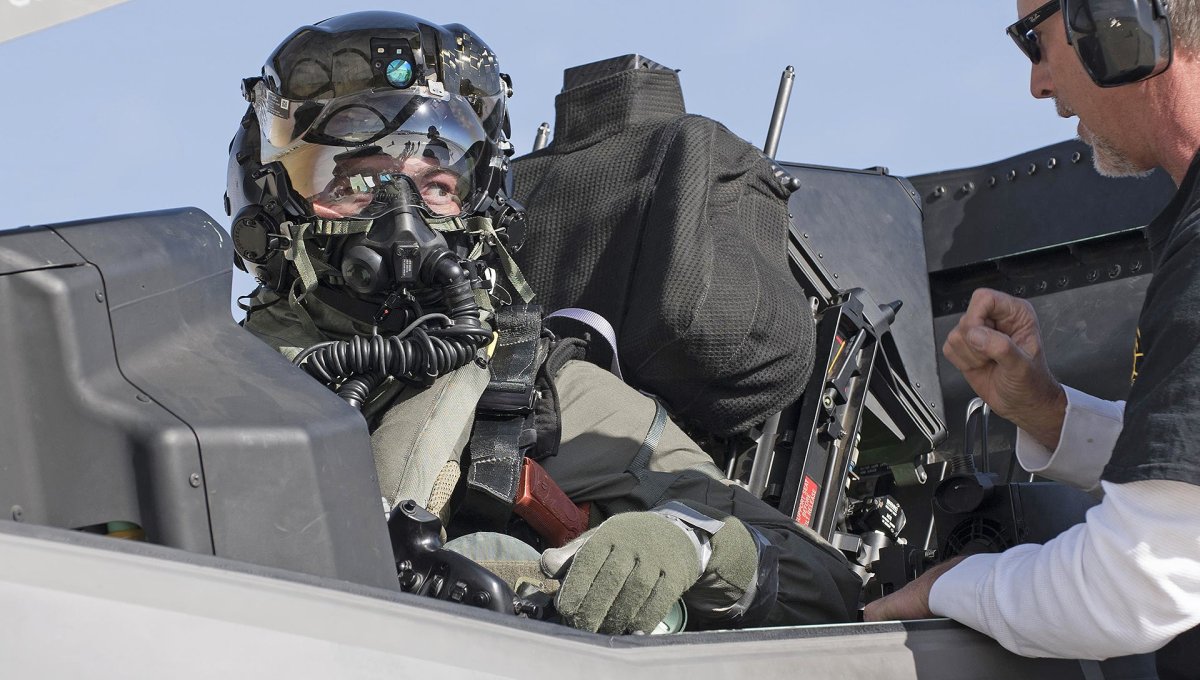
It has taken testers and industry a decade to come up with a flight suit configuration that can keep F-35 pilots alive in biological and chemical warfare environments, and just last week the ensemble flew for the first time.
In a press release , the USAF detailed the different pieces of the modified getup:
“The chemical/biological ensemble consists of a special CB suit, a Joint Service Aircrew Mask used for the F-35, a pilot-mounted CB air filter, CB socks and gloves double taped at the wrists. The ensemble also features a filtered air blower that protects the pilot from CB contamination while walking to the jet. It provides both breathing air and demist air, which goes to the pilot’s mask and goggles. All components of the CB ensemble are in addition to the pilot’s sleeved flight jacket and G suit… The ensemble also includes a communication device so the pilot can speak to people while wearing the ensemble with helmet and mask.”
Darren Cole, the 461st Flight Test Human Systems Integration Lead, described an interesting byproduct of the suit’s communication system in that same release:
“It is a conversational communication unit, which is a box that integrates with the communication system so that when he speaks into his mask it lets people hear the pilot talk… it makes him sound like Darth Vader.”
To test the suit, an F-35B from MCAS Yuma was borrowed, and one of the 461st FLTS pilots, once fully outfitted with all the gear, went about their normal pre-flight and startup operations in the presence of an airborne agent that simulates biological and chemical ones but does not have their same deadly effects. All the while the test team was monitoring their suits for infiltration by the agent. Cole states:
“The first pilot stepped to a clean jet in the CB ensemble and we contaminated it using a simulated agent. The engine run pulls in the simulant so we need to make sure the air is filtered before it gets to the pilot. First, the air goes through the (On-Board Oxygen Generation System) and then the pilot-mounted CB filter to remove any remaining contaminants. There is another filtered air supply blower that provides cooling and demist air to the pilot’s hood and goggles. We also used three air sampling devices to be sure all the air provided to the pilot was clean.”
Then a second pilot in the same outfit stepped to the jet to test the suit in a known “dirty” environment—one where chemical or biological warfare agents are known to have contaminated the cockpit. They then took off on a mission to see not only how the suit would perform but also how the pilot would react to the more cumbersome configuration and how the thermal loads of such a heavy suit would play into a mission. Lauren Gilmore, 461st FLTS engineer describes the scope of the program overall:
“We purposely chose the Marine [short takeoff, vertical landing] version of the F-35 because the equipment is more complicated and basically has more nooks and crannies for the contaminant to hide in. This aircraft also has full-up mission systems. These tests will demonstrate that the U.S. and partner nations can fly, fight, and win in a CB threat environment and then quickly decontaminate the aircraft and return it to normal operation… We’ve established the procedures to step to the aircraft and hook into it and the order of powering on systems to get the filtered air supply to the pilot… We’ve developed procedures on who needs to help the pilot; how many people are needed to support the logistics trail; how many people are needed to help the pilot don the equipment and how many people will be needed in the Life Support unit. We’ve also noted how many Airmen may be needed to escort the pilot out to the aircraft and recover the aircraft. We helped a lot with the F-35 concept of operations.”
The F-35, with its enhanced man-machine interface, has faced hurdles in the past with cumbersome flight gear—especially with the pilot’s much touted helmet mounted display . Combined with the F-35’s ejection seat, the two systems have led to pilot weight restrictions . Ergonomic issues during basic fighter maneuvers (dogfights) have also been noted, along with acuity and night vision issues that are supposed to be fixed with the newest model of helmet. Most recently, the F-35’s helmet has left naval aviators in pain and with fuzzy vision during catapult launches. It will be interesting to see how wearing the chemical and biological warfare protective gear, and especially the eye mask with the helmet, will affect the carrier launch issue.
Conducting flying operations while in Mission Oriented Protective Posture (MOPP) is no easy task, and that is not a challenge specific to the F-35. Ground crews and pilots have to train to adhere to each step of a long set of procedures to fight in conditions up to MOPP4. It is arduous and uncomfortable work that also impacts the fidelity of everyone’s senses and their ability to communicate, which is a big deal when working around air breathing metal pterodactyls and often in nighttime, near “black out” conditions.
Over in South Korea, US forces train regularly on how to do this due to the very possibility of a sudden weapons of mass destruction attack from the North. The videos below give you just a small glimpse of what getting dressed and undressed for these conditions is like. It definitely slows things down, and one small mistake can be deadly.
Over the years I have asked everyone from crew chiefs to pilots if fighting under such conditions would really be effective or sustainable, and I have received different answers. Complaints of ill-fitting gear, especially for ground support crew, and weak spots in the system are common, as is getting a look as if to say “ yeah right .” For units like those forward deployed to South Korea, where infrastructure and training has been built up around fighting in a nuclear-biological-chemical (NBC) environment, there is probably a better chance of successfully sustaining operations under these conditions. For other flying units, it seems less clear, although they do have to pass operational readiness inspections on a fairly regular basis to show that they are prepared to do so.
Obviously, if there is a real chance that any of this terrible stuff is present in the air where flight operations are taking place, crews would be much more careful than they would be in training, it is just a matter of human nature. But imagine asking airman to don these suits in the middle east during summer. How long can anyone last on a baking flightline? Ground forces that have to be prepared to fight in similar conditions also face this question.
Luckily the US has never had to find out if sustaining modern combat aircraft operations in moon suits while being doused with the worst stuff on the planet is feasible or not. In the end, the gear may accomplish its mission without ever being used. If the enemy knows their foes are ready and trained to go about their business under such conditions, why expel the resources testing their preparedness, nor their level of vengeance once the smoke clears?
Contact the author: Tyler@thedrive.com
Comments couldn’t be loaded. Please refresh the page.
更新于美国东部时间2020年7月5日下午6:56
测试人员和业界花了十年时间才研制出一种飞行服配置,可以在生物和化学战环境中保护 F-35 飞行员的生命,而就在上周,这套飞行服进行了首次飞行测试。
美国空军在一份新闻稿中详细介绍了改装装备的各个组成部分:
“化学/生物防护服包括一套特制的化学/生物防护服、F-35战斗机使用的联合军种机组人员防毒面具、飞行员佩戴的化学/生物防护空气过滤器、化学/生物防护袜和腕部双层胶带固定的手套。该防护服还配备一个过滤式送风装置,可在飞行员走向飞机时保护其免受化学/生物污染。该装置可提供呼吸空气和除雾空气,输送至飞行员的防毒面具和护目镜。化学/生物防护服的所有组件均需在飞行员的带袖飞行夹克和抗荷服之外另行配备……该防护服还包含一个通讯设备,以便飞行员在佩戴头盔和防毒面具的情况下也能与他人通话。”
在同一份新闻稿中,第461次飞行测试人体系统集成负责人达伦·科尔描述了该宇航服通信系统的一个有趣的副产品:
“这是一个对话式通讯装置,它是一个与通讯系统集成的盒子,这样当他对着面罩说话时,人们就能听到飞行员的声音……这让他听起来像达斯·维达。”
为了测试这套防护服,他们从尤马海军陆战队航空站借来一架F-35B战斗机,并让第461飞行训练中队的一名飞行员穿戴好所有装备后,在一种模拟生物和化学毒剂(但不具备致命性)的空气传播剂存在的情况下,进行了正常的飞行前准备和启动操作。测试小组全程监测防护服,看是否有毒剂渗入。科尔说道:
“第一位飞行员登上了一架配备CB设备的清洁喷气式飞机,我们使用模拟污染物对其进行污染。发动机运转时会吸入模拟污染物,因此我们需要确保空气在输送给飞行员之前经过过滤。首先,空气会经过机载氧气生成系统,然后再经过飞行员佩戴的CB过滤器,以去除任何残留的污染物。此外,还有一个经过过滤的空气供应鼓风机,为飞行员的头罩和护目镜提供冷却和除雾空气。我们还使用了三个空气采样装置,以确保输送给飞行员的所有空气都是清洁的。”
随后,同一位飞行员登上战机,在已知的“污染”环境中测试这套飞行服——这种环境已知曾被化学或生物战剂污染过。之后,他们执行了一次任务,不仅是为了检验飞行服的性能,也是为了测试飞行员对这种较为笨重的装备的反应,以及如此厚重的飞行服的热负荷会对任务产生怎样的影响。第461飞行试验中队工程师劳伦·吉尔摩(Lauren Gilmore)描述了该项目的整体情况:
“我们特意选择了海军陆战队使用的F-35短距起飞/垂直降落版本,因为它的设备更复杂,而且内部缝隙更多,污染物更容易藏匿其中。这架飞机还配备了完整的任务系统。这些测试将证明,美国及其伙伴国家能够在核生化威胁环境下飞行、作战并取得胜利,然后迅速对飞机进行消毒,使其恢复正常运行……我们已经制定了登机和连接飞机的程序,以及启动系统为飞行员提供过滤空气的顺序……我们还制定了相关程序,包括谁需要协助飞行员;需要多少人来保障后勤保障;需要多少人协助飞行员穿戴设备;以及生命保障部门需要多少人。我们还记录了护送飞行员返回飞机和回收飞机可能需要多少空军人员。我们在F-35作战概念的制定方面提供了很大帮助。”
F-35战斗机凭借其增强的人机交互界面,过去曾因笨重的飞行装备而饱受诟病,尤其是飞行员备受瞩目的头盔显示器。F-35的弹射座椅与头盔显示器相结合,对飞行员的体重造成了限制。此外,在基本的战斗机机动(空战)中,飞行员的人体工程学问题也屡见不鲜,视力和夜视能力方面的问题也应在新型号头盔中得到解决。最近,F-35的头盔还导致海军飞行员在弹射起飞时感到疼痛和视线模糊。值得关注的是,佩戴化学和生物战防护装备,特别是头盔和眼罩,会对航母弹射起飞造成怎样的影响。
在任务导向防护姿态(MOPP)下执行飞行任务绝非易事,这并非F-35独有的挑战。地勤人员和飞行员必须接受训练,严格遵守一系列繁琐的程序步骤,才能在MOPP4级防护条件下作战。这是一项艰苦且令人不适的工作,会影响每个人的感官敏锐度和沟通能力,而与这些“呼吸空气的金属翼龙”协同作战,尤其是在夜间近乎“全黑”的条件下,更是至关重要。
在韩国,由于朝鲜可能突然发动大规模杀伤性武器袭击,美军定期进行此类训练。以下视频仅让您略窥在这种情况下穿脱衣物的流程。这无疑会减慢行动速度,而且一个小小的失误都可能致命。
多年来,我问过从机组长到飞行员的所有人,在这样的条件下作战是否真的有效且可持续,得到的答案各不相同。装备不合身(尤其是地勤人员的装备)和系统存在缺陷是常见的抱怨,人们常常会投来“呵呵,想得美”的眼神。对于像部署在韩国这样的前沿部队来说,由于其基础设施和训练都是围绕核生化(NBC)环境下的作战而建立的,因此在这样的条件下成功维持作战的可能性可能更大。但对于其他飞行部队来说,情况似乎不太明朗,尽管他们必须定期接受作战准备检查,以证明他们已做好应对准备。
显然,如果飞行作业区域真的有可能存在这些可怕的物质,机组人员肯定会比训练时更加谨慎,这是人之常情。但试想一下,如果让飞行员在炎热的夏季身处中东,穿上这些防护服会是什么情况?在酷热的跑道上,谁又能坚持多久?地面部队也面临着同样的问题,他们需要在类似的环境下做好作战准备。
幸运的是,美国从未需要验证在地球上最恶劣的环境中,身穿宇航服维持现代战斗机作战行动是否可行。最终,这套装备或许无需使用就能完成其使命。如果敌人知道他们的对手已经做好准备,并且训练有素,能够在这种条件下开展行动,那么为何要投入资源来测试他们的准备情况,以及硝烟散尽后他们的复仇决心呢?
联系作者:Tyler@thedrive.com
评论加载失败,请刷新页面。