SIT launches new school for working adults to upgrade skills, switch careersSIT推出面向在职成年人的新课程,帮助他们提升技能、转换职业。
Read more at straitstimes.com.
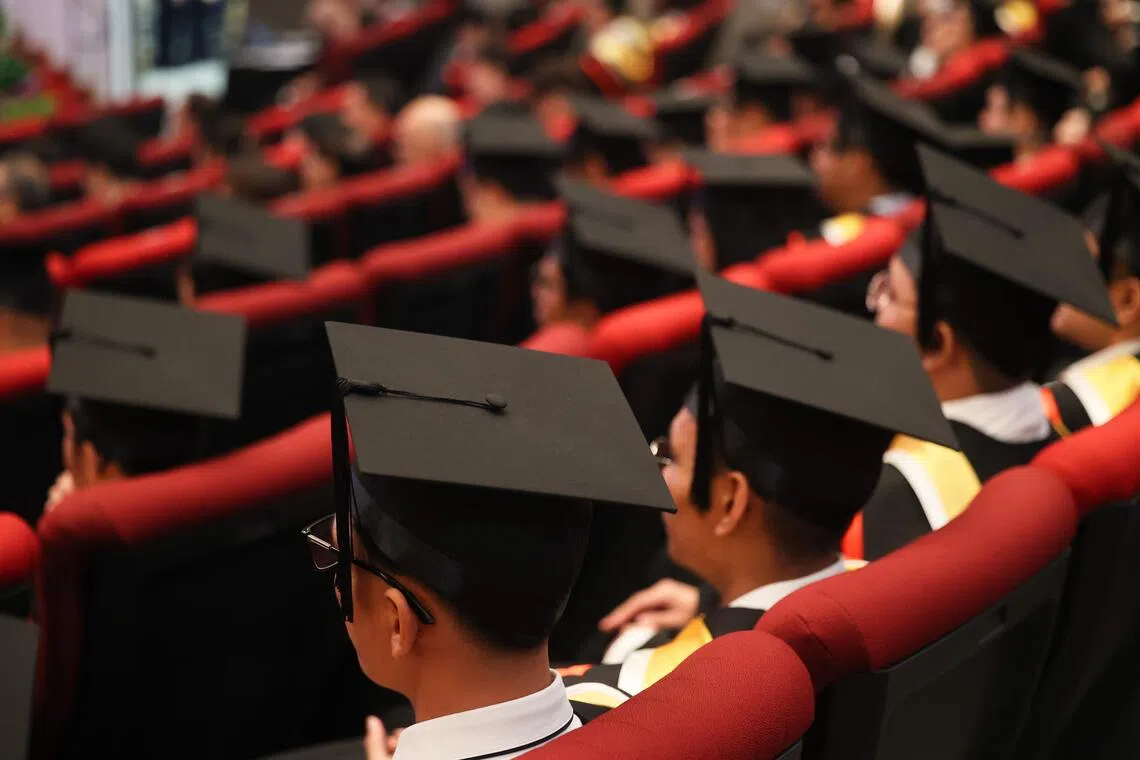
More than 3,200 students will graduate from SIT in 2026, marking the university’s largest graduating cohort to date.
PHOTO: LIANHE ZAOBAO
Vanessa Paige Chelvan
Published Oct 12, 2026, 04:25 PM
Updated Oct 12, 2026, 04:26 PM
SINGAPORE – Working adults looking to upgrade their skills or switch careers will have another avenue for support, with the Singapore Institute of Technology (SIT) setting up a new school on Sept 1 to help them navigate their working lives.
The SIT School of Lifelong Learning and Career Development, or SITLEARN, will help individuals assess existing skills, acquire knowledge and navigate career transitions, while connecting them with potential employers.
It will offer courses developed with industry partners to equip workers with skills in areas such as artificial intelligence (AI) and sustainable data centre operations. Working adults will also be able to tap career guidance to identify skills gaps and plan their next career move.
SIT president Chua Kee Chaing said the new school comes as AI reshapes jobs and the skills needed to perform them.
Citing projections by the World Economic Forum, C hua said at SIT’s convocation ceremony on Oct 12 that nearly four in 10 skills used in workplaces today are expected to change or become outdated by 2030.
As career paths become less predictable, universities must also rethink their role in preparing people for the workforce, he said.
“If careers no longer follow a single, predictable path, then neither can education. A university cannot simply prepare you for your first job and consider its work done.”
SITLEARN will also work with companies to identify skills gaps, develop targeted training programmes and equip employees with skills needed for business transformation.
A dedicated SITLEARN hub is being developed at SIT’s Punggol campus and is targeted to open in the first half of 2027.
SIT deputy president and SITLEARN dean Bernard Nee said the new school was set up in response to the changing demands of the workforce and the shortening lifespan of skills.
“It’s not an academic initiative. It is us working with industry to understand the needs, the solutions, the programmes, and co-creating things with them to help transform the sector,” he said.
The move also supports the shift towards a skills-first economy, he said, where there is greater recognition of skills gained through work experience and projects, rather than formal qualifications alone. These skills can increasingly influence hiring, promotions and career development.
These include programmes developed with AI consultancy Straits Interactive to help workers and companies adopt and use AI responsibly , covering areas such as AI governance, risk management and data protection .
It is also working with Nxera, Singtel’s data centre business, to equip professionals with skills in sustainable data centre operations, including energy management and cooling systems.
Separately, SIT has partnered the Singapore Civil Defence Force (SCDF) to train professionals in managing emerging safety risks associated with new technologies and the energy transition.
The university will partner companies to identify and support employees who can teach and mentor students alongside their industry roles. NCS is the first company to join SITLEARN’s Corporate Adjunct Professorship Scheme, with its chief executive Sam Liew taking on an adjunct professor appointment at SIT.
Course fees at SITLEARN - which currently offers more than 500 courses - will vary, with a two-day professional course costing about $1,700 before subsidies, while longer programmes may cost around $10,000. Eligible Singaporeans and permanent residents can tap government subsidies to offset the cost.
Speaking at the Oct 12 ceremony, Minister for Digital Development and Information Josephine Teo encouraged graduates to combine technological skills with deep knowledge of their chosen profession or industry.
Minister for Digital Development and Information Josephine Teo encouraged graduates to combine technological skills with deep knowledge of their chosen profession or industry. PHOTO: LIANHE ZAOBAO
Minister for Digital Development and Information Josephine Teo encouraged graduates to combine technological skills with deep knowledge of their chosen profession or industry.
She urged them to build expertise in their fields, learn what AI can help them do, and bring the two together.
“It will be useful to treat AI as a teammate rather than as a rival,” she said.
But working well with AI does not mean agreeing with everything it says. “We should understand its strengths, question its answers, and recognise its limitations,” she said.
While AI safety remains an evolving field, individuals can already exercise judgement by testing AI systems carefully, putting guardrails in place and improving practices as they learn, she added.
These include 21 pioneer graduates of its Applied Computing degree offered through its Competency-based Stackable Micro-credential (CSM) pathway, which allows working adults to earn a degree progressively through modules while staying employed.
One of them is Ashwin Dinesh, 25, who earned his Applied Computing degree while working full-time at Singtel. He has a diploma in computer engineering from Singapore Polytechnic.
Ashwin Dinesh earned his Applied Computing degree from SIT while working full-time at Singtel. PHOTO: LIANHE ZAOBAO
Ashwin Dinesh earned his Applied Computing degree from SIT while working full-time at Singtel.
Over three years of studies and work , he had two promotions, rising from an associate in Internet of Things (IoT) product development to an IoT product manager at Singtel.
Ashwin said he chose the pathway for its flexibility. He did not want to spend four years pursuing a degree only to realise upon graduation that he had chosen the wrong field.
The modular approach allowed him to identify gaps in his knowledge and select modules suited to his interests and needs. He eventually chose to specialise in cybersecurity.
Juggling work and studies was not easy, Ashwin said. At times, he had to leave the office to attend classes before returning to work. “It was the most challenging part of my life,” he said.
But studying alongside other working professionals, some much older than him, also gave him opportunities to network and learn from them. The experience taught him to manage his time better and communicate more effectively with colleagues.
Still, Ashwin said the experience helped him grow as a person. “I felt I became a better human being.”
Vanessa Paige Chelvan is an education correspondent at The Straits Times. She also writes the occasional commentary on parenthood, work and family life.
SIT/Singapore Institute of Technology
2026 年,新加坡理工大学将有超过 3200 名学生毕业,这将是该大学迄今为止规模最大的一届毕业生。
图片来源:联合早报
凡妮莎·佩奇·切尔万
发布于 2026 年 10 月 12 日下午 4:25
更新于2026年10月12日下午4:26
新加坡——希望提升技能或转换职业的在职成年人将有更多途径获得支持,新加坡理工大学(SIT)将于9月1日成立一所新学校,帮助他们更好地适应工作生活。
SIT终身学习与职业发展学院(简称SITLEARN)将帮助个人评估现有技能、获取知识并顺利完成职业转型,同时将他们与潜在雇主联系起来。
它将提供与行业合作伙伴共同开发的课程,旨在帮助员工掌握人工智能 (AI) 和可持续数据中心运营等领域的技能。在职人士还可以获得职业指导,以识别技能差距并规划下一步职业发展。
新加坡理工大学校长蔡启昌表示,这所新学校的成立正值人工智能重塑工作岗位和从事这些工作所需技能之际。
蔡先生在10月12日新加坡理工大学毕业典礼上援引世界经济论坛的预测表示,到2030年,目前职场中使用的近40%的技能预计将会发生变化或过时。
他表示,随着职业道路变得越来越难以预测,大学也必须重新思考其在培养人才进入职场方面所扮演的角色。
“如果职业生涯不再遵循单一、可预测的路径,那么教育也同样如此。大学不能仅仅让你为第一份工作做好准备就认为任务完成了。”
SITLEARN 还将与企业合作,找出技能差距,制定有针对性的培训计划,并为员工提供业务转型所需的技能。
新加坡理工大学榜鹅校区正在建设一个专门的 SITLEARN 中心,预计将于 2027 年上半年开放。
新加坡理工大学副校长兼新加坡理工学院学习中心院长Bernard Nee表示,这所新学院的成立是为了应对劳动力市场不断变化的需求和技能生命周期缩短的趋势。
他说:“这不是一项学术计划。而是我们与业界合作,了解他们的需求、解决方案和项目,并与他们共同创造,以帮助该行业转型。”
他还表示,此举也支持向技能型经济转型,在这种经济模式下,人们更加重视通过工作经验和项目获得的技能,而不仅仅是正式学历。这些技能对招聘、晋升和职业发展的影响日益显著。
这些项目包括与人工智能咨询公司 Straits Interactive 合作开发的计划,旨在帮助员工和公司负责任地采用和使用人工智能,涵盖人工智能治理、风险管理和数据保护等领域。
它还与新加坡电信的数据中心业务 Nxera 合作,为专业人员提供可持续数据中心运营方面的技能,包括能源管理和冷却系统。
此外,新加坡理工大学 (SIT) 还与新加坡民防部队 (SCDF) 合作,培训专业人员管理与新技术和能源转型相关的新兴安全风险。
该大学将与企业合作,寻找并支持那些能够在履行企业职责的同时,还能为学生提供教学和指导的员工。NCS是首家加入SITLEARN企业兼职教授计划的公司,其首席执行官Sam Liew将在新加坡理工大学担任兼职教授。
新加坡理工学院(SITLEARN)目前提供超过500门课程,课程费用各不相同。为期两天的专业课程在获得补贴前费用约为1700新元,而更长时间的课程费用可能在10000新元左右。符合条件的新加坡公民和永久居民可以申请政府补贴来抵消部分费用。
10月12日的毕业典礼上,数码发展及新闻部长杨莉明鼓励毕业生将技术技能与他们所选职业或行业的深厚知识相结合。
数码发展及新闻部长杨莉明鼓励毕业生将技术技能与所选职业或行业的深厚知识相结合。图片:联合早报
数字发展及新闻部长杨莉明鼓励毕业生将技术技能与对所选职业或行业的深入了解相结合。
她敦促他们培养各自领域的专业知识,了解人工智能可以帮助他们做什么,并将两者结合起来。
“将人工智能视为队友而不是竞争对手会很有帮助,”她说。
但与人工智能有效合作并不意味着要赞同它所说的每一句话。“我们应该了解它的优势,质疑它的答案,并认识到它的局限性,”她说。
她补充说,虽然人工智能安全仍是一个不断发展的领域,但个人已经可以通过仔细测试人工智能系统、设置防护措施并在学习过程中改进做法来行使判断力。
其中包括 21 位应用计算学位的先驱毕业生,该学位是通过其基于能力的可堆叠微证书 (CSM) 途径提供的,该途径允许在职成年人在继续工作的同时,通过模块逐步获得学位。
其中一位是25岁的阿什温·迪内什,他在新加坡电信全职工作的同时获得了应用计算学位。他拥有新加坡理工学院的计算机工程文凭。
阿什温·迪内什在新加坡理工大学攻读应用计算学位期间,一直在新加坡电信全职工作。图片来源:联合早报
Ashwin Dinesh 在新加坡理工学院 (SIT) 获得应用计算学位的同时,还在新加坡电信 (Singtel) 全职工作。
经过三年多的学习和工作,他获得了两次晋升,从新加坡电信物联网 (IoT) 产品开发助理晋升为物联网产品经理。
阿什温表示,他选择这条道路是因为它比较灵活。他不想花费四年时间攻读学位,毕业后却发现自己选错了专业。
模块化的学习方法让他能够发现自身知识的不足,并选择符合自身兴趣和需求的模块。最终,他选择了网络安全作为自己的专攻方向。
阿什温说,兼顾工作和学习并不容易。有时,他不得不离开办公室去上课,然后再返回工作岗位。“那是我人生中最具挑战性的时期,”他说。
但与一些比他年长得多的职场人士一起学习,也让他有机会拓展人脉并向他们学习。这段经历教会了他更好地管理时间,并更有效地与同事沟通。
不过,阿什温表示,这段经历让他成长了。“我觉得自己变成了一个更好的人。”
Vanessa Paige Chelvan是《海峡时报》的教育记者。她偶尔也会撰写一些关于育儿、工作和家庭生活的评论文章。
新加坡理工学院