Why Navy SEALs Almost Always Go Into Action Aboard Non-Navy Helicopters为什么海豹突击队几乎总是乘坐非海军直升机执行任务
Compared to the Army or the Air Force, the Navy hasn't invested anywhere near as heavily in its airborne special operations transport capabilities.
By Chris "Ox" Harmer
Updated Dec 1, 2019 5:51 AM EST
In his very first installment as a contributor here at The War Zone , veteran Navy Seahawk pilot Chris “Ox” Harmer tells us why the Navy, which is known for its incredible special operations capabilities, has little dedicated special operations airlift capacity and why Navy SEALs often spend far more time in Army or even Air Force aircraft downrange than they do in Navy ones.
Beyond this, Ox gives us a high-level look at how the Navy ended up with just a single special operations-focused helicopter unit, while the Army and Air Force have far greater capacity in this regard. He also explains how all these forces are structured and how all the different special operations ‘customers’ get serviced by the assets at hand.
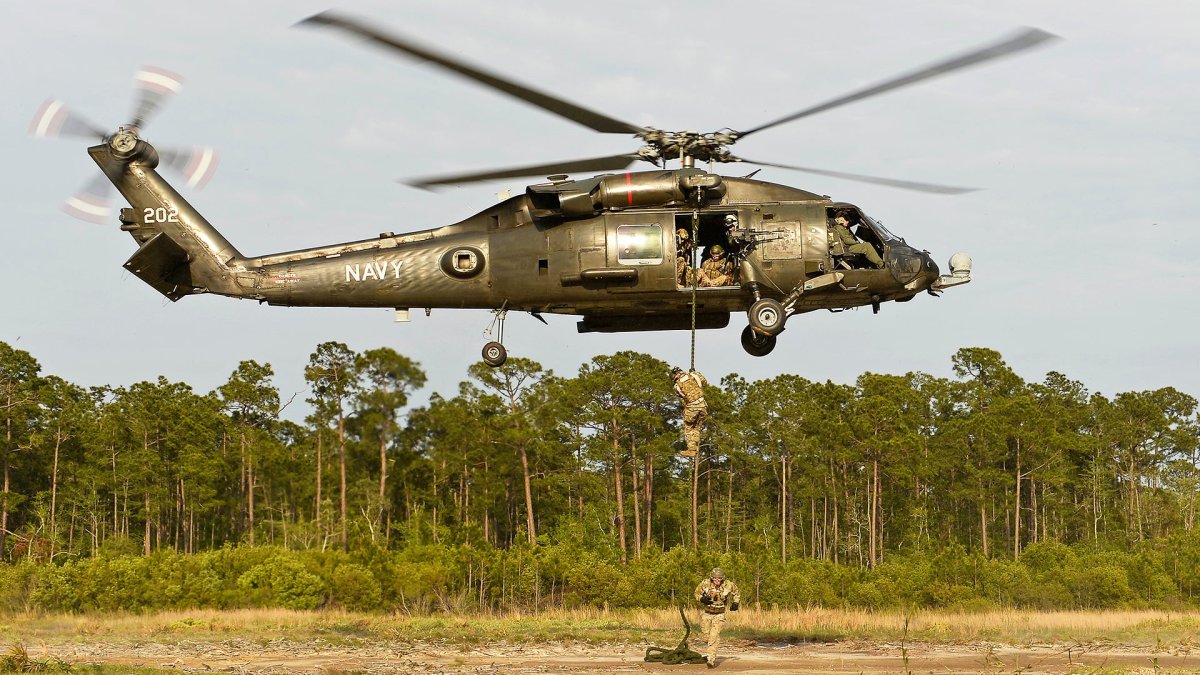
Special ops Seahawk over Iraq. , USN
Without further delay, here’s Ox:
The Most Famous Special Operations Mission Of Modern Times
It was the most famous special operations mission of modern times. Just over eight years ago, on May 2, 2011, a team of Navy SEALS drawn from the secretive Naval Special Warfare Development Group (NSWDG), better known as DEVGRU or Seal Team Six, assaulted a walled compound in Abbottabad, Pakistan, where they found and killed Osama bin Laden as part of Operation Neptune Spear. The SEALs on the assault team and their backup Quick Response Force (QRF) were flown to and from the raid in two different types of helicopters, MH-47 Chinooks and some highly modified stealth versions of the MH-60 Blackhawk. We know one of the aviation units that flew the helicopters was the U.S. Army’s 160th Special Operations Aviation Regiment (SOAR) and it’s possible that another, more secretive unit, the Flight Concepts Division (FCD) also participated. In their own way, the SOAR and FCD are every bit as selective and uniquely qualified as Seal Team Six.
The mission was a complete success. At the end of the operation, the most wanted terrorist in history was dead, all the friendlies were back in Afghanistan with no casualties, and the U.S. was in possession of a treasure trove of intel taken from Bin Laden’s home. The only loss was one of the stealth Black Hawks , which is a unique story in its own right. But the fact is that the entire operation was done with Army pilots flying Navy SEALS to and from the compound.
MH-60 from the 160th SOAR drops off a Marine Force Recon team via fast rope. , US Army
Not Quite Like The Movies
Several years later, my then girlfriend and now wife and I were watching Zero Dark Thirty , the movie adaptation of the raid, and she asked me if I had piloted the type of helicopter the SEALs were flying in. I can’t recall if I was trying to be honest or to just curtail the conversation and get back to the movie, but I answered, “sort of.” Mission fail on both objectives as she then started (okay, restarted) an interrogation about my career as a Naval Aviator, flying the SH-60F and HH-60H models of the Seahawk helicopter, that lasted the rest of our dating life and has shown no sign of abating now that we are married.
The Cliffs Notes version is, yes, I flew a lot of training missions and exercises with SEALs, and even some real-world operations, but I spent the vast majority of my career in the Navy flying other missions. To the extent that I did fly missions with Navy SEALs, Army Rangers, Air Force Pararescuemen (PJs), and Marine Corps Force Reconnaissance (FORECON) personnel, it was as a collateral duty or skill set, not the primary mission focus of any of the squadrons I was attached to.
One part of the movie and my explanation of it that piqued her interest was the fact that the SEALs were transported to and from the raid in Army helicopters. If Navy SEALs were storming the compound to get Bin Laden, why didn’t Navy pilots fly them?
I explained that most Navy helicopter pilots in the Mideast were on ships and that the raid at its closest point to the ocean was well over 700 miles “feet dry,” so the logical solution was to use the Army helicopters and pilots that were already there in Afghanistan or were familiar with the operation and the area it was going to take place. Also, the fact that secret stealth Blackhawks were available was clearly also a unique factor. Beyond all that, I pointed out that this particular Army helicopter unit, the 160th SOAR, had a single mission focus in life, flying special operations missions, and they were extremely good at it. They also had the best equipment for the job.
Had the 160th not been available, an equally capable unit, the Air Force’s 20th Special Operations Squadron, flying the CV-22 Osprey tiltrotor aircraft, would probably have been the next logical choice, assuming the mission was willing to accept the risk of a less stealthy airframe than the highly modified stealth Blackhawks that were used. This sparked her next question—if the Army and Air Force have dedicated aviation units to support their Special Operations Forces (SOF), why doesn’t the Navy? And what about the Marine Corps?
The answer to that question is complicated.
An Army 160th SOAR MH-47 works with Navy special operations boat teams in Moses Lake, Washington. , US Army
A Massive Special Operations Force Structure
The U.S. military has a massive special operations force structure, led by a dedicated Unified Combatant Command, United States Special Operations Command (USSOCOM or SOCOM). Each of the four military services is represented in SOCOM with a component command, including the United States Army Special Operations Command (USASOC), United States Naval Special Warfare Command (NSWC), Air Force Special Operations Command (AFSOC), and Marine Corps Forces Special Operations Command (MARSOC).
[Editor’s note: SOCOM also contains the secretive joint service Joint Special Operations Command (JSOC), which includes the Aviation Tactics Evaluation Group (AVTEG). AVTEG is understood to exercise command and control over a number of top-secret special operations aviation units, such as FCD, and otherwise coordinate aviation support for JSOC. You can read more about AVTEG and its associated units here .]
USASOC and AFSOC are both large component commands; USASOC has an authorized end strength of over 30,000 uniformed personnel and AFSOC has an authorized end strength of over 15,000 uniformed personnel. In contrast, NSWC has an authorized end strength of less than 10,000 uniformed personnel, and MARSOC less than 5,000 uniformed personnel. Along with being responsible for all U.S. military special operations, SOCOM also coordinates with non-military federal agencies, such as the Central Intelligence Agency’s (CIA) Special Activities Center (SAC) .
160th SOAR MH-6 Little Bird and Army special operators in action. , SOCOM
Dedicated SOF Aviation Support: Army And Air Force Have It, Navy & Marines, Not So Much
A big part of the massive U.S. special operations footprint is dedicated aviation support for special operations forces (SOF). The component commands handle this responsibility very differently, at least partially due to their differing sizes. In the case of USASOC and AFSOC, those component commands, in turn, have subordinate elements whose only, or at least primary, responsibility is providing aviation support to SOF, and are directly responsible to SOCOM to do that. Without listing all of those subordinate elements, AFSOC has a number of squadrons that provide fixed wing, tiltrotor, and Unmanned Aircraft Systems (UAS) support to SOF. The Army’s contribution in this regard is the 160th SOAR.
While both AFSOC and SOAR occasionally support missions that are not SOF centric, they do so only on a “not to interfere” basis with their core mission, which is to be trained and ready to support the full spectrum of SOF aviation support missions.
The fact is, while Navy SEALs train on a regular basis with Navy helicopter squadrons and occasionally with fixed-wing Navy cargo squadrons flying the C-130 Hercules and C-2 Greyhounds , they currently wind up flying a majority of their actual combat missions on Army helicopters or Air Force fixed wing support platforms like the MC-130H Combat Talon II, MC-130J Commando II, and the CV-22 Osprey tiltrotor.
CV-22s at the U.S. Air Force Academy., USAF
Navy And Marine Corps Provide Aviation Support To SOF “Out Of Hide”
Compared to USASOC and AFSOC, NSWC and MARSOC are much smaller, and neither NSWC nor MARSOC have any dedicated aviation support for SOF in their component command structure. This isn’t to say the Navy doesn’t provide aviation operations support to the SEALs. It does, just in a very different manner than the Army and Air Force. At least partially because NSWC and MARSOC are so much smaller than USASOC and AFSOC, the Navy and Marine Corps simply can’t afford or justify dedicated aviation support units in their SOCOM component commands. As a result, the majority of training and exercise support the Navy provides to NSWC comes from active duty Navy helicopter squadrons that support NSW/SOF “out of hide,” as a collateral duty, in addition to their other missions. The same norm applies for Marine helicopter support to MARSOC units.
While active duty Navy helicopter squadrons train to NSW/SOF support as a “primary mission,” it is one of several primary missions, along with maritime Search and Rescue (SAR), Combat Search and Rescue (CSAR), Anti Surface Warfare (ASUW), Anti-Submarine Warfare (ASW), and logistics. As a practical matter, this means that active duty Navy helicopter squadrons are significantly less proficient in the SOF support mission than SOAR or AFSOC.
During pre-deployment training and exercises, Navy helicopter squadrons provide the majority of training services to the SEALS, but with so many SEAL deployments being land-based since 9/11, when it comes to actual combat operations, AFSOC and SOAR wind up providing most of that support. That is a result of both proximity—AFSOC and SOAR are present in the land-centric SOF missions SEALS are being used for—as well as proficiency. AFSOC and SOAR are simply more proficient at high-intensity SOF support missions than Navy helicopter squadrons.
MH-60S executing vertical replenishment at sea., USN
Navy Dedicated Support Is a Single Reserve Squadron, Marines Have Nothing
The Navy does maintain a single reserve aviation squadron dedicated specifically to SOF support. The “Firehawks” of Helicopter Sea Combat Squadron 85 (HSC-85) stationed at Naval Air Station North Island, California, are tasked with providing training and exercise support to NSWC, just down the beachline at Naval Amphibious Base Coronado.
HSC-85 has an excellent reputation, but is limited in what it can do at least partially because that squadron does not belong to NSWC. On the Navy’s organization chart, it belongs to the Navy’s Helicopter Sea Combat Wing, Pacific. As a practical matter, that distinction means that in terms of Naval Aviation’s budget requests, funding for SOF aviation support is at or near the bottom of the priorities list. This is in contrast to USASOC and AFSOC, which provide dedicated funding and equipment support for their SOF-centric aviation commands. This, in turn, means the Navy’s aviation equipment in the SOF support mission is not as advanced as that used by SOAR and AFSCOC.
This difference in equipment manifests itself most obviously in two areas—i n-flight refueling and Aircraft Survivability Equipment (ASE). HSC-85 is equipped with the MH-60S Seahawk. It is an adequate platform for SOF support, but is limited compared to the equipment used by SOAR and AFSCOC.
For example, the MH-60S is not capable of inflight refueling. For maritime centric NSW/SOF operations where the “mother ship” hosting the MH-60S can move within a relatively close distance of the target, the limited range of the MH-60S is not an issue. For longer-range SOF support missions, the fact that SOAR MH-47 Chinooks, MH-60 Blackhawks, and AFSOC CV-22 Ospreys are capable of in-flight refueling gives those platforms a much bigger radius of action.
In terms of ASE, Navy helicopters are equipped with the standard suite of chaff and flare dispensers, Infra-Red Guided Missile Countermeasures (IRCM), Radar Warning Receivers (RWR), but when upgrades become available, they are typically last in line to get the new or upgraded equipment.
The Marine Corps has no aviation squadrons assigned exclusively to MARSOC, neither active duty or reserves. This is partially because the Marine Corps, like the Navy, simply can’t afford or justify dedicated aviation SOF units given the small overall size of MARSOC, but there is another reason for this. The Marine Corps has always seen its Force Reconnaissance (FORECON) units as integral to the mission of the Marine Corps and skeptical of placing them under joint command and losing control of them.
Indeed, MARSOC did not stand up and join SOCOM until 2006, at which point the Marine FORECON community was split into two groups, with FORECON units remaining integral to the Marine Corps and the newly formed Raider Regiment and subordinate commands joining SOCOM.
For Navy, It’s All About The Force Structure
The vast majority of Navy helicopter squadrons are organized into one of two “type wings”—Helicopter Sea Combat (HSC) Wing and Helicopter Maritime Strike (HSM) Wing—with each Wing having a Pacific Fleet and Atlantic Fleet component headquarters.
HSC squadrons fly the MH-60S version of the Seahawk and HSM squadrons fly the MH-60R version of the Seahawk. Both of these versions of the Seahawk are incredibly effective in their primary roles, but unlike several airframes operated by the Army and Air Force, neither version of the Seahawk was intended exclusively for NSW/SOF support.
The MH-60R is equipped with a surface search radar, Forward Looking Infrared (FLIR), sonobuoy launcher, dipping sonar, and all the equipment necessary to process and relay all the data generated by those advanced onboard and offboard sensors. In terms of armament, it can carry a mix of lightweight torpedoes, Hellfire missiles, 2.75-inch rockets, and one crew-served machine gun.
As far as its overwater capabilities go, the MH-60R is the most advanced rotary wing platform in the world. If you are looking to search, detect, track, and kill enemy surface ships or submarines, the MH-60R is an extremely capable Anti-Surface Warfare (ASuW) and Anti-Submarine Warfare (ASW) platform. While these capabilities are impressive and necessary for the Navy, they leave the MH-60R extremely limited on space and typically with a pretty narrow margin for additional weight.
If MH-60R squadrons are tasked with supporting NSW/SOF missions, they are limited to a relatively small personnel footprint in the cabin, perhaps a couple of command and communication personnel or a sniper/spotter team. The most obvious use for the MH-60R in NSW/SOF support is as an airborne command platform, reconnaissance asset, sniper perch, or weapons delivery platform. Both it and its predecessor, the SH-60B, have seen extensive use in these roles.
The MH-60S is designed primarily to support logistics, carrying internal and external loads from shore-to-ship and ship-to-ship, allowing sustained maritime operations at sea without warships needing to return to port. The MH-60S is also the Navy’s primary platform for overwater search and rescue and medical evacuations, as well as overland Combat Search and Rescue (CSAR).
Lacking all the sonar and surveillance equipment that the MH-60R has, the MH-60S has much more internal room and carrying capacity, and has two stations for door gunners, allowing crewmen to operate machine guns simultaneously with personnel getting into/out of the aircraft. Like the MH-60R, the MH-60S can carry Hellfire, 2.75-inch rockets, and crew-served machine guns, both 7.62mm and .50 caliber. The primary use of an MH-60S in NSW/SOF support is as a flying truck, taking SEALS into and out of battle and as a sniper and weapons delivery platform. Both it and its predecessor, the HH-60H, have extensive use in these roles.
While both of these platforms are capable of NSW/SOF support, they were built primarily for other missions. More importantly, while their active duty crews are trained to do NSW/SOF support, that is only one of several Primary Mission Areas (PRIMARS) that they train to regularly.
A ‘Sierra’ is loaded with AGM-114 Hellfire missiles. , USN
At Sea, Navy Supports, But Overland, Army And Air Force Take the Lead
So why doesn’t the Navy maintain more than just a single reserve squadron to support NSW/SOF operations? It certainly is not because there is no need for it. Navy SEALs are in constant need of aviation platforms to support their training requirements, not to mention their real-world operations. Aside from the budget constraints, the next most obvious answer is the Navy treats aviation support for NSW/SOF as two separate issues.
The first is the core maritime special operations mission that Naval Aviation can support “out of hide” with existing squadrons. In this role, Navy helicopter squadrons play a primary, almost exclusive role in maritime-centric special operations missions, which center around various iterations of the Maritime Interdiction Operation (MIO) mission and the Visit Board Search Seizure (VBSS) mission. While the frequency of these missions varies with external factors, for all practical purposes the Navy has been conducting MIO and VBSS missions more or less continuously since 2001 in the Persian Gulf, the Gulf of Oman, the Somali Basin, the Red Sea, and the Southwest Pacific. For these missions, the existing sea-based Navy helicopter squadrons do most of the support of NSW/SOF operations.
The second are the deep overland missions that are currently taking place in Afghanistan and to a lesser extent Syria. For these persistent, overland special operations-centric campaigns, Navy SEALs are supporting a land-centric fight, so they wind up using land-centric aviation infrastructure from AFSOC and USASOAC. For all practical purposes, Naval Aviation provides no support to these campaigns at all.
HSC-85 MH-60S hovers over a group of Marine Raiders. , USN
Dedicated Navy Helicopter Support During Operation Iraqi Freedom
Naval Aviation force structure is simply not set up to provide dedicated, ongoing aviation support to SOF. However, during Operation Iraqi Freedom (OIF), when it became apparent that the SEAL mission in Iraq was going to be long term and continuous, thus requiring ongoing dedicated support, the Navy used two of its reserve helicopter squadrons to set up a single detachment in Iraq that essentially served continuously for the duration of active U.S. combat operations from 2003 to 2011.
At the beginning of Operation Iraqi Freedom, the two Navy reserve helicopter squadrons that were dedicated solely to SOF support were the HCS-4 Red Wolves, stationed at Naval Air Station Norfolk, Virginia, and the HCS-5 Firehawks, stationed at Naval Air Station North Island, California. As part of the Navy’s restructuring effort of its helicopter force, these squadrons were eventually redesignated HSC-84 and HSC-85. Both of these squadrons were descendants of Helicopter Attack Light (HAL) Three, the Navy’s active duty helicopter squadron that supported SOF operations during the Vietnam War.
Both these squadrons supplied airframes, aviators, and maintainers to sustain a nearly continuous presence in Iraq for just under nine years. They were stationed at various times in Kuwait, Baghdad, and Balad. Although much of the detachment’s operational history in Iraq remains classified, we do know they flew a total of approximately 13,800 flight hours, completing 2,300 missions supporting special operations, with approximately 1,200 missions consisting of Direct Action (DA) operations targeting enemy combatants. Those DA missions resulted in hundreds of high-value targets captured or killed.
By all accounts, the detachment performed exceptionally well.
HSC-85 spooling up., USN
The Budget Axe Falls – Big Navy Disestablishes HSC-84
While working in the J5 (Strategic Plans and Policy) directorate of the Joint Staff in the Pentagon, one of my superiors commented that “The budget is the policy.” That’s a pithy way of saying if you want to know what an organization really values, look what it spends money on.
By 2013, Big Navy was in a serious budget crunch and started looking at disestablishing both HSC-84 and HSC-85. The view from the Chief of Naval Operations (CNO) staff was simple. The USS Gerald R. Ford (CVN-78), the lead ship in the new class of supercarriers designed to replace the Nimitz class was way over budget and behind schedule . The F-35 was also way over budget and behind timeline. There were a number of other pressing budget issues—the Littoral Combat Ship and Zumwalt class destroyers programs were well behind their timelines to meet performance parameters. Ultimately, Big Navy decided to shut down both squadrons.
To be clear, this was never anything but a budget decision. NSWC made the case, repeatedly, that dedicated helicopter support was essential to their pre-deployment training and exercise program. They could survive on deployment with flight support from SOAR and AFSOC. Getting through workups prior to deployment was going to be nigh on impossible without these dedicated squadrons.
Ostensibly, Big Navy offered to keep both squadrons if SOCOM paid part of the bill. That offer and or agreement, depending on whose version of the story you believe, was never formalized. Ultimately, after a heavy lobbying campaign, Big Navy reluctantly agreed to keep HSC-85.
HSC-84 was disestablished in 2016.
Navy SEALs fast rope from a HSC-85 MH-60S. , USN
The Future of Naval Aviation Support For SOF
Navy active duty helicopter squadrons currently provide support for NSW/SOF in training and exercise situations, and to a limited extent and for a limited mission set, they also perform actual missions.
With that said, those active duty Navy helicopter squadrons have a multitude of other missions competing for their focus and flight hours. Additionally, flying NSW/SOF missions requires a significant amount of focus and training time in order to gain the required expertise.
For the foreseeable future, the demand signal to have at least one Navy helicopter squadron dedicated solely to NSW/SOF support will be significant. Whether or not Big Navy will continue funding it is an open question—that Big Navy should fund it seems beyond dispute at this point.
Contact the editor: Tyler@thedrive.com
Comments couldn’t be loaded. Please refresh the page.
作者:克里斯·“奥克斯”·哈默
更新于美国东部时间2019年12月1日凌晨5:51。
在《战区》杂志的首篇文章中,资深海军海鹰战斗机飞行员克里斯·“奥克斯”·哈默向我们讲述了为什么以令人难以置信的特种作战能力而闻名的海军,却几乎没有专门的特种作战空运能力,以及为什么海军海豹突击队队员在前线乘坐陆军甚至空军飞机的时间,比乘坐海军飞机的时间要多得多。
除此之外,奥克斯还从宏观层面分析了海军为何最终只拥有一支专注于特种作战的直升机部队,而陆军和空军在这方面却拥有更强大的能力。他还解释了这些部队的组织结构,以及现有资源如何为不同的特种作战“客户”提供服务。
美国海军特种作战部队的海鹰直升机飞越伊拉克。
事不宜迟,下面请看Ox的介绍:
现代最著名的特种作战任务
这是现代最著名的特种作战任务。八年多前,2011年5月2日,一支来自神秘的海军特种作战发展大队(NSWDG,又称DEVGRU或海豹突击队第六分队)的海豹突击队突袭了巴基斯坦阿伯塔巴德的一处围墙建筑群,并在“海王星之矛”行动中抓获并击毙了奥萨马·本·拉登。突击队及其后备快速反应部队(QRF)乘坐两种不同的直升机往返于突袭地点:MH-47“支奴干”直升机和一些经过高度改装的隐形版MH-60“黑鹰”直升机。我们知道,参与此次行动的航空部队之一是美国陆军第160特种作战航空团(SOAR),而另一个更为神秘的部队——飞行概念部(FCD)——也可能参与其中。从某种意义上说,SOAR 和 FCD 与海豹六队一样,都是经过严格筛选且具备独特资质的。
这次任务取得了圆满成功。行动结束时,史上头号通缉恐怖分子被击毙,所有友军无一伤亡地返回阿富汗,美国还从本·拉登的住所缴获了大量情报。唯一的损失是一架隐形黑鹰直升机,这本身就是一个独特的故事。但事实是,整个行动都是由陆军飞行员驾驶直升机往返于本·拉登住所和营地之间完成的。
美国陆军第160特种作战航空团的MH-60直升机通过快速绳降的方式投放了一支海军陆战队侦察小队。
与电影不太一样
几年后,我和当时的女友(现在的妻子)一起看电影《猎杀本·拉登》(Zero Dark Thirty),这部电影改编自那次突袭行动。她问我是否驾驶过海豹突击队乘坐的那种直升机。我不记得当时我是想说实话,还是只想赶紧结束对话,继续看电影,总之我回答说“算是吧”。结果两个目的都没达到,因为她开始(好吧,是重新开始)盘问我作为海军飞行员的经历,关于我驾驶SH-60F和HH-60H型海鹰直升机的事。这件事贯穿了我们整个恋爱时期,即使现在我们结婚了,也丝毫没有减弱的迹象。
简而言之,是的,我的确执行过很多与海豹突击队一起的训练任务和演习,甚至参与过一些实战行动,但我职业生涯的大部分时间都在海军执行其他任务。即便偶尔与海军海豹突击队、陆军游骑兵、空军伞降救援队(PJ)和海军陆战队侦察部队(FORECON)人员一起执行任务,那也只是我的兼职或技能,并非我所在中队的主要任务。
电影里有一点以及我对它的解释引起了她的兴趣,那就是海豹突击队员是乘坐陆军直升机往返突袭现场的。如果海军海豹突击队要强攻院落抓捕本·拉登,为什么不是海军飞行员驾驶直升机呢?
我解释说,当时驻扎在中东的大部分海军直升机飞行员都在舰艇上,而此次突袭行动距离海洋最近的地方也超过700英里(约1134公里),因此合乎逻辑的解决方案是使用已经部署在阿富汗或熟悉此次行动及行动区域的陆军直升机和飞行员。此外,能够使用秘密的隐形黑鹰直升机显然也是一个独特的因素。除此之外,我还指出,这支陆军直升机部队——第160特种作战航空团——的唯一任务就是执行特种作战任务,而且他们在这方面非常出色。他们还拥有执行这项任务所需的最佳装备。
如果第160特种作战中队无法出动,那么同样具备强大能力的空军第20特种作战中队(装备CV-22“鱼鹰”倾转旋翼机)很可能是下一个合乎逻辑的选择,前提是任务方愿意承担使用隐身性能不如经过高度改装的“黑鹰”隐形战机的风险。这引发了她的下一个问题——如果陆军和空军都有专门的航空部队来支援他们的特种作战部队(SOF),为什么海军没有?海军陆战队呢?
这个问题的答案很复杂。
美国陆军第160特种作战航空团的一架MH-47直升机在华盛顿州摩西湖与海军特种作战艇队进行联合演练。
庞大的特种作战部队结构
美国军方拥有庞大的特种作战部队体系,由专门的联合作战司令部——美国特种作战司令部(USSOCOM 或 SOCOM)领导。美国四个军种均在 SOCOM 中设有分支机构,包括美国陆军特种作战司令部(USASOC)、美国海军特种作战司令部(NSWC)、空军特种作战司令部(AFSOC)和海军陆战队特种作战司令部(MARSOC)。
【编者注:特种作战司令部(SOCOM)下辖高度机密的联合特种作战司令部(JSOC),其中包括航空战术评估组(AVTEG)。据了解,AVTEG 指挥控制着多个绝密特种作战航空部队,例如飞行控制与发展司令部(FCD),并负责协调 JSOC 的其他航空支援工作。您可以在这里阅读更多关于 AVTEG 及其下属部队的信息。】
美国特种作战司令部(USASOC)和空军特种作战司令部(AFSOC)都是规模庞大的作战司令部;USASOC的核定编制超过30,000名军人,AFSOC的核定编制超过15,000名军人。相比之下,海军水面作战中心(NSWC)的核定编制不足10,000名军人,海军陆战队特种作战司令部(MARSOC)的核定编制不足5,000名军人。特种作战司令部(SOCOM)除了负责所有美军特种作战行动外,还与中央情报局(CIA)特别行动中心(SAC)等非军事联邦机构进行协调。
第160特种作战航空团MH-6“小鸟”直升机和陆军特种作战人员正在执行任务。,特种作战司令部
特种作战部队专用航空支援:陆军和空军拥有,海军和海军陆战队则相对较少。
美国庞大的特种作战体系中,为特种作战部队(SOF)提供专用航空支援至关重要。各组成司令部履行这项职责的方式截然不同,部分原因在于其规模差异。以美国陆军特种作战司令部(USASOC)和空军特种作战司令部(AFSOC)为例,这两个组成司令部下辖多个单位,这些单位的唯一职责(或至少是主要职责)是为特种作战部队提供航空支援,并直接向特种作战司令部(SOCOM)负责。AFSOC下辖多个中队,为特种作战部队提供固定翼飞机、倾转旋翼机和无人机系统(UAS)支援,此处不一一列举。陆军在这方面的贡献是第160特种作战航空团(160th SOAR)。
虽然 AFSOC 和 SOAR 偶尔也会支援一些并非以特种作战部队为中心的任务,但他们这样做只是为了“不干扰”自己的核心任务,即接受训练并随时准备支援特种作战部队航空支援任务的全部范围。
事实上,虽然海豹突击队经常与海军直升机中队进行训练,偶尔也会与驾驶 C-130 大力神和 C-2 灰狗的海军固定翼运输机中队进行训练,但他们目前的大部分实际作战任务都是乘坐陆军直升机或空军固定翼支援平台执行的,例如 MC-130H 战斗爪 II、MC-130J 突击队员 II 和 CV-22 鱼鹰倾转旋翼机。
美国空军学院的CV-22飞机。
海军和海军陆战队为特种作战部队“走出隐蔽”行动提供航空支援
与美国陆军特种作战司令部(USASOC)和空军特种作战司令部(AFSOC)相比,海军水面作战中心(NSWC)和海军陆战队特种作战司令部(MARSOC)规模要小得多,而且NSWC和MARSOC的组成指挥结构中都没有专门为特种作战部队(SOF)提供航空支援的单位。但这并不意味着海军不向海豹突击队提供航空作战支援。事实上,海军确实提供支援,只是方式与陆军和空军截然不同。至少部分原因是由于NSWC和MARSOC的规模远小于USASOC和AFSOC,海军和海军陆战队根本无法负担或证明在其特种作战司令部(SOCOM)组成指挥机构中设立专门的航空支援单位的合理性。因此,海军向NSWC提供的大部分训练和演习支援都来自现役海军直升机中队,这些中队在执行其他任务之外,出于辅助职责而“现役”支援海军特种作战司令部/特种作战部队。海军陆战队向MARSOC单位提供的直升机支援也遵循同样的模式。
虽然现役海军直升机中队接受的训练以支援海军特种作战部队/特种作战部队为“主要任务”,但这只是其众多主要任务之一,其他主要任务还包括海上搜救、战斗搜救、反水面作战、反潜作战和后勤保障。实际上,这意味着现役海军直升机中队在支援特种作战部队方面的能力远逊于特种作战航空团(SOAR)或空军特种作战司令部(AFSOC)。
在部署前训练和演习期间,海军直升机中队为海豹突击队提供大部分训练服务。但自9/11事件以来,海豹突击队的部署大多以陆地为主,因此在实际作战行动中,空军特种作战司令部(AFSOC)和特种作战航空团(SOAR)最终承担了大部分支援任务。这既是因为地理位置接近——AFSOC和SOAR参与了海豹突击队执行的以陆地为主的特种作战任务——也是因为其专业能力更强。AFSOC和SOAR在执行高强度特种作战支援任务方面,比海军直升机中队更加熟练。
美国海军 MH-60S 直升机正在海上执行垂直补给任务。
海军专用支援部队只有一个预备役中队,海军陆战队则没有。
海军确实保留了一个专门负责特种作战部队支援的预备役航空中队。驻扎在加利福尼亚州北岛海军航空站的第85直升机海上作战中队(HSC-85)的“火鹰”中队,其任务是为位于科罗纳多海军两栖基地海岸线附近的美国海军水面作战中心(NSWC)提供训练和演习支援。
HSC-85 中队声誉卓著,但其能力受到一定限制,部分原因是该中队不隶属于海军水面作战司令部(NSWC)。在海军的组织结构图中,它属于海军太平洋直升机海上作战联队。实际上,这意味着在海军航空兵的预算申请中,特种作战部队航空支援的经费优先级排在最后或接近最后。这与美国陆军特种作战司令部(USASOC)和空军特种作战司令部(AFSOC)形成鲜明对比,后者为其以特种作战部队为中心的航空司令部提供专项经费和装备支持。反过来,这也意味着海军在特种作战部队支援任务中使用的航空装备不如特种作战航空团(SOAR)和空军特种作战司令部(AFSOC)使用的装备先进。
这种装备差异最明显地体现在两个方面——空中加油和飞机生存设备(ASE)。HSC-85 装备的是 MH-60S 海鹰直升机。它足以胜任特种作战部队的支援任务,但与特种作战航空团(SOAR)和空军特种作战司令部(AFSCOC)使用的装备相比,其性能存在局限性。
例如,MH-60S不具备空中加油能力。对于以海上作战为主的特种作战/海上支援行动而言,如果搭载MH-60S的“母舰”能够接近目标,那么MH-60S有限的航程便不成问题。而对于远程特种作战支援任务,由于特种作战航空团(SOAR)的MH-47“支奴干”、MH-60“黑鹰”以及空军特种作战司令部(AFSOC)的CV-22“鱼鹰”具备空中加油能力,这些平台的作战半径要大得多。
就防空系统而言,海军直升机配备了标准的箔条和干扰弹投放器、红外制导导弹对抗系统(IRCM)、雷达告警接收器(RWR),但当有升级可用时,它们通常是最后一批获得新设备或升级设备的。
海军陆战队没有专门分配给海军陆战队特种作战司令部(MARSOC)的航空中队,无论是现役还是预备役。部分原因是,与海军一样,鉴于MARSOC的整体规模较小,海军陆战队根本无力承担或证明组建专门的航空特种作战部队的必要性;但还有另一个原因。海军陆战队一直将侦察部队(FORECON)视为海军陆战队任务不可或缺的一部分,并且对将其置于联合指挥之下而失去控制持怀疑态度。
事实上,MARSOC 直到 2006 年才成立并加入 SOCOM,当时海军陆战队侦察部队被分为两组,侦察部队仍然是海军陆战队不可分割的一部分,而新成立的突袭团及其下属指挥部则加入了 SOCOM。
对海军而言,一切都关乎兵力结构。
海军绝大多数直升机中队都编入两个“类型联队”之一——海上直升机作战联队(HSC)和海上直升机打击联队(HSM)——每个联队都设有太平洋舰队和大西洋舰队的组成总部。
HSC中队装备MH-60S型海鹰直升机,HSM中队装备MH-60R型海鹰直升机。这两种型号的海鹰直升机在其主要任务中都非常有效,但与陆军和空军使用的几种机型不同,这两种型号的海鹰直升机并非专门为海军特种作战部队/特种作战部队支援而设计。
MH-60R 配备有水面搜索雷达、前视红外 (FLIR) 系统、声呐浮标发射器、吊放式声呐,以及处理和传输机载和机外先进传感器所生成数据所需的所有设备。武器方面,它可以携带轻型鱼雷、地狱火导弹、2.75 英寸火箭弹和一挺机枪。
就其水上作战能力而言,MH-60R是世界上最先进的旋翼平台。如果您需要搜索、探测、跟踪并摧毁敌方水面舰艇或潜艇,MH-60R是一款极其强大的反水面作战(ASuW)和反潜作战(ASW)平台。虽然这些能力令人印象深刻,对海军而言也必不可少,但它们也使得MH-60R的空间极其有限,通常几乎没有余量来增加额外的重量。
如果MH-60R中队的任务是支援海军特种作战部队(NSW/SOF)的任务,那么机舱内的人员数量会受到限制,可能只有几名指挥通信人员或一个狙击/观察小组。MH-60R在支援海军特种作战部队任务中最明显的用途是作为空中指挥平台、侦察机、狙击手瞭望台或武器投放平台。它及其前身SH-60B都已在这些角色中得到广泛应用。
MH-60S 的主要设计用途是后勤保障,负责在岸上和舰上之间运送内部和外部物资,使军舰无需返回港口即可在海上持续开展海上行动。MH-60S 也是海军执行水上搜救、医疗后送以及陆地战斗搜救 (CSAR) 的主要平台。
MH-60S虽然缺少MH-60R所配备的声呐和监视设备,但其内部空间和载货能力却大大提升,并设有两处舱门机枪位,使机组人员能够在人员上下飞机的同时操作机枪。与MH-60R一样,MH-60S可以携带“地狱火”导弹、2.75英寸火箭弹以及7.62毫米和.50口径的机组机枪。MH-60S在特种作战部队支援中的主要用途是作为空中卡车,运送海豹突击队员进出战场,以及作为狙击和武器投放平台。它及其前身HH-60H都广泛用于这些任务。
虽然这两个平台都具备支援海军特种作战部队的能力,但它们最初的设计用途主要是执行其他任务。更重要的是,尽管它们的现役机组人员接受过支援海军特种作战部队的训练,但这只是他们定期训练的几个主要任务领域(PRIMARS)之一。
一架“塞拉”运输机装载了AGM-114“地狱火”导弹。(美国海军)
海上作战,海军提供支援;陆上作战,陆军和空军主导。
那么,为什么海军只保留一个预备役中队来支援海军特种作战部队的行动呢?这当然不是因为没有必要。海军海豹突击队需要持续不断的航空平台来支持他们的训练,更不用说他们的实战行动了。除了预算限制之外,最显而易见的答案是,海军将海军特种作战部队的航空支援视为两个独立的问题。
首先是海军航空兵能够利用现有中队“现身”支持的核心海上特种作战任务。在这一任务中,海军直升机中队在以海上为中心的特种作战任务中扮演着主要且几乎唯一的角色,这些任务的核心是各种形式的海上拦截行动(MIO)和登临搜查扣押(VBSS)任务。虽然这些任务的频率会受到外部因素的影响,但实际上,自2001年以来,海军一直在波斯湾、阿曼湾、索马里海盆、红海和西南太平洋地区持续开展MIO和VBSS任务。在这些任务中,现有的海上海军直升机中队承担了海军特种作战部队(NSW/SOF)行动的大部分支援工作。
第二类是目前正在阿富汗(以及在较小程度上在叙利亚)进行的深入陆上作战任务。在这些持续进行的、以陆上特种作战为中心的行动中,海豹突击队支援的是以陆地作战为主的战斗,因此他们最终会使用来自空军特种作战司令部(AFSOC)和美国陆军特种作战航空队(USASOAC)的以陆地作战为主的航空基础设施。实际上,海军航空兵根本没有为这些行动提供任何支援。
美国海军HSC-85 MH-60S直升机悬停在一群海军陆战队突击队员上方。
在“伊拉克自由行动”期间,海军直升机提供专门支援。
海军航空兵的兵力结构并非旨在为特种作战部队提供持续的专项航空支援。然而,在伊拉克自由行动(OIF)期间,当意识到海豹突击队在伊拉克的任务将是长期且持续的,因而需要持续的专项支援时,海军动用了两个预备役直升机中队在伊拉克设立了一个分遣队,该分遣队在2003年至2011年美国积极作战行动期间几乎不间断地提供支援。
在“伊拉克自由行动”初期,海军后备役中专门负责特种作战部队支援的两个直升机中队分别是驻扎在弗吉尼亚州诺福克海军航空站的HCS-4“红狼”中队和驻扎在加利福尼亚州北岛海军航空站的HCS-5“火鹰”中队。作为海军直升机部队重组计划的一部分,这两个中队最终被重新命名为HSC-84和HSC-85。这两个中队都源自海军现役直升机攻击轻型中队(HAL)3,该中队曾在越南战争期间支援特种作战部队的行动。
这两个中队为美军在伊拉克近九年的持续驻扎提供了飞机、飞行员和维护人员。他们曾先后驻扎在科威特、巴格达和巴拉德。虽然该分遣队在伊拉克的作战历史大部分仍属机密,但我们知道他们总共飞行了约13800小时,完成了2300次支援特种作战的任务,其中约1200次是针对敌方战斗人员的直接行动(DA)。这些直接行动任务导致数百名高价值目标被俘或击毙。
据各方评价,该分遣队表现非常出色。
HSC-85 正在启动。(美国海军)
预算削减——海军解散HSC-84
我在五角大楼联合参谋部J5(战略计划和政策)部门工作时,一位上级曾说过:“预算就是政策。” 这句话简洁明了地表明,如果你想了解一个组织真正重视什么,那就看看它把钱花在了哪里。
到2013年,海军面临严重的预算危机,开始考虑解散HSC-84和HSC-85两个中队。海军作战部长(CNO)的参谋人员的想法很简单:作为新一代超级航母(旨在取代尼米兹级)的首舰,“杰拉尔德·R·福特”号(CVN-78)的建造严重超支且进度滞后;F-35战斗机的建造也同样严重超支且进度滞后。此外,还有其他一些紧迫的预算问题——濒海战斗舰和朱姆沃尔特级驱逐舰的建造进度严重滞后,无法达到性能指标。最终,海军决定关闭这两个中队。
需要明确的是,这完全是出于预算考虑。海军水面作战中心(NSWC)反复强调,专用直升机支援对其部署前训练和演习计划至关重要。在部署期间,他们依靠特种作战航空团(SOAR)和空军特种作战司令部(AFSOC)的飞行支援勉强维持。但如果没有这些专用中队,部署前的准备工作几乎不可能完成。
表面上,海军高层提出,如果特种作战司令部承担部分费用,就保留这两个中队。但这项提议或协议(取决于你相信谁的说法)从未正式达成。最终,经过一番游说,海军高层勉强同意保留HSC-85中队。
HSC-84 于 2016 年解散。
美国海军海豹突击队队员从HSC-85 MH-60S直升机上快速绳降。
海军航空兵对特种作战部队支援的未来
海军现役直升机中队目前为海军特种作战部队提供训练和演习支持,并且在有限的范围内,针对有限的任务,他们也执行实际任务。
尽管如此,这些现役海军直升机中队还有许多其他任务需要兼顾,这些任务会占用他们的精力和飞行时间。此外,执行海军特种作战部队/特种作战部队的任务需要投入大量的时间和精力进行训练,才能获得所需的专业技能。
在可预见的未来,至少需要一支海军直升机中队专门负责海军特种作战部队的支援工作,这一需求信号将十分显著。海军是否会继续为此提供资金仍是一个悬而未决的问题——但就目前而言,海军应该为此提供资金似乎已是毋庸置疑的。
联系编辑:Tyler@thedrive.com
评论加载失败,请刷新页面。