Minimum safety standards, independent testing are a must to build trust in AI: UN special envoy联合国特使:最低安全标准和独立测试是建立对人工智能信任的必要条件。
Read more at straitstimes.com.
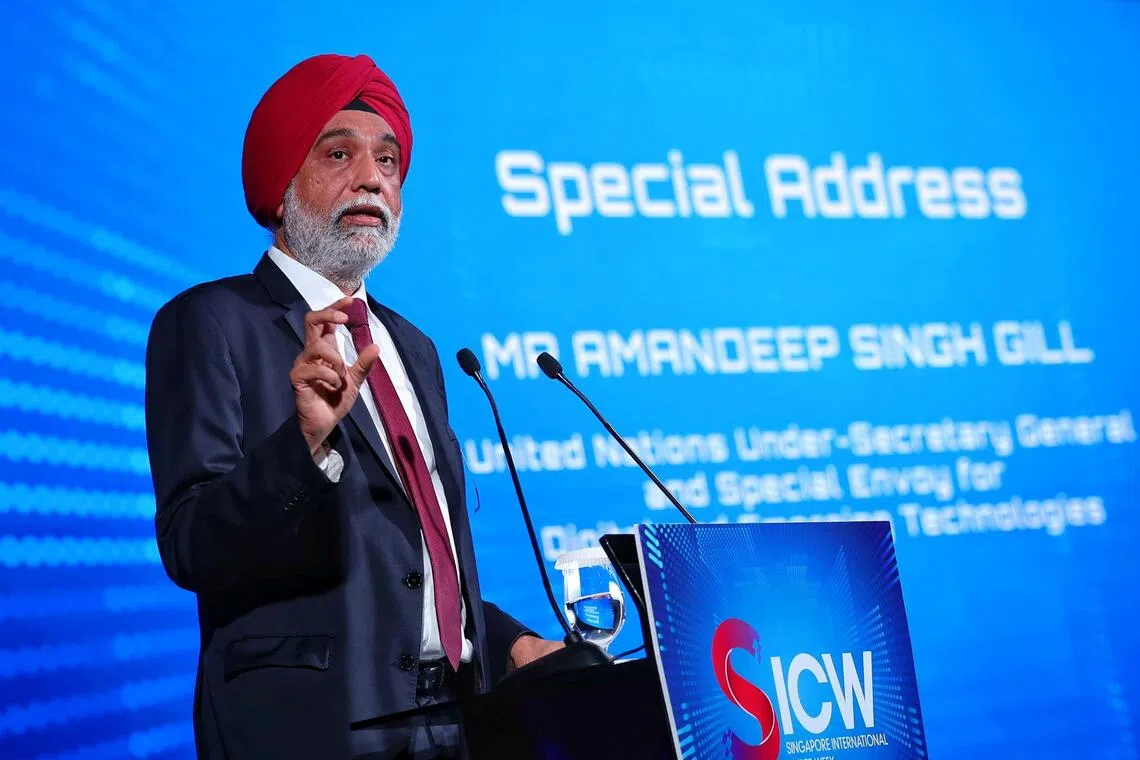
Sharing of information around cyber incidents cannot be left to be done on an ad-hoc basis, said UN Under-Secretary-General and Special Envoy for Digital and Emerging Technologies Amandeep Singh Gill on Oct 13.
Published Oct 13, 2026, 03:33 PM
Updated Oct 13, 2026, 03:33 PM
SINGAPORE - As artificial intelligence models grow more capable and autonomous, building trust based on minimum safety standards, independent testing and open sharing of cybersecurity incidents is no longer negotiable.
Amandeep Singh Gill, the United Nations Under-Secretary-General and Special Envoy for Digital and Emerging Technologies, made this call on the opening day of the 11th Singapore International Cyber Week on Oct 13.
In his special address attended by tech executives, government officials, cybersecurity professionals, he said: “Trust in our domain is often treated as a soft concept...in this AI world, trust should be seen as hard infrastructure.”
Specifically, he called on every nation to build a minimum safety infrastructure, citing Singapore’s AI Safety Institute as a model.
The institute, which was established in 2024, develops evaluation methods to test frontier and generative AI models for risks like data leaks, cybersecurity threats, fraud, and harmful content. It also tests whether AI safety guardrails and filters hold up across languages other than English.
Other countries like the UK have also build AI safety infrastructure that works with the private sector to tackle threats and keep policymakers informed, said Gill .
He added that such efforts needs to be expanded to the rest of the world, regardless of whether the country develops their own, borrows or buy AI models.
Gill also called for the development of minimum standards for AI testing similar to accounting and financial standards , and for independent auditors to be certified to identify acceptable AI baseline behaviour and actions.
“Perhaps most importantly, we need sharing of information, incident reporting, and transparency...this cannot be done through ad-hoc arrangements,” said Gill.
He cited a multilateral AI risk management framework proposed by UN secretary-general Antonio Guterres in September as an example of an international mechanism to oversee such sharing. The proposed framework aims to establish global consensus on AI governance.
To that end, Singapore in September joined more than 20 countries and the European Union to sign a declaration calling for binding international government oversight and control over frontier AI models to replace corporate self-regulation.
During the UN General Assembly held in New York that month, Singapore’s Foreign Affairs Minister Vivian Balakrishnan also proposed a UN framework convention on AI safety.
Developing testing standards and human oversight over AI is crucial in building up trust in the technology, said Gill, adding that trust should no longer be viewed as a “soft concept”.
“We trust a digital system when we can understand what it is designed to do, can test what it claims is being done...and when the system fails, human beings retain the ability to intervene,” said Gill.
He cited public trust in AI as one of the biggest obstacles to adoption of the technology, and added that people need to be able to trust outputs, and governments need to be able to trust systems deployed in critical sectors that are developed in other countries.
During a keynote address at the conference, US White House national cyber director Sean Cairncross said trust is the foundation to America’s cooperation between the government and private sector, which designs, builds, and operates systems that modern society relies heavily on.
“True sovereignty in the digital age is measured by the capacity to defend one’s own networks, protect critical systems, and ensure that supply chains remain free of adversarial influence and hidden dependencies,” said Cairncross.
He also called on nations to strengthen their own defences so as to reinforce the broader network of allied security.
“The new cybersecurity reality cannot be turned over to the international institutions or global governance frameworks with slow-moving, bureaucratized deliberation, or appeasing indecision. It must and will be shaped by trusted and willing partners who refuse to wait for the lowest common denominator agreement.”
Gill and Cairncross were among the first speakers on the first day of SICW. The three-day conference is expected to draw over 15,000 attendees from 90 countries and regions who will discuss the growing impact of AI on cybersecurity, diplomacy and international cooperation.
A panel discussion moderated by Singapore’s chief AI officer He Ruimin on Oct 13 saw foreign government officials and industry representatives agree on the need for evaluation frameworks, external testing, and for all stakeholders to be held accountable in the safe deployment of AI.
A panel discussion at SICW on Oct 13 saw foreign officials and industry representatives agree on the need for external testing and accountability across all stakeholders to oversee the safe deployment of AI. ST PHOTO: KEVIN LIM
A panel discussion at SICW on Oct 13 saw foreign officials and industry representatives agree on the need for external testing and accountability across all stakeholders to oversee the safe deployment of AI.
“The important thing for us is not to redo what the developers and independent third-party evaluators have already done,” said panelist Gracie Lin, regional chief executive of crypto exchange OKX Singapore and Australia.
She added that companies should receive sufficient access to test AI models based on their individual use case.
Asked who should take more responsibility when an AI system is exploited in a cyber attack , Anthropic’s head of Asia-Pacific policy Michael Sellitto said it depends on factors such as whether the system was deployed in a way that was intended.
“I think it’s very difficult to say in advance, there’s going to be this exact liability (framework) that’s going to apply in all scenarios, as models can be used for really everything and anything. So I think it’s very fact specific.”
AI/artificial intelligence
联合国副秘书长兼数字和新兴技术特使阿曼迪普·辛格·吉尔于10月13日表示,不能再以临时方式共享有关网络安全事件的信息。
发布于 2026 年 10 月 13 日下午 3:33
更新于2026年10月13日下午3:33
新加坡——随着人工智能模型变得越来越强大和自主,基于最低安全标准、独立测试和网络安全事件公开共享来建立信任已不再是可有可无的。
联合国副秘书长兼数字和新兴技术特使阿曼迪普·辛格·吉尔在10月13日举行的第11届新加坡国际网络周开幕式上发出这一呼吁。
在向科技高管、政府官员和网络安全专家发表的特别讲话中,他表示:“在我们这个领域,信任通常被视为一个软性概念……在人工智能时代,信任应该被视为一种硬性基础设施。”
他特别呼吁各国建立最低限度的安全基础设施,并以新加坡人工智能安全研究所为例。
该研究所成立于2024年,致力于开发评估方法,以测试前沿和生成式人工智能模型是否存在数据泄露、网络安全威胁、欺诈和有害内容等风险。它还测试人工智能安全防护措施和过滤器在英语以外的其他语言中是否有效。
吉尔表示,英国等其他国家也建立了人工智能安全基础设施,与私营部门合作应对威胁,并让政策制定者了解情况。
他还补充说,无论一个国家是自行开发、借用还是购买人工智能模型,此类努力都需要扩展到世界其他地区。
吉尔还呼吁制定类似于会计和财务标准的AI测试最低标准,并要求对独立审计师进行认证,以识别可接受的AI基线行为和操作。
吉尔说:“或许最重要的是,我们需要信息共享、事件报告和透明度……这无法通过临时安排来实现。”
他以联合国秘书长安东尼奥·古特雷斯9月份提出的多边人工智能风险管理框架为例,说明如何建立监督此类信息共享的国际机制。该框架旨在就人工智能治理达成全球共识。
为此,新加坡于 9 月与 20 多个国家和欧盟签署了一项宣言,呼吁对前沿人工智能模型进行具有约束力的国际政府监督和控制,以取代企业自律。
在当月于纽约举行的联合国大会上,新加坡外交部长维文·巴拉克里希南也提出了一项关于人工智能安全的联合国框架公约。
吉尔表示,制定人工智能测试标准和人工监督对于建立人们对这项技术的信任至关重要,他还补充说,信任不应再被视为一个“软性概念”。
吉尔说:“当我们能够理解数字系统的设计用途,能够测试它声称正在做的事情……并且当系统出现故障时,人类仍然能够进行干预时,我们才会信任数字系统。”
他指出,公众对人工智能的信任是该技术普及的最大障碍之一,并补充说,人们需要能够信任人工智能的输出结果,政府需要能够信任部署在关键领域、由其他国家开发的系统。
在会议的主题演讲中,美国白宫国家网络安全主管肖恩·凯恩克罗斯表示,信任是美国政府与私营部门合作的基础,而私营部门负责设计、建造和运营现代社会高度依赖的系统。
“数字时代的真正主权,取决于保卫自身网络、保护关键系统以及确保供应链不受敌对势力影响和隐性依赖的能力,”凯恩克罗斯说。
他还呼吁各国加强自身防御,以加强更广泛的盟国安全网络。
“新的网络安全形势不能通过缓慢、官僚主义的审议或绥靖式的犹豫不决交由国际机构或全球治理框架来塑造。它必须也必将由值得信赖且愿意合作的伙伴来塑造,这些伙伴不会等待达成最低限度的共识。”
吉尔和凯恩克罗斯是SICW首日的首批演讲嘉宾之一。为期三天的会议预计将吸引来自90个国家和地区的15000多名与会者,他们将共同探讨人工智能对网络安全、外交和国际合作日益增长的影响。
10 月 13 日,由新加坡首席人工智能官何瑞敏主持的小组讨论中,外国政府官员和行业代表一致认为,需要建立评估框架、进行外部测试,并且所有利益相关者都应在人工智能的安全部署中承担责任。
10月13日,在新加坡国际计算机周(SICW)上举行的小组讨论中,外国官员和行业代表一致认为,需要对所有利益相关方进行外部测试和问责,以监督人工智能的安全部署。照片:KEVIN LIM
10 月 13 日在 SICW 举行的小组讨论中,外国官员和行业代表一致认为,需要对所有利益相关者进行外部测试和问责,以监督人工智能的安全部署。
“对我们来说,重要的是不要重复开发人员和独立第三方评估人员已经完成的工作,”小组成员、加密货币交易所 OKX 新加坡和澳大利亚区域首席执行官 Gracie Lin 表示。
她补充说,企业应该获得足够的权限,根据其各自的用例来测试人工智能模型。
当被问及当人工智能系统在网络攻击中被利用时,谁应该承担更多责任时,人道组织亚太政策负责人迈克尔·塞利托表示,这取决于系统是否按照预期的方式部署等因素。
“我认为很难事先说会存在一个适用于所有情况的确切责任(框架),因为模型几乎可以用于任何情况。所以我认为这很大程度上取决于具体事实。”
人工智能