From selling second-hand clothes to starting a lingerie brand with his equally entrepreneurial wife从出售二手服装到与同样富有创业精神的妻子共同创立内衣品牌。
Kingsley Peh and his wife Elfaine Tan started their first business together at 15. Read more at straitstimes.com.
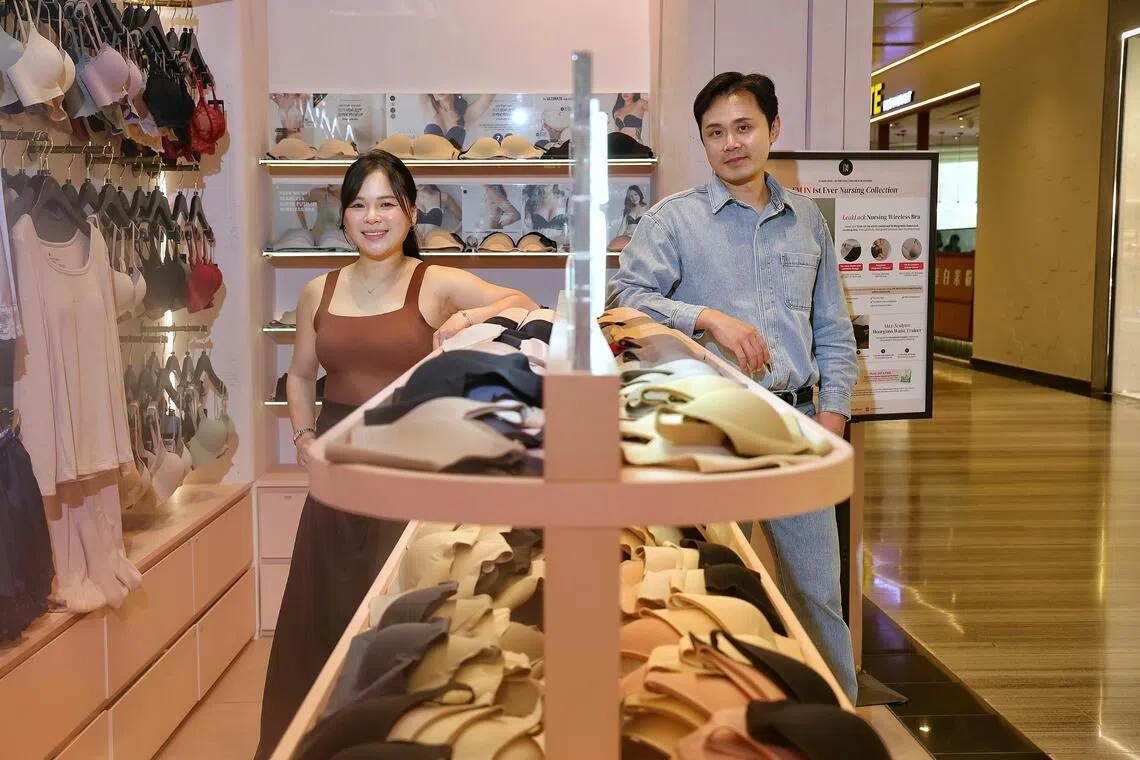
Kingsley Peh and his wife Elfaine Tan at their I’m In lingerie store in Jewel Changi Airport. They started their first business together at 15, selling second-hand clothing.
Published Sep 06, 2026, 05:00 AM
Updated Sep 06, 2026, 05:00 AM
SINGAPORE – Entrepreneurship has long run in Kingsley Peh’s blood. He and his wife Elfaine Tan, whom he met when they were both 13, started their first business together at 15, selling second-hand clothing online and at neighbourhood market stalls.
“School was closed during the SARS (severe acute respiratory syndrome) outbreak, and instead of simply sitting around, we decided to try selling second-hand clothes at a neighbourhood market,” said Peh, 37.
“We had very little capital and no business experience, but we were curious to see whether we could sell something and make money on our own,” he said, adding that the experience gave them their first taste of entrepreneurship.
When they were 20, Tan started Singapore’s first online “tryvertising” platform, The Sample Store, with Peh. The platform allowed customers to order free beauty samples and try them before buying, and earn more samples by posting reviews. It was eventually acquired by Singapore Post in 2013.
In 2015, the couple went on to launch lingerie brand I’m In.
Tan had suffered the discomfort and pain of underwired bras and was convinced that women would want more comfortable, wireless support.
The duo poured $100,000 into raw material research and development, fabric chemistry, and custom steel mould engineering for wireless bras.
Today, they have scaled I’m In from an online store to five physical stores in Singapore and regional distribution in Indonesia, Malaysia, the Philippines and Brunei.
Peh has a diploma in infocommunications, and Tan has a diploma in biomedical informatics and engineering, both from Temasek Polytechnic. They have a six-year-old son and a baby girl on the way.
What do you invest in and why?
Our biggest investment has consistently been back into I’m In. Whenever the business does well, our instinct has usually been to reinvest in products, people, technology and expansion. It probably isn’t the most diversified approach, but it keeps us very committed.
There’s nowhere to hide either. The results are brutally honest. If we make good decisions, we see it. If we make bad ones, we learn very quickly.
What’s your biggest or most valuable asset right now?
Tangibly, it would be I’m In. But increasingly, I think the more valuable asset is actually intangible: the people behind it. Products can be copied and strategies can change, but having a strong team that learns, adapts and grows together is very difficult to replicate.
What’s your approach when it comes to growing your money?
I think of it a little like a slow cooker. I’m less interested in chasing 10 different opportunities and more interested in building one good system that compounds over time, with good people, good products and good fundamentals. It may not always be exciting, but I like the idea of quietly building something that becomes stronger year after year.
Do you invest in any other tangible assets such as art, crystals or Pokemon cards?
Not seriously. I’m more of a casual collector. For me, the story or idea behind something matters more than its rarity or resale value. I can enjoy a PopMart figurine simply because I like the character or the story behind it. Not everything I buy needs to become an investment.
What was your first exposure to investing?
Probably buying stock for our little market stall. We didn’t have much money then. When we made some, we treated ourselves to a good meal and put almost everything else back into buying more stock. Looking back, that was probably my first lesson in reinvestment and compounding, although we definitely didn’t use those words at the time.
What has been your best financial decision?
When we were 25, we sold The Sample Store, a business we had spent about five years building, to SingPost for $1.2 million. There was a strategic fit. We had built something innovative and agile, while SingPost had a much larger distribution network and infrastructure. The acquisition took roughly a year of discussions and negotiations to complete.
At that age, going through an acquisition taught me much more than the dollar value of the deal. I learnt how businesses are valued, how deals are structured and negotiated, and how two companies can create value by bringing different strengths together. It also taught me something I still believe today: When you’re young, time is one of your greatest forms of capital. You can afford to try, fail, learn and rebuild.
Moneywise, what were your growing-up years like?
I grew up in a simple household. My dad was an SBS bus driver, and my mum was a housewife, so being prudent with money was something we learnt very early. We also saw the anxiety that comes when a family has to make ends meet. I don’t look back at that negatively, though. Starting from a more modest place made every bit of progress feel meaningful and it shaped how I think about money today.
What was your childhood dream?
I wanted to be a computer scientist. Somewhere along the way, I became an entrepreneur instead, although with how much time I spend thinking about AI now, perhaps I’ve somehow gone full circle.
What was your first job?
My first full-time job was technically CEO of our first start-up, The Sample Store, though “CEO” makes it sound much more glamorous than it was. In reality, it stood for “Chief Everything Officer”. Sales, marketing, packing, operations, customer service – whatever needed to be done that day.
Where’s home for you?
We live in a terraced house in the central area of Singapore.
We currently drive a Porsche Macan EV and a Mercedes-Benz CLA.
What was your most frivolous or guilty-pleasure purchase?
Probably paying a ridiculous amount for front-row tickets to a K-pop concert. Flying business class for a short flight purely because I desperately wanted a few hours of sleep comes pretty close.
What does work-life balance mean to you?
I prefer the idea of work-life harmony rather than perfect balance. There are seasons when work genuinely takes 80 per cent of my energy and life gets the other 20 per cent. And there are other periods when family, friends and travel take 80 per cent, and work sits quietly in the remaining 20 per cent.
I don’t think my life naturally divides itself into a neat 50:50 every day. For me, what matters is recognising which season I’m in and being fully present in it.
What would you do if you suddenly had a windfall of millions?
I’d probably put a significant part of it into finding and developing great people for I’m In. The longer I build a business, the more convinced I am that the quality of the people around you determines how far the company can go. So I’d invest in increasing our talent density – with people who have both strong capabilities and the right attitude.
If you suddenly had only $100 to your name, what would you do?
I’d give it to my kids, then I’d start again. I’ve built from very little before, so I’d trust my ability to figure it out once more.
金斯利·佩和他的妻子艾尔芬·谭在他们位于樟宜机场星耀樟宜的内衣店“I'm In”前。他们15岁时就开始一起创业,当时是卖二手衣服。
发布于 2026 年 9 月 6 日上午 5:00
更新于2026年9月6日上午5:00
新加坡——金斯利·佩(Kingsley Peh)的血液里一直流淌着创业的基因。他和妻子艾尔芬·谭(Elfaine Tan)在13岁时相识,15岁时他们一起创办了第一家公司,在网上和社区市场摊位上销售二手服装。
“SARS(严重急性呼吸综合征)爆发期间学校关闭,我们没有闲着,而是决定尝试在附近的集市上卖二手衣服,”37岁的Peh说道。
“我们当时资金很少,也没有经商经验,但我们很好奇自己能否卖出一些东西来赚钱,”他说,并补充说,这次经历让他们第一次尝到了创业的滋味。
20岁时,谭和白共同创办了新加坡首个线上“试用广告”平台——The Sample Store。该平台允许顾客订购免费美妆样品,在购买前试用,并通过发布评论赢取更多样品。2013年,The Sample Store被新加坡邮政收购。
2015年,这对夫妇创立了内衣品牌I'm In。
谭女士曾饱受钢圈胸罩带来的不适和疼痛之苦,她确信女性会想要更舒适、无钢圈的支撑。
两人投入了 10 万美元用于原材料研发、织物化学以及无钢圈胸罩的定制钢模工程。
如今,I'm In 已从一家线上商店发展成为在新加坡拥有五家实体店,并在印度尼西亚、马来西亚、菲律宾和文莱等地开展区域分销业务的品牌。
Peh拥有淡马锡理工学院信息通信专业的文凭,Tan拥有淡马锡理工学院生物医学信息学与工程专业的文凭。他们有一个六岁的儿子,妻子即将迎来一个女儿。
你投资什么?为什么?
我们最大的投资始终是对 I'm In 的持续投入。每当公司业绩良好时,我们通常都会本能地将资金再投资于产品、人才、技术和扩张。这或许不是最多元化的投资策略,但它让我们始终保持高度专注。
无处可藏。结果残酷无情。如果我们做出正确的决定,我们就能看得出来。如果我们做出错误的决定,我们也能很快吸取教训。
你现在最大或最有价值的资产是什么?
从字面上看,我会说“我加入”。但我认为,越来越有价值的资产实际上是无形的:那就是背后的人。产品可以复制,策略可以改变,但拥有一支能够共同学习、适应和成长的强大团队却很难复制。
您在理财方面有什么策略?
我觉得这有点像慢炖锅。我不太热衷于追逐十几个不同的机会,而是更想打造一个能够随着时间推移不断增值的优质系统,这需要优秀的人才、优质的产品和扎实的基本面。这或许并不总是令人兴奋,但我喜欢这种默默耕耘、逐年壮大的感觉。
你还会投资其他有形资产,例如艺术品、水晶或宝可梦卡牌吗?
不,我不是认真的。我只是个业余收藏家。对我来说,物品背后的故事或理念比它的稀有度或转售价值更重要。我喜欢PopMart的玩偶,仅仅是因为我喜欢它背后的角色或故事。我买的东西并非都要成为投资。
你第一次接触投资是什么时候?
大概是给我们的小摊位进货吧。那时候我们没什么钱。赚到一些钱后,我们会犒劳自己一顿美餐,然后把剩下的钱几乎都用来进货了。现在回想起来,那大概是我第一次接触到再投资和复利的概念,虽然当时我们肯定没用过这些词。
你做过的最明智的财务决定是什么?
25岁那年,我们把花了五年时间打造的“样品店”(The Sample Store)以120万美元的价格卖给了新加坡邮政。这笔交易在战略上非常契合。我们打造了一个创新且灵活的平台,而新加坡邮政则拥有规模更大、基础设施更完善的分销网络。这笔收购历经了大约一年的讨论和谈判才最终完成。
在那段年纪,经历一次收购让我学到的远不止交易的金额。我学会了如何评估企业价值,如何构建和谈判交易,以及两家公司如何通过优势互补创造价值。它还教会了我一个至今仍让我深信不疑的道理:年轻的时候,时间是你最宝贵的财富之一。你有时间去尝试、去失败、去学习、去重建。
从金钱角度来看,你的成长岁月是怎样的?
我成长在一个普通的家庭。我父亲是SBS巴士司机,母亲是家庭主妇,所以我们很早就学会了精打细算。我们也目睹了家庭捉襟见肘时的焦虑。不过,我并不觉得那段经历是件坏事。正是因为出身贫寒,每一份进步都显得格外珍贵,也塑造了我如今的金钱观。
你小时候的梦想是什么?
我原本想成为一名计算机科学家。但不知从何时起,我却成了一名企业家。不过,鉴于我现在花这么多时间思考人工智能,或许我又回到了原点。
你的第一份工作是什么?
我的第一份全职工作,严格来说是我们第一家创业公司“样品店”(The Sample Store)的首席执行官,不过“首席执行官”听起来比实际情况光鲜亮丽得多。实际上,它代表的是“首席全能官”(Chief Everything Officer)。销售、市场营销、包装、运营、客户服务——当天需要做的任何事,我都得负责。
你的家在哪里?
我们住在新加坡市中心的一栋排屋里。
我们目前驾驶的是保时捷 Macan EV 和奔驰 CLA。
你买过最轻率或最让你感到愧疚的商品是什么?
大概是花冤枉钱买K-pop演唱会前排的票吧。为了睡几个小时就坐商务舱飞短途航班,也差不多是这种感觉。
你认为工作与生活平衡意味着什么?
我更倾向于工作与生活的和谐,而非完美的平衡。有些时候,工作确实会占据我80%的精力,生活只占20%。而另一些时候,家人、朋友和旅行占据了我80%的时间,工作则静静地占据了剩下的20%。
我不认为我的生活会自然而然地分成每天一半的时间和一半的时间。对我来说,重要的是认清自己所处的阶段,并全身心地投入其中。
如果你突然获得数百万美元的意外之财,你会怎么做?
我可能会把很大一部分资金投入到为 I'm In 寻找和培养优秀人才上。我经营企业的时间越长,就越发相信,员工的素质决定了公司的发展速度。因此,我会投资提升我们的人才密度——招募那些既具备卓越能力又拥有正确态度的人才。
如果你突然发现自己身上只剩下100美元,你会怎么办?
我会把它交给孩子们,然后重新开始。我以前也白手起家,所以我相信自己能再次成功。