Business judgement, AI proficiency key as cyber defender roles evolve; new professional standards being developed随着网络安全防御者角色不断演变,商业判断力和人工智能能力至关重要;新的专业标准正在制定中。
Singapore will roll out a voluntary two-year accreditation pilot for cybersecurity professionals from the second quarter of 2027. Read more at straitstimes.com.
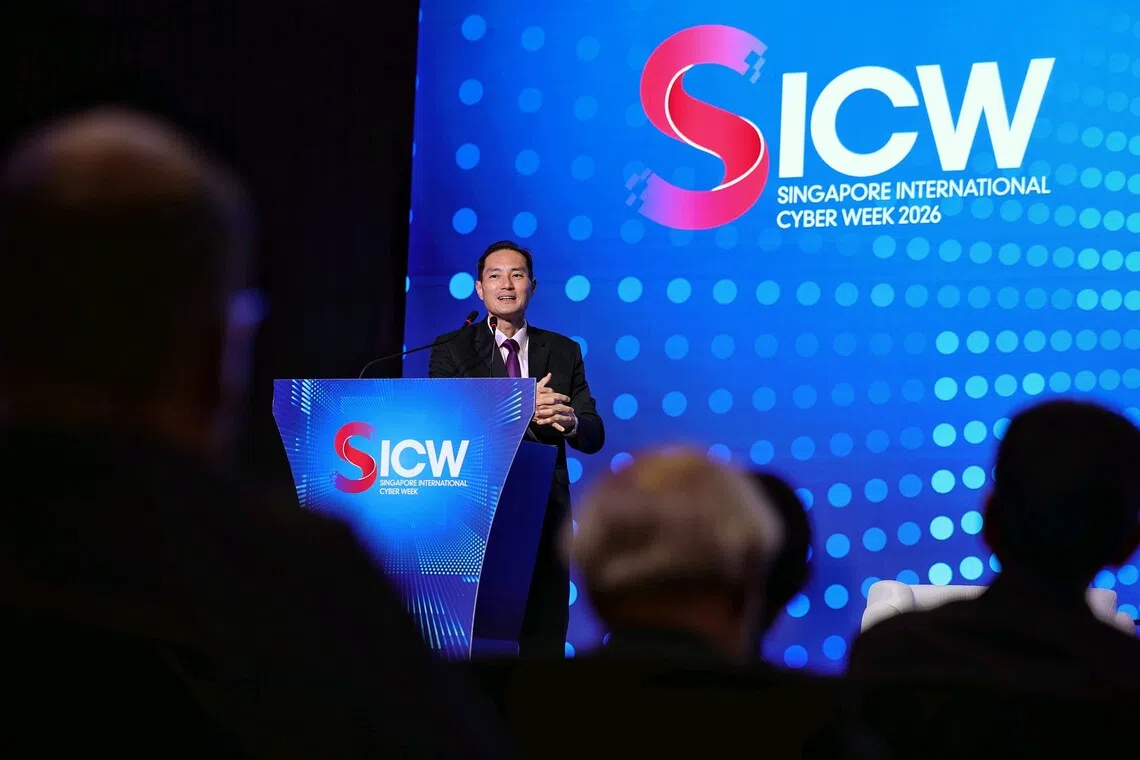
Senior Minister of State for Digital Development and Information Tan Kiat How announced the Cybersecurity Professional Accreditation Framework at the Singapore International Cyber Week on Oct 13.
Published Oct 13, 2026, 04:33 PM
Updated Oct 13, 2026, 04:33 PM
Cybersecurity jobs are changing fast. Workers now need business judgement, strong technical skills and AI fluency to spot AI-enabled threats.
CSA’s new professional accreditation framework will set common standards across roles and levels. A voluntary two-year pilot starts in Q2 2027.
Singapore says the framework will give employers clearer standards and strengthen cyber defences.
SINGAPORE – Cybersecurity professionals need to do more than fix technical flaws ; they must also understand organisational risks and weigh business trade-offs against priorities when making decisions.
This is the highest-rated capability for cyber security professionals across all levels over the next three years according to the findings of a new study on how artificial intelligence (AI) is shaping cybersecurity jobs.
Commissioned by the Cyber Security Agency of Singapore (CSA), the survey of 1,000 organisations also found that cybersecurity professionals need to have a strong grasp of technical knowledge in their field to effectively evaluate threats, assess vulnerabilities and guide sound security decisions.
Notably, the third most highly-rated skill involves AI, so cybersecurity professionals can better detect and respond to AI-enabled cyber threats.
The study also said while AI reduces the operational load of cybersecurity work by augmenting tasks, humans are still needed to determine if the alerts are credible and the threats are genuine.
The latest findings mirror an April 30 survey by the Singapore Ministry of Manpower , which found that AI was primarily transforming tasks rather than replacing roles.
The Building Singapore’s Cybersecurity Workforce for the Age of AI report was released at Singapore International Cyber Week on Oct 13.
The study found that AI is reshaping cybersecurity so quickly that professionals will encounter a meaningful AI-enabled cyber threat within the next 12 months, requiring them to acquire new skills. Such threats include AI-enabled phishing, deepfakes and malware-development.
These findings will help shape new professional standards for CSA’s upcoming accreditation framework to reflect AI fluency as an important part of cybersecurity competence. Specifically, cyber defenders need a new skillset: the ability to spot when an AI makes a mistake or gets manipulated, and knowing how to fix the problem safely.
CSA will set common professional standards across roles and proficiency levels, followed by a voluntary two-year accreditation pilot from the second quarter of 2027.
The Cybersecurity Professional Accreditation Framework, announced by Senior Minister of State for Digital Development and Information Tan Kiat How on Oct 13 , is a key plank of Singapore’s refreshed cybersecurity strategy .
“If the work is changing, the profession must evolve with it. Our people need greater clarity about the capabilities they should develop. Employers need a clearer understanding of what good looks like. And training providers need to know what industry will need next,” said Tan.
The new framework is needed to formalise and recognise competencies in the AI age because the wide range of cybersecurity certifications has made it hard for employers to assess practitioners’ capabilities.
“We are not trying to create another layer of certificates. We want to build a framework that gives employers greater confidence, gives professionals greater recognition, and gives the profession a stronger common standard,” said Tan.
The survey used to inform the new framework was conducted by Blackbox Research between August and September 2026. It covered 1,000 respondents from government agencies, critical information infrastructure owners, cybersecurity services companies and the private sector who are using AI tools in their work.
The survey found that demand for mid-level and senior cybersecurity professionals is expected to grow over the next three years, while junior roles are expected to be redesigned to include more complex work supported by AI. Such work requires technical depth to spot missing evidence and assess whether AI recommendations are credible and appropriate.
Roles substantially redesigned by AI include analysts in security operations, vulnerability assessment and penetration testing.
In security operations, for instance, AI can now automatically analyse system logs, flag suspicious activity, and draft detection rules or reports. So human analysts need to shift their focus toward investigating findings, judging severity and orchestrating responses. Consequently, the ability to recognise AI-enabled attacks, write effective prompts, configure AI safeguards and verify the reliability of automated detections has also become essential.
For vulnerability assessment and penetration testing, new skills include testing AI systems for attempts to manipulate human instructions to bypass safeguards.
At the leadership level, chief information security officers still have to set the tone for an organisation’s cybersecurity vision and make key decisions. But going forward, leaders will need to understand AI-specific risks, and lead teams that combine human expertise with AI.
The accreditation framework aims to give employers a clearer way to judge whether the growing pool of cybersecurity professionals have these capabilities. The workforce has more than doubled from 4,000 in 2016 to over 10,000 in 2025.
A separate study commissioned by CSA and conducted by Ernst & Young in 2024 and 2025 found that professionals also struggled to identify and keep up with the skills needed for their roles and career progression. Existing certifications, while useful, did not offer a comprehensive assessment of technical knowledge, practical experience and professional ethics.
CSA will establish three bodies by the end of 2026 to oversee accreditation.
A Cyber Security Professional Office, set up with the Association of Information Security Professionals, will handle assessments, appeals and renewals, and maintain a public register of accredited practitioners. A panel of senior representatives from government, industry and academia will oversee professional standards and approve the award of titles. Committees of technical experts will review assessment criteria, examine candidates’ portfolios and conduct interviews.
CSA said accreditation would complement existing qualifications and certifications, giving professionals formal recognition of their expertise and employers greater confidence in their capabilities.
The initial pilot will involve professionals from selected government agencies and cybersecurity service providers, focusing on areas such as security operations and vulnerability assessment and penetration testing. Application fees will be waived during the pilot.
Details on eligibility, assessments and applications will be available from March 2027. The standards will be updated regularly to reflect changing industry needs and emerging areas such as AI security.
Tan said that if Singapore can build professionals who can exercise sound judgement over how AI is used, it will strengthen Singapore’s cyber defences.
“We will build a cybersecurity profession that is trusted, resilient and ready for the next generation of threats,” he said.
AI/artificial intelligence
新加坡数码发展及新闻部高级政务部长陈杰豪于10月13日在新加坡国际网络安全周上宣布了网络安全专业人员认证框架。
发布于 2026 年 10 月 13 日下午 4:33
更新于2026年10月13日下午4:33
网络安全工作岗位正在快速变化。如今,从业人员需要具备商业判断力、扎实的技术技能和人工智能素养,才能识别人工智能驱动的威胁。
CSA 的全新专业认证框架将为不同角色和级别设定通用标准。一项为期两年的自愿试点项目将于 2027 年第二季度启动。
新加坡表示,该框架将为雇主提供更清晰的标准,并加强网络防御。
新加坡——网络安全专业人员不仅需要修复技术漏洞;他们还必须了解组织风险,并在做决策时权衡业务利弊与优先事项。
根据一项关于人工智能 (AI) 如何塑造网络安全工作的新研究结果,在未来三年内,这是各级别网络安全专业人员最看重的能力。
新加坡网络安全局 (CSA) 委托进行的这项针对 1000 个组织的调查还发现,网络安全专业人员需要对其领域的技术知识有很强的掌握,才能有效地评估威胁、评估漏洞并指导合理的安全决策。
值得注意的是,评分第三高的技能与人工智能有关,因此网络安全专业人员可以更好地检测和应对人工智能驱动的网络威胁。
该研究还指出,虽然人工智能通过增强任务来减轻网络安全工作的运营负担,但仍然需要人类来确定警报是否可信以及威胁是否真实存在。
最新调查结果与新加坡人力部 4 月 30 日的一项调查结果相吻合,该调查发现人工智能主要是在改变工作任务,而不是取代工作岗位。
《构建新加坡人工智能时代网络安全人才队伍》报告于 10 月 13 日在新加坡国际网络安全周上发布。
该研究发现,人工智能正在以惊人的速度重塑网络安全,专业人士将在未来12个月内遭遇重大的人工智能网络威胁,这将迫使他们掌握新的技能。此类威胁包括人工智能网络钓鱼、深度伪造和恶意软件开发。
这些研究结果将有助于制定CSA即将推出的认证框架中的新专业标准,将人工智能素养作为网络安全能力的重要组成部分。具体而言,网络防御人员需要掌握一套新的技能:能够识别人工智能何时出错或被操纵,并知道如何安全地解决问题。
CSA 将制定跨角色和熟练程度的通用专业标准,随后从 2027 年第二季度开始进行为期两年的自愿认证试点。
新加坡数码发展及新闻部高级政务部长陈杰豪于 10 月 13 日宣布的网络安全专业认证框架,是新加坡更新后的网络安全战略的关键组成部分。
“如果工作内容在变化,职业也必须随之发展。我们的从业人员需要更清楚地了解他们应该培养哪些能力。雇主需要更清楚地了解优秀人才的标准。而培训机构则需要知道行业未来需要什么,”谭说道。
人工智能时代需要新的框架来规范和认可各项能力,因为种类繁多的网络安全认证使得雇主很难评估从业人员的能力。
“我们并非要增设另一层证书。我们希望构建一个框架,让雇主更有信心,让专业人士获得更高的认可,并为该行业制定更严格的共同标准,”谭说道。
用于制定新框架的调查由 Blackbox Research 于 2026 年 8 月至 9 月期间进行。调查对象包括来自政府机构、关键信息基础设施所有者、网络安全服务公司和私营部门的 1000 名受访者,他们在工作中都使用了人工智能工具。
调查发现,未来三年对中高级网络安全专业人员的需求预计将会增长,而初级岗位则有望进行重新设计,纳入更多由人工智能支持的复杂工作。这类工作需要深厚的技术功底,才能发现缺失的证据,并评估人工智能建议是否可信且恰当。
人工智能大幅重新设计了安全运营、漏洞评估和渗透测试等领域的分析师角色。
例如,在安全运营中,人工智能现在可以自动分析系统日志、标记可疑活动并生成检测规则或报告。因此,人工分析人员需要将工作重心转移到调查发现的问题、判断问题的严重程度以及协调应对措施上。相应地,识别人工智能攻击、编写有效的提示信息、配置人工智能安全防护措施以及验证自动检测结果的可靠性也变得至关重要。
对于漏洞评估和渗透测试,新的技能包括测试人工智能系统是否存在试图操纵人类指令以绕过安全措施的行为。
在领导层面,首席信息安全官仍然需要为组织的网络安全愿景定调并做出关键决策。但展望未来,领导者需要了解人工智能特有的风险,并领导将人类专业知识与人工智能相结合的团队。
该认证框架旨在为雇主提供更清晰的途径,以判断日益增长的网络安全专业人员队伍是否具备这些能力。网络安全从业人员数量已从2016年的4000人增加到2025年的10000多人,增幅超过一倍。
CSA委托安永会计师事务所于2024年和2025年开展的一项独立研究发现,专业人士也难以识别并跟上自身岗位和职业发展所需的技能。现有的认证虽然有用,但并未对技术知识、实践经验和职业道德进行全面评估。
CSA 将在 2026 年底前成立三个机构来监督认证工作。
网络安全专业人员办公室(由信息安全专业人员协会设立)将负责评估、申诉和续期工作,并维护认证从业人员的公开名录。一个由政府、行业和学术界资深代表组成的小组将监督专业标准并批准授予资格。技术专家委员会将审查评估标准、审核候选人资料并进行面试。
CSA表示,认证将补充现有的资格和证书,使专业人士的专业知识得到正式认可,并使雇主对其能力更有信心。
首轮试点将邀请部分政府机构和网络安全服务提供商的专业人员参与,重点关注安全运营、漏洞评估和渗透测试等领域。试点期间免收申请费。
资格、评估和申请的详细信息将于2027年3月起公布。相关标准将定期更新,以反映不断变化的行业需求和人工智能安全等新兴领域。
陈先生表示,如果新加坡能够培养出对人工智能的使用做出合理判断的专业人才,这将加强新加坡的网络防御。
他说:“我们将打造一个值得信赖、具有韧性并能应对下一代威胁的网络安全专业队伍。”
人工智能