The F-117 Tested A Mirror-Like Skin Decades Before The F-22 DidF-117 比 F-22 早几十年就测试了镜面般光滑的蒙皮。
We have more on the 'mirrored' F-22 Raptor mystery that includes a historical connection and an official Air Force statement.
Updated Dec 22, 2021 9:11 PM EST
Since our initial reporting, Nellis Air Force Base’s ‘mirrored’ F-22 has grabbed a ton of attention. The aircraft has been flying regular sorties, and some great additional photos and videos have emerged of it in action. That being said, we want to add a bit of important historical connective tissue to our original story, which has to do with the F-117 Nighthawk. We also have a statement from the Air Force on the Raptor’s mysterious metallic coating to share.
The same mirrored F-22 is seen from different angles. The reflectivity totally changes depending on the viewing aspect., Anthony Vogel
We wrote the following about the SENIOR SPUD program earlier this year, in a story to mark the 40th anniversary of the F-117’s first flight, in which we laid out all the unique paint schemes and treatments the F-117 had worn over the years:
Another oddity around the same time was the half-black, half-metallic 79-10784, another one of the FSD [full-scale development] jets, which was trialed under the SENIOR SPUD program in July 1993. Over the course of four test flights, these metallic areas were apparently used to evaluate ways of reducing infrared signature, Paul F. Crickmore records, with the jet flying together with the NKC-135A Flying Infrared Signature Technology Aircraft (FISTA). It’s not clear how successful that was, but, in terms of visual signature, the metallic panels made the jet highly conspicuous in the daytime, at least. Similar testing continues to this very day, including using other surrogate aircraft.
The surrogate aircraft we mentioned was one of Scaled Composites’ shadowy ‘Son of Ares’ Model 401 aircraft, which was caught flying over Naval Air Weapons Station China Lake covered in a very similar coating as what we have seen on the F-22 recently. You can read all about that revelation here. When it comes to the SENIOR SPUD program, the only image of this metallic treatment on the F-117 we knew about was included in the original article, as well as below:
In its half-metallic scheme, the coated F-117 is refueled by a KC-135., Public Domain
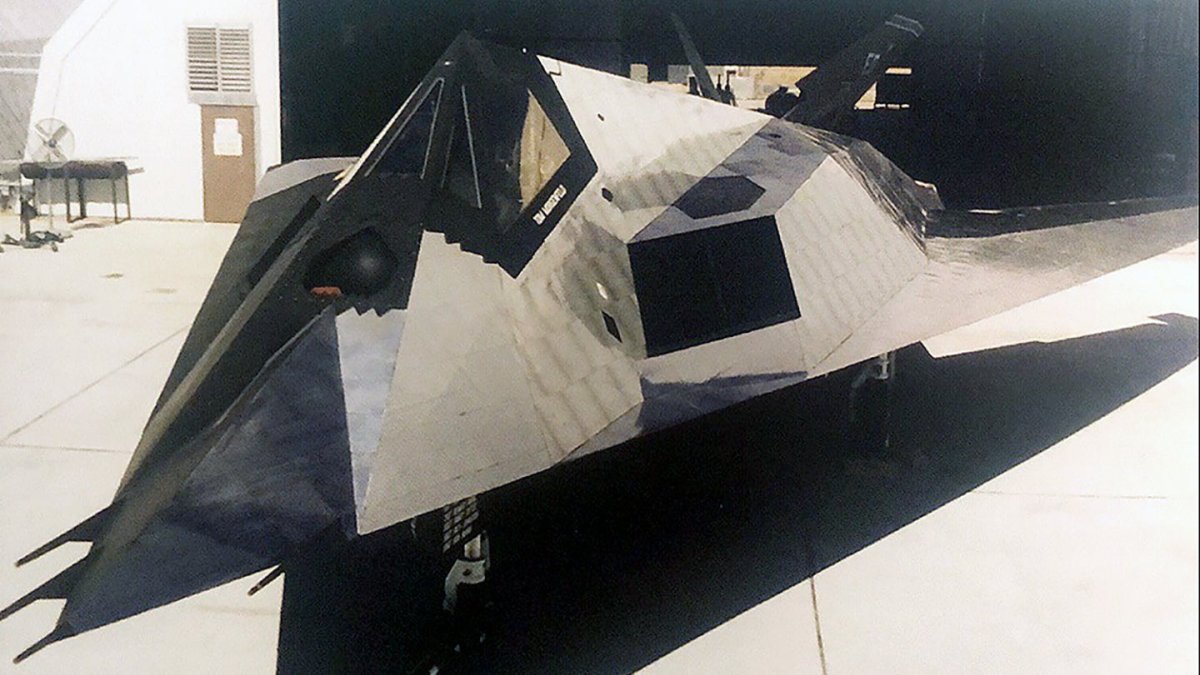
It turns out that there is another image, seen at the top of this story, that really helps shed light on the nature of the material applied to the F-117 under the SENIOR SPUD program. The metallic coating looks extremely similar to what the F-22 in question is wearing today. That image was posted by aviation author Peter Merlin in the Dreamlandresort.com forums , along with the statement:
“It looks similar to the SENIOR SPUD test project. In July 1993 an F-117A was partially coated with a reflective material in an attempt to reduce the aircraft’s infrared (IR) signature. Flight testing took place with the F-117A performing various maneuvers in the vicinity of Edwards AFB including low passes over the main runway. IR measurements were taken by sensors onboard the NKC-135A Flying Infrared Signatures Technology Aircraft (FISTA). Photos of the aircraft show what looks like some sort of diffraction grating (what we used to call “spectrum tape” or “rainbow tape” back in the 1970s). I have seen video footage of the flight tests. The coating may have reduced the IR signature, but it increased the visual signature like you wouldn’t believe. When the sun struck the coated surface, it lit up like crazy.”
“It looks similar to the SENIOR SPUD test project. In July 1993 an F-117A was partially coated with a reflective material in an attempt to reduce the aircraft’s infrared (IR) signature. Flight testing took place with the F-117A performing various maneuvers in the vicinity of Edwards AFB including low passes over the main runway. IR measurements were taken by sensors onboard the NKC-135A Flying Infrared Signatures Technology Aircraft (FISTA).
Photos of the aircraft show what looks like some sort of diffraction grating (what we used to call “spectrum tape” or “rainbow tape” back in the 1970s). I have seen video footage of the flight tests. The coating may have reduced the IR signature, but it increased the visual signature like you wouldn’t believe. When the sun struck the coated surface, it lit up like crazy.”
Just like on the F-22, the coating on the F-117 is made up of a mosaic of metallic tiles and sheets, which allows it to be applied to conform to critical areas, such as the wings, and to be arrayed around moving parts and apertures. But most importantly, it is something akin to a chameleon nature, in that it looks mirror-like when viewed from some angles and matte-like and unreflective when viewed from others.
SENIOR SPUD also had a direct relation to the F-22 program. The coating seen in a strip on the F-117’s right wing was developed for the F-22 and tested aboard the F-117 under the SENIOR SPUD initiative.
It’s also worth mentioning that F-117s may have donned a similar skin more recently. Images of an F-117 flying with a bizarre metallic leading edge emerged in 2019 (seen in the tweet below). As we have noted for years, F-117s still serve in a research and development role for testing low-observable treatments and new sensor systems , as well as providing low-observable adversary air support .
The idea that the F-22 program could be looking at a similar concept 30 years later isn’t too surprising. Even if this material has an adverse effect on the F-22’s radar cross-section, but greatly reduces its infrared signature, the trade may become well worth it in an age of rapidly advancing infrared search and track (IRST) systems, including those mounted on advanced drones . IRSTs, which are totally passive sensors that scan for aerial targets in the infrared spectrum, are fully immune to the F-22’s radar-evading qualities.
View this post on Instagram A post shared by santos caceres (@santos_caceres.lv)
A post shared by santos caceres (@santos_caceres.lv)
Clearly, the technology has evolved in the years since SENIOR SPUD tested its reflective material. We have received various degrees of speculation regarding exactly what this material may do and how it works, including folks thinking it carries an electric current to help mask the jet’s skin temperature. Others have said the coating’s unique properties — high reflectivity and low emissivity — helps decrease radiant energy, making it basically a stealth coating designed for the infrared, not radio-frequency spectrum.
Ever more capable IRSTs are being fielded on foreign fighter aircraft, and for the first time in decades, domestic fighters as well. Here we see a line of Chinese J-10s equipped with IRSTs mounted on their upper nose areas., PLAAF
As for the Air Force, the 57th Wing was kind enough to get back to us on our inquiry about the ‘mirrored Raptor,’ their response was quite cryptic, but at least we got one:
The F-22 is part of a material demonstration that will evaluate material suitability to improve aircraft sustainment. New materials may reduce the lifecycle management burden associated with maintaining the aircraft, and increasing the useable lifetime of aircraft is essential to optimize government resources.
Increasing the useable lifetime of the aircraft clearly makes sense, as new low-observable treatments could enhance its survivability under evolving threat circumstances. As for the rest, it isn’t clear how hundreds of individual metallic tiles, sheets, and strips would help with sustainment, but it is possible this is a new coating that does help in those regards, at least partially.
The F-22’s radar-absorbent coatings are notoriously maintenance-intensive . As noted earlier, trading some low observability in the RF spectrum for enhanced low observability in the IR spectrum, while also realizing a more reliable F-22 fleet, may be a worthy tradeoff. And we still don’t know if the metallic cladding does reduce the F-22’s stealthiness when it comes to radar detection at all. Maybe advances in material science have allowed for the best of both worlds in that regard. On the other hand, the 57th Wing’s reply could be a boilerplate response for new coatings on the F-22 in general.
We are also marching towards an age where directed energy warfare, primarily in the form of lasers , will pose an increasing risk to combat aircraft, especially in the air-to-air combat domain . It isn’t clear if this material may favorably impact the survivability of an aircraft when faced with such a threat. Even relatively conservative reductions in the range at which such an aircraft is vulnerable to laser attacks of a certain power and beam quality could be a serious advantage in the decades to come.
So, the mirrored Raptor still remains something of a mystery, but it would seem that it is related, at least in some regard, to SENIOR SPUD and the F-117 program that served as a progenitor to the F-22 decades ago.
Contact the author: Tyler@thedrive.com
Comments couldn’t be loaded. Please refresh the page.
更新于美国东部时间2021年12月22日晚上9:11
自我们最初报道以来,内利斯空军基地的“镜像”F-22战机引起了广泛关注。这架战机一直在进行常规飞行任务,并且涌现出许多精彩的实战照片和视频。鉴于此,我们想在最初的报道中补充一些重要的历史背景,这与F-117“夜鹰”战机有关。此外,我们还将分享空军关于“猛禽”战机神秘金属涂层的声明。
从不同角度观察同一架F-22战机,其镜面反射率会随着观察角度的变化而发生显著改变。——安东尼·沃格尔
今年早些时候,为了纪念 F-117 首飞 40 周年,我们撰写了一篇关于 SENIOR SPUD 计划的文章,其中详细介绍了 F-117 多年来采用的所有独特涂装方案和处理方法:
大约在同一时期,另一架奇特的飞机是编号为79-10784的飞机,它一半是黑色,一半是金属色。这架飞机也是FSD(全尺寸开发)喷气式飞机之一,于1993年7月在SENIOR SPUD项目下进行了试飞。保罗·F·克里克莫尔记录道,在四次试飞中,这些金属区域显然被用于评估降低红外特征的方法,当时这架飞机与NKC-135A飞行红外特征技术飞机(FISTA)一同飞行。目前尚不清楚这种方法的效果如何,但至少在视觉特征方面,这些金属面板使这架飞机在白天非常显眼。类似的测试至今仍在继续,包括使用其他替代飞机。
我们提到的那架替代飞机是Scaled Composites公司神秘的“战神之子”401型飞机之一,它曾被拍到飞越中国湖海军航空武器站,机身涂装与我们最近在F-22上看到的非常相似。您可以在这里阅读所有相关报道。至于SENIOR SPUD项目,我们所知的F-117采用这种金属涂层的唯一图片包含在原文中,以及下方:
这架半金属涂装的F-117战斗机正在由KC-135加油机进行空中加油。(公共领域)
原来,本文开头展示的另一张图片,确实有助于我们了解“高级无人机”(SENIOR SPUD)项目下F-117战机所使用的材料特性。这种金属涂层看起来与目前F-22战机所使用的涂层极其相似。这张图片由航空作家彼得·默林(Peter Merlin)发布在Dreamlandresort.com论坛上,并附有以下说明:
“这看起来和SENIOR SPUD测试项目很相似。1993年7月,一架F-117A战斗机被部分涂上了反光材料,试图降低其红外特征。随后,这架F-117A在爱德华兹空军基地附近进行了飞行测试,包括低空飞越主跑道。红外测量数据由NKC-135A飞行红外特征技术飞机(FISTA)上的传感器采集。飞机照片显示,其表面似乎涂有某种衍射光栅(我们在20世纪70年代称之为“光谱带”或“彩虹带”)。我看过飞行测试的视频片段。这种涂层或许降低了红外特征,但却极大地增强了可见光特征,令人难以置信。当阳光照射到涂层表面时,它像疯了一样闪闪发光。”
“这看起来与SENIOR SPUD测试项目类似。1993年7月,一架F-117A战斗机被部分涂上反光材料,以降低其红外特征。随后,F-117A在爱德华兹空军基地附近进行了飞行测试,执行了包括低空飞越主跑道在内的各种机动动作。红外测量数据由NKC-135A飞行红外特征技术飞机(FISTA)上的传感器采集。”
飞机照片显示,其表面似乎覆盖着某种衍射光栅(我们在20世纪70年代称之为“光谱带”或“彩虹带”)。我看过飞行测试的视频片段。这种涂层或许降低了红外特征,但它却以令人难以置信的方式增强了可见光特征。当阳光照射到涂层表面时,它像疯了一样闪闪发光。
与F-22一样,F-117的涂层也由金属片和瓦片拼接而成,使其能够贴合机翼等关键区域,并围绕活动部件和孔径进行排列。但最重要的是,它具有类似变色龙的特性,从某些角度看如同镜面,而从另一些角度看则呈现哑光不反光的效果。
“高级土豆”计划也与F-22项目有着直接联系。F-117右翼上的一条涂层就是为F-22开发的,并在“高级土豆”计划的框架下在F-117上进行了测试。
值得一提的是,F-117战机近期可能也采用了类似的涂装。2019年,一架F-117战机飞行时,机身前缘涂有奇特的金属涂层,相关图片已曝光(见下方推文)。正如我们多年来所报道的,F-117战机目前仍承担着研发任务,用于测试低可探测性涂装和新型传感器系统,以及提供低可探测性对抗空中支援。
30年后,F-22项目可能考虑采用类似概念,这并不令人意外。即使这种材料会对F-22的雷达反射截面产生不利影响,但只要能大幅降低其红外特征,在红外搜索与跟踪(IRST)系统(包括安装在先进无人机上的IRST)飞速发展的时代,这种权衡或许是值得的。IRST是一种完全被动的传感器,它扫描红外光谱中的空中目标,完全不受F-22的雷达规避性能的影响。
在 Instagram 上查看此帖子 由 santos caceres (@santos_caceres.lv) 分享的帖子
由 santos caceres (@santos_caceres.lv) 分享的帖子
显然,自“高级SPUD”号测试其反射材料以来,这项技术已经取得了长足的进步。我们收到了关于这种材料的具体作用和工作原理的各种猜测,包括有人认为它能导电以帮助掩盖飞机表面的温度。另一些人则表示,这种涂层的独特性能——高反射率和低发射率——有助于降低辐射能量,使其成为一种专为红外线而非射频频谱设计的隐身涂层。
性能日益强大的红外搜索跟踪系统(IRST)正被部署在外国战斗机上,而几十年来,国产战斗机也首次开始装备该系统。图中所示为一排中国歼-10战斗机,其机头上方均安装了IRST。(中国人民解放军空军)
至于空军方面,第57联队很友好地回复了我们关于“镜像猛禽”的询问,他们的回复相当含糊,但至少我们得到了一个答复:
F-22是材料验证项目的一部分,该项目旨在评估材料的适用性,以提升飞机的维护保障能力。新材料有望减轻飞机全寿命周期管理的负担,而延长飞机的使用寿命对于优化政府资源配置至关重要。
延长飞机的使用寿命显然是明智之举,因为新型低可探测性处理可以增强其在不断变化的威胁环境下的生存能力。至于其他方面,目前尚不清楚数百块独立的金属瓦片、薄片和条带将如何有助于维护保养,但这或许是一种至少在一定程度上能在这方面发挥作用的新型涂层。
F-22的雷达吸波涂层维护成本极高,这一点众所周知。如前所述,牺牲一些射频频谱的隐蔽性来换取红外频谱的隐蔽性提升,同时还能提高F-22机队的可靠性,这或许是一种值得的权衡。我们目前仍不清楚金属外壳是否会降低F-22在雷达探测方面的隐蔽性。或许材料科学的进步已经实现了两全其美。另一方面,第57联队的回复可能只是针对F-22新型涂层的一般性标准答复。
我们正迈向一个定向能武器(主要以激光形式出现)对作战飞机,尤其是空对空作战飞机构成日益严重威胁的时代。目前尚不清楚这种材料能否有效提升飞机在面对此类威胁时的生存能力。即使只是相对保守地降低飞机易受特定功率和光束质量激光攻击的射程,在未来几十年也可能成为一项重大优势。
因此,镜像猛禽战机仍然有些神秘,但它似乎至少在某些方面与 SENIOR SPUD 和 F-117 项目有关,而 F-117 项目是几十年前 F-22 的先驱。
联系作者:Tyler@thedrive.com
评论加载失败,请刷新页面。