Singapore firm NEU Battery Materials secures US$7.6m to scale up lithium recycling, expand overseas新加坡公司NEU Battery Materials获得760万美元融资,用于扩大锂回收规模并拓展海外业务。
NEU Battery Materials raises US$7.6 million to scale LFP battery recycling and expand lithium supply chain operations. Read more at straitstimes.com.
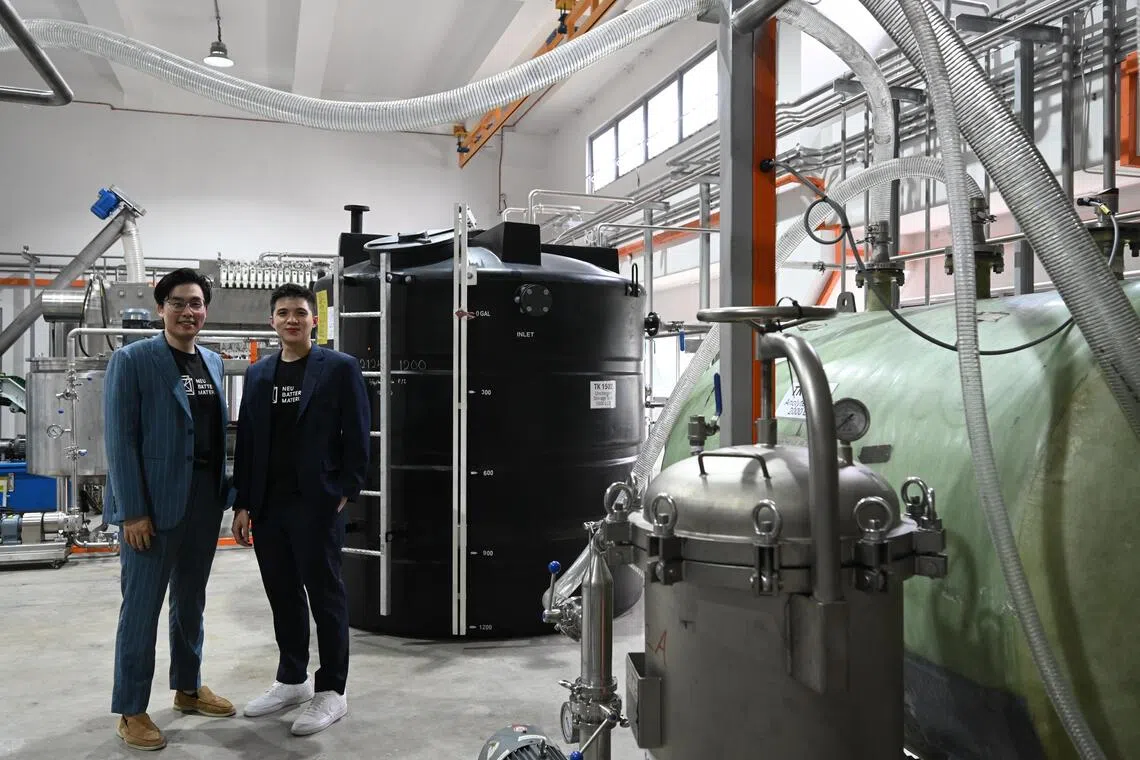
Co-Founders of NEU Battery Materials Bryan Oh Hong En (left) and Kenneth Graeme Palmer.
ST PHOTO: NG SOR LUAN
Published Oct 13, 2026, 07:25 PM
Updated Oct 13, 2026, 07:25 PM
NEU Battery Materials raised US$7.6 million in an oversubscribed round led by Shift4Good and SGInnovate to scale LFP recycling and support the battery supply chain.
The money will run its new Singapore plant, cut production costs through R&D, and expand overseas to Europe and the United States.
CEO Bryan Oh said the water-and-electricity process is scalable, six times lower in CO2, and could help secure lithium supplies as EV battery waste grows.
SINGAPORE – Singapore-based deep-tech company NEU Battery Materials has raised US$7.6 million (S$9.7 million) in an oversubscribed funding round to expand its battery recycling business.
The funding comes after NEU commissioned a new facility in Tuas capable of processing 1,300 tonnes of battery materials a year. The facility marks a major step towards scaling up its operations, although it will not initially run at full capacity.
The company will use the funds to increase production of battery-grade lithium from battery manufacturing scraps and materials from end-of-life batteries, as well as expand overseas.
According to chief executive Bryan Oh, the funds are predominantly allocated to three key areas.
“The first is operating the facility, to help us run the production and collect data,” he said.
NEU Battery Materials chemical engineer Kek Yi Qiang with a bottle of LFP black mass (right) and a bottle of the finished product lithium carbonate. ST PHOTO: NG SOR LUAN
NEU Battery Materials chemical engineer Kek Yi Qiang with a bottle of LFP black mass (right) and a bottle of the finished product lithium carbonate.
“The second is investing significantly in R&D to reduce production costs. Our company’s goal is to become the cheapest source of lithium.”
The third area focuses on expanding the business overseas, specifically in Europe and the US. By partnering with battery manufacturers abroad, NEU aims to scale up its Singapore-designed technology, potentially by five to 10 times, to help countries develop local recycling capabilities.
Oh said localised recycling could help countries secure their lithium supplies and retain greater control over their battery supply chains, given China’s dominance in the lithium supply chain and the lack of natural lithium deposits in Singapore.
The International Energy Agency notes that lithium iron phosphate (LFP) batteries account for over 55 per cent of electric vehicle (EV) batteries and more than 90 per cent of global battery energy storage systems.
According to Oh, mass-market EVs, including models made by BYD, predominantly use LFP batteries due to their lower cost and safety advantages. This makes recycling LFP waste an urgent priority.
“We use an electromechanical redox targeting technology to recycle lithium batteries,” Oh said.
“We specifically focus on recycling LFP and put these waste batteries into our process, and we are able to extract the lithium through an electrolyser to form battery-grade lithium hydroxide, which we then convert to lithium carbonate,” he explained.
The NEU Battery Materials lithium production plant. ST PHOTO: NG SOR LUAN
The NEU Battery Materials lithium production plant.
He added that the process is unique in three ways: it uses only water and electricity, is highly scalable because of the design of its cells or electrolyser, and is more sustainable than traditional recycling methods.
The facility will not be running at full capacity for now.
“The purpose is to run tests and then improve (the process) so that we can create the final blueprint to replicate for really big scale,” he said.
NEU is working with manufacturers to ensure the recovered lithium meets quality and consistency standards. It is supplying increasingly larger batches for testing, including to some manufacturers that provided the production scrap.
The materials NEU currently receives are mostly manufacturing rejects rather than end-of-life EV batteries, Oh said the company had “future-proofed Singapore for the next decade” by preparing to handle potential increases in EV battery waste.
He noted that the core plant was built to operate at a larger scale and that expanding its capacity to handle thousands of EV batteries would require only minor modifications, such as adding more cells to the electrolyser stack.
This would allow NEU to double its capacity within weeks.
With its scalable recycling model, the company aims to help position Singapore at the forefront of the green transition. Its process generates up to 83 per cent lower carbon emissions than traditional recycling methods, said Oh.
Environmental issues
NEU电池材料公司的联合创始人Bryan Oh Hong En(左)和Kenneth Graeme Palmer。
圣徒照片:吴索銮
发布于 2026 年 10 月 13 日晚上 7:25
更新于2026年10月13日晚上7:25
NEU Battery Materials 在由 Shift4Good 和 SGInnovate 领投的超额认购轮融资中筹集了 760 万美元,用于扩大 LFP 回收规模并支持电池供应链。
这笔资金将用于运营其位于新加坡的新工厂,通过研发降低生产成本,并向欧洲和美国等海外市场扩张。
首席执行官 Bryan Oh 表示,水电工艺具有可扩展性,二氧化碳排放量降低六倍,并且随着电动汽车电池废料的增加,可以帮助保障锂的供应。
新加坡——总部位于新加坡的深科技公司 NEU Battery Materials 在超额认购的融资轮中筹集了 760 万美元(970 万新元),用于扩大其电池回收业务。
在NEU位于大士的新工厂投产后,该公司获得了这笔资金。该工厂每年可处理1300吨电池材料。尽管初期不会满负荷运转,但该工厂的投产标志着NEU在扩大运营规模方面迈出了重要一步。
该公司将利用这笔资金,提高电池制造废料和废旧电池材料生产电池级锂的产量,并拓展海外市场。
据首席执行官 Bryan Oh 称,这些资金主要分配给三个关键领域。
他说:“首先是运营该设施,以帮助我们进行生产和收集数据。”
中电电池材料公司化学工程师柯义强(右)手持一瓶磷酸铁锂黑色原料,以及一瓶成品碳酸锂。(海峡时报摄影:吴淑銮)
东北大学电池材料化学工程师柯义强手持一瓶磷酸铁锂黑色物质(右)和一瓶成品碳酸锂。
“第二点是加大研发投入,以降低生产成本。我们公司的目标是成为最便宜的锂供应商。”
第三个重点领域是拓展海外业务,特别是欧洲和美国市场。NEU计划通过与海外电池制造商合作,将其新加坡研发的技术规模扩大5到10倍,以帮助这些国家发展本地化的电池回收能力。
Oh表示,鉴于中国在锂供应链中的主导地位以及新加坡缺乏天然锂矿藏,本地化回收可以帮助各国确保锂供应并更好地控制其电池供应链。
国际能源署指出,磷酸铁锂(LFP)电池占电动汽车(EV)电池的 55% 以上,占全球电池储能系统的 90% 以上。
据Oh介绍,包括比亚迪在内的大众市场电动汽车主要使用磷酸铁锂电池,因为磷酸铁锂电池成本更低、安全性更高。因此,回收利用废弃磷酸铁锂电池成为当务之急。
“我们采用机电氧化还原靶向技术来回收锂电池,”Oh说道。
他解释说:“我们特别专注于回收磷酸铁锂,并将这些废旧电池投入我们的生产流程中,我们能够通过电解槽提取锂,形成电池级氢氧化锂,然后将其转化为碳酸锂。”
NEU电池材料锂生产厂。ST摄影:吴淑銮
NEU电池材料锂生产厂。
他还补充说,该工艺有三个独特之处:它只使用水和电,由于其电解槽的设计,具有很高的可扩展性,并且比传统的回收方法更具可持续性。
该设施目前不会满负荷运转。
他说:“我们的目的是进行测试,然后改进(流程),以便我们能够创建最终蓝图,从而实现大规模复制。”
NEU正与制造商合作,确保回收的锂符合质量和一致性标准。它正在向包括一些提供生产废料的制造商在内的各方供应越来越大批量的样品进行测试。
吴先生表示,NEU目前收到的材料大多是生产废料,而不是报废的电动汽车电池,公司已经通过应对电动汽车电池废弃物可能增加的情况,为新加坡“未来十年做好了充分准备”。
他指出,核心工厂是按照更大规模建造的,要扩大其处理数千个电动汽车电池的能力,只需要进行一些小的改动,例如在电解槽堆中添加更多的电池。
这将使东北大学在几周内将其招生规模扩大一倍。
凭借其可扩展的回收模式,该公司旨在帮助新加坡在绿色转型中占据领先地位。Oh表示,与传统回收方法相比,其工艺产生的碳排放量最多可减少83%。
环境问题