Harbour craft operators to be given grants of up to $250k for switching to electric vessels港口船舶经营者若改用电动船舶,将获得最高25万美元的补助。
MPA unveils grants of up to $250,000 to support adoption of electric harbour craft in Singapore. Read more at straitstimes.com.
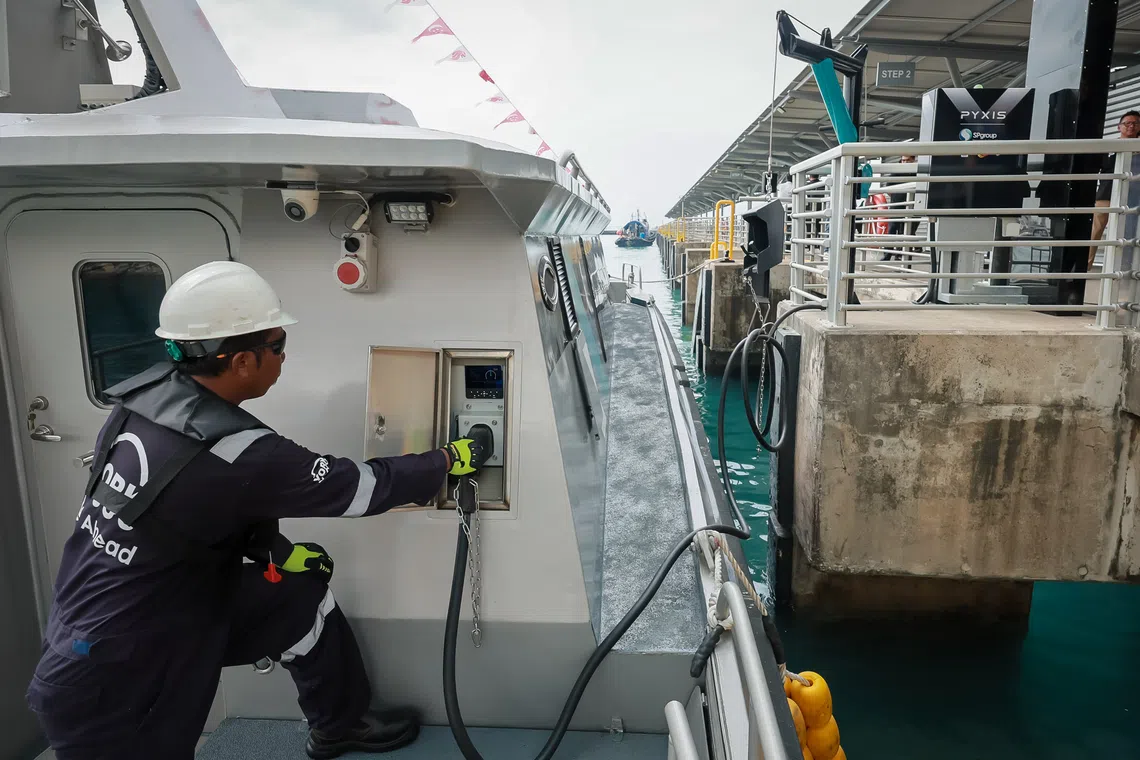
A worker charging the Pyxis X Tron, a fully electric passenger vessel, berthed at Marina South Pier on April 8, 2024.
Published Oct 14, 2026, 09:30 AM
Updated Oct 14, 2026, 09:30 AM
MPA will give up to $250,000 in grants for early adopters of fully electric harbour craft, with payments based on battery capacity and vessel size.
Singapore wants all new harbour craft from 2030 to use electric power, B100 biofuel, or net-zero fuels, as it moves a diesel fleet of more than 1,600 vessels towards net zero by 2050.
MPA is also pushing alternative fuels and digital change through ammonia standards, bio-methane plans, LNG storage units, and phase two of digital bunkering.
SINGAPORE – Electric harbour craft operators can qualify for up to $250,000 in grants as part of efforts to help offset costs and encourage the early adoption of greener vessels .
The Maritime and Port Authority of Singapore (MPA) on Oct 14 said the scheme will run for two years and aims to spur early demand, giving manufacturers and technology providers greater confidence to invest in production and expand capacity.
MPA added that the funding will be split into three payments and disbursed based on a vessel’s battery capacity, at $250 for every kilowatt-hour.
The grant will be determined by vessel size, said MPA.
Smaller boats, such as passenger craft carrying up to 12 people or vessels hauling up to 20 tonnes of cargo, can receive up to $150,000, while larger vessels qualify for the maximum amount of $250,000.
While the scheme officially kicks in on Jan 1, 2027, any fully electric vessel that secures a harbour craft licence between Oct 14, 2026, and Dec 31, 2028, will be eligible.
MPA said the harbour craft sector – which comprises more than 1,600 diesel-powered vessels – is expected to hit net-zero emissions by 2050, in line with national targets.
However, because vessels typically remain in service for more than 20 years, the transition to greener alternatives will need to kick into gear soon.
From 2030, all new harbour craft operating in Singapore’s waters will need to be fully electric or capable of using B100 biofuel – a pure form of biodiesel made from renewable sources – or be compatible with net-zero fuels such as hydrogen.
Senior Minister of State for Transport Murali Pillai said “every transition needs first movers”.
In an address at the Singapore International Bunkering Conference on Oct 14, he said: “Without early adopters, there are no initial orders. Without orders, suppliers have no opportunity to scale.
“And without scale, costs remain high.”
More than 2,000 maritime professionals from over 60 countries attended the conference, which takes place every two years. In 2026 , it was held at Resorts World Sentosa, with the theme “Charting a resilient multi-fuel future”.
Murali said: “With the future fuel mix still uncertain, Singapore has decided not to bet on a single winning fuel but is instead building optionality.”
Singapore, he added, is working to ensure that infrastructure is ready to support the use of alternative fuels like ammonia.
On Oct 14, MPA and Enterprise Singapore launched a new Singapore Standard and two technical references for the fuel.
MPA chief executive Ang Wee Keong said: “As shipping transitions towards a wider range of marine fuels, our bunkering standards and capabilities must evolve with it.”
He added that the new standards will support the maritime industry’s transition towards alternative fuels while also strengthening Singapore’s capabilities in meeting global bunkering needs.
To that end, bunkering trials using ammonia will take place at ports in Singapore and Western Australia.
Through the Singapore-Australia Green and Digital Shipping Corridor, the experiences gleaned from the trials will be shared between MPA and the Pilbara Ports Authority.
Besides ammonia, MPA also signed a memorandum of understanding with French ocean transportation and logistics firm CMA CGM and Singapore LNG Corporation to look into the potential use of liquefied bio-methane as marine fuel, including how existing gas infrastructure can be used to support its supply.
At the same time, MPA will open licence applications to operate floating storage units for liquefied natural gas in Singapore’s anchorages by the end of 2026. MPA added that these units will expand storage capacity and make the supply chain more resilient, supporting growing demand.
On the digital front, MPA will start on the second phase of its digital bunkering initiative. While the first phase introduced digital documentation, this next stage aims to boost security and automate data transfers for relevant stakeholders.
Aqil Hamzah is a transport journalist at The Straits Times. He is also interested in issues related to crime and technology.
Maritime and shipping
Maritime and Port Authority of Singapore
Electric and hybrid vehicles
2024年4月8日,一名工人在码头南码头为全电动客船 Pyxis X Tron 充电。
发布于2026年10月14日上午9:30
更新于2026年10月14日上午9:30
MPA 将向早期采用全电动港口船舶的用户提供高达 25 万美元的补助金,补助金额将根据电池容量和船舶尺寸而定。
新加坡希望从 2030 年起所有新的港口船舶都使用电力、B100 生物燃料或净零燃料,因为新加坡计划到 2050 年将其 1600 多艘柴油船组成的船队逐步实现净零排放。
MPA 还通过氨标准、生物甲烷计划、液化天然气储存装置和数字加注第二阶段来推动替代燃料和数字化变革。
新加坡——电动港口船舶运营商可获得高达 25 万美元的补助金,这是政府为帮助抵消成本和鼓励尽早采用更环保的船舶而采取的措施之一。
新加坡海事及港务管理局 (MPA) 于 10 月 14 日表示,该计划将持续两年,旨在刺激早期需求,使制造商和技术提供商更有信心投资生产和扩大产能。
MPA补充说,这笔资金将分三期支付,并根据船舶的电池容量进行分配,每千瓦时250美元。
MPA表示,拨款金额将根据船舶大小而定。
载客量不超过 12 人的小型船只或载货量不超过 20 吨的船舶,最高可获得 15 万美元的补贴,而大型船舶最高可获得 25 万美元的补贴。
虽然该计划将于 2027 年 1 月 1 日正式生效,但任何在 2026 年 10 月 14 日至 2028 年 12 月 31 日期间获得港口船舶许可证的全电动船舶都将有资格参与。
海事及港务管理局表示,港口船舶行业(包括 1600 多艘柴油动力船舶)预计将在 2050 年实现净零排放,符合国家目标。
然而,由于船舶的服役年限通常超过 20 年,向更环保的替代方案过渡需要尽快启动。
从 2030 年起,所有在新加坡水域运营的新港口船舶都必须是全电动的,或者能够使用 B100 生物燃料(一种由可再生资源制成的纯生物柴油),或者与氢气等净零排放燃料兼容。
交通部国务高级部长穆拉利·皮莱表示,“任何转型都需要先行者”。
他在10月14日新加坡国际燃油供应大会上发表讲话时说:“如果没有早期用户,就没有初始订单。没有订单,供应商就没有机会扩大规模。”
“而且如果没有规模,成本就会居高不下。”
来自60多个国家的2000多名海事专业人士参加了此次两年一度的会议。2026年的会议在圣淘沙名胜世界举行,主题是“规划一个具有韧性的多燃料未来”。
穆拉里表示:“由于未来的燃料组合仍不明朗,新加坡决定不押注于单一的制胜燃料,而是构建多种选择。”
他补充说,新加坡正在努力确保基础设施做好准备,以支持使用氨等替代燃料。
10 月 14 日,新加坡海事及港务管理局 (MPA) 和新加坡企业发展局 (Enterprise Singapore) 发布了新的新加坡燃料标准和两项技术参考。
海事及港务管理局首席执行官洪伟强表示:“随着航运业向更广泛的船用燃料过渡,我们的加油标准和能力也必须随之发展。”
他还补充说,新标准将支持海运业向替代燃料转型,同时也将增强新加坡满足全球船舶加油需求的能力。
为此,将在新加坡和西澳大利亚的港口进行使用氨气的加注试验。
通过新加坡-澳大利亚绿色和数字航运走廊,新加坡海事及港务管理局和皮尔巴拉港务局将分享从试验中获得的经验。
除了氨之外,MPA 还与法国远洋运输和物流公司 CMA CGM 以及新加坡液化天然气公司签署了一份谅解备忘录,以研究液化生物甲烷作为船用燃料的潜在用途,包括如何利用现有的天然气基础设施来支持其供应。
与此同时,新加坡海事及港务管理局(MPA)将于2026年底前开放在新加坡锚地运营液化天然气浮式储存装置的许可证申请。MPA补充说,这些装置将扩大储存能力,增强供应链的韧性,从而支持不断增长的需求。
在数字化方面,MPA将启动其数字化加油计划的第二阶段。第一阶段引入了数字化文档,而第二阶段旨在提升安全性并实现相关利益攸关方的数据传输自动化。
阿基尔·哈姆扎是《海峡时报》的交通记者。他也对犯罪和科技相关议题感兴趣。
海事和航运
新加坡海事及港务管理局
电动和混合动力汽车