GovTech and Google DeepMind developing real-time detection of AI scams on devicesGovTech 和 Google DeepMind 正在开发针对设备的 AI 诈骗实时检测技术。
Organisations will also receive funding through a new grant to protect against quantum threats.
Organisations will also receive funding through a new grant to protect against quantum threats.
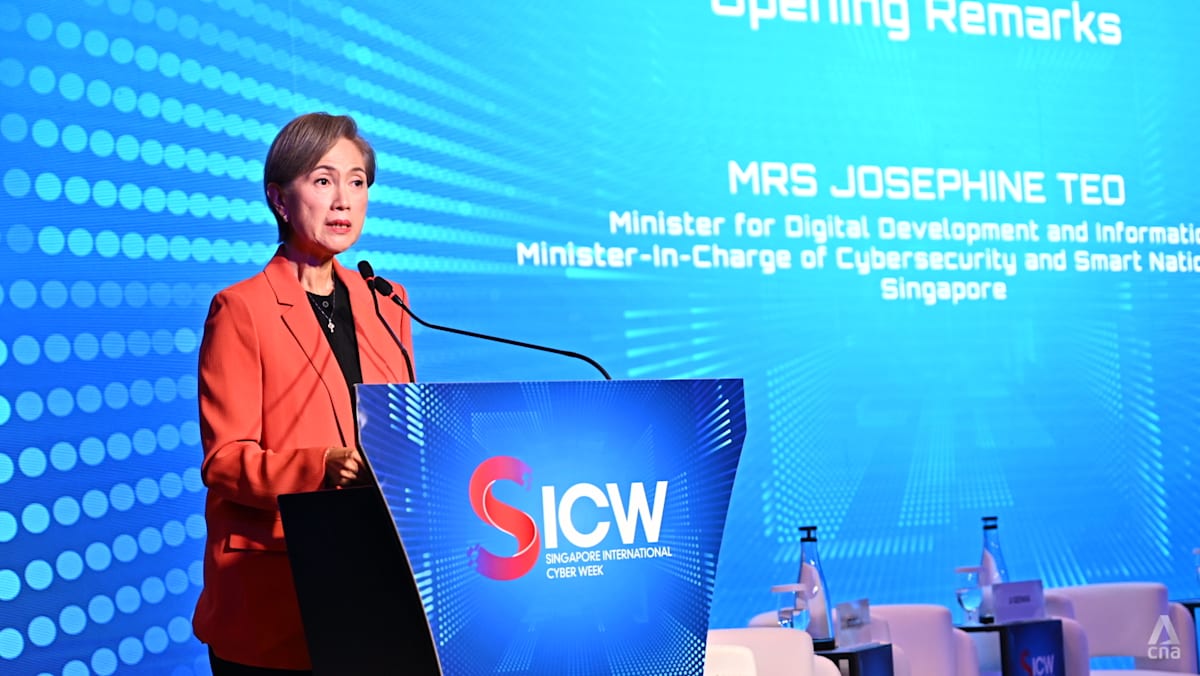
Minister for Digital Development and Information, Josephine Teo, delivers an opening address on quantum-safe migration at an SICW event at the Sands Expo and Convention Centre on Oct 14, 2026. (Photo: CNA/Raydza Rahman)
This audio is generated by an AI tool.
SINGAPORE: The Government Technology Agency of Singapore (GovTech) is collaborating with artificial intelligence research laboratory Google DeepMind to develop real-time detection of AI scams on devices, Minister for Digital Development and Information Josephine Teo said on Wednesday (Oct 14).
Mrs Teo, who is also the minister-in-charge of cybersecurity and smart nation group, said the collaboration could provide stronger protection while preserving privacy.
“If our devices can recognise signs of manipulation early, we can help potential victims avoid financial or credential loss, while keeping their personal messages on their devices,” she said.
Speaking at the Singapore International Cyber Week at the Sands Expo and Convention Centre, she said the fight against scams has become “harder to win” because of artificial intelligence.
CNA Games Guess Word Crack the word, one row at a time Buzzword Create words using the given letters Mini Sudoku Tiny puzzle, mighty brain teaser Mini Crossword Small grid, big challenge Word Search Spot as many words as you can Show More Show Less “Our response should not be to turn away from AI because scammers misuse it. Instead, we must tune up our defences and make them better,” she said, adding that Singapore must coordinate its responses more tightly as scammers deploy their tactics across multiple systems. A victim may first encounter a scam on social media, move to a messaging platform, receive a phone call and transfer money through a financial institution, said Mrs Teo. Each stage offers a chance to intervene, but no single defender sees the whole chain. “It is therefore not enough to make every organisation better at stopping scams. We must also connect our defences so that a single signal detected on one part of the ecosystem can trigger action elsewhere.” At the same time, AI can be used to detect threats at scale, she said. For example, the Scam Analytics and Tactical Intervention System by GovTech and the Singapore Police Force uses AI to scan and assess more than 600,000 websites every day, each in a matter of seconds. It disrupts around 20,000 malicious websites every month, and has expanded to include mobile numbers and online platforms that are suspicious. This allows Singapore to find and act on threats at a speed and scale that human effort alone cannot match, Mrs Teo said.
“Our response should not be to turn away from AI because scammers misuse it. Instead, we must tune up our defences and make them better,” she said, adding that Singapore must coordinate its responses more tightly as scammers deploy their tactics across multiple systems.
A victim may first encounter a scam on social media, move to a messaging platform, receive a phone call and transfer money through a financial institution, said Mrs Teo. Each stage offers a chance to intervene, but no single defender sees the whole chain.
“It is therefore not enough to make every organisation better at stopping scams. We must also connect our defences so that a single signal detected on one part of the ecosystem can trigger action elsewhere.”
At the same time, AI can be used to detect threats at scale, she said. For example, the Scam Analytics and Tactical Intervention System by GovTech and the Singapore Police Force uses AI to scan and assess more than 600,000 websites every day, each in a matter of seconds.
It disrupts around 20,000 malicious websites every month, and has expanded to include mobile numbers and online platforms that are suspicious.
This allows Singapore to find and act on threats at a speed and scale that human effort alone cannot match, Mrs Teo said.
Singapore should also pay close attention to quantum-related risks, said Mrs Teo.
Quantum computing uses the principles of quantum physics to solve complex problems. While it holds “enormous promise”, sufficiently powerful quantum computers could eventually break some of the cryptography protecting financial transactions, sensitive communications and digital systems, she said.
“We do not know when this will happen. But we know we must prepare for it. Bad actors are already motivated to steal sensitive encrypted data while waiting for quantum computers to decrypt them in future,” she said.
For larger organisations, migrating to quantum-safe solutions can take several years. They must assess risks, prioritise systems and data, and identify where current encryption can be broken.
They also need to work with technology suppliers, test alternative methods of encryption and progressively migrate their systems, she said.
In June, the Cyber Security Agency of Singapore (CSA) issued guidance on migration milestones for owners of critical information infrastructure, or computer systems that provide essential services. They are expected to complete migration by 2031.
The agency previously identified energy, water, banking and finance, healthcare, transport, infocomm, media, security and emergency services, and government as sectors with such systems.
Mrs Teo said Singapore will issue guidance for other organisations to work towards quantum-safe migration by 2035. These include organisations whose exposure to the quantum threat could have serious consequences, she said.
For example, organisations that hold sensitive information that must remain confidential for many years, and those that provide critical services such as communications or digital transactions where maintaining integrity and confidentiality of information are essential.
A new quantum-safe kickstarter grant will also fund organisations to move from planning to implementation. The time-bound seed funding will help them identify implementation challenges, test quantum-safe solutions in real operating environments and build the experience needed for migration at scale.
The grant is open to all organisations, with priority for owners of critical information infrastructure systems. It will run from Nov 1 to Oct 31, 2027, with each funded pilot lasting up to six months.
Organisations may undertake pilots in-house or work with suitable solution providers, CSA said. Priority will go to use cases that address common migration challenges, including migrating an application or system from end to end and cryptographic discovery and inventory.
Mrs Teo said neither scams nor quantum threats can be solved by the government alone, or by any country on its own.
“Staying ahead depends not only on what we can build ourselves, but what we can pool together through mutual support,” she said.
Get our pick of top stories and thought-provoking articles in your inbox
Stay updated with notifications for breaking news and our best stories
Join our channel for the top reads for the day on your preferred chat app
各组织还将通过一项新的拨款获得资金,用于防范量子威胁。
2026年10月14日,新加坡数码发展及新闻部长杨莉明在金沙会展中心举行的SICW活动上就量子安全迁移发表开幕致辞。(图片:CNA/Raydza Rahman)
这段音频是由人工智能工具生成的。
新加坡:新加坡数码发展及新闻部长杨莉明周三(10月14日)表示,新加坡政府科技局(GovTech)正与人工智能研究实验室谷歌DeepMind合作,开发实时检测设备上人工智能诈骗的技术。
同时兼任网络安全和智慧国家事务部长的张女士表示,此次合作可以在保护隐私的同时提供更强有力的保护。
“如果我们的设备能够及早识别出篡改迹象,我们就可以帮助潜在受害者避免经济或凭证损失,同时保留他们设备上的个人信息,”她说。
她在新加坡金沙会展中心举行的国际网络安全周上发表讲话时表示,由于人工智能的出现,打击诈骗的斗争变得“更加艰难”。
CNA游戏猜词游戏:逐行破解单词;流行词游戏:用给定的字母组成单词;迷你数独:小巧的谜题,强大的脑力挑战;迷你填字游戏:小方格,大挑战;单词搜索:尽可能多地找出单词。显示更多 显示更少 “我们不应该因为诈骗分子滥用人工智能就放弃它。相反,我们必须加强防御,使其更加完善,”她说道。她还补充说,随着诈骗分子在多个系统中部署诈骗手段,新加坡必须更紧密地协调应对措施。张女士表示,受害者可能首先在社交媒体上遇到诈骗,然后转移到即时通讯平台,接到电话,最后通过金融机构转账。每个阶段都提供了干预的机会,但没有哪个防御者能够看到整个链条。“因此,仅仅提高每个机构阻止诈骗的能力是不够的。我们还必须连接我们的防御系统,以便在生态系统的某个部分检测到的单个信号可以触发其他地方的行动。”她还表示,与此同时,人工智能可以用于大规模检测威胁。例如,新加坡政府科技局和新加坡警察部队联合开发的诈骗分析和战术干预系统利用人工智能技术,每天扫描和评估超过60万个网站,每个网站仅需几秒钟即可完成。该系统每月可拦截约2万个恶意网站,并且其检测范围已扩展至可疑的手机号码和在线平台。张女士表示,这使得新加坡能够以人力无法企及的速度和规模发现并应对威胁。
她表示:“我们不应因为诈骗分子滥用人工智能就放弃它。相反,我们必须加强防御,使其更加完善。”她还补充说,由于诈骗分子会在多个系统中部署诈骗手段,新加坡必须更紧密地协调应对措施。
张女士表示,受害者可能首先在社交媒体上遇到诈骗,然后转移到即时通讯平台,接着接到电话,最后通过金融机构转账。每个阶段都提供了干预的机会,但没有哪个保护者能够看到整个诈骗链条。
“因此,仅仅提高每个组织打击诈骗的能力是不够的。我们还必须将各个防御环节连接起来,以便在生态系统的某个环节检测到的单一信号能够触发其他环节的行动。”
她表示,人工智能还可以用于大规模检测威胁。例如,新加坡政府科技局和新加坡警察部队联合开发的诈骗分析和战术干预系统,就利用人工智能技术,每天扫描和评估超过60万个网站,每个网站只需几秒钟即可完成。
它每月可干扰约 20,000 个恶意网站,并且已扩展到包括可疑的手机号码和在线平台。
张女士表示,这使得新加坡能够以仅靠人力无法企及的速度和规模发现并应对威胁。
张女士表示,新加坡也应该密切关注量子相关的风险。
量子计算利用量子物理学的原理来解决复杂问题。她表示,虽然量子计算“前景广阔”,但功能足够强大的量子计算机最终可能会破解一些保护金融交易、敏感通信和数字系统的加密技术。
“我们不知道这种情况何时会发生。但我们知道必须为此做好准备。不法分子已经开始伺机窃取敏感的加密数据,等待未来量子计算机对其进行解密,”她说道。
对于规模较大的组织而言,迁移到量子安全解决方案可能需要数年时间。他们必须评估风险,确定系统和数据的优先级,并找出当前加密技术可能被破解的地方。
她还表示,他们还需要与技术供应商合作,测试替代加密方法,并逐步迁移他们的系统。
今年6月,新加坡网络安全局(CSA)发布了针对关键信息基础设施(即提供重要服务的计算机系统)所有者的迁移里程碑指南。预计这些所有者将在2031年前完成迁移。
该机构此前已将能源、水务、银行和金融、医疗保健、交通运输、信息通信、媒体、安全和应急服务以及政府等行业列为拥有此类系统的行业。
张女士表示,新加坡将发布指导方针,指导其他组织在2035年前实现量子安全迁移。她指出,这些组织包括那些可能因量子威胁而遭受严重后果的组织。
例如,持有必须保密多年的敏感信息的组织,以及提供通信或数字交易等关键服务的组织,在这些服务中,维护信息的完整性和保密性至关重要。
一项新的量子安全启动基金将资助相关机构从规划阶段过渡到实施阶段。这项有时限的种子资金将帮助他们识别实施过程中遇到的挑战,在实际运行环境中测试量子安全解决方案,并积累大规模迁移所需的经验。
该项资助面向所有机构开放,但优先考虑拥有关键信息基础设施系统的机构。资助期限为2020年11月1日至2027年10月31日,每个获资助的试点项目最长持续六个月。
CSA表示,各组织可以自行开展试点项目,也可以与合适的解决方案提供商合作。优先考虑的是能够解决常见迁移挑战的用例,包括应用程序或系统的端到端迁移以及加密发现和清单。
张女士表示,无论是诈骗还是量子威胁,都无法仅靠政府或任何国家单独解决。
“保持领先地位不仅取决于我们自身能够取得的成就,还取决于我们通过相互支持能够汇集的资源,”她说。
订阅我们的邮件,即可获取精选热点新闻和引人深思的文章。
订阅通知,第一时间获取突发新闻和精彩报道。
加入我们的频道,即可在您常用的聊天应用上获取当日热门文章。