Small steps, big hearts: Learning together at an inclusive pre-school小步,大爱:在包容性幼儿园一起学习
At Kindle Garden, Singapore’s first inclusive pre-school, neurotypical and able-bodied children learn and play alongside those with diverse needs. Read more at straitstimes.com.
新闻视频
Published: Oct 14, 2026, 05:00 AM
When pre-school teacher Nur Allysha Osman begins her K2 class’ indoor gym session with instructions to set up a play area, her charges get to work enthusiastically.
They arrange blocks around a wheelchair-using classmate who has pachygyria, a rare brain development condition, in order to make him feel included.
Next, the children carefully guide another classmate who has Mowat-Wilson syndrome to the centre of a ball pit, where they play together. Mowat-Wilson syndrome is a rare genetic disorder which causes intellectual disability and developmental delays.
Being inclusive comes easily for children at the Kindle Garden pre-school in the Enabling Village, where typically developing children learn and play alongside classmates with special needs, at a ratio of 70:30.
The mission of Kindle Garden, located in Lengkok Bahru, is to “nurture conscientious, compassionate, and confident children through personalised learning, collaboration, and purpose-built spaces”.
“(It has become) natural for the kids to take all their friends into account when setting up the play area,” says Nur Allysha, affectionately known to the children as teacher Ally.
Senior teacher Nur Allysha Osman with her K2 charges, including Huang Yichen (right), who has autism spectrum disorder. While typically developing children play freely with their special needs peers, there is also freedom for all learners to engage with the activity according to their personal comfort level.
“The kids understand that each one of us is different. Teachers share (such lessons) in simpler words in a way the kids can understand. I might share briefly what the traits an (autism spectrum disorder) kid might have. Some kids might pinpoint the traits in their friend, and that’s how they gain more awareness about special needs.”
Senior teacher Nur Allysha Osman (left) and Kindle Garden principal Dawn Hu soothing six-year-old Huang Yichen during lunchtime.
Teacher assistant Zhang Yanqiu caring for David Tan, six, who has Mowat-Wilson syndrome, during an outdoor play session.
Encouraging words espousing inclusive values seen in one of the open-concept classrooms.
She says her current class of 11 K2 learners have bonded so well that they can soothe and manage their special needs classmates unprompted by teachers, such as retrieving a favourite toy for a friend who is having a meltdown.
Huang Yichen (right), who has autism spectrum disorder, playing with (from left) Sofea Ariana Muhammad Shalehin, Zoe Lee and Amber Ang at the indoor gym.
Five of the children in the class have been together since they were toddlers, while the rest joined later.
Kindle Garden senior teacher Nur Allysha Osman (third from right) conducting an art lesson for her K2 class.
Since social service agency AWWA opened Kindle Garden, Singapore’s first inclusive pre-school, in 2016, more than 700 children have passed through its doors. Currently, there are 47 children enrolled in the pre-school.
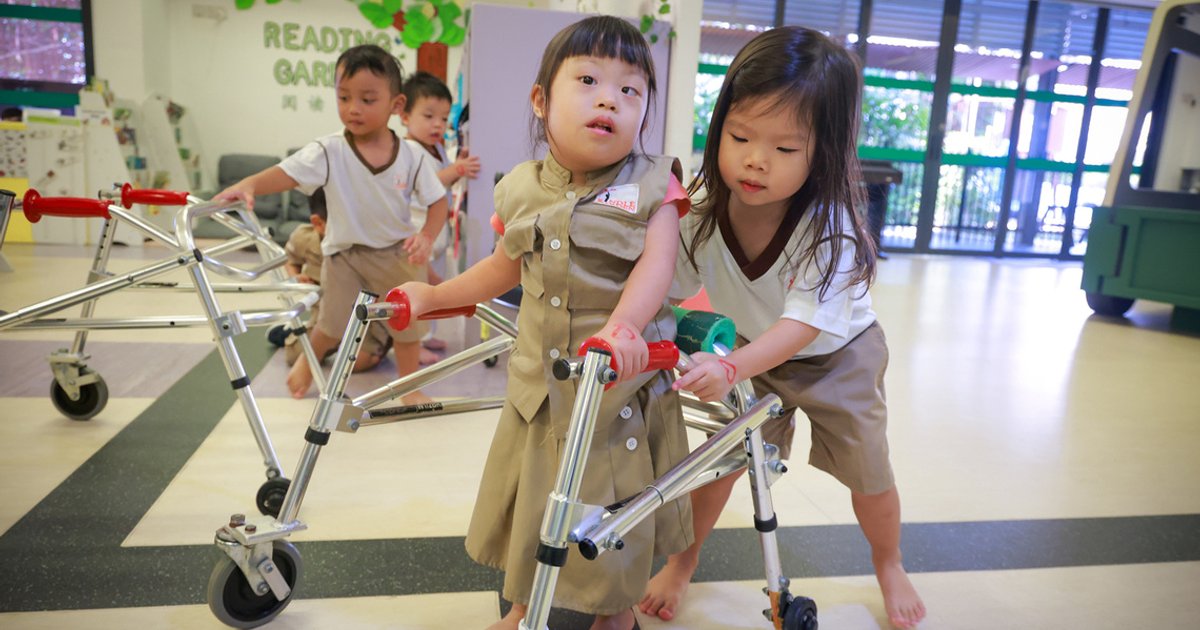
Three-year-old Liv Heng (right) helping classmate Anna Kham, three, who has Down syndrome, with her walker.
Monthly fees at Kindle Garden used to be up to $1,800 before subsidies. Since March, fees have been capped at $900.
Anna Kham (second from left), who has Down syndrome, settling down to nap with her classmates at the inclusive pre-school.
Now there are other inclusive pre-schools, including TOUCH Community Services’ HATCH by TOUCH Preschools, and the Bright Path inclusive pre-school .
“Inclusion has evolved,” says AWWA director of disability and inclusion Ng Lee Lee. “Many in the past confused integration with inclusion. Putting a sole child with additional needs in a standard classroom and hoping for the best isn’t inclusion.”
A chart showing the buddy system of the N1 class.
Amber Ang guiding classmate David Tan, who has Mowat-Wilson syndrome.
Kindle Garden has moved beyond one-off moments of inclusion to “intentionally build inclusive elements and principles into thought, action, systems, tools and values, which are grounded in science”, she adds.
Instructions on how to use sign language to indicate the days of the week.
All learners at Kindle Garden participate in the same activities according to their abilities and study the same curriculum as that of mainstream pre-schools.
Nur Ilhan Yusri (bottom), seven, who has Down syndrome, lying down during a phonics lesson. All learners at Kindle Garden go through the same lessons and activities, but children with special needs are given space to join in at their own pace and comfort level.
But they receive personalised support based on their needs, and have different learning goals every semester.
Teacher Lakshanaa Ganeson (right) consulting speech therapist Jacqui Tan on a child with communication difficulties.
For example, speech therapists help less verbal children communicate their feelings, choices and needs more effectively using tools such as visual aids.
Speech therapist Jacqui Tan working with three-year-old Ari Izuan Mohati Wei An, who has Down syndrome, at the pre-school.
Tools such as visual aids are used to help less verbal children communicate more effectively.
Senior teacher Nur Allysha Osman using picture flashcards to communicate with David Tan, six, who has Mowat-Wilson syndrome.
And, compared with a typically developing child, who might be working on forming sentences, a child with additional needs could have a goal of remaining at a table activity for five minutes.
Teacher assistant Auralina Michaille Joseph Raj with pre-schoolers (from left) Adriel Chiam, four, who has Down syndrome; Muhammad Omar Muhd Solihin, three; Ari Izuan Mohati Wei An, three, who has Down syndrome; and Nur Hidayah Muhammad Solihin, four, at play with puzzle toys.
Inclusivity is also embedded in the pre-school’s design.
Anna Kham, three, who has Down syndrome, reading a book at the reading corner.
A “calm-down space” for children who may need to regulate their feelings and emotions.
Outdoors, the playground has wide ramps to accommodate mobility aids such as wheelchairs, and a communication board for non-verbal children.
Teacher assistant Zhang Yanqiu using a communication board with David at the pre-school’s playground.
Inside, Kindle Garden’s facilities include open-concept classrooms; textured flooring to support sensory awareness, supporting children in navigating and engaging with their environment; and wooden ceiling beams that help absorb sound, accommodating special needs children who may be overstimulated by loud sounds.
Huang Yichen, six, who has autism spectrum disorder, having a moment to himself by a hammock. Inclusive design elements of the pre-school include open-concept classrooms and wooden ceiling beams that help absorb sound.
There is a calming tent for children who need space to regulate themselves, as well as a truck structure which is accessible to children of all abilities.
Senior teacher Nur Allysha Osman conducting a reading session in the “calm-down tent”. The tent provides a quiet space for children who may feel overstimulated or need to regulate themselves, or simply serves as a cosy space for various activities.
Senior teacher Nur Allysha Osman conducting a play session for her K2 students (from left) David Tan, who has Mowat-Wilson syndrome, Cheyenne Ng, Zoe Lee and Sofea Ariana Muhammad Shalehin. David is the “customer” patronising a “food truck” run by his classmates.
It is not only special needs children who benefit from learning at Kindle Garden. In learning and playing alongside their special needs friends, typically developing children grow their empathy and emotional intelligence, says Ng.
Six-year-old David, who has Mowat-Wilson syndrome, receiving help from Zariff Aryyan Saidina Bakri, six, to wash his hands before lunch. Being inclusive comes easily for children at the pre-school.
This was why Geraldine Tay chose to enrol her typically developing daughter Cheyenne Ng at Kindle Garden.
“Character-building is just as important as academics,” says the 38-year-old home-based baker. “What drew us to Kindle Garden was its inclusive environment and the way every child is valued as an individual. We want Cheyenne to grow up appreciating differences while having the freedom to develop at her own pace.”
Cheyenne Ng (far right) helping David Tan up the steps to a ball pit prepared by fellow classmates (from left) Amber Ang, Zoe Lee and Sofea Ariana Muhammad Shalehin during an indoor gym session.
Her daughter, now six and in K2, has become more independent, expressive and understanding of others, Tay says.
(From left) Cheyenne Ng, Amber Ang and Zoe Lee, all six years old, playing in the playground at Kindle Garden.
In September , Cheyenne even received the Little Heroes of Inclusion Award at the Good Start Early Childhood Conference, which champions inclusion, early childhood education and pre-school development in Singapore. The award recognises children who exemplify inclusive values through their everyday actions.
Nur Allysha, who teaches Cheyenne’s K2 class, says Cheyenne often reminds her friends to slow down and be more patient when playing with special needs peers, and will take the initiative to adapt an activity to include them, such as bringing out items like music bells that she knows her friends will enjoy.
Cheyenne Ng (right) playing with music bells alongside David Tan (second from right), who has Mowat-Wilson syndrome, as senior teacher Nur Allysha Osman holds Kyle Wong, who has pachygyria and tubulinopathy.
As it steps into its second decade, Kindle Garden will be expanding to a second location in the east.
AWWA had taken over the premises of Little Preschool Pasir Ris from April , and will welcome children with additional needs in 2027.
This shows there is a real space for inclusive early childhood education in our nation to further develop, says Ng.
Cheyenne says she will miss “everything” about the pre-school after she graduates from K2 – from teacher Ally to her classmate David’s “chubby cheeks” that she says feels like “squishing a butter squishy toy”.
Cheyenne squishing David’s cheeks as senior teacher Nur Allysha Osman looks on.
Nur Allysha has high hopes for Cheyenne and the rest of her K2 class as they move on to the next step of their education. “They’ve learnt so much about inclusivity,” she says. “I want them to bring this to their new schools, to continue to be empathetic, continue being that caring and responsible friend and to share those values with other children in their new schools.”
Children hugging senior teacher Jewelyn Siew as she prepares to leave at the end of the school day at Kindle Garden.
Produced by: Andy Chen, Irene Ang, Jason Quah and Neo Xiaobin
Main photographs and videos by : Jason Quah
发布时间:2026年10月14日 上午5:00
当学前班老师努尔·艾丽莎·奥斯曼开始她的K2班室内体育课,并指导孩子们布置游戏区时,孩子们都热情地投入其中。
他们围绕着一位患有脑回增厚症(一种罕见的脑发育障碍)的坐轮椅的同学摆放积木,让他感受到被接纳。
接下来,孩子们小心翼翼地引导另一位患有莫瓦特-威尔逊综合征的同学来到球池中央,一起玩耍。莫瓦特-威尔逊综合征是一种罕见的遗传性疾病,会导致智力障碍和发育迟缓。
在 Enabling Village 的 Kindle Garden 幼儿园,包容性对孩子们来说很容易理解。在那里,正常发育的孩子们与有特殊需要的同学一起学习和玩耍,比例为 70:30。
位于 Lengkok Bahru 的 Kindle Garden 的使命是“通过个性化学习、协作和专门建造的空间,培养有责任心、有同情心和自信的孩子”。
“孩子们在布置游戏区时,自然而然地会考虑到所有朋友的感受,”努尔·艾丽莎说道,孩子们亲切地称她为艾丽老师。
资深教师努尔·艾丽莎·奥斯曼和她的K2班学生在一起,其中包括患有自闭症谱系障碍的黄一辰(右)。正常发育的孩子们可以和有特殊需要的同伴们自由玩耍,所有学生也都可以根据自己的舒适程度参与活动。
孩子们明白我们每个人都是不同的。老师们会用孩子们能理解的简单语言来讲解(这些知识)。我可能会简要地介绍一下自闭症谱系障碍儿童可能具有的特征。有些孩子可能会指出他们朋友身上的这些特征,这样他们就能更多地了解特殊需求。
资深教师 Nur Allysha Osman(左)和 Kindle Garden 校长 Dawn Hu 在午餐时间安抚六岁的 Huang Yichen。
教师助理张艳秋在户外游戏课上照顾患有莫瓦特-威尔逊综合征的六岁男孩大卫·谭。
在一间开放式教室里可以看到鼓励人心、倡导包容价值观的标语。
她说,她目前班上的 11 名 K2 学生彼此之间关系非常好,他们无需老师提醒就能安抚和照顾有特殊需要的同学,例如,当朋友情绪崩溃时,他们会主动去拿回自己最喜欢的玩具。
患有自闭症谱系障碍的黄宜辰(右)在室内体育馆与(从左至右)Sofea Ariana Muhammad Shalehin、Zoe Lee 和 Amber Ang 玩耍。
班里有五个孩子从蹒跚学步时就在一起,其余的孩子是后来才加入的。
Kindle Garden 高级教师 Nur Allysha Osman(右三)正在为她的 K2 班级上美术课。
自社会服务机构AWWA于2016年开设新加坡首家包容性幼儿园Kindle Garden以来,已有超过700名儿童从这里入学。目前,该幼儿园共有47名在读儿童。
三岁的 Liv Heng(右)正在帮助患有唐氏综合症的三岁同学 Anna Kham 使用助行器。
在获得补贴之前,Kindle Garden 的月费最高可达 1800 美元。自 3 月起,费用上限已降至 900 美元。
患有唐氏综合症的安娜·卡姆(左二)和她的同学们在融合式幼儿园里安顿下来午睡。
现在还有其他包容性幼儿园,包括 TOUCH 社区服务机构的 HATCH by TOUCH 幼儿园和 Bright Path 包容性幼儿园。
“融合教育已经发展演变,”美国妇女福利协会(AWWA)残疾与融合事务主任吴丽丽(Ng Lee Lee)表示,“过去很多人把融合教育和统筹安排混为一谈。把一个有特殊需要的孩子放在普通教室里,然后听天由命,这根本不是融合教育。”
一张显示N1级学员结对互助制度的图表。
Amber Ang指导患有莫瓦特-威尔逊综合征的同学David Tan。
她补充说,Kindle Garden 已经超越了一次性的包容性时刻,而是“有意识地将包容性元素和原则融入到思想、行动、系统、工具和价值观中,而这些都以科学为基础”。
如何用手语表示星期几的说明。
Kindle Garden 的所有学生都根据自己的能力参加相同的活动,学习与主流幼儿园相同的课程。
七岁的努尔·伊尔汉·尤斯里(下图)患有唐氏综合征,在拼读课上躺着。在金德尔花园幼儿园,所有学生都学习相同的课程和活动,但有特殊需要的孩子可以根据自己的节奏和舒适程度参与其中。
但他们会根据自身需求获得个性化的支持,并且每个学期都有不同的学习目标。
教师 Lakshanaa Ganeson(右)正在咨询语言治疗师 Jacqui Tan,帮助一名有沟通障碍的孩子。
例如,语言治疗师会利用视觉辅助工具等手段,帮助语言能力较弱的儿童更有效地表达他们的感受、选择和需求。
语言治疗师 Jacqui Tan 在幼儿园为患有唐氏综合征的三岁男孩 Ari Izuan Mohati Wei An 进行治疗。
视觉辅助工具等手段可以帮助语言表达能力较弱的儿童更有效地进行沟通。
资深教师努尔·艾丽莎·奥斯曼使用图片闪卡与患有莫瓦特-威尔逊综合征的六岁男孩大卫·谭进行交流。
与正在学习造句的正常发育儿童相比,有特殊需要的儿童的目标可能是在桌边进行一项活动五分钟。
教师助理 Auralina Michaille Joseph Raj 与学前班的孩子们(从左至右)Adriel Chiam(四岁,患有唐氏综合症)、Muhammad Omar Muhd Solihin(三岁)、Ari Izuan Mohati Wei An(三岁,患有唐氏综合症)和 Nur Hidayah Muhammad Solihin(四岁)一起玩拼图玩具。
包容性也体现在幼儿园的设计中。
三岁的安娜·卡姆患有唐氏综合征,她在阅读角看书。
为需要调节情绪的儿童提供的“冷静空间”。
户外游乐场设有宽阔的坡道,方便轮椅等行动辅助设备通行,还设有供不会说话的儿童使用的沟通板。
教师助理张艳秋在幼儿园操场上用沟通板与大卫交流。
Kindle Garden 内部设施包括开放式教室;纹理地板有助于培养感官意识,帮助儿童探索和融入周围环境;以及有助于吸收声音的木制天花板横梁,以适应可能因大声喧哗而过度兴奋的特殊需求儿童。
患有自闭症谱系障碍的六岁男孩黄一辰独自一人在吊床上享受片刻宁静。这所幼儿园的包容性设计元素包括开放式教室和有助于吸音的木质天花板横梁。
这里有一个能让孩子平静下来的帐篷,供他们需要空间来调节情绪的孩子使用;还有一个卡车结构,适合所有能力的孩子玩耍。
资深教师努尔·艾丽莎·奥斯曼在“平静帐篷”内进行阅读活动。该帐篷为感到过度兴奋或需要自我调节的孩子们提供了一个安静的空间,或者也可以作为开展各种活动的舒适场所。
资深教师努尔·艾丽莎·奥斯曼正在为她的K2班学生(从左至右)组织一场游戏活动。这些学生分别是患有莫瓦特-威尔逊综合征的戴维·谭、夏安·吴、佐伊·李和索菲亚·阿丽亚娜·穆罕默德·沙莱欣。戴维扮演“顾客”,光顾由他的同学们经营的“餐车”。
吴女士表示,受益于Kindle Garden学习的不仅仅是特殊儿童。通过与特殊儿童朋友一起学习和玩耍,正常发育的孩子们也能培养同理心和情商。
患有莫瓦特-威尔逊综合征的六岁男孩大卫在六岁的扎里夫·阿里扬·赛迪娜·巴克里的帮助下,于午餐前洗手。在这所幼儿园里,孩子们很容易就能融入集体。
这就是为什么 Geraldine Tay 选择将她发育正常的女儿 Cheyenne Ng 送入 Kindle Garden 的原因。
这位38岁的家庭烘焙师说:“品格培养与学业同等重要。我们选择Kindle Garden的原因在于它包容的环境,以及每个孩子都被视为独立的个体而受到重视。我们希望Cheyenne在成长过程中懂得欣赏差异,同时也能自由地按照自己的节奏发展。”
在室内体育课上,Cheyenne Ng(最右)帮助 David Tan 走上台阶,来到同学们(从左至右)Amber Ang、Zoe Lee 和 Sofea Ariana Muhammad Shalehin 准备的球池旁。
Tay说,她的女儿现在六岁,上幼儿园小班,变得更加独立、善于表达,也更能理解他人。
(从左至右)六岁的 Cheyenne Ng、Amber Ang 和 Zoe Lee 在 Kindle Garden 的游乐场玩耍。
今年九月,夏安在新加坡“美好开端幼儿教育大会”上荣获“包容小英雄奖”。该大会旨在倡导包容性教育、幼儿教育和学前发展,表彰那些在日常生活中践行包容价值观的儿童。
教夏安K2班的努尔·艾丽莎说,夏安经常提醒她的朋友们在和有特殊需要的同伴玩耍时要慢下来,要更有耐心,并且会主动调整活动以让他们参与进来,例如拿出她知道朋友们会喜欢的音乐铃铛之类的物品。
Cheyenne Ng(右)和患有 Mowat-Wilson 综合征的 David Tan(右二)一起玩音乐铃铛,而高级教师 Nur Allysha Osman 抱着患有脑回增厚和微管病的 Kyle Wong。
进入第二个十年之际,Kindle Garden 将在东部开设第二家分店。
AWWA 已于 4 月接管了巴西立小幼儿园的校舍,并将于 2027 年接收有特殊需要的儿童。
吴先生表示,这表明我国包容性幼儿教育还有很大的发展空间。
Cheyenne 说,从 K2 毕业后,她会想念幼儿园的“一切”——从老师 Ally 到同学 David 的“胖乎乎的脸颊”,她说那感觉就像“捏一个黄油软玩具”。
夏安捏着大卫的脸颊,资深教师努尔·艾丽莎·奥斯曼在一旁观看。
努尔·艾莉莎对夏安和她K2班的其他同学寄予厚望,希望他们能顺利过渡到下一个学习阶段。“他们学到了很多关于包容的知识,”她说,“我希望他们能把这些带到新的学校,继续保持同理心,继续做个有爱心、负责任的朋友,并将这些价值观分享给新学校的其他孩子。”
在 Kindle Garden,孩子们拥抱即将放学离开的高级教师 Jewelyn Siew。
制作人:Andy Chen、Irene Ang、Jason Quah 和 Neo Xiaobin
主要照片和视频由:Jason Quah 提供