Indonesia’s haze problem starts underground: How peatland fires keep burning印尼的雾霾问题始于地下:泥炭地火灾如何持续燃烧
JAKARTA, Oct 14 — For weeks, parts of Indonesian Borneo have resembled an Armageddon landscape, with masked residents engulfed in a putrid, red-brown haze as wildfires devour...
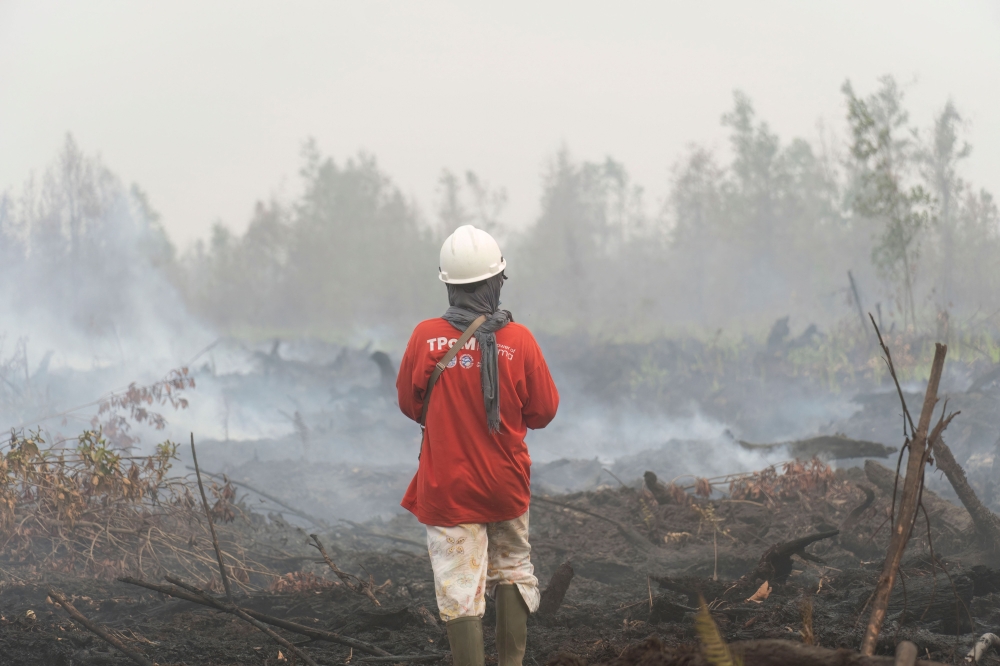
In recent weeks, wildfires have ravaged Indonesian Borneo's peatlands, generating a widespread haze and severely affecting air quality across Southeast Asia.
Peatland fires, often burning underground for extended periods, contribute significantly to haze, emit harmful pollutants, and threaten diverse wildlife habitats.
These fires, exacerbated by industrial-scale plantation development and drainage, have severe health impacts and contribute to substantial greenhouse gas emissions.
Efforts to mitigate the situation include revoking extraction licenses, rewetting peatlands, and establishing a new management agency, though the effectiveness and mandate of restoration efforts remain subjects of concern.
JAKARTA, Oct 14 — For weeks, parts of Indonesian Borneo have resembled an Armageddon landscape, with masked residents engulfed in a putrid, red-brown haze as wildfires devour peatlands near homes and farms.
Burning slowly, mostly underground and sometimes for months, peatland fires are responsible for much of the dry-season haze that this year has affected air quality as far away as Malaysia, Singapore and the Philippines.
Peatlands are made up of organic material that does not fully decompose in waterlogged conditions and has accumulated over thousands of years into layers of soil-like matter.
Healthy peatlands are home to diverse plants and trees such as nutmeg and durian, as well as animals including endangered orangutans, clouded leopards, Sumatran tigers, sun bears and tapirs.
They are porous and absorbent, making them important for flood control.
Although peatlands cover only about three per cent of the world’s land surface, they store about a third of global soil carbon — twice the amount held by forests.
Indonesia has the world’s largest share of tropical peatland, accounting for about a third of the global total.
Why are they burning?
Of Indonesia’s estimated 24.2 million hectares of peatland, 16.4 million hectares have been degraded and are vulnerable to fire, according to environmental group Pantau Gambut.
The main cause is the development of industrial-scale plantations for timber, pulp and paper, rice and palm oil, of which Indonesia is by far the world’s biggest producer.
To cultivate peatlands, they are drained using canal networks that stretch about 285,000 kilometres across Indonesia, according to Pantau Gambut research — about seven times the circumference of the Earth.
The water flows into rivers or the sea, leaving the dried peatlands vulnerable to fire, particularly during strong El Niño years that can bring severe drought to Indonesia.
Peatland fires are often difficult to detect apart from the foul smoke they produce and the heat generated beneath the ground.
Layers of carbon-rich peat can continue smouldering in so-called “zombie fires” for weeks, making them difficult to extinguish.
What are the impacts?
Although less than a third of Indonesia’s wildfires occur on peatlands, they produce most of the haze, according to Greenpeace research.
The toxic smog contains harmful substances including formaldehyde, hydrogen cyanide and ammonia, as well as PM2.5 particles small enough to penetrate the lungs and bloodstream.
The World Health Organisation has linked exposure to PM2.5 pollution with increased illness and death.
Indonesia and Malaysia have closed hundreds of schools because of the haze, while more than 170,000 people in Indonesia required treatment for acute respiratory infections in August and September, according to the country’s Health Ministry.
Many more people have fallen ill in Malaysia and Singapore.
Peatland fires also destroy wildlife habitats, further threatening endangered species such as orangutans and Sumatran rhinos.
What about greenhouse gases?
By October 6, Indonesian wildfires had emitted 140.5 megatonnes of planet-warming carbon, accounting for around 13 per cent of the global total this year, according to the Copernicus Atmosphere Monitoring Service.
It was Indonesia’s highest level of fire emissions since 2019, another strong El Niño year.
Indonesia also produces significant greenhouse gas emissions from its coal-powered electricity grid and is seeking to reduce emissions partly by ensuring forests, peatlands and other ecosystems absorb more carbon than they release.
Activists and experts say concession licences for extractive activities on peatlands should be revoked, while degraded peatlands should be rewetted and replanted with native species.
They have also called for drainage canals to be blocked.
Indonesia has imposed a moratorium on new permits to clear 66 million hectares of land classified as primary forest and peatland.
In a statement last year, the government said it had rewetted 4.16 million hectares of peatland, built 45,000 canal barriers and replanted various native species.
However, questions remain over the effectiveness of some restoration efforts.
“Today, some of the peat hydrological units that have received major restoration efforts... have experienced fires and have some of the highest hotspot counts,” Greenpeace forest campaigner Belgis Habiba told AFP.
Last month, the government announced the creation of a new National Peatland and Mangrove Management Agency to replace a body whose mandate expired in 2024.
The agency’s responsibilities and resources are still being worked out, but activists have raised concerns that its name makes no reference to restoration or protection.
“Does managing in this context serve as a pretext for the state to grant new concessions on peatlands?” Belgis said.
Indonesia’s Forestry Ministry did not respond to AFP’s request for comment. — AFP
US busts alleged ‘laptop farm’ network funneling earnings to North Korea
Pope Leo XIV undergoes successful surgery to remove cancerous lung tumour
El Nino Watch: How the weather phenomenon is impacting the world this week
Minister: Putrajaya targets 2027 for anti-rent seeking law
MCMC testing new disaster warning system on Nov 19: Here’s why your phone might sound an alarm
TNB explains cause of electric shock incident during Mergong temple procession
最近几周,野火肆虐印尼婆罗洲的泥炭地,造成大范围雾霾,严重影响东南亚的空气质量。
泥炭地火灾经常在地下燃烧很长时间,会造成严重的雾霾,排放有害污染物,并威胁各种野生动物的栖息地。
这些火灾因工业规模的种植园开发和排水工程而加剧,对健康造成严重影响,并导致大量温室气体排放。
为缓解这种情况,已采取的措施包括撤销开采许可证、重新湿润泥炭地以及建立新的管理机构,但恢复工作的有效性和授权范围仍然令人担忧。
雅加达,10 月 14 日——数周以来,印尼婆罗洲的部分地区宛如世界末日的景象,戴着口罩的居民被笼罩在腐臭的红褐色烟雾中,野火吞噬着房屋和农场附近的泥炭地。
泥炭地火灾燃烧缓慢,大多在地下进行,有时持续数月之久,是造成今年旱季雾霾的主要原因,而今年的雾霾甚至影响到了远至马来西亚、新加坡和菲律宾的空气质量。
泥炭地是由有机物质组成,这些有机物质在水饱和的条件下不能完全分解,经过数千年积累形成类似土壤的物质层。
健康的泥炭地是多种植物和树木的家园,例如肉豆蔻和榴莲,以及包括濒危猩猩、云豹、苏门答腊虎、马来熊和貘在内的动物的家园。
它们具有多孔性和吸水性,因此对防洪非常重要。
虽然泥炭地仅占世界陆地面积的约 3%,但它们储存了全球土壤碳的约三分之一——是森林碳储量的两倍。
印度尼西亚拥有世界上最多的热带泥炭地,约占全球总量的三分之一。
它们为什么会燃烧?
据环保组织 Pantau Gambut 称,印度尼西亚约有 2420 万公顷泥炭地,其中 1640 万公顷已经退化,容易发生火灾。
主要原因是工业规模的木材、纸浆和造纸、大米和棕榈油种植园的发展,其中印度尼西亚是迄今为止世界上最大的棕榈油生产国。
根据 Pantau Gambut 的研究,为了耕种泥炭地,人们利用运河网络将其排水,这些运河网络横跨印度尼西亚约 285,000 公里——大约是地球周长的七倍。
水流入河流或海洋,使干涸的泥炭地容易发生火灾,尤其是在强厄尔尼诺年份,这会给印度尼西亚带来严重的干旱。
除了产生的恶臭烟雾和地下产生的热量外,泥炭地火灾通常很难被发现。
富含碳的泥炭层可以在所谓的“僵尸火”中持续阴燃数周,因此很难扑灭。
会产生哪些影响?
根据绿色和平组织的研究,虽然印尼不到三分之一的野火发生在泥炭地上,但它们却产生了大部分的烟雾。
有毒的烟雾中含有甲醛、氰化氢和氨等有害物质,以及小到足以穿透肺部和血液的 PM2.5 颗粒。
世界卫生组织已将接触 PM2.5 污染与疾病和死亡人数增加联系起来。
由于雾霾,印度尼西亚和马来西亚关闭了数百所学校;据印尼卫生部称,8 月和 9 月,印尼有超过 17 万人因急性呼吸道感染需要治疗。
马来西亚和新加坡有更多人患病。
泥炭地火灾还会破坏野生动物栖息地,进一步威胁到猩猩和苏门答腊犀牛等濒危物种。
温室气体呢?
据哥白尼大气监测服务中心称,截至 10 月 6 日,印尼野火已排放 1.405 亿吨导致全球变暖的碳,约占今年全球总量的 13%。
这是自 2019 年以来印尼最高的火灾排放量,而 2019 年又是厄尔尼诺现象强烈的一年。
印度尼西亚的燃煤电网也会产生大量的温室气体排放,该国正努力减少排放,部分措施是确保森林、泥炭地和其他生态系统吸收的碳比释放的碳多。
活动人士和专家表示,应该撤销在泥炭地进行采掘活动的特许许可证,同时应该对退化的泥炭地进行重新注水,并重新种植本地物种。
他们还呼吁堵塞排水沟渠。
印尼已暂停发放新的许可证,禁止清理 6600 万公顷被划为原始森林和泥炭地的土地。
政府去年在一份声明中表示,已重新注满 416 万公顷泥炭地,建造了 45000 个运河屏障,并重新种植了各种本地物种。
然而,一些修复工作的有效性仍然存在疑问。
“如今,一些经过大规模修复的泥炭水文单元……已经发生过火灾,并且拥有最高的火灾热点数量,”绿色和平组织森林活动家贝尔吉斯·哈比巴告诉法新社。
上个月,政府宣布成立新的国家泥炭地和红树林管理机构,以取代一个授权期限于 2024 年到期的机构。
该机构的职责和资源仍在制定中,但活动人士提出担忧,认为其名称没有提及修复或保护。
贝尔吉斯说:“在这种情况下,管理是否成为国家授予泥炭地新特许权的借口?”
印尼林业部未回应法新社的置评请求。——法新社
美国捣毁涉嫌向朝鲜输送收益的“笔记本电脑农场”网络
教宗利奥十四世成功接受手术,切除肺部癌性肿瘤。
厄尔尼诺现象观察:本周这种天气现象如何影响世界
部长:布城计划在2027年之前通过反寻租法
马来西亚通信与多媒体委员会(MCMC)将于11月19日测试新的灾害预警系统:以下是您的手机可能发出警报的原因
TNB解释了梅尔贡寺庙游行期间触电事故的原因