DNA, fingerprints and photos: Singapore police join international effort to identify Nepal flood deadDNA、指纹和照片:新加坡警方加入国际行动,辨认尼泊尔洪灾遇难者身份
With nearly 4,900 people still missing after Nepal’s devastating floods, Singapore police forensic specialists are helping local authorities identify the dead and bring answers to families desperately searching for loved ones.
With nearly 4,900 people still missing after Nepal’s devastating floods, Singapore police forensic specialists are helping local authorities identify the dead and bring answers to families desperately searching for loved ones.
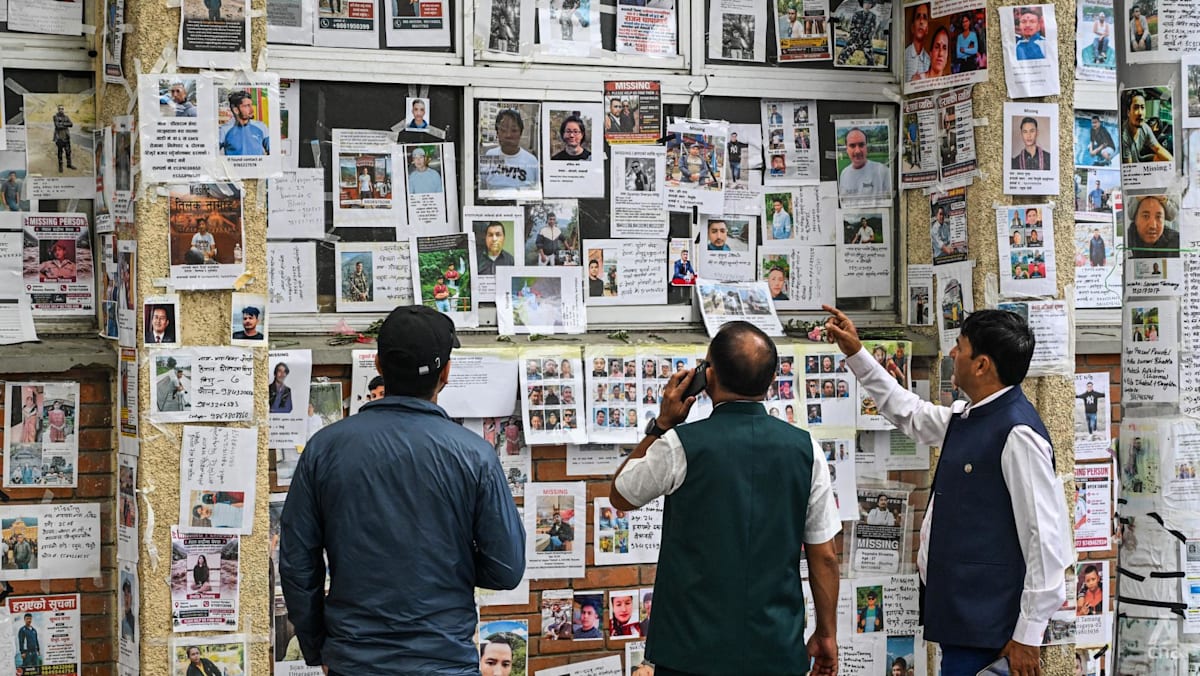
People look at photographs of those reported missing following the Aug 26 flood, displayed outside Tribhuvan University Teaching Hospital in Kathmandu, Nepal. (Photo: CNA/Jack Board)
This audio is generated by an AI tool.
KATHMANDU: At Kathmandu’s Tribhuvan University Teaching Hospital, photos and names of those lost after the devastating flood on Aug 26 are plastered on a wall: a makeshift missing persons’ bulletin board.
They are the faces behind the tragedy.
There are hundreds of posters put up here by family members of the missing: for locals, newlyweds, foreigners, members of the army and children. All of it is out of pure desperation for just a little bit of information about what might have happened to them.
Twenty-nine-year-old Sahil Dewan is here looking for his brother, Samim, a cargo driver working near the Nepal-China border.
CNA Games Guess Word Crack the word, one row at a time Buzzword Create words using the given letters Mini Sudoku Tiny puzzle, mighty brain teaser Mini Crossword Small grid, big challenge Word Search Spot as many words as you can Show More Show Less He sent his family a photo shortly before the flood struck and spoke to them on the phone. They have not heard from him since. “All of us have been trying to locate him. Our entire family has been praying and trying to find him,” Dewan said. Soon, he said, he plans to try and travel to the disaster zone himself, in a desperate final effort. More than a week after the flood, those still searching are confronting an increasingly grim reality: most of those being found are no longer alive, despite several extraordinary rescues offering flashes of hope.
He sent his family a photo shortly before the flood struck and spoke to them on the phone. They have not heard from him since.
“All of us have been trying to locate him. Our entire family has been praying and trying to find him,” Dewan said.
Soon, he said, he plans to try and travel to the disaster zone himself, in a desperate final effort.
More than a week after the flood, those still searching are confronting an increasingly grim reality: most of those being found are no longer alive, despite several extraordinary rescues offering flashes of hope.
Families look at photographs of people reported missing following the Aug 26 flood, displayed outside Tribhuvan University Teaching Hospital in Kathmandu, Nepal. (Photo: CNA/Jack Board)
The recovery of the dead is also far outpacing efforts to identify them, creating new pressures on Nepal’s forensic services. As of Sep 5, 1,342 bodies have been found, yet fewer than 100 have been identified and returned to their families.
According to police, 4,886 people remain missing or out of contact, leaving the eventual scale of the disaster unclear.
Authorities have collected more than 2,200 DNA samples, including from 1,260 bodies and more than 1,000 relatives searching for loved ones. Details of 1,270 unidentified bodies have also been uploaded online in an effort to help families find a connection.
To ease the mounting pressure on Nepal’s disaster victim identification (DVI) operations, a specialist team from the Singapore Police Force (SPF) is now on the ground in Kathmandu, joining forensic experts from India, China and South Korea in supporting local authorities.
Assistant Commissioner of Police Patrick Tan briefs members of the contingent deployed to Nepal to support disaster victim identification efforts following the deadly Aug 26 flood. (Photo: CNA/Jack Board)
Members of the Singapore Police Force contingent deployed to Nepal for disaster victim identification and other operations attend a briefing in Kathmandu. (Photo: CNA/Jack Board)
Members of a Singapore Police Force contingent prepare equipment in Kathmandu, Nepal, as they support local authorities with disaster victim identification efforts following the Aug 26 flood. (Photo: CNA/Jack Board)
Members of Singapore’s Ministry of Foreign Affairs crisis response team work in Kathmandu, Nepal, as efforts continue to locate nine Singaporeans missing after the devastating Aug 26 flood. (Photo: CNA/Jack Board)
The 35-person contingent of SPF forensic specialists began departing Singapore on Sep 1. They will examine the dead and collect evidence that could help establish their identities, including DNA, fingerprints and photographs.
“I think typically in a flood situation, especially at this point in time, the bodies are quite badly decomposed, and the effect of the water actually causes some damage to the bodies,” said Eugene Wang, assistant commissioner of Singapore Police and DVI commander.
At another area of the Teaching Hospital, another set of photographs shows those realities of the difficulties identifying victims.
Dozens of photos are strung up of the unidentified dead, many in a deep state of decomposition. They are waiting to be matched to a name and a family.
“That's why bodies can become fragmented and that complicates and makes it a lot more difficult in terms of the DVI process. We want to work towards that identification that will help towards reconciliation and give some peace and hope to the families,” Wang told CNA.
And more are still being recovered. They keep arriving by the day.
People gather near photographs of unidentified flood victims displayed outside Tribhuvan University Teaching Hospital in Kathmandu, as families search for information about missing loved ones. (Photo: CNA/Jack Board)
The sheer number of unidentified bodies has overwhelmed mortuaries in parts of the country.
In Chitwan in southern Nepal, about 150 km from the capital, authorities have begun temporarily burying victims after forensic samples are taken.
The floodwaters that surged down the Trishuli River system travelled hundreds of kilometres bringing with them mud, debris and the dead.
Here, the scale quickly overwhelmed local capacity. Hospitals across Chitwan had mortuary space for only about 50 bodies when more than 200 had already been recovered in the district.
Before burial, forensic teams collect DNA and preserve identifying information for each set of remains, while the location of individual graves is recorded.
The system is designed so that if DNA later produces a match, authorities can locate and exhume the remains and return them to relatives for the appropriate final rites.
Many victims have been recovered far from where they disappeared. By Sep 5, 360 bodies had been found in Chitwan, more than twice the number recovered in Rasuwa, where the disaster began.
Here, Nepali police continue to scour the waters, a grim task growing tougher by the day.
A temproary mass burial site set up following the Aug 26 Nepal flood. (Photo: CNA/Erwin Chua)
Finding all the missing dead bodies will be a very challenging task, which can hopefully be completed with foreign assistance, said Om Bahadur Rana, the deputy inspector general of Nepal Police.
“A lot of countries are affected by disasters. It could be any other country next time. The support has been great,” he said.
Nepal has appealed internationally for more DNA testing kits, laboratory freezers and equipment for handling human remains as it struggles with the scale of the operation.
A crisis response team from Singapore's Ministry of Foreign Affairs has also been in Nepal since Aug 27, searching for information on nine Singaporeans who remain missing.
Singapore authorities have collected DNA samples from the next-of-kin of the missing Singaporeans to assist with identification efforts, while officials on the ground are pursuing possible leads and working with Nepali authorities for information on their whereabouts.
“We're chasing every possible lead, and within the constraints that are set by the Nepali authorities, we're doing everything that we can to assist in the search of the missing Singaporeans and leaving no stone unturned,” said Joshua Lim, a first secretary (Political) at the Singapore High Commission in New Delhi.
MFA said it is in close contact with families of those missing, providing regular updates, assistance on the ground and other support.
Homes stand beside a vast expanse of mud and debris left by the floods in Syabru Besi, Nepal, on Sep 3, 2026. (Photo: CNA/Jack Board)
Where road safety conditions permit, the crisis team has also travelled out to disaster-hit areas including Nuwakot, Chitwan and Pokhara to follow up and gather as much information as possible, Lim said.
For the Singapore police delegation, the scale and conditions here are unlike anything they would encounter at home.
“We are operating in a very different operating environment. Mentally, our team is prepared” said Patrick Tan, assistant commissioner of Singapore Police and the contingent commander.
“I think this is the main challenge we are facing now. But with our training and our teamwork, we can overcome the challenges by working closely and with our Nepali counterparts,” he said.
While the team is hopeful of finding answers about the missing Singaporeans, Wang said they were “humbled” to be able to help in any way they can.
For thousands of families, the wait for answers continues.
Banjyan Tamang has been missing her son - and several other family members - since the Aug 26 flood. (Photo: CNA/Jack Board)
Among them is Banjyan Tamang. Her son Rohit is one of eight missing family members, she said, from the Rasuwa district near the Tibetan border, one of the areas worst hit by the disaster.
But unlike the families whose photographs cover these walls, she does not have one to put up. Nor does she own a mobile phone on which she could show images of those she has lost.
“One of the photos on top there resembled my son but when I checked the name, it was someone else who looks exactly the same,” she said.
“There is no trace of them until now. What should I do? If they are safe and alive anywhere, I am ready to go rescue them myself,” she added. “But at this point, we don’t know whether we are looking for the dead or the living.”
An automated curation of our top stories to start your day.
Get our pick of top stories and thought-provoking articles in your inbox
Stay updated with notifications for breaking news and our best stories
Join our channel for the top reads for the day on your preferred chat app
尼泊尔发生毁灭性洪灾后,仍有近 4900 人失踪,新加坡警方法医专家正在帮助当地政府确认死者身份,并为焦急寻找亲人的家庭带来答案。
在尼泊尔加德满都特里布万大学教学医院外,人们正在观看8月26日洪灾后失踪人员的照片。(图片:CNA/Jack Board)
这段音频由人工智能工具生成。
加德满都:在加德满都特里布万大学教学医院,8 月 26 日毁灭性洪水过后遇难者的照片和姓名被贴在墙上:这是一个临时搭建的失踪人员公告板。
他们是这场悲剧背后的罪魁祸首。
这里张贴着数百张寻人启事,都是失踪者的家属做的:有本地人、新婚夫妇、外国人、军人,还有孩子。这一切都源于他们迫切的渴望,希望能得到哪怕一点点关于亲人下落的信息。
29岁的萨希尔·德万来到这里寻找他的兄弟萨米姆,萨米姆是一名在尼泊尔-中国边境附近工作的货运司机。
CNA游戏 猜词游戏 逐行破解单词 流行词游戏 用给定的字母组成单词 迷你数独 小小的谜题,强大的脑力挑战 迷你填字游戏 小方格,大挑战 单词搜索 尽可能多地找出单词 显示更多 显示更少 洪水来袭前不久,他给家人发了一张照片,还和他们通了电话。之后就再也没有他的消息了。“我们全家都在努力寻找他。我们全家都在祈祷,努力寻找他,”德万说。他说,他计划很快亲自前往灾区,做最后的努力。洪水过后一个多星期,仍在搜寻的人们面临着一个日益残酷的现实:尽管几次非凡的救援行动带来了一线希望,但大多数被找到的人已经遇难。
洪水来临前不久,他给家人发了一张照片,还和他们通过电话。之后,他们就再也没有他的消息了。
“我们全家人都在努力寻找他。我们全家都在祈祷,努力找到他,”德万说。
他说,不久之后,他计划亲自前往灾区,做最后的孤注一掷的努力。
洪水过后一周多,仍在搜寻的人们面临着越来越严峻的现实:尽管几次非凡的救援行动带来了一线希望,但大多数被找到的人已经遇难。
在尼泊尔加德满都特里布万大学教学医院外,家属们正在查看8月26日洪灾后失踪人员的照片。(图片:CNA/Jack Board)
遗体搜寻速度远远超过身份识别速度,给尼泊尔的法医部门带来了新的压力。截至9月5日,已发现1342具遗体,但只有不到100具遗体被确认身份并归还给家属。
据警方称,仍有 4,886 人失踪或失联,因此灾难的最终规模尚不清楚。
当局已采集了超过2200份DNA样本,其中包括1260具遗体和1000多名寻亲家属的DNA样本。此外,当局还在网上上传了1270具身份不明遗体的详细信息,以帮助家属找到线索。
为了缓解尼泊尔灾难受害者身份识别(DVI)行动面临的日益增长的压力,新加坡警察部队(SPF)的一个专家小组现已抵达加德满都,与来自印度、中国和韩国的法医专家一起为当地政府提供支持。
警务助理总监陈柏健向派往尼泊尔支援灾民身份识别工作的特遣队成员通报情况,此前尼泊尔发生了8月26日致命洪灾。(图片:CNA/Jack Board)
新加坡警察部队派往尼泊尔执行灾难遇难者身份识别及其他行动的特遣队成员在加德满都参加情况介绍会。(图片:CNA/Jack Board)
新加坡警察部队成员在尼泊尔加德满都准备设备,协助当地政府开展8月26日洪灾后的遇难者身份识别工作。(图片:CNA/Jack Board)
新加坡外交部危机应对小组的成员在尼泊尔加德满都开展工作,继续搜寻在8月26日毁灭性洪灾中失踪的9名新加坡公民。(图片:CNA/Jack Board)
由 35 名新加坡警察部队法医专家组成的队伍于 9 月 1 日开始离开新加坡。他们将检查死者并收集有助于确定其身份的证据,包括 DNA、指纹和照片。
“我认为,在洪水情况下,尤其是在目前这种时候,尸体已经严重腐烂,水流实际上会对尸体造成一些损害,”新加坡警察助理总监兼DVI指挥官尤金·王说。
在教学医院的另一个区域,另一组照片显示了辨认受害者身份的困难的现实。
数十张身份不明的死者照片被悬挂起来,许多照片已经严重腐烂。这些照片等待着与死者的姓名和家庭匹配。
王告诉中央社:“这就是为什么遗体可能会碎裂,这会使身份识别过程更加复杂和困难。我们希望努力实现身份识别,以帮助和解,并给家属带来一些慰藉和希望。”
而且还有更多遗体正在被打捞上来。每天都有新的遗体运抵。
在加德满都特里布万大学教学医院外,人们聚集在展示的身份不明洪灾遇难者照片旁,家属们正在寻找失踪亲人的消息。(图片:CNA/Jack Board)
大量身份不明的尸体已经使该国部分地区的太平间不堪重负。
在尼泊尔南部距离首都约 150 公里的奇特旺,当局在采集法医样本后已开始暂时掩埋遇难者遗体。
特里苏里河水系的洪水奔涌数百公里,裹挟着泥沙、碎片和尸体。
在这里,死亡人数迅速超过了当地的承载能力。奇特旺各地的医院太平间仅能容纳约50具遗体,而该地区已发现200多具遗体。
埋葬前,法医团队会收集每具遗骸的 DNA 并保存其身份信息,同时记录每个墓穴的位置。
该系统的设计目的是,如果 DNA 检测结果与死者相符,当局可以找到并挖掘遗骸,将其归还给亲属,以便举行适当的葬礼。
许多遇难者遗体在远离失踪地点的地方被发现。截至9月5日,奇特旺已发现360具遗体,是灾难发生地拉苏瓦发现遗体的两倍多。
在这里,尼泊尔警方继续搜寻水域,这项艰巨的任务日益艰难。
尼泊尔8月26日洪灾后设立的临时集体墓地。(图片:CNA/Erwin Chua)
尼泊尔警察副总监奥姆·巴哈杜尔·拉纳表示,找到所有失踪的尸体将是一项非常具有挑战性的任务,希望在外国援助下能够完成。
“很多国家都遭受过灾害。下次可能就是其他国家了。大家的支持非常巨大,”他说。
由于行动规模庞大,尼泊尔已向国际社会呼吁提供更多 DNA 检测试剂盒、实验室冷冻机和处理人类遗骸的设备。
自 8 月 27 日以来,新加坡外交部危机应对小组也一直在尼泊尔,寻找 9 名仍然失踪的新加坡人的信息。
新加坡当局已采集失踪新加坡公民近亲的 DNA 样本,以协助身份识别工作,同时当地官员正在追查可能的线索,并与尼泊尔当局合作,以获取有关失踪人员下落的信息。
“我们正在追查每一条可能的线索,并在尼泊尔当局设定的限制范围内,尽一切努力协助寻找失踪的新加坡人,不放过任何蛛丝马迹,”新加坡驻新德里高级专员公署一等秘书(政治)林约书亚说。
外交部表示,他们与失踪人员家属保持密切联系,定期提供最新消息、实地援助和其他支持。
2026年9月3日,尼泊尔夏布鲁贝西,洪水过后留下大片泥浆和瓦砾,房屋就矗立在旁边。(图片:CNA/Jack Board)
林表示,在道路安全条件允许的情况下,危机应对小组也已前往努瓦科特、奇特旺和博卡拉等受灾地区进行后续跟进,并尽可能多地收集信息。
对于新加坡警方代表团来说,这里的规模和条件是他们在国内遇到的任何事情都截然不同的。
“我们是在截然不同的作战环境下作战。但从心理上讲,我们的团队已经做好了准备。”新加坡警察助理总监兼特遣队指挥官陈柏腾说道。
“我认为这是我们目前面临的主要挑战。但通过我们的训练和团队合作,与尼泊尔同行密切合作,我们可以克服这些挑战,”他说。
王表示,虽然团队希望找到有关失踪新加坡人的答案,但他们也“感到荣幸”能够以任何方式提供帮助。
成千上万个家庭仍在等待答案。
自8月26日洪水以来,班吉安·塔芒一直与儿子以及其他几位家人失散。(图片:CNA/杰克·博德)
班吉扬·塔芒就是其中之一。她说,她的儿子罗希特是家中八名失踪成员之一,他们来自靠近西藏边境的拉苏瓦地区,那里是受灾最严重的地区之一。
但与墙上挂满照片的那些家庭不同,她没有照片可以挂。她也没有手机可以用来展示逝者的照片。
“上面那张照片里有一张照片很像我儿子,但我查了名字之后发现,那是另一个长得一模一样的人,”她说。
“到现在为止,我们还没有他们的任何消息。我该怎么办?如果他们平安无事,还活着,我愿意亲自去救他们,”她补充道。“但现在,我们甚至不知道我们是在寻找死去的人还是活着的人。”
每天清晨,我们都会自动为您推送最热门的新闻资讯,助您开启美好的一天。
订阅我们的邮件,即可获取精选热门新闻和引人深思的文章。
订阅通知,第一时间获取突发新闻和精彩报道。
加入我们的频道,即可在您常用的聊天应用上获取当日热门文章。