More US troop withdrawals from Europe expected, NATO commander says北约指挥官称,预计将有更多美军从欧洲撤军。
Gen. Alexus Grynkewich said Europe should "absolutely" expect additional U.S. troop withdrawals as NATO allies provide more of their own defense.
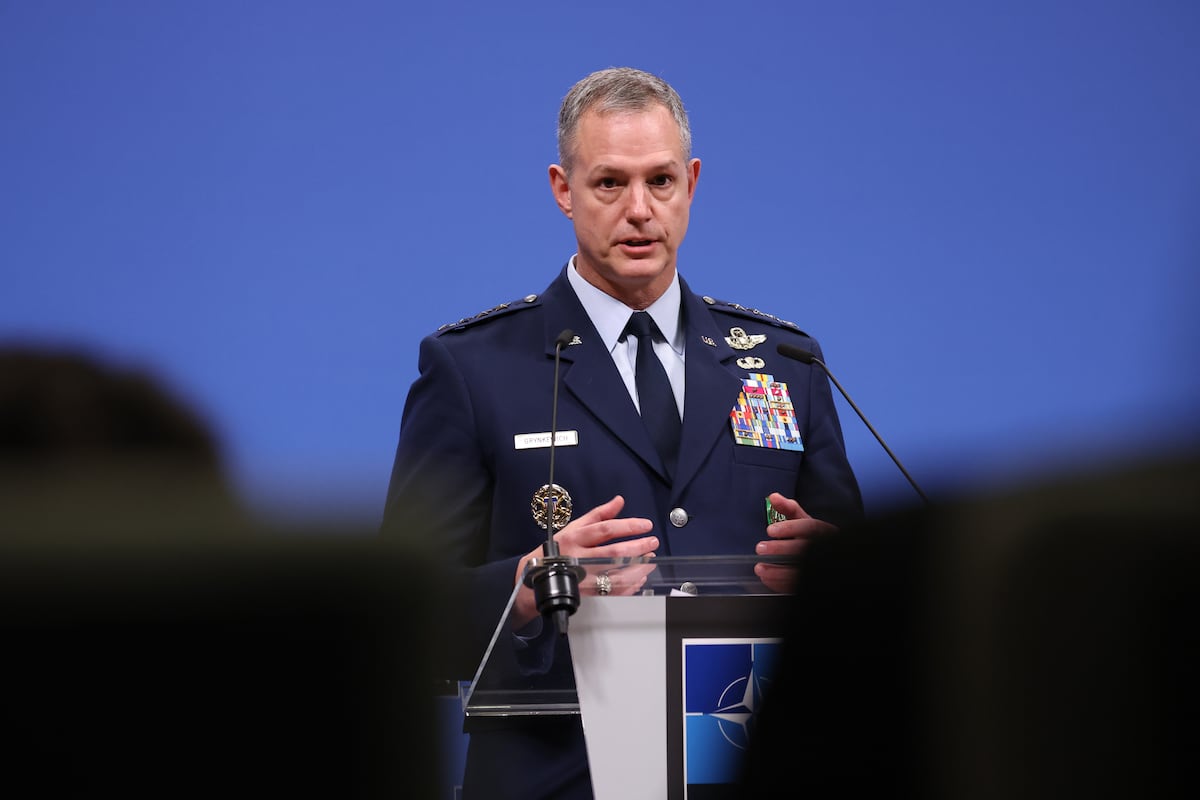
PARIS — Europe should “absolutely” expect additional United States troop withdrawals in the future as European NATO allies strengthen their capability to provide more of their own conventional defense, according to the U.S. general who is the alliance’s top military commander for the region.
The redeployment of U.S. troops from Europe will be an ongoing process for several years, even if there’s no exact timeline, Supreme Allied Commander Europe Gen. Alexus Grynkewich said in a press conference in Brussels on Tuesday, following a meeting of NATO military chiefs.
“What we’re basically saying is, as the European pillar of the alliance gets stronger, this allows the U.S. to reduce its presence in Europe and limit itself to providing only those critical capabilities that allies cannot yet provide,” Grynkewich said. “So we should expect there to be a redeployment of U.S. forces over time as allies build their capacity.”
The remark comes as Polish government leaders expressed concern about the Pentagon abruptly canceling a planned rotation of an armored brigade combat team of more than 4,000 soldiers to the country on NATO’s eastern flank.
The military chiefs discussed the U.S. decision to redeploy the armored brigade combat team, which Grynkewich said doesn’t impact what he called “executability” of NATO’s regional plans. He said the U.S. is withdrawing a total of 5,000 troops from Europe, with the armored brigade combat team accounting for a large part, as well as the cancellation of a long-range fires battalion deployment.
Grynkewich said planning is ongoing to redeploy “additional minor elements” accounting for another several hundred troops.
U.S. President Donald Trump has repeatedly expressed animosity towards European NATO members, prompting concern in European capitals about whether American commitments to the alliance still hold. The Pentagon said earlier this month it will withdraw 5,000 troops from Germany, whose Chancellor Friedrich Merz has criticized Washington’s handling of the war with Iran.
The withdrawal of additional troops is a decision for U.S. political leadership, according to Grynkewich. He said the timeline will “vary broadly” across different capabilities as NATO members meet spending commitments agreed in 2025 in The Hague and as they meet their capability targets.
NATO’s top military commander said a lot has happened since 2022, as the Baltic countries, Poland and “many others have really built up their ground combat power. So there’s substantially more capability in the ground domain than there was previously.”
Grynkewich name-checked the Canada-led Multinational Brigade in Latvia , which he said is fully operational and “highly effective,” and noted Germany continues to build up a brigade in Lithuania .
“As allies build up their capability, the United States is able to pull capability back and use it for other global priorities,” Grynkewich said.
The general said he’ll continue work in his joint role as the commander of U.S. European Command and NATO’s top military commander, “to ensure we’ve got the right coverage in the right places to maintain deterrence.”
The conflicts in Ukraine and the Middle East have shown war is now shaped by “speed, mass, software, drones, electronic warfare, space and data, areas where we have a lot to do,” said Adm. Pierre Vandier, Supreme Allied Commander Transformation, at the press conference.
While NATO needs more missiles, artillery shells, air defense, high-end capabilities and stockpiles, those will not be sufficient on their own, according to Vandier. He said legacy platforms are not obsolete, but “the decisive question is the force mix” of combining ships, aircraft and tanks with robots, drones, sensors, software and new effectors.
”More of the same is necessary, but more of the same will not be enough by far,” Vandier said. “If we want mass and speed, we need to know how we can build fast, produce at scale, adapt quickly, and still deliver real operational effect. And we need to identify which part of our industrial base can actually deliver it.”
巴黎——据北约欧洲盟国加强自身常规防御能力的美国将军称,随着欧洲北约盟国加强自身常规防御能力,欧洲“绝对”应该预料到未来美国会进一步撤军。这位将军是北约在该地区的最高军事指挥官。
欧洲盟军最高司令阿莱克西斯·格林克维奇将军周二在布鲁塞尔举行的新闻发布会上表示,尽管没有确切的时间表,但从欧洲重新部署美军将是一个持续数年的过程。此前,北约军事首脑举行了会议。
格林克维奇说:“我们基本上是想说,随着联盟的欧洲支柱不断增强,美国就可以减少在欧洲的驻军,只提供盟友目前尚无法提供的关键能力。因此,随着盟友能力的提升,我们应该预料到美军会逐渐重新部署。”
此前,波兰政府领导人对五角大楼突然取消向北约东翼国家波兰轮换部署一支由 4000 多名士兵组成的装甲旅战斗队的计划表示担忧。
军方高层讨论了美国重新部署装甲旅战斗队的决定。格林克维奇表示,这不会影响他所谓的北约区域计划的“可执行性”。他指出,美国将从欧洲撤出总计5000名士兵,其中装甲旅战斗队占很大一部分,此外,美国还取消了远程火力营的部署。
格林克维奇表示,目前正在进行重新部署“其他少量兵力”的计划,预计将有数百名士兵加入。
美国总统唐纳德·特朗普多次表达对欧洲北约成员国的敌意,引发欧洲各国首都对美国是否仍信守对北约的承诺的担忧。五角大楼本月早些时候宣布将从德国撤出5000名士兵,而德国总理弗里德里希·默茨曾批评华盛顿处理伊朗战争的方式。
格林克维奇表示,是否撤出更多部队是美国政治领导层的决定。他说,撤军时间表将因北约成员国履行2025年在海牙达成的军费开支承诺以及实现自身能力目标而“大相径庭”。
北约最高军事指挥官表示,自2022年以来发生了许多变化,波罗的海国家、波兰和“许多其他国家都真正增强了地面作战能力。因此,地面作战能力比以前有了显著提高。”
格林克维奇特别提到了加拿大领导的驻拉脱维亚多国旅,他说该旅已全面投入运作且“非常有效”,并指出德国正在继续在立陶宛组建一支旅。
格林克维奇说:“随着盟友能力的提升,美国能够将部分能力撤回,用于其他全球优先事项。”
这位将军表示,他将继续履行其作为美国欧洲司令部司令兼北约最高军事指挥官的双重职责,“以确保我们在合适的地方拥有合适的兵力,以维持威慑力。”
盟军转型最高司令皮埃尔·范迪耶海军上将在新闻发布会上表示,乌克兰和中东的冲突表明,战争现在是由“速度、规模、软件、无人机、电子战、太空和数据”塑造的,而这些领域我们还有很多工作要做。
范迪尔表示,虽然北约需要更多的导弹、炮弹、防空系统、高端能力和库存,但这本身并不足以应对挑战。他指出,传统平台并未过时,但“决定性问题在于力量组合”,即将舰艇、飞机和坦克与机器人、无人机、传感器、软件和新型作战武器相结合。
“我们需要更多类似的举措,但这远远不够,”范迪尔说。“如果我们想要规模化和速度,就需要知道如何快速建造、大规模生产、迅速调整,并最终实现真正的运营效果。而且,我们还需要确定我们工业基础的哪些部分能够真正做到这一点。”