The Army has ‘owned the night’; now it must own the electromagnetic spectrum陆军已经“掌控了黑夜”;现在它必须掌控电磁频谱。
The US Army must master electromagnetic spectrum operations, resilient communications and electronic warfare to maintain connectivity and freedom of maneuver in contested environments.
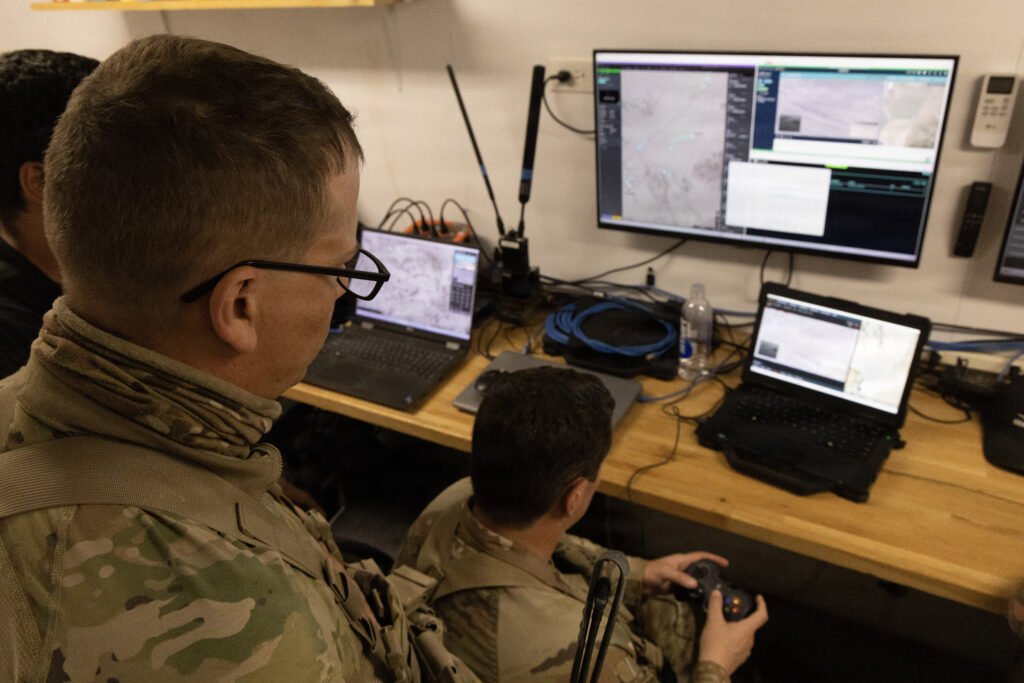
U.S. Soldiers, assigned to the 4th Infantry Division, train with unmanned aircraft system operators during Project Convergence Capstone 6 (PC-C6), at Fort Irwin, California, July 18, 2026. PC-C6 is focused on experimenting with future warfighting capabilities, demonstrating interoperability, and integrating joint and multinational participants and systems across vast distances and multiple domains. (Photo by Spc. Angeles Cruz Vega)
During the wars in Iraq and Afghanistan, the US Army benefited from an enormous advantage in night-vision technology — an advantage captured in the phrase “we own the night.” Retired Maj. Gen. Jefforey Smith argues that commanders now need to bring a similar mindset to electromagnetic spectrum operations (EMSO), where the ability to sense, communicate, maneuver and survive in a contested spectrum increasingly determines battlefield advantage.
Smith, market development executive for the US Army and USSOCOM at Silvus Technologies , spoke with Breaking Defense about how the electromagnetic spectrum is changing warfare, what commanders need at the tactical edge, and why resilient communications increasingly require multiple layers of electronic warfare protection.
Breaking Defense: From your perspective as a former Army commander, how has the character of warfare changed?
Maj. General (ret.) Jefforey Smith, market development executive, U.S. Army and USSOCOM, Silvus Technologies.
Smith: When I commanded a brigade in the 82nd Airborne Division during Operation Iraqi Freedom, we operated in what, by today’s standards, was a relatively permissive electromagnetic environment. There were emerging electronic warfare threats, particularly associated with the counter-IED fight, but we did not face anything approaching the scale and sophistication of the spectrum threat that commanders must prepare for today.
Our tactical communications were relatively straightforward: SINCGARS, point-to-point communications and, when available, satellite communications. We were not connecting anywhere near the number of sensors, unmanned systems, vehicles, command posts and individual Soldiers that we’re connecting today.
That has fundamentally changed. Today, virtually everything on the battlefield is connected—and everything that is connected creates both opportunity and vulnerability. Soldiers, sensors, vehicles, unmanned systems, weapons and command nodes are constantly producing, consuming and transmitting data across the electromagnetic spectrum.
That connectivity gives commanders extraordinary situational awareness and lethality. But it also creates an electromagnetic signature and a much larger attack surface. An adversary can potentially detect it, characterize it, geolocate it, disrupt it and ultimately use it to target the force.
For decades, the US military talked about how we “owned the night.” Everybody understood what that meant. Our night-vision capability allowed American forces to see, maneuver and fight in conditions where our adversaries could not compete effectively. I believe we need to approach the electromagnetic spectrum with that same mindset.
We have to own the spectrum. That doesn’t mean the spectrum will be uncontested. We should expect adversaries to transmit, interfere and actively challenge our ability to operate. Owning the spectrum means having the technology, training, tactics and operational understanding to see the spectrum, survive in it, maneuver through it and exploit it faster than the adversary. If we cannot do that, we should not assume that the network—or the decision advantage it enables—will be there when the shooting starts.
What does a commander specifically need to “own” in the electromagnetic spectrum?
I think it comes down to three things: awareness, resilient connectivity and adaptability.
First, commanders need spectrum awareness. You cannot effectively maneuver through an environment you don’t understand. We wouldn’t send a commander into terrain without a map or intelligence preparation of the battlefield. Increasingly, the same principle applies to the electromagnetic environment. Commanders need to understand what is happening around them: Where is the spectrum congested? Where is the interference? What is friendly? What may be adversarial? What is changing? And, most importantly, what does that mean for the mission?
Second is resilient connectivity. The bandwidth demands of modern formations are enormous compared with what we experienced 20 or 30 years ago. We’re moving full-motion video, position-location information, sensor feeds, targeting information, voice and command-and-control data across formations that are increasingly distributed and constantly moving. That information has to continue flowing while the force is on-the-move, dispersed and under electronic attack.
The third requirement is adaptability—and that includes controlling your RF signature. Commanders increasingly have to ask: Who can see my network? Who can hear it? Can they locate it? And how quickly can they turn that information into targeting data? That is why low probability of intercept/low probability of detection—LPI/LPD—matter so much. Connectivity is only an advantage if you can maintain it without unnecessarily exposing the force.
This is where software-defined mobile ad hoc network radio technology becomes increasingly important. With Silvus StreamCaster MANET radios, capabilities can continue evolving through software and firmware updates rather than requiring an entirely new hardware architecture every time the threat changes. Powering StreamCaster MANET radios is Silvus’ proprietary MN-MIMO waveform that provides a resilient communications foundation. On top of this foundation, we’ve built additional capabilities to reduce the radio’s RF signature, maneuver away from interference and mitigate electronic attack.
The key point is that EW resilience begins before the jammer turns on. If I can make my network more difficult to detect, characterize and geolocate in the first place, I’ve already complicated the adversary’s kill chain.
Connectivity and electronic warfare capabilities are critical tools for troops in the field. (Photo illustration courtesy of Silvus Technologies.)
Why is avoiding detection so important in a contested spectrum?
Because today, every transmission can become a targeting opportunity. For much of the counterinsurgency era, commanders were primarily concerned with whether communications worked. Today the question is broader: Can the enemy detect it, can they locate it, and what can they do with that information?
Every transmission contributes to an electromagnetic signature. A capable adversary may be able to detect that signature, geolocate the source and feed that information into a targeting process. LPI/LPD isn’t simply a communications issue. It’s a survivability issue.
That is especially important for command posts, dismounted formations, reconnaissance elements and other units that depend upon remaining difficult to find. This is where resilient communications and Silvus’ Spectrum Dominance suite of EW defenses come together.
MANET Power Control, or MAN-PC, for example, dynamically adjusts transmit power to the minimum amount required to maintain network connectivity. Instead of transmitting at unnecessary power levels, the network reduces its RF footprint wherever conditions permit.
Wake on Wireless takes that concept further by allowing StreamCaster MANET radios to remain RF silent while still receiving mission-critical information, without emitting even routine control traffic that could reveal their position. Consider the operational implications: a dismounted element could receive ISR information from an airborne unmanned system while minimizing its own RF emissions and reducing the risk of revealing its position.
The broader principle is straightforward: If the enemy can’t detect you, they have a harder time finding you. If they can’t find you, they have a harder time targeting you. That’s why signature management has to become part of how commanders think about tactical communications.
Resilient communications are foundational. What needs to exist around the waveform to keep communications functioning under electronic attack?
I think of the MN-MIMO waveform as the nucleus of the network. It has to be resilient from the beginning, but the waveform alone isn’t enough. No single anti-jam technique is going to defeat every threat. That’s why you need layers of protection and multiple options that allow the network to respond differently depending on what is happening in the electromagnetic environment.
That’s the approach behind Spectrum Dominance 2.0. StreamCaster MANET radios incorporate real-time spectrum monitoring through their built-in MANET Spectrum Analyzer. That provides awareness of interference conditions and gives the network and the operator information needed to respond. From there, different threats can require different anti-jam techniques.
Dual Frequency Link provides frequency diversity by allowing radios to transmit on one frequency channel and receive on another, making the network more resilient to jamming across multiple concurrent frequencies. MANET Interference Avoidance, or MAN-IA, enables the network to identify interference and dynamically move to a cleaner frequency without requiring the operator to manually reconfigure every radio. MANET Interference Cancellation, or MAN-IC, takes another approach. It characterizes the interfering signal and uses spatial processing to suppress that interference while preserving network connectivity.
These capabilities address the problem differently, and that’s important. There is no silver bullet in electronic warfare. A sophisticated adversary will change techniques, frequencies, power levels and tactics. The network therefore has to be capable of adapting as quickly as the threat does.
The objective isn’t merely to survive one particular jammer. The objective is to give commanders multiple layers of resilience and multiple courses of action so the network can continue supporting the mission as the electromagnetic environment changes.
And the challenge is doing that without forcing the commander to choose between EW resilience and operational performance. Warfighters still need range, throughput, mobility and network robustness while these protections are operating. That’s ultimately what we’re delivering with Spectrum Dominance: advanced EW defenses that enable the network to maintain mission-critical performance under electronic attack – preserving freedom of maneuver in the electromagnetic spectrum.
What else should commanders understand about electromagnetic spectrum operations?
From my perspective as a practitioner of warfare, we have to operationalize the spectrum. It’s similar to the way we learned to operate with night-vision goggles. Putting NVGs on a Soldier didn’t automatically make that Soldier more effective at night. You had to train with them. You had to understand depth perception and their limitations. Leaders had to learn how formations moved, fought and commanded differently at night.
Eventually, operating at night became part of our culture. It became second nature. That’s where we need to go with EMSO. The challenge is that the electromagnetic spectrum is invisible. A Soldier can’t see RF energy the way he can see a ridgeline, road intersection or enemy vehicle. Because it’s invisible, it’s easy to treat the spectrum as something belonging to signal officers or electronic warfare specialists.
It isn’t. It’s the commander’s business. Commanders need to understand their electromagnetic terrain just as they understand physical terrain. They need to understand their signatures. They need to know how their networks behave under attack. And their units need to train in contested spectrum environments until operating through interference and electronic attack becomes routine rather than exceptional.
We have to make the invisible visible. That means giving Soldiers and commanders the tools to understand, visualize and maneuver within the electromagnetic environment—and then incorporating that understanding into training, planning and tactical decision-making. The force that can do that faster than its opponent creates a powerful advantage.
Ultimately, nearly every modern military operation depends in some way on access to the electromagnetic spectrum—from sensing and communications to navigation, targeting, unmanned systems and command and control. Spectrum superiority isn’t an abstract technical objective – it’s about preserving freedom of action.
It’s about giving warfighters the awareness, resilient connectivity and freedom to maneuver they need to understand faster, decide sooner and act decisively.
2026年7月18日,在加利福尼亚州欧文堡,隶属于美国陆军第4步兵师的士兵正在与无人机系统操作员一起参加“融合项目顶石6”(PC-C6)演习。PC-C6旨在试验未来作战能力,展示互操作性,并整合跨越广阔距离和多个领域的联合及多国参与者和系统。(摄影:下士安吉利斯·克鲁兹·维加)
在伊拉克和阿富汗战争期间,美军凭借夜视技术获得了巨大优势——这一优势被誉为“我们掌控黑夜”。退役少将杰弗里·史密斯认为,指挥官们现在需要将类似的理念运用到电磁频谱作战(EMSO)中,因为在竞争激烈的频谱环境中,感知、通信、机动和生存的能力越来越决定着战场上的胜负。
Silvus Technologies 的美国陆军和美国特种作战司令部市场开发主管史密斯与 Breaking Defense 谈到了电磁频谱如何改变战争、指挥官在战术前沿需要什么,以及为什么弹性通信越来越需要多层电子战保护。
突破防务:作为一名前陆军指挥官,您认为战争的性质发生了哪些变化?
美国陆军和美国特种作战司令部市场开发主管、退役少将杰弗里·史密斯 (Jefhomery Smith),Silvus Technologies 公司。
史密斯:在伊拉克自由行动期间,我指挥第82空降师的一个旅时,我们当时所处的电磁环境,以今天的标准来看,相对宽松。虽然电子战威胁正在涌现,尤其是在反简易爆炸装置作战中,但我们当时面临的频谱威胁的规模和复杂程度,远不及今天指挥官们必须应对的威胁。
我们的战术通信方式相对简单:SINCGARS、点对点通信,以及在条件允许的情况下使用卫星通信。我们当时连接的传感器、无人系统、车辆、指挥所和单兵数量远不及今天。
情况已经发生了根本性的变化。如今,战场上几乎所有事物都相互连接——而这种连接既带来了机遇,也带来了风险。士兵、传感器、车辆、无人系统、武器和指挥节点都在不断地在电磁频谱范围内产生、使用和传输数据。
这种互联互通赋予指挥官非凡的态势感知能力和杀伤力。但同时也产生了电磁特征,并扩大了攻击面。敌方有可能探测到这种特征,对其进行表征、定位、干扰,并最终利用它来攻击敌方部队。
几十年来,美军一直宣称我们“掌控了黑夜”。人人都明白这意味着什么。我们的夜视能力使美军能够在对手无法有效对抗的条件下进行观察、机动和作战。我认为,我们也需要以同样的思维方式来看待电磁频谱。
我们必须掌控频谱。但这并不意味着频谱不会受到任何干扰。我们应该预料到对手会进行传输、干扰,并积极挑战我们的作战能力。掌控频谱意味着拥有相应的技术、训练、战术和作战理解能力,以便能够比对手更快地发现频谱、在其中生存、灵活机动并加以利用。如果我们做不到这一点,就不能想当然地认为,在交战开始时,网络——或者说它所带来的决策优势——会一直存在。
指挥官具体需要在电磁频谱中“掌控”哪些方面?
我认为关键在于三点:意识、稳定的连接和适应能力。
首先,指挥官需要具备频谱感知能力。你无法有效地在不了解的环境中行动。我们不会在没有地图或战场情报准备的情况下派遣指挥官进入战场。同样的道理也越来越适用于电磁环境。指挥官需要了解周围发生的情况:频谱拥堵点在哪里?干扰点在哪里?哪些是友方信号?哪些可能是敌方信号?哪些情况正在发生变化?最重要的是,这些变化对任务意味着什么?
其次是可靠的连接。与二三十年前相比,现代部队对带宽的需求巨大。我们需要在日益分散且不断移动的部队中传输全动态视频、位置信息、传感器数据、目标信息、语音和指挥控制数据。即使部队处于行进状态、分散部署且遭受电子攻击,这些信息也必须持续传输。
第三项要求是适应性——这包括控制你的射频特征。指挥官们越来越需要问自己:谁能看到我的网络?谁能听到它?他们能定位它吗?他们能以多快的速度将这些信息转化为目标数据?这就是为什么低截获概率/低探测概率(LPI/LPD)如此重要。只有在不造成部队不必要暴露的情况下保持连接,连接才能成为优势。
正是在这种背景下,软件定义移动自组织网络无线电技术的重要性日益凸显。借助 Silvus StreamCaster MANET 无线电,其功能可以通过软件和固件更新不断演进,而无需每次威胁发生变化时都采用全新的硬件架构。StreamCaster MANET 无线电采用 Silvus 专有的 MN-MIMO 波形,提供可靠的通信基础。在此基础上,我们还构建了其他功能,以降低无线电的射频特征、规避干扰并抵御电子攻击。
关键在于,电子战的韧性始于干扰器启动之前。如果我能从一开始就让我的网络更难被探测、识别和定位,我就已经使敌方的攻击链变得更加复杂。
互联互通和电子战能力是前线部队的关键工具。(图片由Silvus Technologies公司提供。)
在频谱资源紧张的情况下,避免被探测为何如此重要?
因为如今,每一次通信都可能成为攻击目标。在反叛乱战争的大部分时期,指挥官们主要关注的是通信是否畅通。而如今,问题更加广泛:敌人能否探测到通信,能否定位通信源,以及他们能利用这些信息做什么?
每一次传输都会产生电磁特征。有能力的敌方可能探测到这种特征,确定信号源的地理位置,并将该信息用于目标锁定。低功率干扰/低功率探测不仅仅是通信问题,更是生存问题。
这一点对于指挥所、徒步部队、侦察分队以及其他依赖于保持隐蔽性的单位尤为重要。而这正是高可靠性通信与Silvus公司的“频谱优势”电子战防御系统相结合的关键所在。
例如,MANET功率控制(MAN-PC)能够动态地将发射功率调整到维持网络连接所需的最低功率。这样,网络就不会以不必要的功率水平进行发射,而是在条件允许的情况下降低其射频辐射。
无线唤醒技术进一步拓展了这一概念,它允许 StreamCaster MANET 无线电在接收关键任务信息的同时保持射频静默,甚至不会发出任何可能暴露其位置的例行控制通信。试想一下其作战意义:下车作战人员可以从机载无人系统接收情报、监视和侦察 (ISR) 信息,同时最大限度地减少自身的射频辐射,降低暴露位置的风险。
更广泛的原则很简单:如果敌人无法探测到你,他们就更难找到你;如果他们找不到你,就更难锁定你。这就是为什么信号特征管理必须成为指挥官思考战术通信方式的一部分。
弹性通信是基础。在电子攻击下,波形周围需要具备哪些条件才能保证通信正常运行?
我认为MN-MIMO波形是网络的核心。它必须从一开始就具备强大的抗干扰能力,但仅仅依靠波形本身是不够的。没有任何一种抗干扰技术能够抵御所有威胁。因此,我们需要多层保护和多种选项,使网络能够根据电磁环境的变化做出不同的响应。
这就是频谱优势 2.0 背后的理念。StreamCaster MANET 无线电通过其内置的 MANET 频谱分析仪实现实时频谱监测。这可以感知干扰情况,并为网络和运营商提供响应所需的信息。基于此,不同的威胁可能需要不同的抗干扰技术。
双频链路通过允许无线电设备在一个频率信道上发射信号并在另一个频率信道上接收信号,从而提供频率分集,使网络更能抵抗多个并发频率上的干扰。MANET干扰规避(MAN-IA)使网络能够识别干扰并动态切换到更干净的频率,而无需操作员手动重新配置每个无线电设备。MANET干扰消除(MAN-IC)则采用另一种方法。它对干扰信号进行特征分析,并利用空间处理来抑制干扰,同时保持网络连接。
这些功能以不同的方式应对问题,这一点至关重要。电子战没有万全之策。老练的对手会不断改变技术、频率、功率水平和战术。因此,网络必须能够像威胁一样快速地进行调整。
目标不仅仅是抵御一次特定的干扰。目标是为指挥官提供多层防御机制和多种应对方案,以便网络能够在电磁环境变化的情况下继续支持任务执行。
真正的挑战在于如何在不迫使指挥官在电子战韧性和作战性能之间做出选择的情况下实现这一点。作战人员在这些防护措施生效的同时,仍然需要覆盖范围、吞吐量、机动性和网络鲁棒性。这正是我们通过“频谱优势”技术最终实现的目标:先进的电子战防御系统,使网络能够在遭受电子攻击的情况下保持关键任务性能,从而保障在电磁频谱中的行动自由。
指挥官还应该了解电磁频谱操作的哪些方面?
从我作为作战实践者的角度来看,我们必须将光谱技术应用于实战。这类似于我们学习使用夜视镜的方式。给士兵戴上夜视镜并不意味着他/她夜间作战能力就自动提升。你必须进行相关训练,了解深度感知及其局限性。指挥官必须学习部队在夜间如何以不同的方式行进、作战和指挥。
最终,夜间作战成为我们文化的一部分,成为一种本能。这就是我们在电磁频谱作战(EMSO)方面需要达到的目标。挑战在于电磁频谱是不可见的。士兵无法像看到山脊线、道路交叉口或敌方车辆那样看到射频能量。正因为它不可见,所以很容易将其视为通信军官或电子战专家的专属领域。
并非如此。这是指挥官的职责。指挥官需要了解电磁环境,就像了解物理环境一样。他们需要了解自身的电磁特征。他们需要知道网络在遭受攻击时的表现。他们的部队需要在频谱资源紧张的环境下进行训练,直到在干扰和电子攻击下作战成为常规操作,而非例外情况。
我们必须将不可见的事物变为可见。这意味着要赋予士兵和指挥官理解、可视化和操控电磁环境的工具,并将这种理解融入训练、计划和战术决策中。能够比对手更快做到这一点的部队将获得强大的优势。
归根结底,几乎所有现代军事行动都在某种程度上依赖于电磁频谱的获取——从传感和通信到导航、目标定位、无人系统以及指挥控制。频谱优势并非抽象的技术目标,而是关乎行动自由的保障。
其目的是赋予作战人员所需的意识、强大的连接性和行动自由,以便更快地了解情况、更快地做出决定并果断行动。